

Your firework night plan: the safe den, the routine, the do’s and don’ts
Alastair Greenway
BVM&S MRCVS
The bangs may be only days away, and if your pet falls apart every firework season, there is still plenty you can do before the next display. Start with the scale of it. Noise fear is the most common behavioural problem in dogs, with somewhere between a quarter and half of the pet dog population affected (Riemer, 2023), and the true figure is almost certainly higher than owners realise. In one large UK survey only a quarter of owners called their dog "fearful" of noises, yet almost half described behaviour that gave the fear away once they were asked the right questions (Blackwell et al., 2013). This is not a strange or shameful problem. It is an extremely common one, and there is a great deal you can do tonight, and this week, to make the next display easier on your pet.
What follows is the practical night-of plan: how to build a safe den, what to do during the fireworks, and the do’s and don’ts that genuinely matter, including one myth that, if you believe it, will make you hold back exactly the comfort your pet needs. It is the seasonal companion to our explainer on why noise fear happens and why it tends to worsen with age, and to the longer game of retraining the fear in the off-season. Tonight, though, we manage.
One quick gate first. If your pet’s noise fear is brand new, suddenly much worse, or your pet is hurting itself in panic, that deserves a vet conversation rather than just a den, because new or escalating fear can have a medical or pain driver underneath it. Riemer notes that a dog suddenly developing noise fear at an older age may be signalling an underlying pain issue (Riemer, 2023). Our piece on whether a problem is behavioural or medical and the behaviour triage checker will help you judge. For everyone else, let us build the plan.
Build the safe den, before the season starts
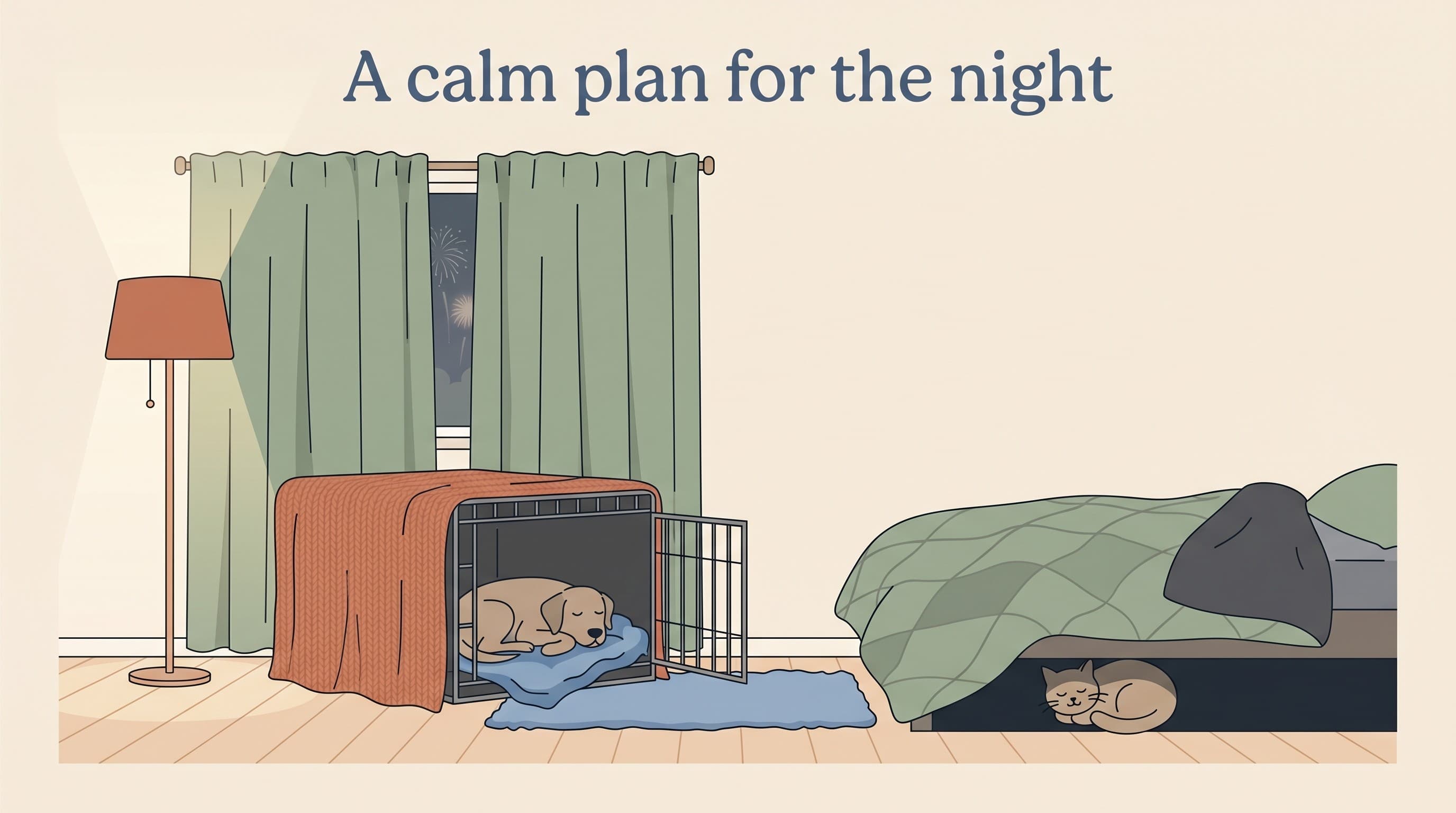
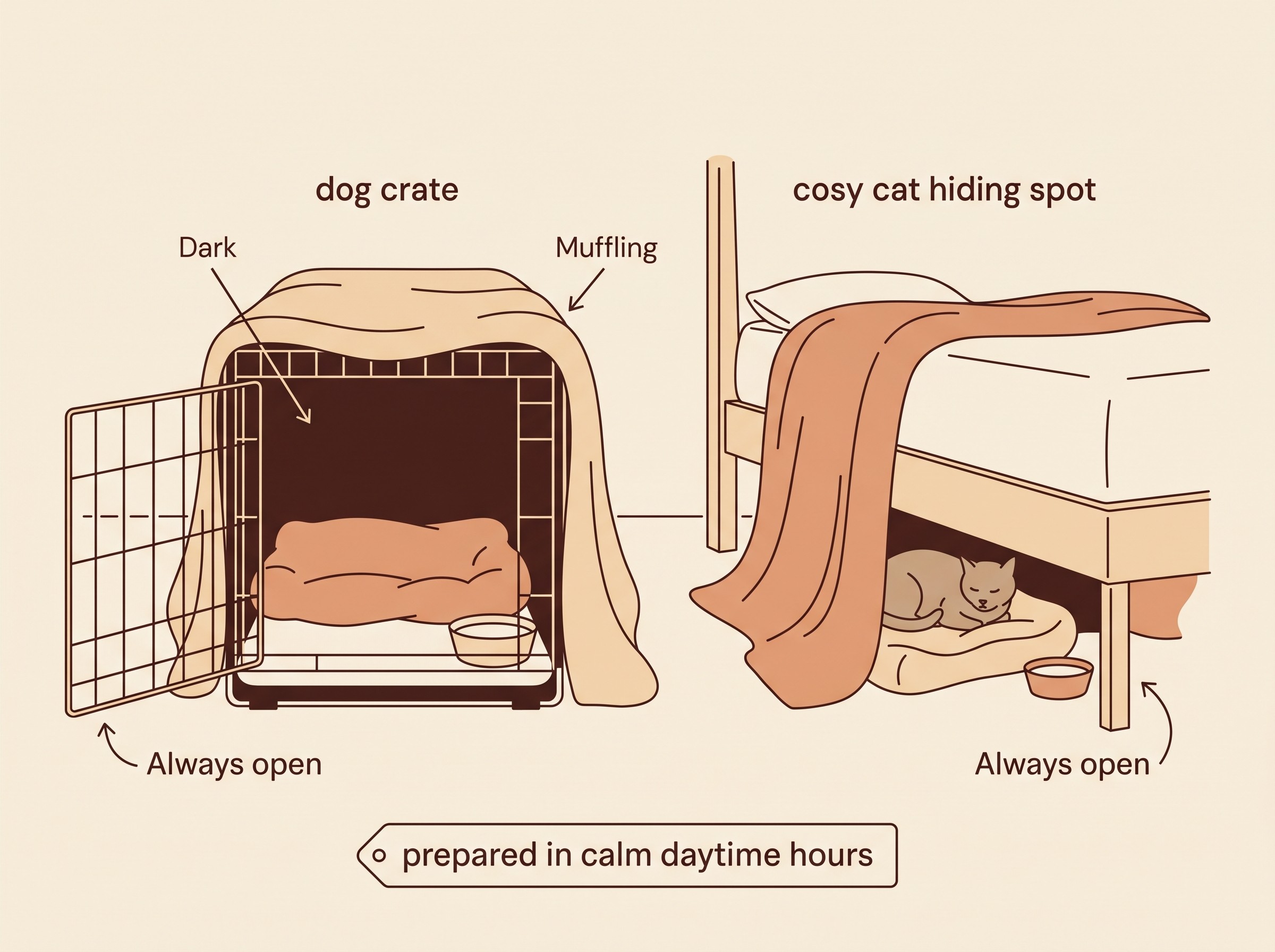
The single most useful piece of physical preparation is a safe haven your pet can retreat into and feel hidden. For a dog this might be a covered crate or a quiet corner behind the sofa; for a cat it is a choice of bolt-holes, a wardrobe, under the bed, the back of a cupboard. The principles are the same: make it dark, make it muffling, and make it absolutely voluntary.
Riemer’s review is specific about how to get this right. A crate may be covered to block out the visual flashes, but keeping a dog in a closed crate is acceptable only for short periods and only after the dog has been gradually accustomed to it, and entering and leaving must always be possible by choice (Riemer, 2023). Treat that as a safety rule, not a technicality. Never shut a panicking dog inside a closed crate. A frightened animal that hits a barrier it cannot get through can injure itself badly, breaking teeth or nails in the scramble to escape. The den has to be open, prepared in advance, and already a good place to be, not something you spring on your pet as the rockets start.
That phrase "in advance" carries the weight here: the den needs building days before Bonfire Night, not on the evening itself. Set it up now. Put familiar bedding in it, feed the odd treat near it, let your pet discover it as a nice quiet spot during calm daytime hours, so that by the time it matters it already feels like home.
Getting the daylight hours right
A few things done in daylight set the whole evening up. Walk your dog while it is still light, before any fireworks are likely to start, so the day’s exercise and toileting are already behind you and you are not forced outside after dark (RSPCA). Feed earlier rather than later for the same reason, and because a pet in the grip of fear often will not eat once the noise begins.
Then secure the house. Close windows, curtains and blinds to muffle the sound and block the flashes, and black out the safe den too if you can (RSPCA). Shut and lock cat flaps and external doors. Firework season is a documented bolt-and-escape risk, frightened animals genuinely do get out and run, so this is the moment to check, today, that your pet’s microchip details are up to date with your current address and phone number (RSPCA).
A word on sound masking, because most advice stops at "put some classical music on" and that is not quite right. The trick is to match the masking sound to the noise you are covering. Riemer notes that the similarity of the masking sound to the noise being masked is critical, and that a loud fan or repetitive drum beats may suit thunder or fireworks (Riemer, 2023). Fireworks are bass-heavy, low-frequency booms, so rumbling, broadband sound, a fan, the television with something low and continuous on, will mask them better than gentle, high-register piano that leaves the booms poking through.
During the fireworks: comfort is not the enemy
You cannot reinforce fear by comforting a frightened pet. Fear is an emotion, not an operant behaviour that a reward can strengthen. The old advice to ignore a fearful dog seeking contact has been turned on its head: that advice is no longer considered advisable, and rewards by definition cannot make an emotion more negative; on the contrary, the positive experience of being comforted can elicit more positive feelings (Riemer, 2023). You are not rewarding "the act of being scared". You are supporting an emotional state that your kindness cannot worsen.
And there is hard evidence that comfort actively helps. In a controlled study, dogs whose owners petted and talked to them during a stressful veterinary examination showed a smaller rise in heart rate and in eye-surface temperature, a physiological stress marker, than dogs whose owner was present but not interacting (Csoltova et al., 2017). So if your pet comes to you, welcome them. Stroke them, talk to them calmly, let them lean on you. The one caveat is your own manner: aim for calm, available company rather than anxious over-fussing, because a pet can read your own panic. Be the steady person in the room, not another frightened animal in it.
If your pet would rather hide than be touched, let them. If they are pacing, whining or burying themselves somewhere, do not haul them out to reassure them, they are trying to find safety (RSPCA). Comfort offered and hiding allowed sit happily together; you are simply following your pet’s lead.
One more thing is genuinely worth trying, if your pet will accept it. Of all the things owners do, feeding and playing with a dog as the bangs happen was the only approach a large survey linked to an actual improvement in firework fear over time, rather than just getting a pet through the night, and owners rated it the most effective of the strategies they had tried (Riemer, 2020). So offer high-value food, a stuffed lick mat, a favourite game, and make good things happen as the fireworks go off. But be realistic: an animal in genuine panic very often will not eat or play, and that is fine. Offer, do not force. A flat refusal of food it would normally adore is itself a useful signal that the fear is severe, and a pointer towards planning event medication with your vet for next time.
What not to do, and the sedative trap
A short list of things to avoid, because some of them feel intuitive and are wrong.
Do not take your dog out to "get used to" the fireworks, and do not walk near displays. Do not leave a frightened pet alone if you can possibly help it; your calm presence is part of the plan. Never punish a scared pet, not for hiding, not for pacing, not for a toileting accident born of fear: punishment adds a second thing to be frightened of and makes next year worse (RSPCA).
And do not reach for sedatives that flatten your pet without touching the fear. Acepromazine, the older sedative often known as ACP, is the classic example: it is contraindicated for noise fears, appears to have no anxiolytic properties at all, and is even suggested to heighten sensitivity to sound, leaving a pet trapped, immobilised but still terrified inside (Riemer, 2023). The right kind of medication exists and can be genuinely transformative, but it works on the anxiety, not just the body, and it must be prescribed by your vet and ideally trial-dosed before the season, never sourced yourself or dug out of a drawer from last year. Our article on event medication that actually works covers the options in full; the headline for tonight is simply that the goal is calm, not collapse. The same "prepare early, ask your vet" principle applies to pheromone diffusers such as Adaptil and Feliway, which some owners set up well ahead as a gentle adjunct: our guide to calming aids, pheromones and supplements weighs the evidence.
Why one survey seems to warn against the den
Go looking and you may stumble on a striking result from the same survey: the cluster of providing a hiding place, closing the windows and playing music was statistically associated with worse firework fear. A careless reading would be "do not bother with a den". That reading is wrong.
The data are correlational, and Riemer is explicit that it is very unlikely these strategies are themselves making the fear worse. Far more probably, owners only reach for the den, the blackout and the music once their dog is already very frightened, and often use them without adding the active counterconditioning, the food and play, that genuinely helps (Riemer, 2020). The den, in other words, is not the cause of severe fear but the marker of it. Riemer’s review still recommends a prepared safe haven as part of good environmental management (Riemer, 2023). The lesson is not "skip the den", it is "build the den and, if your pet will engage, layer comfort and good things on top of it". Management plus counterconditioning, not management instead of it.
Cats, and a candid word about the evidence
Almost everything above leans on canine research, because that is where the good evidence sits. Cats are genuinely under-studied here, and I would rather tell you that than dress up extrapolation as proof. What we have is sensible, welfare-body-backed consensus, and it matters.
Keep cats indoors and block the cat flap for the evening (RSPCA). Provide plenty of hiding places, your wardrobe, under the bed, inside cupboards, and importantly, put an indoor litter tray out in a quiet, convenient spot in advance, because a cat that will not venture outside still needs somewhere to go (Vets Now; RSPCA). Allow your cat access to its favourite safe place, and resist the urge to keep checking on a cat that has chosen to hide; leave it be (Vets Now). Cats show fear far more quietly than dogs, by hiding, by going off their food, by toileting outside the tray, so read those signs for what they are. A cat weeing on the rug on Bonfire Night is frightened, not naughty, and the cardinal rule still holds: never punish.
Turn this season into next year’s plan
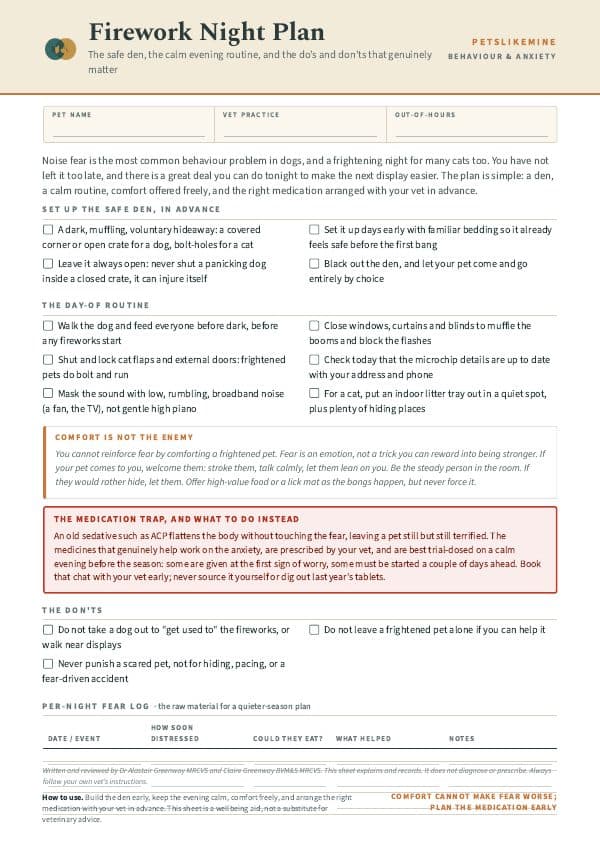
Get through the night with the den, the routine and the comfort, and you have managed the problem well. The lasting fix, though, happens in the quiet months. Make a note now of how this season went, how soon your pet became distressed, whether it could eat, what helped; an observation note kept tonight is exactly the raw material a future plan is built from, and our printable Firework Night Plan is designed to hold it. Then, in the off-season, that record points the way: a structured course of sound desensitisation to lower the fear itself, and a conversation with your vet about event medication before the next Bonfire Night, New Year or Diwali comes round.
References
- Riemer S. Therapy and Prevention of Noise Fears in Dogs—A Review of the Current Evidence for Practitioners. Animals (Basel), 2023;13(23):3664.
- Blackwell EJ, Bradshaw JWS, Casey RA. Fear responses to noises in domestic dogs: Prevalence, risk factors and co-occurrence with other fear related behaviour. Applied Animal Behaviour Science, 2013;145(1-2):15-25.
- Csoltova E, Martineau M, Boissy A, Gilbert C. Behavioral and physiological reactions in dogs to a veterinary examination: Owner-dog interactions improve canine well-being. Physiology & Behavior, 2017;177:270-281.
- Riemer S. Effectiveness of treatments for firework fears in dogs. Journal of Veterinary Behavior, 2020;37:61-70.
- RSPCA. Keeping dogs, cats and other small pets safe during fireworks. RSPCA, 2024.
- Vets Now. How do fireworks affect cats? Vets Now, 2024.
Free downloads
Companion worksheets to put what you've read into practice. Free PDFs, print at home.
Keep track of how your pet is doing
The owners who cope best are the ones who notice changes early. A simple health log shows you what is working, and what is not, before the next vet visit.
Start tracking, freeYou're not doing this alone
Compare treatment journeys and talk to owners managing behaviour & anxiety. Free to join.
Join PetsLikeMine