
Sound desensitisation: retraining the fear in the off-season
Alastair Greenway
BVM&S MRCVS
The work that actually changes how a dog feels about fireworks happens in months with no fireworks in them. When November comes and your dog is shaking behind the sofa, the instinct is to reach for the night: more den, more cuddles, a calming chew, perhaps something from the vet on the worst evenings. All of that has its place, and our firework night plan covers the night itself. What none of it does is change how your dog feels about the bangs. The one thing that genuinely retrains the fear is done in the quiet months, when no real fireworks are going off and you control exactly what your dog hears. That is sound desensitisation: the long game, done so that it helps rather than quietly making things worse.
It is worth the effort because noise fear is common and, left alone, tends to deepen with age rather than fade (Storengen & Lingaas, 2015), which is exactly why "he'll grow out of it" is usually wrong. One caveat up front: almost all of the good evidence here is in dogs, and I will be straight about cats towards the end. And as with anything in behaviour, if the fear arrived suddenly, is worsening, or is spreading to new situations, the first move is a veterinary check to rule out pain or illness, because noise sensitivity can be a sign of an aching body rather than a frightened mind (is it behaviour or is it medical?; the hidden pain link).
Why the quiet months are the time to fix this
Fear-reduction work needs one thing above all: control. You can only teach a dog that a sound is harmless if you can deliver it quietly, predictably, and stop the instant your dog tenses. Real fireworks offer none of that, which is why training during the season is close to impossible and the months between are where the work happens.
The timing principle is not just intuition, it is one of the better-supported findings in this field. Dogs worked with before they ever show fear end up markedly less frightened than those given nothing. On a five-point scale of how badly fireworks compromised a dog's welfare, the median score was 1 for dogs worked with as puppies and 2 for those worked with as adults, against 4 for dogs that had no such training before the fear set in (Riemer, 2019). The other reason to start early is that this is no quick fix: sound work is measured in weeks and months of short, frequent, low-key sessions, not a crash course the weekend before. Begin in spring or summer and you have the runway to go slowly, which matters more than anything else.
What sound desensitisation is actually doing
There are two halves to this. Desensitisation means presenting the frightening sound at a level so low it provokes no fear at all, then raising the volume only gradually across many repetitions, so the fear response slowly fades (Riemer, 2023). Counter-conditioning means pairing that sound with something your dog loves, food or play, so the bang stops predicting "something bad" and starts predicting "chicken." It works best when the reward reliably follows the sound every single time, and when it is combined with desensitisation rather than used alone (Riemer, 2023). We explain the mechanics of both, thresholds, gradients and how to build a ladder, in our guide to desensitisation and counter-conditioning; here I focus on the sound-specific version.
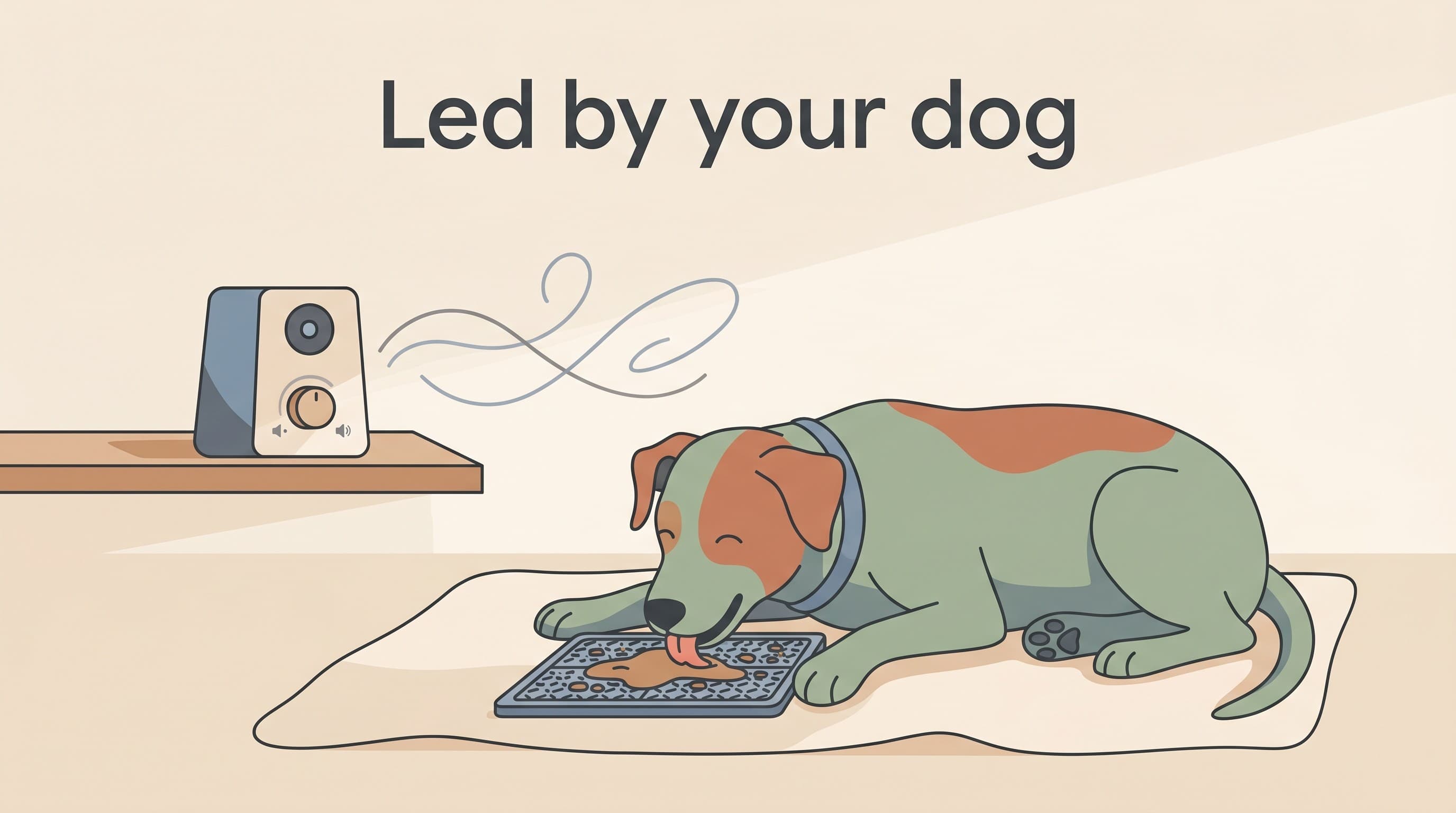
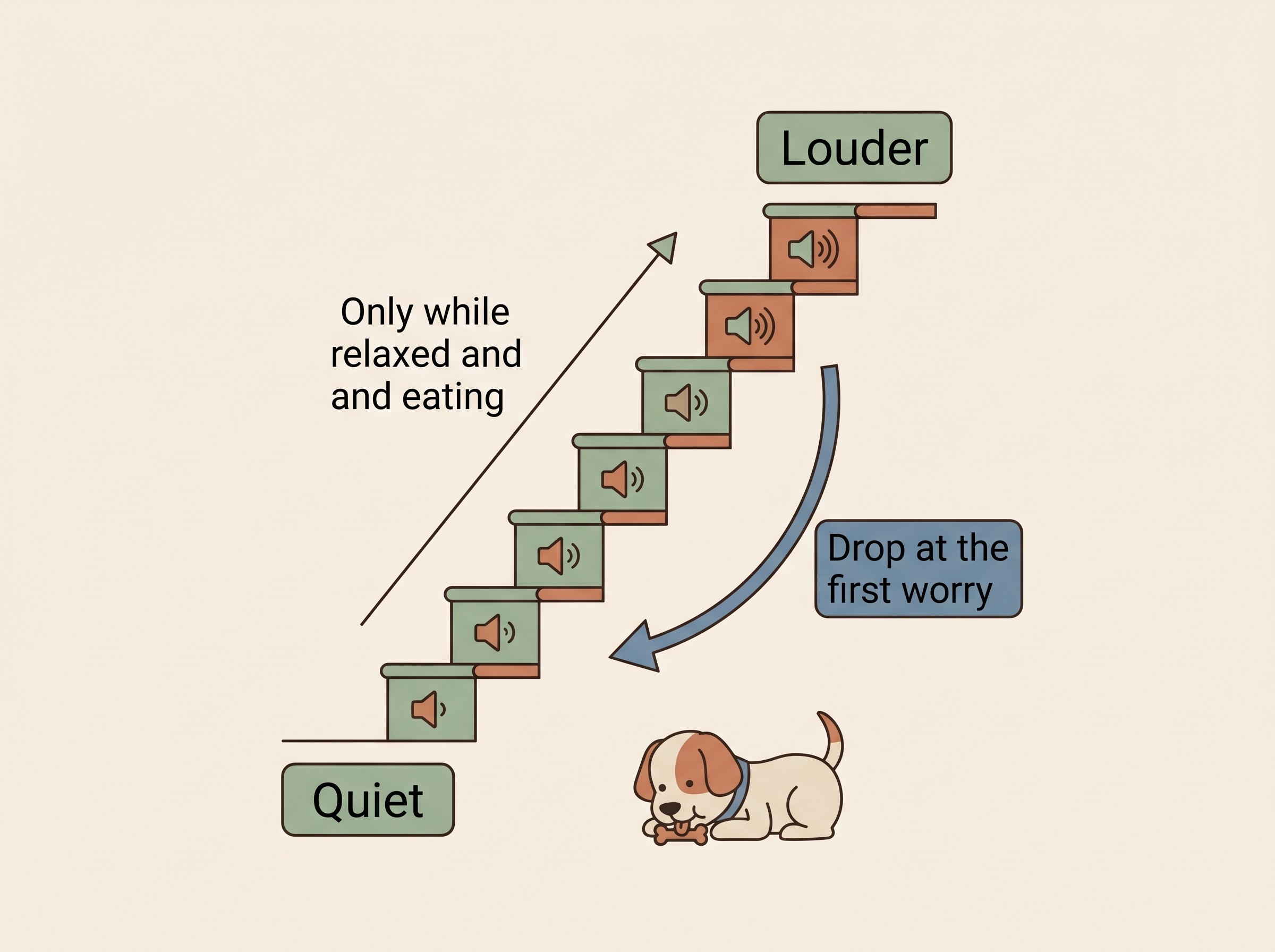
In practice you find a recording of the trigger, fireworks, thunder, gunshots, and play it at a volume so faint your dog barely registers it while you feed small, delicious treats or have a gentle game. The criterion for everything that follows is your dog staying relaxed and happily eating or playing; while that holds, you can nudge the volume up a notch at a time across many sessions. The moment your dog stops eating, stiffens, looks worried or leaves, you have gone too far: turn it down and make the next session easier.
One myth worth retiring right here, because it underpins the whole counter-conditioning half: you cannot make fear worse by giving food or comfort. Fear is an emotion, not a trained behaviour, and rewards by definition cannot make an emotion more negative; offering high-value treats is in fact recommended even once a dog is already showing signs of fear (Riemer, 2023). So feeding your dog during the quiet bangs is not "rewarding the fear," it is the treatment. The version that applies on the night itself, when comforting a frightened dog is absolutely fine, belongs to our firework night plan.
Ready-made programmes, and how to use them well
You do not have to assemble this from scratch. The best-known free resource is the Dogs Trust Sounds Scary programme, with a sister set called Sounds Sociable for puppies, developed by the veterinary behaviourists Sarah Heath and Jon Bowen and provided with a how-to guide and downloadable recordings. Its evidence base is a study in which self-help, CD-based desensitisation and counter-conditioning programmes, run over eight weeks, significantly reduced firework fear in pet dogs (Levine et al., 2007).
These programmes are well designed and genuinely useful, and I would happily point an owner towards one. But be realistic about the evidence grade. You will see "more than 90% of dogs improved in eight weeks" quoted widely, stated in the official Dogs Trust booklet itself and attributed to an independent study. The catch is what that study actually was: an open-label trial that bundled the recordings with a dog-appeasing pheromone (the same Adaptil the booklet recommends alongside the programme), so the recordings were never tested on their own (Levine et al., 2007). Reviews of this literature note that such trials showed clear owner-reported improvement but no improvement on objective behavioural measures (Riemer, 2023). In the largest survey of what owners themselves found effective, desensitisation with recordings came out at around 54%, real and worthwhile but modest, and lower than counter-conditioning to live everyday noises (around 71%) and relaxation training (around 69%) (Riemer, 2020). Start with realistic expectations and you are far likelier to stick with the work.
A practical tip flows straight from that survey: the under-used adjunct is teaching your dog to relax on cue. A settle on a mat paired with a calm signal, built up step by step until it is reliable, gives your dog a learned "off switch" that pairs beautifully with sound work and costs only a few minutes a day (Riemer, 2023).
Where it goes wrong
The single biggest way this goes wrong is rushing. Owners see the dog looking fine and crank the volume; the dog tips over its threshold, the session turns frightening rather than reassuring, and instead of desensitising you sensitise: you teach the dog the sound is worse than it thought (Riemer, 2023). So hold this rule above all others: progression is led by your dog, not by the calendar or by your patience running out. The bar to move up a level is not "the dog didn't react," it is "the dog stayed relaxed and kept eating or playing." If you are ever unsure, you are going too fast.
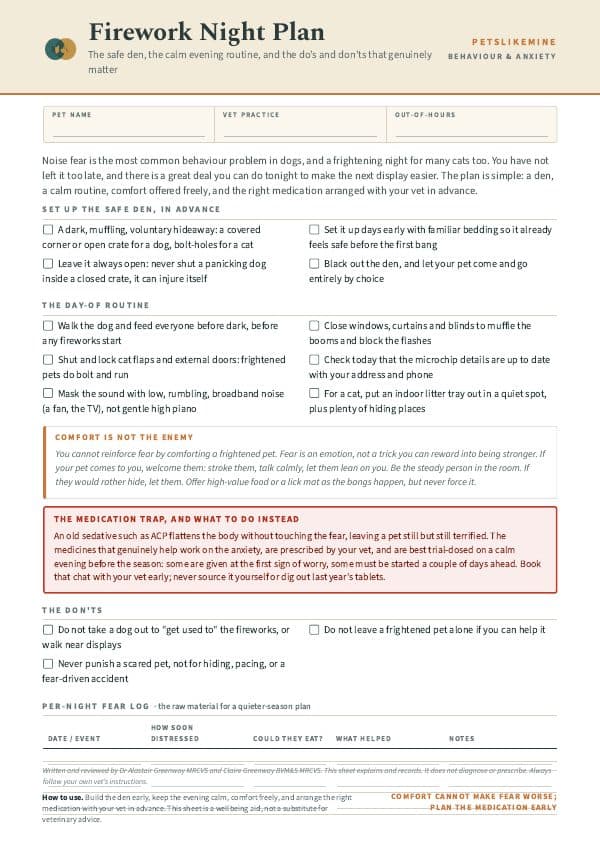
A second, gentler caveat: recordings are not real fireworks. Even a beautifully run programme cannot reproduce the flashes, the pressure changes, the smell and the sheer unpredictability of a live display, and some dogs that panic at real events show no reaction at all to recordings (Riemer, 2023). A dog can become bombproof to the recording and still wobble on the night, which is not a failure of the method: it just means sound desensitisation is one leg of a three-legged stool. The second leg is management: a prepared safe den your dog already loves and retreats to (firework night plan). The third, where the fear is significant, is vet-prescribed event medication that can calm a brain enough to let it learn and cope. That is a decision to make with your vet, never something to source or dose yourself, but for some dogs it is exactly what makes the rest of the plan possible. A pheromone diffuser or other calming aid can sit alongside it (calming aids, pheromones and supplements).
Measuring progress, and keeping it
Because this is slow, you need a way to see that it is working, otherwise it is easy to lose heart. Note the volume level you are working at, whether your dog is still taking food readily, how quickly they settle, and whether they will now sleep through a level that used to make them lift their head. Those small, recordable shifts are the real evidence of progress, far more reliable than your week-to-week impression. If you would value a structured prompt for whether a problem like this needs a vet or a behaviourist alongside your home work, our behaviour check is built for that.
The other half of measuring is knowing it can slip back. Once your dog has improved, the gains are best protected with occasional top-up sessions rather than stopping dead, because intermittent training helps prevent relapse (Riemer, 2023). A short refresher every few weeks through the quiet months, and a more deliberate run-up before a known season, keeps the work banked.
A word on cats
I promised to be straight about cats, so here it is. The high-quality evidence base for sound desensitisation is almost entirely canine. There is essentially no controlled evidence that playing recordings reduces noise fear in cats, and cats are far harder to counter-condition with food on cue, because a frightened cat's instinct is to hide, not to sit and take treats. I would not pretend the dog evidence transfers across.
For a noise-fearful cat the realistic emphasis is different. Give them a secure, elevated hiding place they can reach and control, keep their routine predictable, and reduce their exposure to triggers as far as you can, much of which our firework night plan covers. You can attempt gentle sound work if your cat is the confident, food-motivated sort, at the very lowest volumes and with no pressure, but expect hiding to be the main coping strategy, and consider a behaviourist early rather than pushing a reluctant cat.
That last point holds for dogs too. If your dog cannot stay calm even at the lowest volume, panics, or the fear is severe or spreading, this is not a cue to pile on more home sessions; it is the moment to bring in your vet and very likely a clinical behaviourist, who can build a proper plan and, where needed, prescribe the medication that makes learning possible (finding real help; event medication). Done well in the calm of the off-season, sound work genuinely changes how your pet feels about the bangs rather than just helping them survive the night. The best day to start is a quiet one, and there are plenty between now and bonfire night.
References
- Storengen LM, Lingaas F. Noise sensitivity in 17 dog breeds: Prevalence, breed risk and correlation with fear in other situations. Applied Animal Behaviour Science, 2015; 171: 152-160.
- Riemer S. Not a one-way road - Severity, progression and prevention of firework fears in dogs. PLOS ONE, 2019; 14(9): e0218150.
- Riemer S. Therapy and Prevention of Noise Fears in Dogs - A Review of the Current Evidence for Practitioners. Animals, 2023; 13(23): 3664.
- Levine ED, Ramos D, Mills DS. A prospective study of two self-help CD based desensitization and counter-conditioning programmes with the use of Dog Appeasing Pheromone for the treatment of firework fears in dogs (Canis familiaris). Applied Animal Behaviour Science, 2007; 105(4): 311-329.
- Riemer S. Effectiveness of treatments for firework fears in dogs. Journal of Veterinary Behavior, 2020; 37: 61-70.
Free downloads
Companion worksheets to put what you've read into practice. Free PDFs, print at home.
Keep track of how your pet is doing
The owners who cope best are the ones who notice changes early. A simple health log shows you what is working, and what is not, before the next vet visit.
Start tracking, freeYou're not doing this alone
Compare treatment journeys and talk to owners managing behaviour & anxiety. Free to join.
Join PetsLikeMine