

Calming aids, pheromones and supplements: what the evidence really says
Alastair Greenway
BVM&S MRCVS
Walk down the calming aisle of any pet shop and you would be forgiven for thinking the anxiety problem was solved. Plug-in diffusers, calming collars, milk-protein capsules, "tranquillity" treats, valerian sprays, special diets, all promising a calmer, happier pet. Some of it genuinely helps a little. Quite a lot is marketing that has sprinted miles ahead of the evidence. And almost none of it does what the most anxious owners hope it will, which is to fix a frightened pet on its own.
So let me do something the packaging will not: give you a straight, product-by-product reading of what the research actually shows, graded plainly, so you can spend on what has a fair chance of helping and skip what does not. Two things hold this together. The first is that every product here is an adjunct, a helper that sits alongside a behaviour plan and proper veterinary care, never a standalone cure (Frank et al., 2010). The second is that "natural" and "over the counter" do not mean "proven", and in several cases the most rigorous studies found no measurable effect at all. None of this is reason to feel cynical, just reason to choose with your eyes open.
Pheromones, and where the evidence is strongest
Pheromones are not drugs and not sedatives. They are synthetic copies of chemical signals animals naturally produce to feel safe. The dog product, dog-appeasing pheromone or DAP, sold in the UK as Adaptil, copies the appeasing scent a nursing mother secretes from the glands between her teats, the signal that settles a litter. The cat product, Feliway Classic, copies the F3 fraction of the facial pheromone a cat deposits when it cheek-rubs the corner of a sofa it has decided is its own (Mills, Dube & Zulch, 2013). They come as diffusers, sprays and collars, they are species-specific, and they have no known systemic side effects, which is part of the appeal: the downside risk is genuinely low.
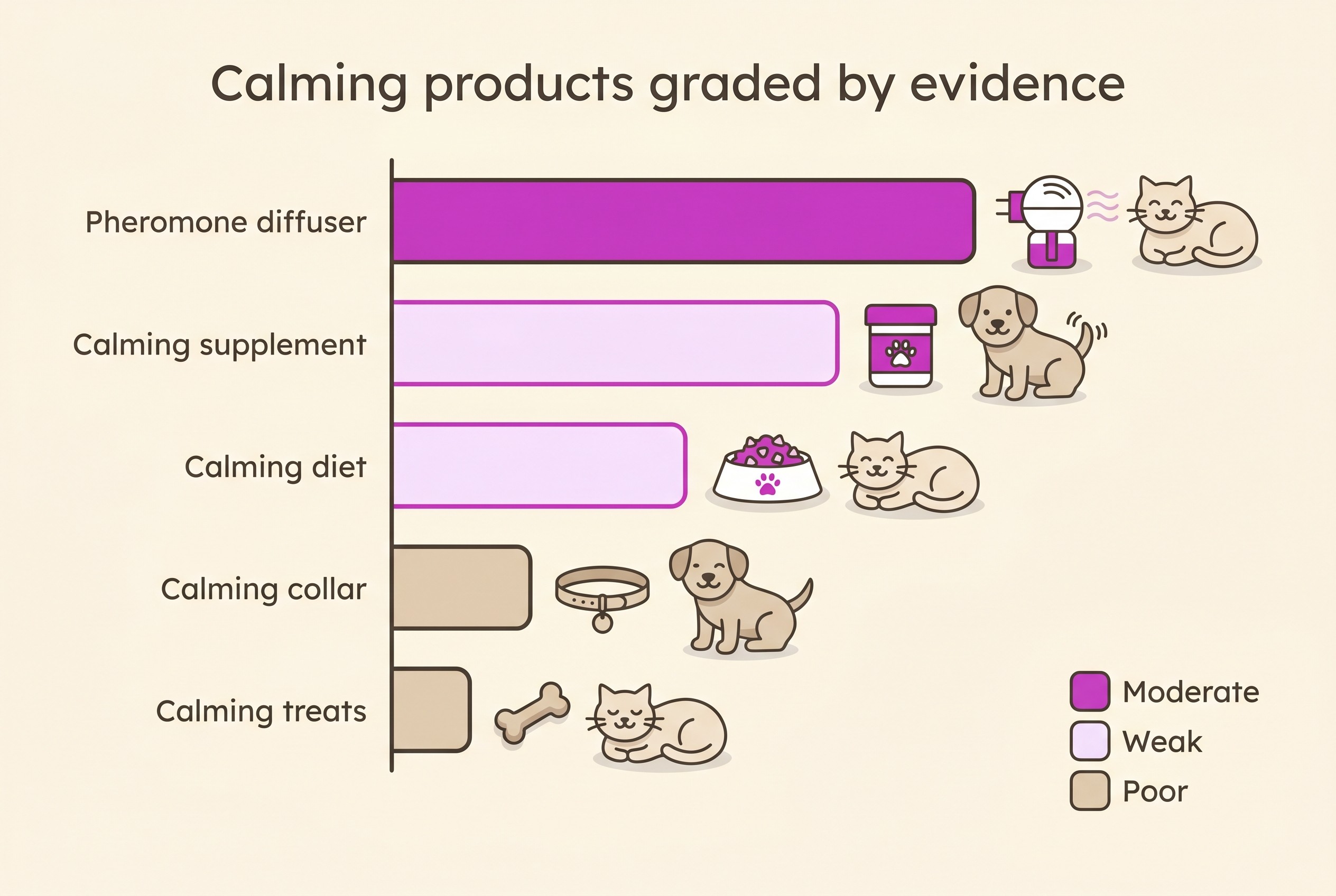
Where they earn their keep is in narrow, specific situations, not generalised anxiety. A systematic review of eight controlled DAP trials found moderate evidence it reduces some fear behaviours from thunderstorm noise, weaker evidence for non-specific stress in hospitalised dogs, and, usefully, no evidence that any one format works better than another (Wong & Govendir, 2021). The most convincing positive study is in puppies: a randomised, placebo-controlled trial of 45 puppies aged twelve to fifteen weeks found that wearing a DAP collar through puppy class reduced fear in the class and, on owner reports a year later, left them better socialised and more adaptable (Denenberg & Landsberg, 2008). If you have a nervous youngster starting classes, that is a reasonable, low-risk thing to try.
It matters just as much to know where the famous claims rest on shakier ground. The often-quoted firework study, in which owners reported improvement in most of the fear signs they had recorded, was an open trial of 30 dogs with no placebo group (Sheppard & Mills, 2003). With no control, there is no way to separate a real effect from owners' hopes, from the dogs simply getting used to the noise, or from natural variation, so it is suggestive at best, not proof. Likewise, a study of 67 dogs with separation-related problems found DAP performed about as well as the medication clomipramine over four weeks, but again with no placebo arm, so it shows the two were comparable rather than proving either worked beyond expectation (Gaultier et al., 2005). The fair verdict on DAP: low risk, modest and situation-specific benefit, worth trying as one layer of a plan, not a treatment to lean your hopes on.
Is Feliway as good as the box claims?
Cat owners are often surprised that the evidence for Feliway Classic is weaker than its reputation. A systematic review found insufficient evidence that the facial pheromone helps with idiopathic cystitis or calms cats for catheterisation, and did not support a claim that it reduces stress in hospitalised cats (Frank et al., 2010). A later knowledge summary of F3 for acute clinic stress graded the evidence only moderate and genuinely mixed: it improved some signs of stress in some studies, while one controlled trial found no significant effect, and the reviewers concluded it should never be used as a sole calming agent (Veterinary Evidence, 2023). And a well-designed placebo-controlled study of 30 cats found Feliway spray made no difference to heart rate, breathing rate, blood pressure or struggling during handling (Conti et al., 2017). That is the counterweight to the confident claims on the box.
One feline product has more encouraging data, and it is a different pheromone from Classic. Feliway Friends, aimed at tension between cats in the same home, was tested in a randomised, double-blind, placebo-controlled pilot of 45 multi-cat households, and the pheromone group showed lower aggression scores than placebo at day 21 and across the full six weeks (DePorter et al., 2019). That is the most promising cat trial in the field, though it was a small pilot funded by the manufacturer, every household also got behaviour advice that may have contributed, and it needs replication. If your cats are not getting along it is reasonable to add, but only as part of the wider plan, because how you manage their space, food and escape routes does the heavy lifting. That work belongs in our guide to managing conflict between cats at home, and the deeper feline picture in our article on feline stress, cystitis and enrichment, where Feliway sits as one tool among several.
Supplements and calming diets: a realistic grade
The supplement shelf trades heavily on the word "natural", so let me grade the main players plainly. Alpha-casozepine, a milk-protein fragment sold as Zylkene, acts gently on the brain's calming receptors without sedation and is well tolerated and lactose-free. Small studies suggest a calming effect in anxious cats, and one trial in dogs found it comparable to a prescription anxiety drug, but with no large, well-controlled placebo trial the independent reviewers grade the evidence as weak (Beata et al., 2007). L-theanine, an amino acid from tea sold as Anxitane, has only weak, mostly open-label support; its storm-fear study had no placebo group, so while it is plausibly safe, we cannot say with confidence it has a meaningful clinical effect (Pike et al., 2015). Tryptophan, a serotonin building block, does not reliably reduce anxiety on its own: a randomised, double-blind, placebo-controlled trial of 138 mildly anxious dogs found no effect on behaviour or stress hormones (Bosch et al., 2009). An older finding that is often misremembered as proof tryptophan calms pets was in fact narrower than that, showing only that adding tryptophan, or lowering dietary protein, modestly reduced aggression in already-aggressive dogs, not that it eases everyday anxiety (DeNapoli et al., 2000).
Calming diets, which combine alpha-casozepine and tryptophan into a complete food, have slightly firmer footing than the single supplements. A study of 24 cats on such a diet found reduced signs of anxiety when they were placed in an unfamiliar room, though no change in their fear of unfamiliar people (Landsberg et al., 2017), and a comparable diet in 44 anxious dogs improved owner-rated stress measures after about seven weeks (Kato et al., 2012). Note the shape of that result: small, slow to appear, and partial. A calming diet is a sensible adjunct for a generally anxious pet, but a months-long nudge rather than a switch you flip.
One pattern is worth naming out loud, fairly and without labouring it. A large share of the positive studies in this field are funded by, or written by employees of, the company selling the product, while the most independent placebo-controlled work tends to come out more negative (Conti et al., 2017; Bosch et al., 2009). That does not make in-house studies worthless, but it is exactly why a blinded, independent trial finding no effect carries more weight than a glossy manufacturer one finding a big one, and why your scepticism is healthy.
The newcomers: promising signals, preliminary evidence
Two newer categories deserve a brief word. Probiotics aimed at anxiety, built around a specific strain of Bifidobacterium longum, have produced eye-catching figures, with a manufacturer crossover study in 24 Labradors reporting that around 90% of dogs improved. The catch is that this work has not been published in a peer-reviewed journal, only in company summaries, which is a meaningful gap, and the wider evidence that gut bacteria can ease canine anxiety is still very early (McGowan, Calming Care; Sacoor et al., 2024). CBD-based calming treats are the other rising star. A blinded crossover trial in 54 dogs found a treat combining CBD with tryptophan and alpha-casozepine produced a smaller stress-hormone rise during car travel than placebo, but most other measures were unchanged, and the study came from a company that makes such products (Flint et al., 2025). Both are genuinely interesting and may earn their place in time; for now the grade is early and preliminary, and CBD products for animals sit in an unsettled regulatory and quality space in the UK, which is another reason to involve your vet rather than buy blind.
Herbal and essential-oil sprays deserve a separate caution, the valerian-based "tranquillity" products in particular. The best-quality randomised controlled trial of one popular valerian product found no significant effect on stress-prone dogs, and the supportive studies were industry-involved, poorly reported and not peer-reviewed (Veterinary Evidence, 2018). Essential oils carry an extra warning in cats, who lack much of the liver pathway other mammals use to break down certain plant compounds, so concentrated oils can build up and harm them, and a "natural calming" spray or diffuser is not automatically a safe one (Merck Veterinary Manual). Treat this corner of the market with particular caution.
When to step up from the calming aisle
Carry this line away, because every reputable behaviour specialist agrees on it: these products support a behaviour plan, they do not replace one. A diffuser will not teach a dog to cope with being left, and a treat will not undo a fear of fireworks. What changes a frightened pet is a structured plan, usually built around gently re-teaching them that the scary thing is safe, the technique our article on desensitisation and counter-conditioning explains in full. The aids here are the supporting cast, lowering the background dial a notch so the real work has a better chance of landing (Frank et al., 2010). Used that way they are worth trying. Used as a substitute, they reliably disappoint.
A few practical safety notes are worth keeping in mind. These are nutraceuticals and devices, loosely regulated, so the claims often outrun the evidence and quality and dosing vary between brands, which is reason enough to introduce anything new through your vet rather than guessing from a label. Pheromones have no known systemic side effects, but they are not inert sedatives, and a collar must fit correctly, snug but not tight, and be checked for skin reaction. Supplements and diets can be unsuitable for some pets and must never displace a balanced diet, so again, run them past your vet.
There is one situation where reaching for an over-the-counter aid is the wrong move: when your pet is genuinely suffering. None of these products touch a true phobia or panic disorder, and quietly trying calming treats for weeks while a terrified animal stays terrified is a kindness gone wrong, because it delays the help that would actually work. The first step for any anxious pet is still to rule out pain and illness, covered in whether it is behaviour or medical, and you can start that triage now with our behaviour check. When fear is severe, or a generally anxious pet is not responding, the right next step is not a stronger supplement but a conversation with your vet about prescription medication, which is genuinely effective for the right patient and is theirs to prescribe and dose, never something to source yourself. For a chronically anxious pet that means the daily anti-anxiety medicines in our article on separation anxiety medication, and for firework, storm and other event fear the situational options that actually work for noise phobia, in our guide to noise and event medication, both alongside the calm, structured approach in helping a fearful pet. Knowing when to step up from the calming aisle to your vet's prescription pad is not a failure of the gentle approach. It is the gentle approach, done properly.
References
- Frank D, Beauchamp G, Palestrini C. Systematic review of the use of pheromones for treatment of undesirable behavior in cats and dogs. Journal of the American Veterinary Medical Association, 2010; 236(12): 1308-1316.
- Mills DS, Braem Dube M, Zulch H. Stress and Pheromonatherapy in Small Animal Clinical Behaviour. Wiley-Blackwell, 2013. ISBN 978-0-470-67118-4.
- Wong HS, Govendir M. Can dog appeasing pheromone ameliorate stress behaviours associated with anxiety in mature domestic dogs? A knowledge summary. Veterinary Evidence, 2021; 6(4).
- Denenberg S, Landsberg GM. Effects of dog-appeasing pheromones on anxiety and fear in puppies during training and on long-term socialization. Journal of the American Veterinary Medical Association, 2008; 233(12): 1874-1882.
- Sheppard G, Mills DS. Evaluation of dog-appeasing pheromone as a potential treatment for dogs fearful of fireworks. Veterinary Record, 2003; 152(14): 432-436.
- Gaultier E, Bonnafous L, Bougrat L, Lafont C, Pageat P. Comparison of the efficacy of a synthetic dog-appeasing pheromone with clomipramine for the treatment of separation-related disorders in dogs. Veterinary Record, 2005; 156(17): 533-538.
- Crump E. Effectiveness of F3 feline facial pheromone analogue for acute stress reduction within clinical veterinary practice. Veterinary Evidence, 2023; 8(4).
- Conti LMC, Champion T, Guberman UC, et al. Evaluation of environment and a feline facial pheromone analogue on physiologic and behavioral measures in cats. Journal of Feline Medicine and Surgery, 2017; 19(2): 165-170.
- DePorter TL, Bledsoe DL, Beck A, Ollivier E. Evaluation of the efficacy of an appeasing pheromone diffuser product vs placebo for management of feline aggression in multi-cat households: a pilot study. Journal of Feline Medicine and Surgery, 2019; 21(4): 293-305.
- Beata C, Beaumont-Graff E, Diaz C, et al. Effects of alpha-casozepine (Zylkene) versus selegiline hydrochloride (Selgian, Anipryl) on anxiety disorders in dogs. Journal of Veterinary Behavior, 2007; 2(5): 175-183.
- Pike AL, Horwitz DF, Lobprise H. An open-label prospective study of the use of l-theanine (Anxitane) in storm-sensitive client-owned dogs. Journal of Veterinary Behavior, 2015; 10(4): 324-331.
- Bosch G, Beerda B, Beynen AC, et al. Dietary tryptophan supplementation in privately owned mildly anxious dogs. Applied Animal Behaviour Science, 2009; 121(3-4): 197-205.
- DeNapoli JS, Dodman NH, Shuster L, Rand WM, Gross KL. Effect of dietary protein content and tryptophan supplementation on dominance aggression, territorial aggression, and hyperactivity in dogs. Journal of the American Veterinary Medical Association, 2000; 217(4): 504-508.
- Landsberg G, Milgram B, Mougeot I, Kelly S, de Rivera C. Therapeutic effects of an alpha-casozepine and L-tryptophan supplemented diet on fear and anxiety in the cat. Journal of Feline Medicine and Surgery, 2017; 19(6): 594-602.
- Kato M, Miyaji K, Ohtani N, Ohta M. Effects of prescription diet on dealing with stressful situations and performance of anxiety-related behaviors in privately owned anxious dogs. Journal of Veterinary Behavior, 2012; 7(1): 21-26.
- McGowan RTS. Tapping into those gut feelings: impact of BL999 (Bifidobacterium longum) on anxiety in dogs (Purina Pro Plan Veterinary Supplements Calming Care; manufacturer crossover study, unpublished). Nestle Purina.
- Sacoor C, Barros LM, Montezinho L. Gut-brain axis impact on canine anxiety disorders: new challenges for behavioral veterinary medicine. Veterinary Medicine International, 2024; 2024: 2856759.
- Flint HE, Weller JE, Parry-Howells N, et al. Treats containing cannabidiol, L-tryptophan and alpha-casozepine have a mild stress-reducing effect in dogs. Frontiers in Veterinary Science, 2025; 12: 1632868.
- Buckley LA. Does Pet Remedy reduce stress in dogs? A knowledge summary. Veterinary Evidence, 2019; 4(3).
- Merck Veterinary Manual. Toxicoses From Essential Oils in Animals. Merck & Co., Inc.
Keep track of how your pet is doing
The owners who cope best are the ones who notice changes early. A simple health log shows you what is working, and what is not, before the next vet visit.
Start tracking, freeYou're not doing this alone
Compare treatment journeys and talk to owners managing behaviour & anxiety. Free to join.
Join PetsLikeMine