

Equipment for reactivity: harnesses, head-collars, and why a muzzle is kind
Alastair Greenway
BVM&S MRCVS
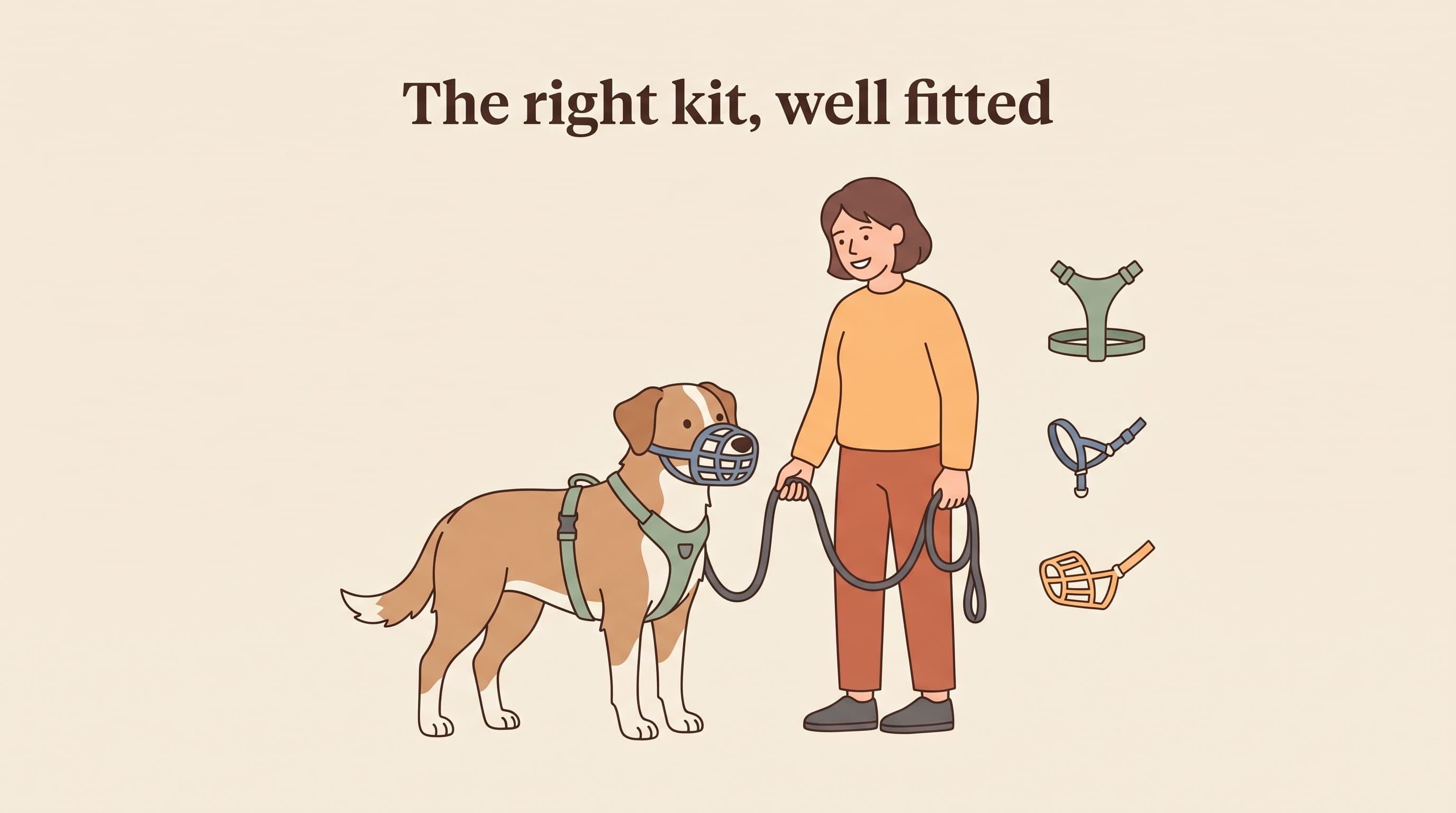
The single fact worth knowing before you spend a penny is this: no piece of equipment will train your reactive dog. Gear does not cure lunging and barking, and no harness, head-collar or clever lead does the behaviour work for you. What good equipment does is narrower but genuinely valuable. It keeps your dog, and the people and dogs around you, safe, and it keeps your dog under threshold and physically manageable while the actual training happens elsewhere. Think of it as the scaffolding around a building site, not the building. Get it right and the real work becomes possible. Get it wrong, with the popular tools that work by pain or fear, and you can make a frightened or frustrated dog measurably worse.
The current evidence is clear that there is no single "best" device. A 2025 review of walking equipment concluded plainly that there is no one-size-fits-all tool, and that the right choice should suit the individual dog and handler rather than a slogan on the packaging (Cavalli & Protopopova, 2025). So this is a guide to choosing well, not a league table. One quick note before we start: gear cannot fix a sore body, and pain is a surprisingly common driver of reactivity, so if your dog's behaviour is new, escalating or out of character, rule out pain and illness first, which we cover in is it behaviour or medical.
Harness over collar, and the reason why
For a dog who pulls or lunges, the case for a harness rather than a flat collar is not about comfort alone, it is about what happens to the neck. When a dog hits the end of a lead clipped to a collar, the force lands on the throat, and one of the better-known effects is on the eyes: collar pressure raises the pressure inside the eye when the dog pulls, whereas a harness does not. In the foundational study, intraocular pressure rose significantly through a collar but not a harness (Pauli et al., 2006), and a 2025 replication found that collars elevated eye pressure during exercise in both long-nosed and flat-faced dogs, and even at rest in the flat-faced ones, while harnesses produced no significant change (Bailey et al., 2025). This matters most if your dog has glaucoma, a thin or weakened cornea, or any existing eye disease. And for a reactive dog, the lunge is the moment the lead snaps tight, so you are choosing the gear for the dog's worst predictable moments, not its calm ones. Reassuringly, a well-fitted harness does not appear to stress a dog compared with a collar: a behavioural study found no significant difference in stress signs such as lip-licking, panting and tail position (Grainger et al., 2016).
I do want to be straight with you about one thing, because candid equipment advice is rare. A harness is the welfare-preferable choice for the neck-pressure and pulling reasons above, but it is not biomechanically "free". A small treadmill study found that both restrictive and non-restrictive harnesses reduced shoulder extension compared with no harness at all, and, counter-intuitively, the design marketed as non-restrictive reduced it slightly more (Lafuente et al., 2019). The takeaway is not that harnesses are bad, it is that fit and design are load-bearing rather than cosmetic. A poorly cut harness whose chest strap crosses the point of the shoulder will restrict the gait, so you want a Y-shaped front that sits clear of the shoulder joint and straps that do not dig in.
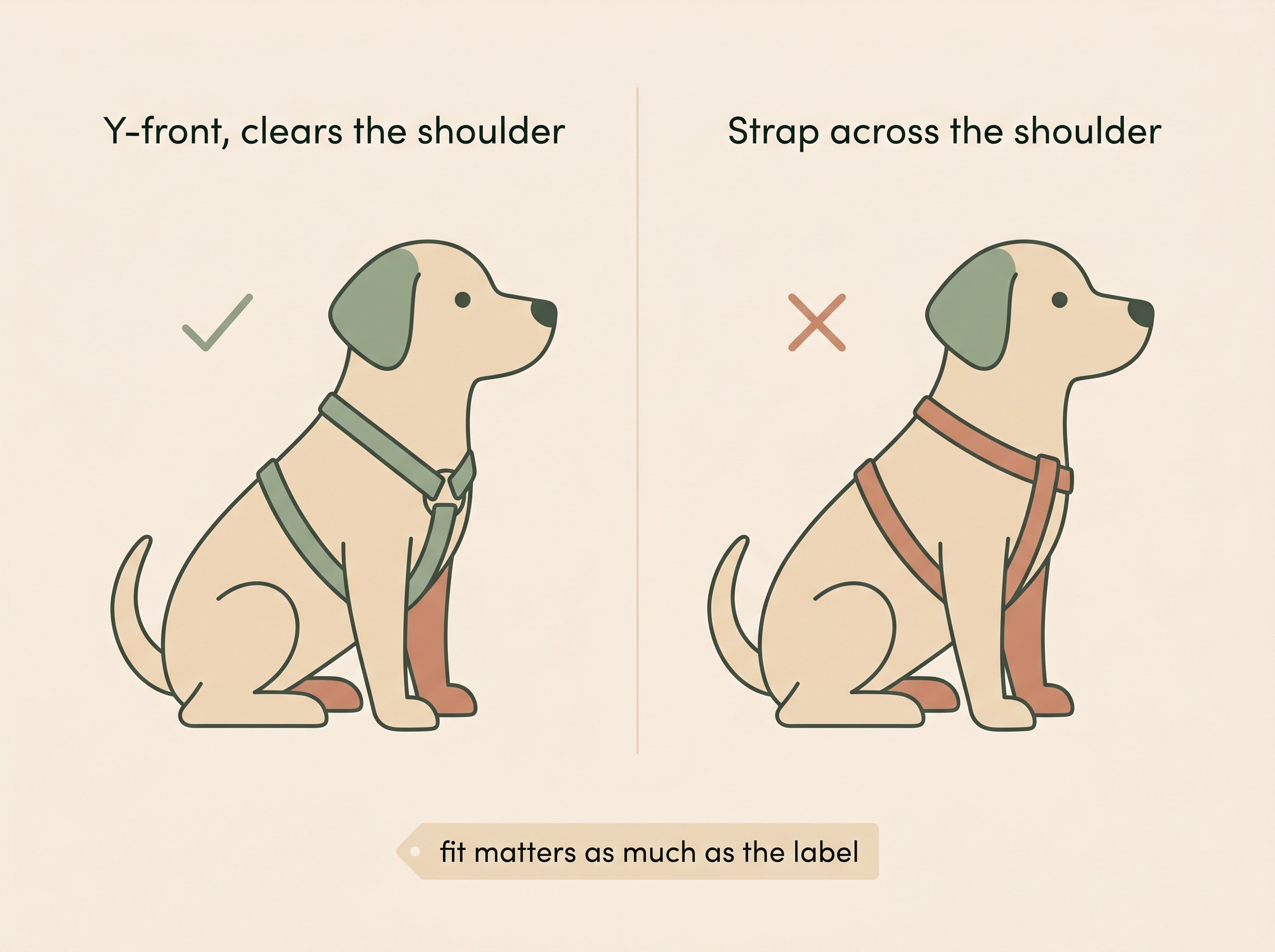
On clip position, the modern review is helpfully specific. For dogs that pull, a non-tightening front-clip harness offers the best balance between minimising discomfort and reducing pulling, while tightening harnesses constrict and should be used with more caution; for dogs that do not really pull, and for flat-faced breeds, a well-fitted back-clip Y-shaped or chest-strap harness is perfectly suitable (Cavalli & Protopopova, 2025). A front clip gives you a useful steering point that turns a lunging dog rather than letting them throw their full weight forward, which is why many reactive-dog handlers favour a harness with both a front and a back ring.
Head-collars: useful for some, not automatically "humane"
A head-collar, the kind that loops over the muzzle and behind the ears, gives you control of the head, and because a dog goes where its head goes, it can take real power out of a big lunging dog. For some dog and handler combinations it is the difference between a walkable dog and one that drags a smaller handler into the road, which is a legitimate use.
What I would gently push back on is the common belief that a head-collar is automatically the "humane" option. It is not inherently gentle. Head-collars constrict and can cause greater discomfort than a simple harness (Cavalli & Protopopova, 2025), and dogs frequently dislike the sensation: in a study comparing a head-collar with a neck collar, dogs pawed at their noses more and watched the handler less while wearing the head-collar (Ogburn et al., 1998). There is also a real safety point, which is that a sharp jerk torques the neck and head sideways, so a head-collar must never be used with a sudden lead pop, only with gentle, steady guidance. For a reactive dog who may hit the end of the lead hard and unexpectedly, that handling discipline is not optional.
This is also where the driver behind your dog's reactivity nudges the choice. A head-collar can suit a powerful, frustrated greeter who simply needs steering, whereas for a fearful reactor it can add another thing to feel trapped by, so a front-clip harness is often the kinder starting point. If you are not sure which type you have, it is worth reading frustrated greeters versus fearful reactors before you spend, because the gear is shared across both but the emphasis differs. Whichever you choose, a head-collar must be introduced with positive associations before it ever appears on a walk, never just strapped on at the front door, and we will come to how in a moment.
Prong, choke, slip and e-collars: the wrong tool
Some equipment is sold specifically to stop pulling and lunging by being unpleasant: prong and pinch collars, choke chains, slip leads used as correction tools, and electronic shock collars. For a reactive dog these are the wrong tools, and not because of squeamishness. They work by pain or positive punishment, they carry a real risk of physical injury, and they can worsen the very fear and frustration that drive reactivity by adding pain to the sight of the trigger.
On the injury point the evidence is stark. In a study using a model of a dog's neck, every collar type tested, at every level of force from a light pull to a hard pull to a sharp jerk, produced pressures known to cause tissue damage and death in humans, and no collar gave a low enough pressure to mitigate the risk of injury when a dog pulls (Carter et al., 2020). I will not re-argue the full evidence base against aversive methods here, but the short version is that professional bodies advise against these tools, that there is no evidence they outperform reward-based methods, and that they risk fear, increased aggression and suppression of the warning signs a dog gives before it bites (AVSAB, 2021). For the reasoning, and the studies showing reward-based training is at least as effective without the fallout, see how pets learn: reward versus punishment. For a dog who is already over-aroused or frightened on the lead, adding a painful correction the instant it sees another dog is precisely the wrong lesson.
A muzzle is a kindness, not a verdict
Now the piece of equipment that carries the most stigma and deserves it the least. A basket muzzle is a kind, responsible safety tool. It is not a punishment, not an admission that you have a "bad dog", and certainly not a shortcut that fixes the behaviour. What it does is hold a clear margin of safety around your dog while the behaviour work goes on, so that a worst-case moment, a sudden close pass or a dog that rushes up off-lead, stays a fright rather than a tragedy.
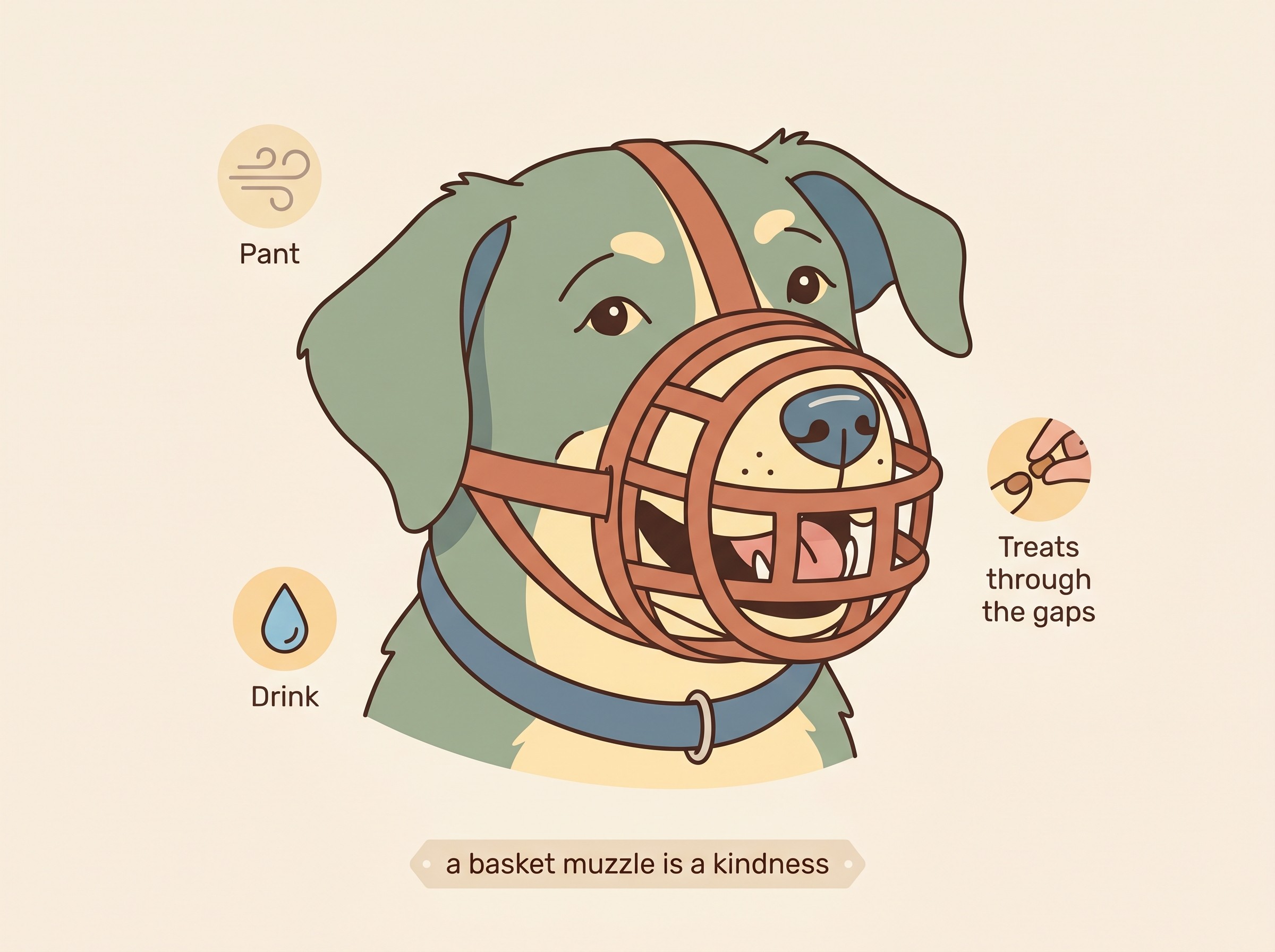
The key is the right muzzle. A well-fitted basket muzzle, the open, cage-style kind, lets your dog pant, drink water and take treats while wearing it, so it protects everyone without taking away the things a dog needs to cope and stay cool (Cornell Riney Canine Health Center). That matters because the alternative, a soft fabric sleeve muzzle that holds the jaws shut, prevents panting and is unsafe for anything beyond a brief moment of veterinary handling, since a dog cannot regulate its temperature with its mouth clamped shut. For everyday reactivity work a basket muzzle is the only humane choice. Properly conditioned, a muzzle can actually make life gentler, because a muzzled dog can often be handled more calmly and given more freedom once everyone around can relax. Veterinary professionals increasingly frame it as a misunderstood welfare tool rather than a marker of a dangerous animal (AAHA).
There is an important boundary here. The everyday muzzle conditioning below is for ordinary reactivity safety, the buffer that lets you walk a lungy dog without dread. If your dog has actually bitten, or you are dealing with a genuine bite risk and the legal questions that come with it, that is a deeper and more serious pathway, covered in after a dog bite: safety, the law and getting help. The same positive muzzle skills, incidentally, make veterinary and grooming visits far less stressful, which is why they overlap so neatly with cooperative care and fear of the vet.
Introducing any new gear so your dog likes it
Here is the rule that ties the whole kit together: every new piece of equipment, the harness, the head-collar and above all the muzzle, has to be introduced gradually and positively, below your dog's stress threshold, and trained in calm, neutral moments long before it is actually needed. This is desensitisation and counter-conditioning applied to gear, and the underlying method is covered in desensitisation and counter-conditioning. The principle that matters here: you never want your dog to learn that the muzzle or head-collar only ever appears right before something frightening, because then the gear itself becomes a warning of bad things to come.
For a muzzle, the gentlest route is two clear stages, letting your dog set the pace rather than forcing anything (Cornell Riney Canine Health Center). First you make the muzzle a happy object, feeding a treat through it so your dog chooses to push its own nose in to reach the food, in short, cheerful sessions of a few minutes a few times a week, until your dog targets the muzzle the moment it appears. Only once that is reliable and happy do you do up the strap, building duration slowly while the good things keep coming. The same logic applies to a head-collar: plenty of treats for accepting the noseband, never strapped on and straight out the door. Done this way, the gear does not just become tolerable, it becomes a cue that good things are about to happen.
The harness, the head-collar and the muzzle are the safety half of managing a reactive dog. The other half is what you actually do on the walk, the distance you keep, the early disengagement, the calm U-turn before your dog tips over threshold, and that is its own craft, set out in the reactive-dog walking plan. So get the gear sorted first, condition it kindly, then take a properly equipped, safely managed dog out and start the real work. And if you are unsure whether what you are seeing is reactivity or something a vet should look at, the behaviour check is a sensible next step.
References
- Cavalli C, Protopopova A. Review of Collars, Harnesses, and Head Collars for Walking Dogs. Animals, 2025;15(15):2162.
- Pauli AM, Bentley E, Diehl KA, Miller PE. Effects of the application of neck pressure by a collar or harness on intraocular pressure in dogs. Journal of the American Animal Hospital Association, 2006;42(3):207-211.
- Bailey ME, Packer MJ, Wills AP. Effect of a Collar and Harness on Intraocular Pressure and Respiration Rate of Brachycephalic and Dolichocephalic Dogs. Veterinary Medicine and Science, 2025;11(3):e70384.
- Grainger J, Wills AP, Montrose VT. The behavioral effects of walking on a collar and harness in domestic dogs (Canis familiaris). Journal of Veterinary Behavior, 2016;14:60-64.
- Lafuente MP, Provis L, Schmalz EA. Effects of restrictive and non-restrictive harnesses on shoulder extension in dogs at walk and trot. Veterinary Record, 2019;184(2):64.
- Ogburn P, Crouse S, Martin F, Houpt K. Comparison of behavioral and physiological responses of dogs wearing two different types of collars. Applied Animal Behaviour Science, 1998;61(2):133-142.
- Carter A, McNally D, Roshier A. Canine collars: an investigation of collar type and the forces applied to a simulated neck model. Veterinary Record, 2020;187(7):e52.
- American Veterinary Society of Animal Behavior (AVSAB). Humane Dog Training Position Statement. AVSAB, 2021.
- Cornell Riney Canine Health Center. Basket muzzle training. Cornell University College of Veterinary Medicine.
- American Animal Hospital Association (AAHA). Muzzles are misunderstood. AAHA Trends Magazine.
Keep track of how your pet is doing
The owners who cope best are the ones who notice changes early. A simple health log shows you what is working, and what is not, before the next vet visit.
Start tracking, freeYou're not doing this alone
Compare treatment journeys and talk to owners managing behaviour & anxiety. Free to join.
Join PetsLikeMine