

Frustrated greeters vs fearful reactors: telling them apart changes everything
Alastair Greenway
BVM&S MRCVS
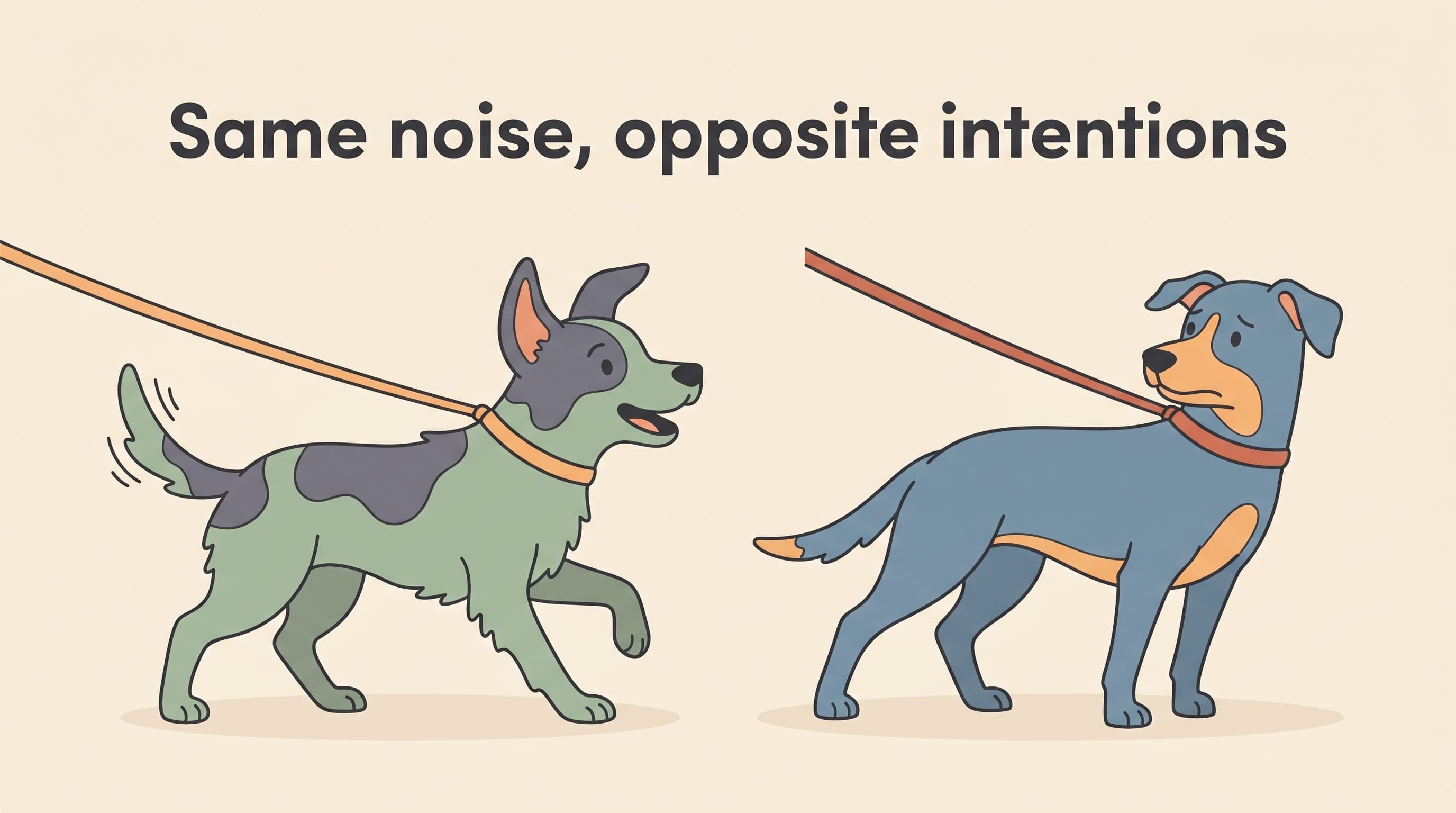
Two dogs are barking, lunging and straining at the end of the lead at the sight of another dog across the road. To you, to a passer-by, even to a fair few trainers, they look identical: the same noise, the same theatrics, the same red-faced owner wishing the pavement would swallow them. And yet one of those dogs desperately wants to rush over and say hello, while the other is shouting at the thing it is frightened of to please go away. Same picture, opposite goals. That is not a detail. It is the single most useful thing you can work out about your reactive dog, because it quietly decides which plan will help and which will, however kindly meant, make things worse.
This article is about telling those two dogs apart. If you are still getting to grips with what reactivity is, and why it is so often misread as a "dominant" or "bad" dog, start with our overview of lead reactivity, and the idea that behaviour is driven by underlying emotions like fear and frustration is laid out in why your pet does this. Here I want to take that fear-versus-frustration lens and point it squarely at the dog on the end of your lead.
One outburst, two very different meanings
The reason this matters is not academic. Aggressive-looking behaviour can present in outwardly similar ways, a dog barking, lunging or even biting, while arising from genuinely different underlying causes, and fear and frustration are two of the commonest. Those causes call for different treatment, because they are responses to a situation the dog is reading in completely different ways, and if the underlying cause is misjudged the advice that follows can simply fail to work, which in turn raises the risk of a dog being given up altogether (Wilson et al., 2024). So this is not hair-splitting. It is the difference between a plan that works and months of frustration for both of you.
Start with the two emotions themselves, because they are not the same thing wearing different hats. Fear is about threat: the dog perceives something as dangerous and wants it gone. Frustration is something else entirely. It is the negative state a dog feels when a positive expectation is violated, when something it actively wants is delayed, reduced, or put out of reach behind a barrier (McPeake et al., 2019; Bremhorst et al., 2019). The frustrated dog is not frightened of the other dog. It is desperate to get to it, and the lead, the fence or the window is the wall it cannot get through.
That gives us the load-bearing distinction. Fear-driven reactivity is what behaviourists call distance-increasing: the bark, the growl and the lunge are all there to drive the perceived threat away. Frustration runs the other way. The frustrated dog is trying to close the distance, not open it. The clinical literature puts the two side by side in exactly this everyday scene: a dog on a lead can bark and lunge at another dog out of fear, reading it as a threat, or out of frustration, because the lead is stopping them interacting (Wilson et al., 2024; Overall, 2013). Same display, contrary aims, which is precisely why a single "reactivity" label is not enough to act on.
There is a neat piece of brain science underneath this. Frustration is thought to involve mild engagement of the brain's reactive-aggression system, and that engagement grows in proportion to how intensely the dog wanted the thing it has been thwarted from reaching. The everyday triggers named for this in pet dogs are exactly the ones we are discussing: a physical barrier such as a door, or being restrained on a lead (McPeake et al., 2019). In other words, the harder your sociable dog wants to reach its friend, and the more the lead stops it, the bigger the outburst. The display is not hostility. It is thwarted enthusiasm with nowhere to go.
Meet the frustrated greeter
Picture the classic frustrated greeter. Off the lead in the park, this dog is often a model citizen: friendly, bouncy, civil with other dogs, the one that trots over for a polite sniff and a play bow. The wheels come off only when something stops it reaching what it wants, a lead, a garden fence, a window, a baby gate. Behind that barrier you get the full performance: pulling and lunging towards the other dog, scrabbling at the barrier, and a frantic, high-pitched, whiny vocal quality, sometimes tipping into snarling or snapping that looks aggressive but is really a thwarted "let me AT them" (McPeake et al., 2019).
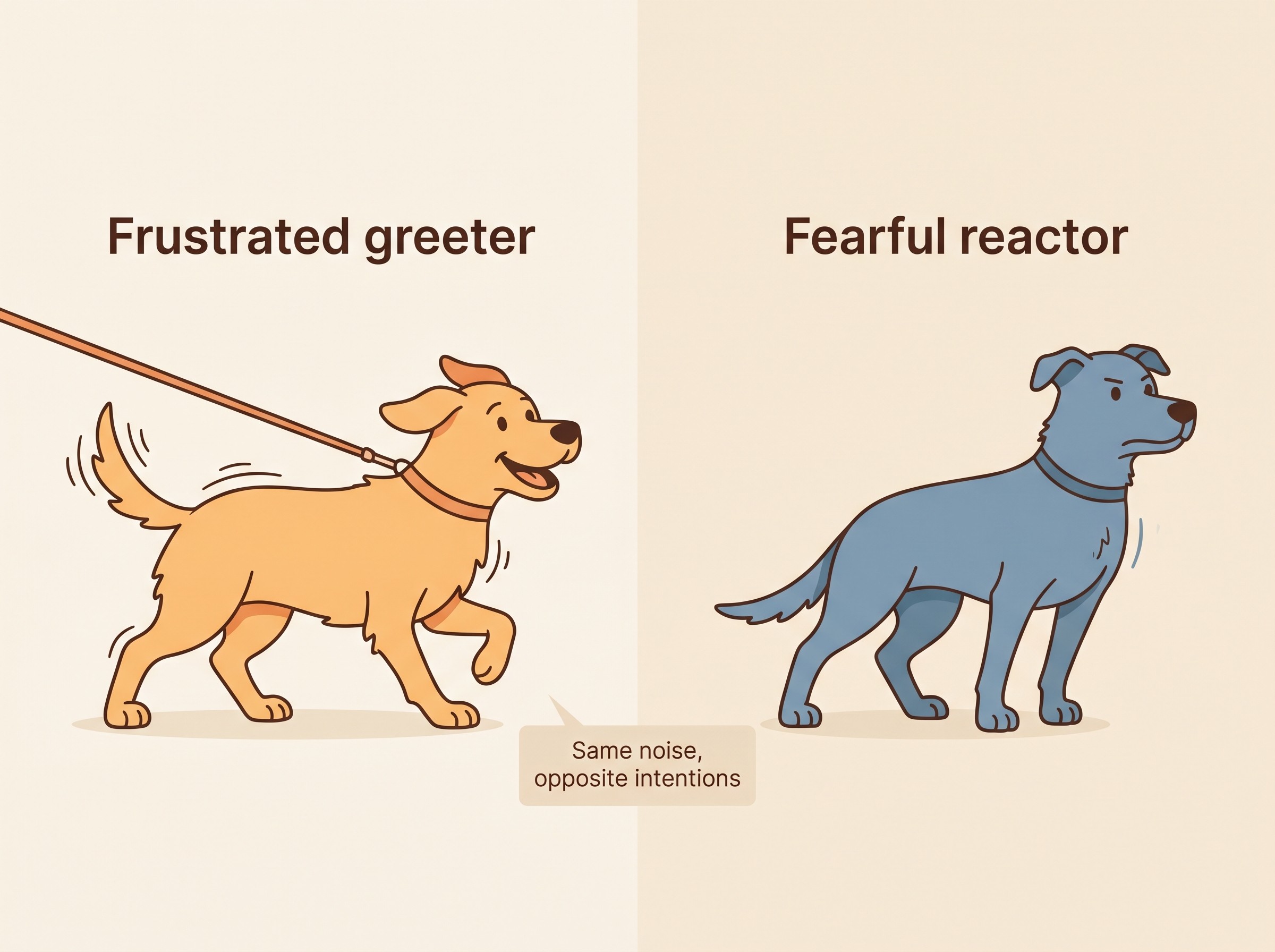
The tell is the direction of all that energy. The frustrated greeter's body and intent point forwards, towards the trigger: straining to get there, leaning into the harness, eyes locked on the prize. The mood, underneath the racket, is closer to "I want, I want" than to "stay away". This is also why one of the most stubborn myths in dog training, that a friendly dog cannot be reactive, is simply wrong. A frustrated greeter is frequently the most sociable dog on the street. Its reactivity is about blocked access, not hostility, which is a completely different problem with a completely different fix.
Meet the fearful reactor
Now the other dog. The fearful reactor is not trying to make friends. It perceives the trigger as a threat and its whole strategy is to create space, so every bark and lunge carries the message "go away, give me room". Importantly, this dog usually wants that space whether it is on the lead or off it. It is not the restraint that sets it off, it is the proximity. Take the lead away and a truly fearful dog will still tend to avoid, hang back, dart behind your legs, or scan nervously for the next thing to worry about.
The body language points the opposite way to the greeter's. Where the greeter pours itself forwards, the fearful reactor's weight more often goes back and away, even as it barks. You may see a conflicted, jack-in-the-box pattern of darting forward to bark and then retreating, a hard fixed stare, a tense closed mouth, "whale eye" with the whites showing, a lower more guttural growl, and small stress signals such as lip-licking, nose-licking or yawning before the explosion. I will not catalogue the whole signalling system here, our guide to reading your pet's body language does that properly, but the headline is the contrast: forward-and-eager versus back-and-wary.
Working out which one you have
The part that matters most: there is no single magic tell. Treat this as weighing up several clues rather than hunting for one defining tic, because some of the individual signs genuinely overlap. A nose-lick, a lip movement or a flattened ear can show up in a frustrated dog, a frightened dog, or simply a highly aroused one, so on their own these signs cannot reliably separate the two states (Bremhorst et al., 2019). What follows is a weight-of-evidence read, not a checklist.
The strongest single clue is off-lead behaviour and history. What is this dog like when it is not restrained, and at a comfortable distance? The frustrated greeter is typically friendly and appropriate off the lead and falls apart only when held back or stuck behind a barrier, because for that dog the barrier is the entire problem (McPeake et al., 2019). The fearful reactor wants space on or off the lead and tends to avoid, hide or startle rather than rush in, because for it the other dog itself is the problem, lead or no lead. If your dog adores other dogs at the park but loses its mind on the lead, frustration is high on your list. If it gives other dogs a wide berth even when free to approach, fear is more likely.
A second clue is direction and posture, as above: forward, loose and whiny versus weight-back, stiff, hard-staring and lower-pitched. A third is what happens as distance grows or the trigger leaves. A fearful dog tends to settle, often quite quickly, once it has its space back, because its goal of getting away has been met. A frustrated dog may keep fixating and even escalate for as long as the inaccessible thing is still in sight, because from its point of view the goal is still sitting there, maddeningly out of reach.
I want to be straight about the evidence here. There is no single clean trial that lines up "frustrated greeters" against "fearful reactors" as named owner-facing types and proves they need different protocols. The distinction is built from solid pieces: the emotion science establishing frustration as a real, measurable state distinct from fear (McPeake et al., 2019; Bremhorst et al., 2019), the proposed brain mechanism by which restraint and barriers amplify it (McPeake et al., 2019), and the clinical reality that experienced behaviourists treat the two as distinct drivers needing distinct strategies, while admitting they can be genuinely hard to tell apart in the moment (Wilson et al., 2024; Overall, 2013). So read this as well-grounded clinical reasoning to apply thoughtfully, not settled experimental fact, and lean hardest on the off-lead history rather than any one facial sign.
Why the two plans pull in opposite directions
Once you know which dog you have, you can see why the same intervention cannot serve both, because the two emotions are responses to the situation perceived in different ways and call for different strategies (Wilson et al., 2024). For the fearful reactor, the work is about building safety and gradually growing tolerance at a distance the dog can cope with. That is the territory of desensitisation and counter-conditioning, changing the underlying emotion so the trigger stops meaning "danger", and the method is set out in our guide to desensitisation and counter-conditioning. Push this dog too close too fast and you simply confirm its fear.
For the frustrated greeter, the centre of gravity is different. The job is to bring down that boiling-over arousal, to teach calmer ways to handle the presence of something it wants, and to build genuine impulse control, so an exciting trigger no longer means an instant meltdown. The greeter does not need convincing it is safe; it already feels safe. It needs help not detonating when it cannot have what it wants right now. Hand a greeter a fear protocol built around ever-greater distance and you may never address the real issue, while drilling a frightened dog on impulse control around a thing that genuinely scares it misses the point entirely. Same lunge, opposite homework.
I am deliberately not writing the walking protocol here, because that is a full article in its own right. The practical, on-the-pavement plan, distance and threshold, the focus and engage-disengage games, the emergency U-turn, and route and timing choices, lives in our reactive-dog walking plan, along with the printable walk plan that accompanies it. Once you have settled which type you are dealing with, that is the article that turns the diagnosis into a daily routine.
When it is both, and staying safe
Real life is rarely tidy, and some dogs will not slot neatly into one box. Fear and frustration are not always cleanly discrete states, and a single reactive outburst can carry more than one motivation at once (Wilson et al., 2024). The categories are not fixed for life either: a frustrated greeter whose attempts to reach other dogs are repeatedly thwarted, or who is punished or has a few genuinely frightening encounters on the lead, can develop a fearful, avoidant overlay, so a dog who started out merely over-keen ends up genuinely worried (Wilson et al., 2024). The picture can shift, which is why it is worth reassessing rather than labelling once and forgetting. When a dog seems to be both, the safest working rule is to treat the fear: keep more distance, prioritise safety, and never push a dog that might be frightened closer than it can cope with, while still working on calm.
Two safety points deserve saying plainly. First, this is not "harmless excitement", whichever type you have. A highly aroused dog of either kind can cause real injury through redirected aggression, whipping round to bite the lead, your hand, or another dog in the household when it cannot reach what it is fixated on. Frustration in particular has been specifically linked to this redirected aggression (McPeake et al., 2019), so a wound-up greeter is not automatically a safe greeter. Second, while genuine offensive aggression, a dog actively trying to make contact to do harm, is very much the minority of lead reactivity, it does exist and is a different conversation altogether. That is the territory of our guide to understanding aggression, and a dog like that needs qualified, hands-on help, not a greeting plan. For mixed, severe or genuinely aggressive cases, getting the right professional involved early is the kind move, and our guide to finding real help explains who does what.
One last thing, and it is the thread that runs through this whole space: rule out pain and illness first. Discomfort lowers a dog's tolerance and can tip ordinary arousal over into reactivity, so a dog that has suddenly become reactive, or noticeably more so, deserves a veterinary once-over before you assume it is purely behavioural. Our article on whether a problem is behavioural or medical covers why, and you can use the behaviour check to work out whether a vet visit belongs on your list before anything else.
So here is your next step. Spend a week genuinely watching your dog, not just on the lead but off it, at a distance, and in the minute after the trigger has gone, and decide which of these two dogs you are living with: the one straining to get there, or the one trying to get away. Once you have your answer, take it to the reactive-dog walking plan, because that is where knowing which dog you have stops being interesting and starts being the thing that finally changes your walks.
References
- Wilson BM, Soulsbury CD, Mills DS. Problem Behaviours and Relinquishment: Challenges Faced by Clinical Animal Behaviourists When Assessing Fear and Frustration. Animals, 2024; 14(18): 2718.
- McPeake KJ, Collins LM, Zulch H, Mills DS. The Canine Frustration Questionnaire—Development of a New Psychometric Tool for Measuring Frustration in Domestic Dogs (Canis familiaris). Frontiers in Veterinary Science, 2019; 6: 152.
- Bremhorst A, Sutter NA, Würbel H, Mills DS, Riemer S. Differences in facial expressions during positive anticipation and frustration in dogs awaiting a reward. Scientific Reports, 2019; 9: 19312.
- Overall KL. Manual of Clinical Behavioral Medicine for Dogs and Cats. Elsevier Mosby, St Louis, 2013.
Keep track of how your pet is doing
The owners who cope best are the ones who notice changes early. A simple health log shows you what is working, and what is not, before the next vet visit.
Start tracking, freeYou're not doing this alone
Compare treatment journeys and talk to owners managing behaviour & anxiety. Free to join.
Join PetsLikeMine