

Reading your pet: body language and the early warning signs
Alastair Greenway
BVM&S MRCVS
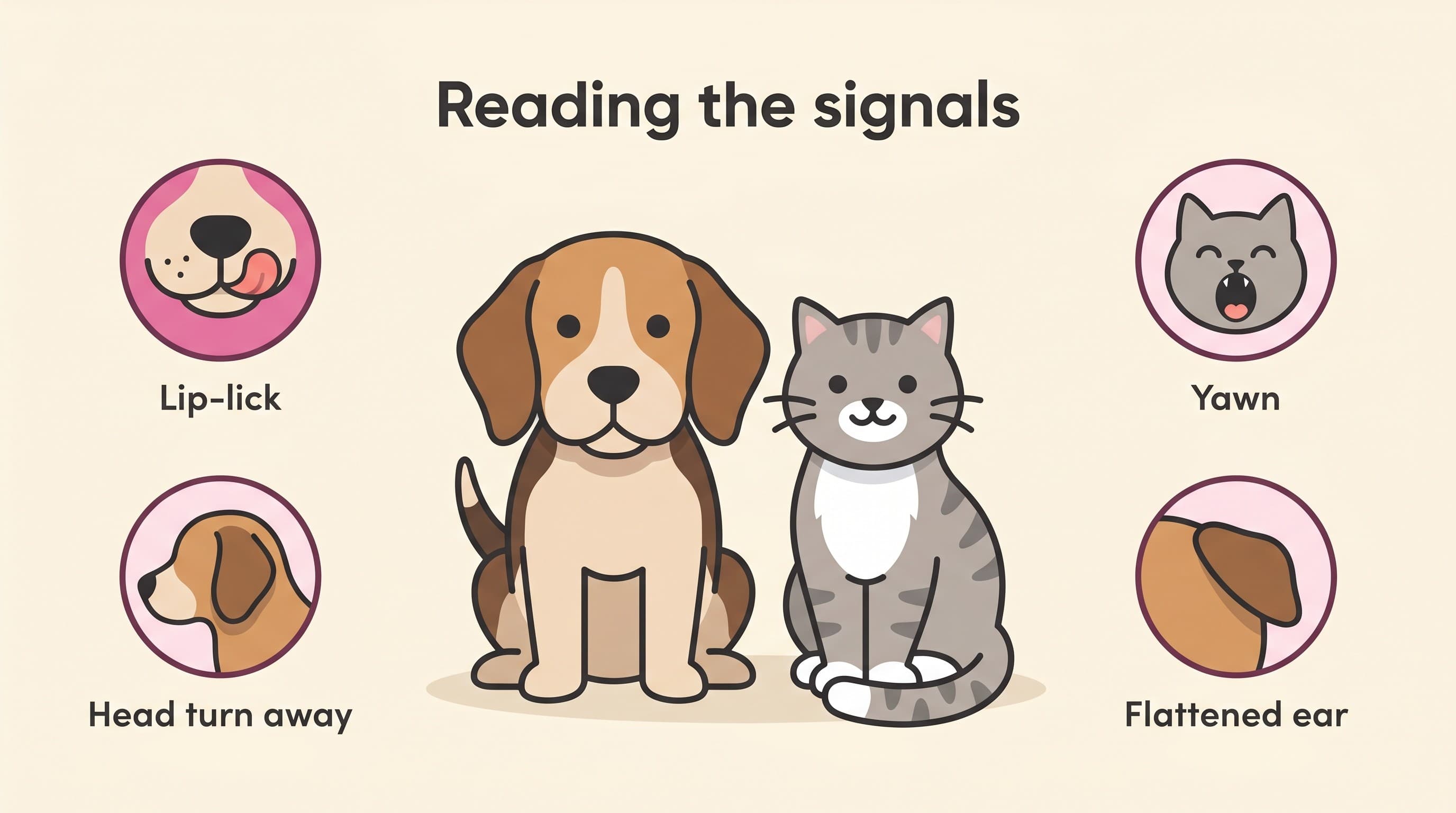
Ask almost anyone who has been bitten or scratched and you will hear the same line: it came out of nowhere. The dog was fine, and then it was not. The cat was purring on a lap one second and drawing blood the next. It feels genuinely random, and that is exactly why it frightens people. But the uncomfortable, useful truth is that it almost never comes out of nowhere. The animal was talking the entire time, yawning, licking its lips, turning away, freezing, flattening an ear, and we were not reading it, because nobody taught us the language and the early lines are quiet.
This is the most practical skill in the whole of behaviour, and you can learn it in an afternoon. Once you can read the early signals you stop arriving at the loud ones: you give the dog space before it has to growl, and let the cat leave before it has to swat. The bite that "came out of nowhere" never happens, because you answered the question while it was still being asked politely. This article teaches you to read what your dog or cat is telling you, and what to do the moment you see it. It does not cover why the fear or frustration is there, or how to change it: that is its own subject, and we hand you there at the end.
Why a bite is almost never sudden
Animals warn before they bite. They escalate through a recognisable sequence of signals, and the bite is the last rung, not the first. The classic teaching model for dogs is the ladder of aggression: a description of how a dog moves up through escalating appeasement and stress behaviours when its earlier, gentler attempts to defuse a situation are not working (Shepherd, 2009).
Low on the ladder sit the easy-to-miss signals: yawning when there is nothing to yawn about, blinking, turning the head away, a lifted paw, a quick lick of the lips or nose, the "whale eye" where the dog shows a crescent of white as it looks sideways without turning its head. Higher up come the harder-to-ignore ones: walking away, creeping with the ears back, crouching with the tail tucked, then standing stiff and staring, growling, snapping the teeth as a warning that deliberately misses, and finally biting (Shepherd, 2009).
Treat the ladder as a teaching tool, though, not a fixed staircase that every dog climbs one rung at a time. Real animals skip rungs, change the order with the situation, and a frightened dog cornered at close quarters can move from a quiet signal to a snap within seconds (Shepherd, 2009). What is reliable is the principle: there is almost always something before the bite, and the more practised you become, the earlier you will catch it.
So why does it feel sudden? Largely because owners, even experienced and devoted ones, are genuinely poor at spotting the quiet end of the scale. When researchers surveyed nearly 1,200 owners about stress in their dogs, the signs people named most readily were the dramatic ones, trembling and whining, while the subtle changes of the earlier stages of arousal, the lip-lick, the yawn, the look away, were rarely reported (Mariti et al., 2012). We see the shout and miss the whisper. There is a second reason too.
Never punish the warning
Getting this wrong is how a manageable problem becomes a dangerous one. Do not punish a growl. Do not punish a hiss, a snap, a snarl or any other warning. Ever.
The instinct is understandable: the growl is alarming, it feels like defiance, and the obvious response is to tell the dog off for it. But think about what the growl actually is. It is the smoke alarm. It is the animal saying, as clearly as it can, "I am not comfortable, please stop, I do not want to bite you." Punish that and you do not make the dog feel any safer. You teach it only that warning does not work and gets it told off. The fear that drove the growl is still there; what you have removed is the warning itself.
This is not a hunch, it is the explicit position of the veterinary behaviour community. Punishment can suppress behaviour, including the behaviours that warn that a bite may be coming, so that an animal whose fear is punished may go on to attack with little or no warning at all (AVSAB, 2007). You have taught the smoke alarm to stay silent while the fire still burns.
A second problem is more immediate: confrontation tends to provoke the very thing you are trying to stop. In a survey of owner-applied techniques, confrontational responses frequently triggered aggression, with hitting or kicking the dog drawing an aggressive response in 43 per cent of cases, growling back at it in 41 per cent, an "alpha roll" in 31 per cent and a stare-down in 30 per cent (Herron et al., 2009). Correcting a frightened animal does not lower the temperature, it raises it. The full case for reward over punishment is its own article at /articles/how-pets-learn-reward-vs-punishment; here the point is narrow and absolute. When your pet warns you, the warning is good information, and your job is to listen to it, not silence it.
A cat's quieter language
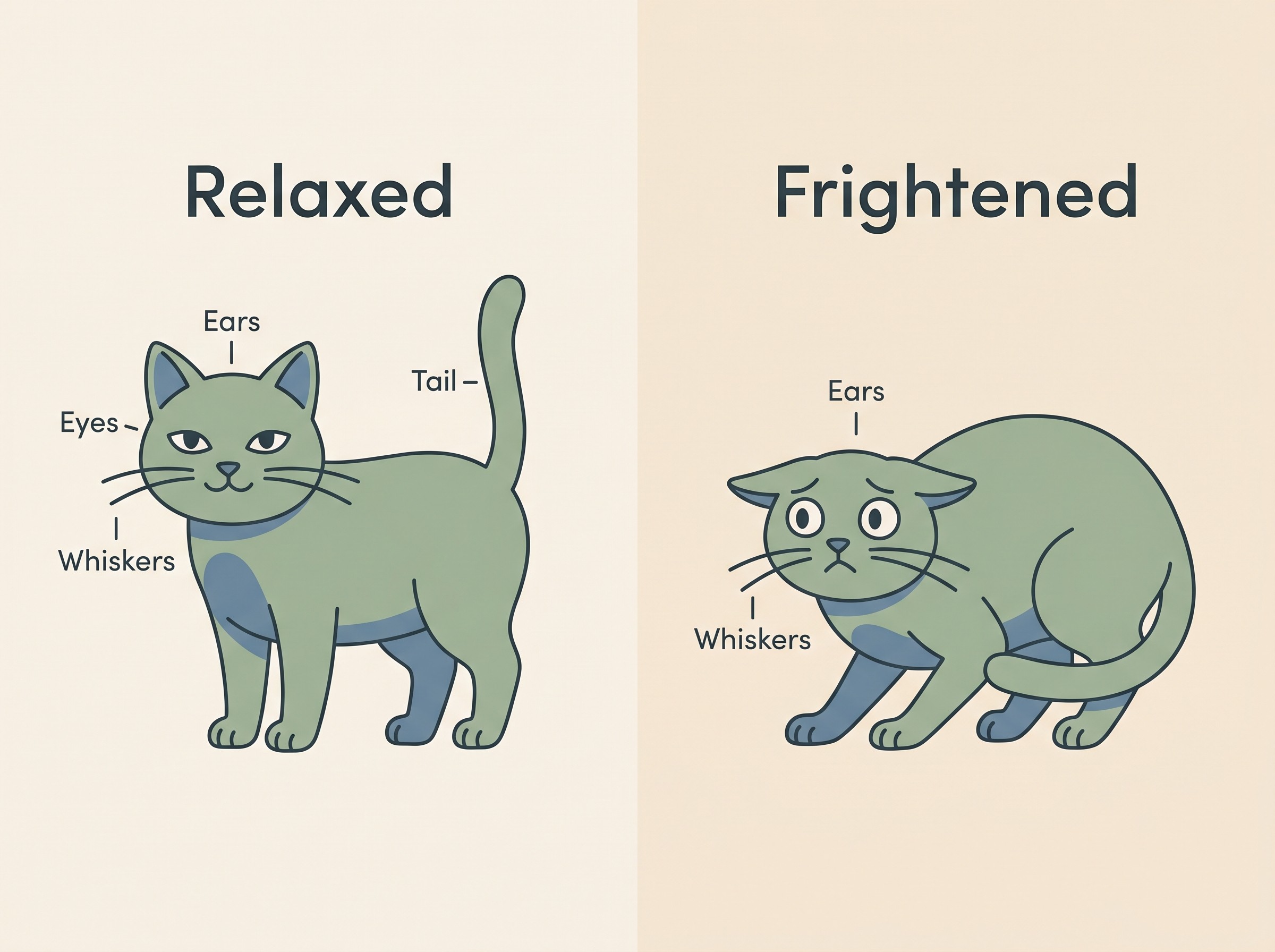
If dogs whisper before they shout, cats whisper more quietly still, which is precisely why so many people believe cats are unpredictable. They are not. They are subtle, and they are easy to read with the wrong rulebook. Feline signals are read mostly off the eyes, the ears, the whiskers, the body posture and the tail, and they grade smoothly from mild unease to "back off now" (Rodan et al., 2022).
In mild fear, a cat will often dilate its pupils a little, avoid eye contact and turn away, rotate its ears out to the sides, wrap its tail in close, and perhaps groom itself briefly out of context, a displacement behaviour that is the feline equivalent of a nervous fidget. As fear escalates, the pupils widen further, the ears rotate then flatten against the head, the body crouches or tenses, the whiskers and face stiffen, and the stare hardens, before you reach the hiss, the spit and the swat (Rodan et al., 2022; Rodan et al., 2011). Reading the early end matters for the same reason as in dogs: it lets you act before things escalate, by giving the cat the one thing it usually wants, which is more distance (Rodan et al., 2022).
Not every signal is a warning, and cats give you good news too. A slow blink, the half-closing and narrowing of the eyes that cat people instinctively love, is a real, evidence-backed affiliative signal. Cats are more likely to return a slow blink when their owner slow-blinks at them, and more likely to approach an unfamiliar person who has slow-blinked first, which suggests it functions as positive emotional communication (Humphrey et al., 2020). You can use it: catch your cat's eye, soften your gaze, and give a slow, lazy blink. It is one of the few things in this whole field you can try tonight and very often get an answer back.
Three signals owners cross-wire
Most bites and scratches to familiar people come not from missing the signals entirely but from reading them backwards. Three misreads do most of the damage, and they share a root: we read one species with the other's rulebook, or with a cartoon version of body language we absorbed as children.
Start with the wagging tail. A wag is not a reliable "I am happy" sign in a dog. It signals arousal, and arousal can be friendly or anything but. A loose, low, sweeping wag of the whole back end is a very different message from a high, stiff, fast flag of just the tail tip, which marks a tense, aroused dog you should give room, not reach for. Worse, cat tails and dog tails speak almost opposite languages. In cats, a tail held straight up on approach is a friendly greeting: pet cats will approach a tail-up silhouette faster than a tail-down one, which tells us the raised tail signals an intention to interact amicably (Bradshaw & Cameron-Beaumont, 2000). A lashing cat tail, by contrast, signals agitation, and a bristled, bottle-brush tail signals fear. Reading a swishing cat tail as the happy wag of a dog is a classic route to a scratched hand.
Next comes the exposed belly, and this one catches almost everyone. A dog that rolls over is sometimes inviting a rub, but in a tense, stiff dog with a closed mouth and a hard eye, the rollover is an appeasement signal, a "please stop, I am no threat" gesture, not a request (Shepherd, 2009). Reach in to rub that belly and you have walked straight up the ladder. In cats the belly-up posture is more often a defensive position that frees all four sets of claws and the teeth. The cat that flops over and shows you its tummy is, as a rule, not asking to be touched there, however much we wish it were.
Last is the trickiest: reading the absence of a loud signal as the presence of a calm one. A frozen, still animal is not necessarily a relaxed one. Stillness, a hard stare and a closed, tense mouth are often the quiet moment near the top of the ladder, the held breath before the snap. Mistaking that freeze for calm, and pressing on, is one of the commonest ways a confident hand gets bitten by a dog that "gave no warning". It gave plenty; it just stopped using words.
The instant you spot it
So you have read the signal, the lip-lick, the freeze, the flattened ear, the hard stare. What now? The rule is simple and it has one direction: you change the environment, not the animal.
Stop what you are doing. Increase the distance, either by moving yourself and others away or, better, by letting the animal move away from whatever is worrying it. Remove or reduce the trigger if you can, and give the dog or cat a clear, unblocked route to a safe place that it can take without being followed. Critically, do not crowd it, corner it, reach towards it, or try to "reassure" a frightened animal by handling it, because to a fearful pet a looming hand is part of the problem, not the solution. You are aiming to lower the pressure as fast as you took it up. Then, once everyone is safe, you think about the underlying driver, which is where the real work begins.
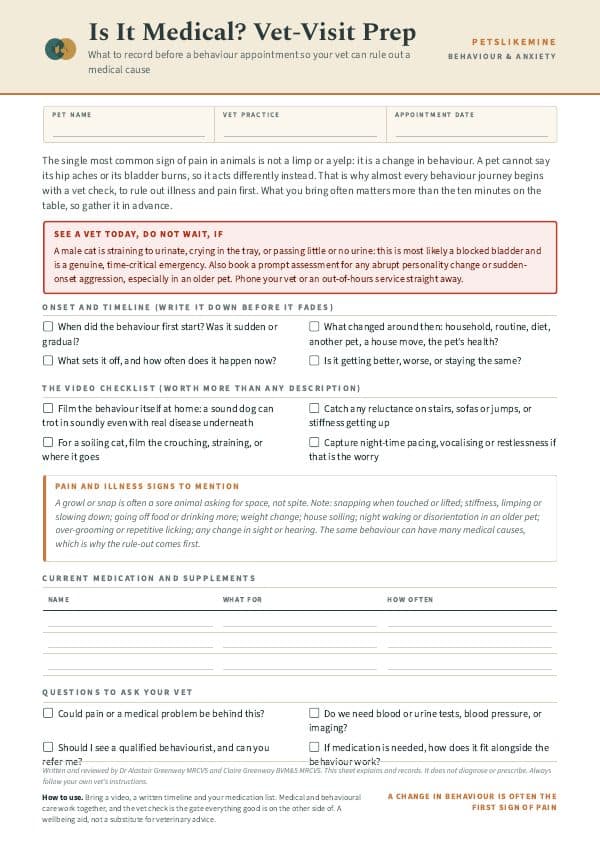
Two footnotes belong here. First, if your normally tolerant pet has suddenly started warning you, resenting being touched, flinching from a lifted hand or snapping when picked up, treat that as a possible medical sign, not just a behavioural one. Pain makes animals irritable and intolerant of handling, and a sudden change in temper warrants a vet check before anything else; our guide at /articles/is-it-behaviour-or-medical walks through that, and the behaviour check tool will help you decide how urgently to act. Second, the stakes are never higher than with children, who are bitten most often, frequently by a familiar dog, and often during an interaction that looked benign to the adults watching. The supervision rules that prevent those bites have their own article at /articles/children-and-dogs-safety; if you have both children and a dog at home, read it next.
Reading the signal is the foundation for everything else in this space, but it tells you only that your pet is struggling, not why or how to change it. For the why, the fear, frustration and conflict sitting behind the growl or the hiss, go to /articles/why-pets-behave-fear-frustration. If what you are recognising is chronic, low-level fear in an anxious dog or cat, /articles/helping-a-fearful-pet is the practical next step, and if the warnings have already tipped into growling and snapping, /articles/understanding-dog-aggression takes the subject on safely. Start watching, properly, this week. Once you have seen the early signals a few times, you will never quite be able to un-see them, and that is the moment your pet becomes a great deal safer to live with.
References
- Shepherd K. Behavioural medicine as an integral part of veterinary practice: the ladder of aggression. In: Horwitz DF, Mills DS, eds. BSAVA Manual of Canine and Feline Behavioural Medicine. 2nd ed. Gloucester: British Small Animal Veterinary Association, 2009: 13-16.
- Mariti C, Gazzano A, Moore JL, Baragli P, Chelli L, Sighieri C. Perception of dogs' stress by their owners. Journal of Veterinary Behavior: Clinical Applications and Research, 2012; 7(4): 213-219.
- American Veterinary Society of Animal Behavior (AVSAB). Position Statement: The Use of Punishment for Behavior Modification in Animals, 2007.
- Herron ME, Shofer FS, Reisner IR. Survey of the use and outcome of confrontational and non-confrontational training methods in client-owned dogs showing undesired behaviors. Applied Animal Behaviour Science, 2009; 117(1-2): 47-54.
- Rodan I, Dowgray N, Carney HC, Carozza E, Ellis SLH, Heath S, Niel L, St Denis K, Taylor S. 2022 AAFP/ISFM Cat Friendly Veterinary Interaction Guidelines: Approach and Handling Techniques. Journal of Feline Medicine and Surgery, 2022; 24(11): 1093-1132.
- Rodan I, Sundahl E, Carney H, Gagnon AC, Heath S, Landsberg G, Seksel K, Yin S. AAFP and ISFM Feline-Friendly Handling Guidelines. Journal of Feline Medicine and Surgery, 2011; 13(5): 364-375.
- Humphrey T, Proops L, Forman J, Spooner R, McComb K. The role of cat eye narrowing movements in cat-human communication. Scientific Reports, 2020; 10: 16503.
- Bradshaw JWS, Cameron-Beaumont C. The signalling repertoire of the domestic cat and its undomesticated relatives. In: Turner DC, Bateson P, eds. The Domestic Cat: The Biology of its Behaviour. 2nd ed. Cambridge: Cambridge University Press, 2000: 67-93.
Free downloads
Companion worksheets to put what you've read into practice. Free PDFs, print at home.
Keep track of how your pet is doing
The owners who cope best are the ones who notice changes early. A simple health log shows you what is working, and what is not, before the next vet visit.
Start tracking, freeYou're not doing this alone
Compare treatment journeys and talk to owners managing behaviour & anxiety. Free to join.
Join PetsLikeMine