

After a bite: safety, the law, muzzle training and getting qualified help
Alastair Greenway
BVM&S MRCVS
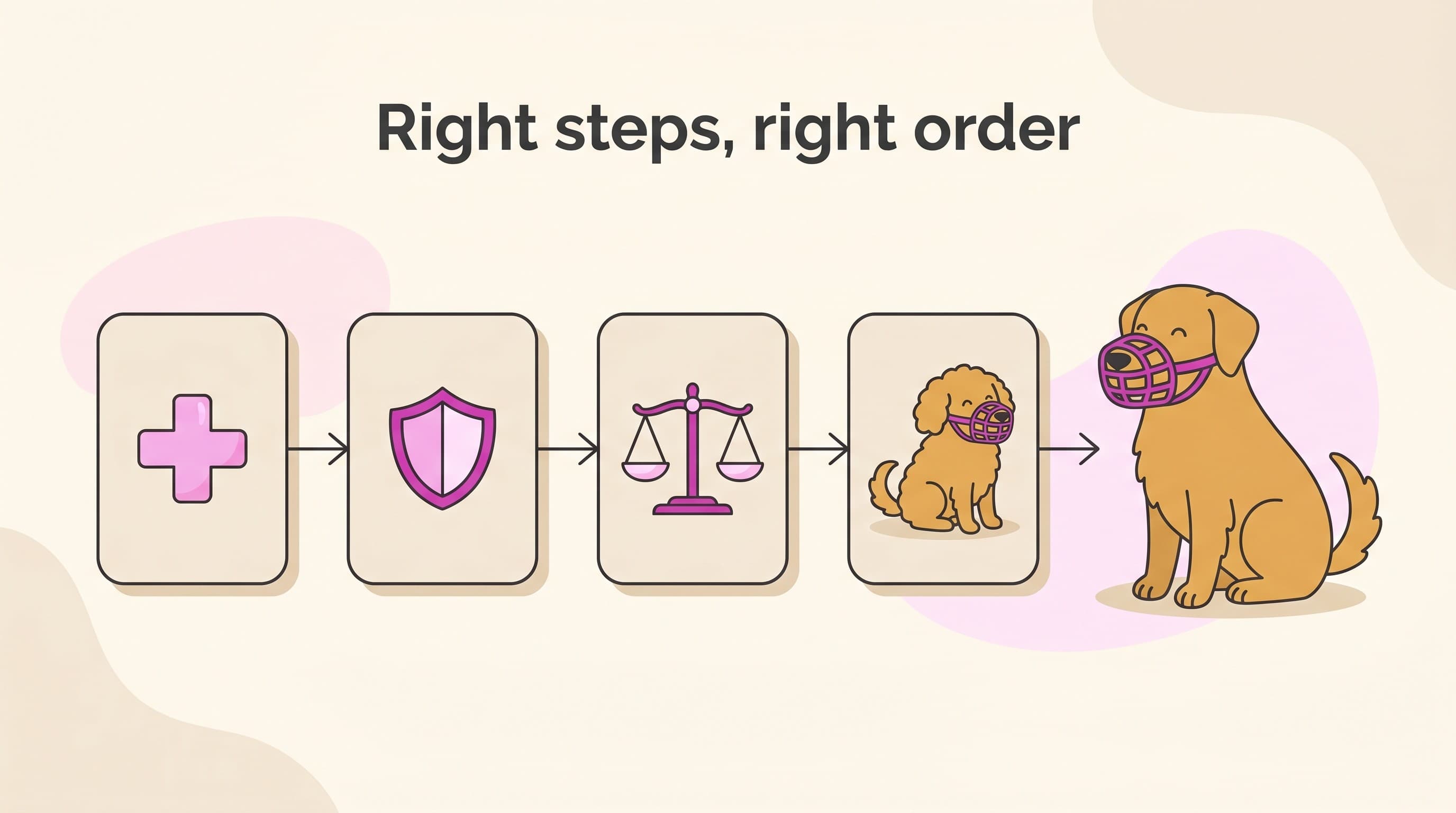
A dog who has bitten someone puts an owner into a difficult few days, and there are really only two things worth saying at the outset. Looking for proper guidance, rather than pretending it never happened, is the responsible move. And a bite is not a verdict on you or your dog. It is a serious event that needs a clear head and the right steps in the right order, and most dogs who have bitten can be managed safely with the right help. What follows is the practical pathway: what to do in the first hours, how to judge how bad the bite really was, where you stand with UK law, how to make your home safe, why a muzzle is a kindness, and how to find genuine help. It is candid, including about the hardest possibilities, but it is not here to frighten you.
One boundary before we start. This is a guide, not legal or veterinary advice for your case, and it is written for England and Wales, where dog law has changed repeatedly and is still changing, so treat it as a map and confirm the current rules for your own situation. The crisis-moment basics, breaking up a fight and first aid for the animals, live in our behaviour emergencies guide; this picks up the deeper after-a-bite pathway.
The first hours: people first, then the dog
Even when nothing about the moment feels simple, the order of priorities is. People first, then containment, then the harder thinking.
Start with the injured person. Any dog bite that breaks human skin needs attention, because the mouth carries bacteria such as Pasteurella that can seed a fast, serious infection, sometimes within a day, and punctures to the hand, foot, head or face are especially prone to it (NHS, animal and human bites). Wash the wound under running water with soap for several minutes, encourage a little bleeding from a clean puncture, cover it, and seek medical advice the same day rather than waiting to "see if it gets infected". Deep punctures, bites to the hand or face, bleeding that will not stop, anyone immunocompromised, and anyone whose tetanus cover is not current should be assessed by a clinician or NHS 111. Anything severe is a 999 call. Do not let worry about your dog delay care for a person.
Then contain the dog, calmly and without punishment. Put a door between it and everyone else and let the adrenaline settle. This is the most important thing to grasp now: telling the dog off or "showing it who is boss" makes nobody safer and tends to do the opposite, because punishment suppresses the warning signals that come before a bite and can make the next one happen with less notice (AVSAB Position Statement on the Use of Punishment). The dog is not being defiant. It has just done the most frightening thing in its repertoire, almost always from fear, pain or conflict, and adding fear on top is exactly wrong.
One last thing while it is fresh: write down what happened. Who was bitten, where on the body, what the dog and person were each doing in the ten seconds beforehand, and any warning the dog gave. That record is what a behaviourist needs to work out why it happened, and the factual account you may need if anyone official becomes involved.
How bad was it, really? The Dunbar bite scale
Owners tend to swing between "it was nothing, he just caught me" and "he could have killed someone". It is more useful to grade the bite objectively, because the actual wound is one of the better guides we have to how much danger a dog presents and how guarded the outlook is.
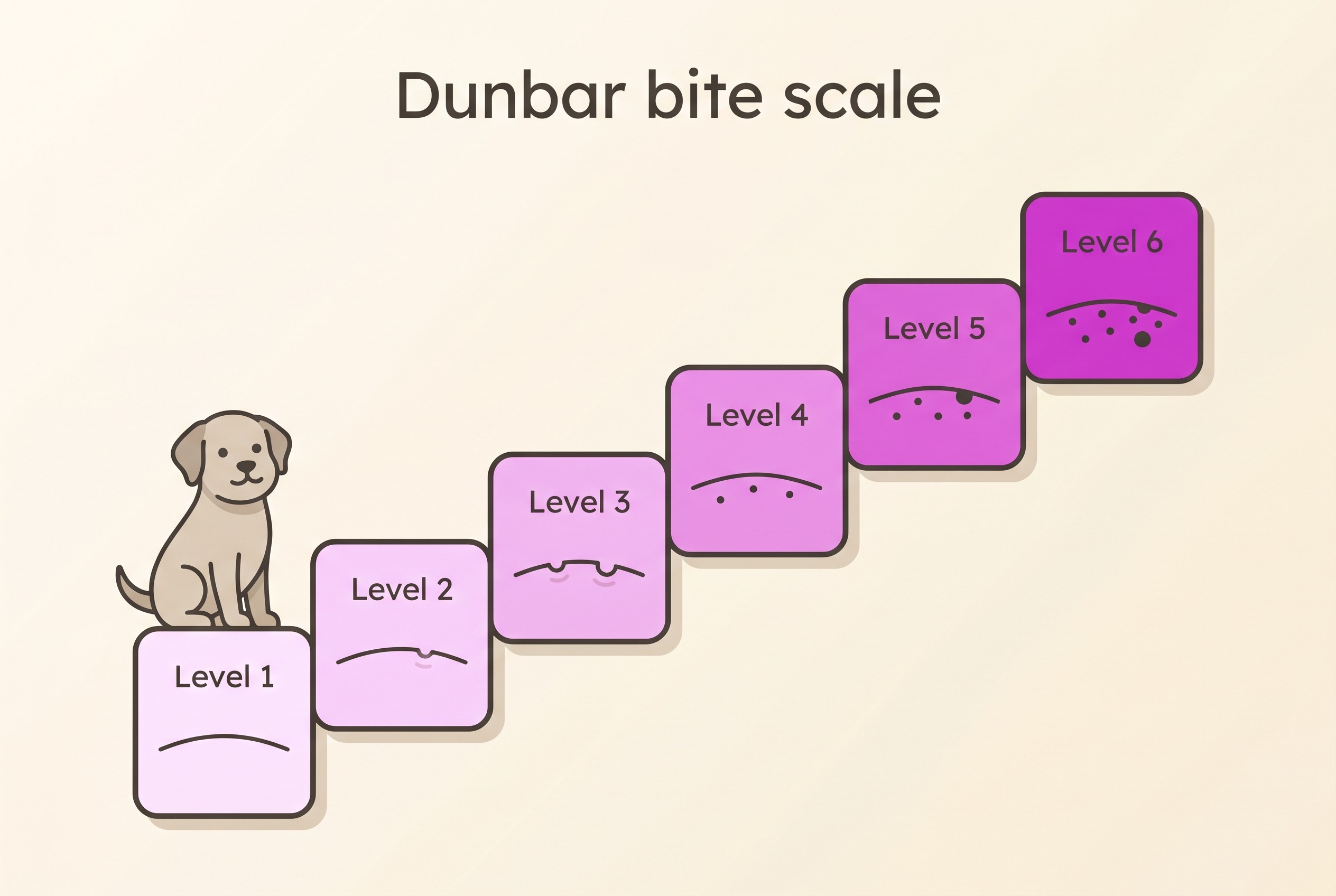
The standard framework is Dr Ian Dunbar's bite scale, which ranks a bite by what the teeth did rather than how dramatic it felt (Dunbar, Association of Professional Dog Trainers). In brief: Level 1 is aggressive behaviour with no skin contact; Level 2 is teeth touching skin but no puncture; Level 3 is one to four shallow punctures, none deeper than half the length of the dog's canine teeth; Level 4 is a single bite with at least one deep puncture, often with bruising or tearing that shows the dog clamped or shook; Level 5 is multiple Level 4 bites or a sustained attack; and Level 6 is a fatality. Reassuringly, the great majority of bites, well over ninety-nine percent of incidents, sit at Levels 1 and 2, where the dog deliberately inhibited and chose not to do real damage (Dunbar, Association of Professional Dog Trainers).
Two very different situations hide inside the same word, and that distinction is what separates them. A dog that connected but left only redness or a graze showed good bite inhibition: it could have done far worse and chose not to. A dog at Level 3 or 4, with real punctures, showed less inhibition and a poorer prognosis, and a dog at Level 5 is a serious safety problem. Where your dog sits is not a label to despair over, it is information that helps you and your vet judge how cautious to be, and exactly what a behaviourist will ask for. So note the wound accurately, photograph it if you reasonably can, and resist the urge to round it down.
Where you stand with the law (England and Wales, and check it)
The reality is that the law is serious, owner-focused and frequently changing, so you must confirm the current position rather than rely on what a friend told you years ago. What follows is a plain-English orientation, not legal advice.
The central law is the Dangerous Dogs Act 1991. It is an offence to let a dog of any breed be "dangerously out of control", which the law treats as covering a dog that injures someone, or even one that makes a person reasonably worried it might, and since 2014 this applies on private property too, including your own home, with a limited exception for a trespasser breaking in (gov.uk, Controlling your dog in public). The penalties are not trivial: an unlimited fine or up to six months in prison for a dog being out of control, up to five years if it injures someone, up to fourteen years if a dog kills someone, and up to three years if it injures an assistance dog, and a court can order a dog destroyed or impose control conditions (gov.uk, Controlling your dog in public). This is not meant to terrify you; it is why getting ahead of the situation matters so much.
There is a second strand to the Act, which bans certain types of dog identified by how the dog looks rather than its breed or name: the Pit Bull Terrier, Japanese Tosa, Dogo Argentino and Fila Brasileiro, and, since the law was amended for England and Wales across late 2023 and early 2024, the XL Bully (gov.uk, Ban on XL Bully dogs). Owners of an XL Bully needed a Certificate of Exemption and must keep the dog muzzled and leaded in public, neutered, microchipped and securely kept. This area is a moving target: the exemption conditions are being adjusted, with the third-party insurance requirement set to fall away from 1 July 2026 and a new rule from 1 November 2026 about not leaving a child under twelve alone with a banned-type dog in a home setting (gov.uk, Ban on XL Bully dogs). That churn is exactly why this article signposts rather than advises.
What about reporting? A dog attack on a person should be reported to the police, on 101, or 999 if there is immediate danger, as they investigate under the Act, and many owners also contact their local council's dog warden (gov.uk, Report a dog). If the person bitten was outside your household, expect they may report it, and be aware that being open and able to show you are taking responsible steps is far better than hoping it goes unnoticed. If you are worried about the legal consequences for your dog, that is the point to get advice from a solicitor who handles dog law, not a forum. The most protective thing you can do, legally and behaviourally, is to make a visible, genuine effort to prevent a recurrence.
Making the home safe: management that prevents a recurrence
Before any training changes the underlying emotion, management is what keeps everyone safe, and after a bite it is non-negotiable. The rule is simple to state and harder to live: the dog must not be put in the situation that produced the bite again until a professional has helped you change it.
Work out the exact trigger from your written account, then engineer the home so it cannot recur by accident. If the bite happened over a food bowl, the dog eats alone behind a closed door and nobody approaches it while it eats. If it happened when the dog was disturbed resting, its bed or crate becomes sacred, never reached into, and everyone calls the dog to them rather than going to a sleeping dog. If it happened with visitors, the dog is routinely put away before anyone arrives. Stair gates, a crate used as a genuine safe den rather than a punishment, leads on indoors at trigger moments, and one person always responsible for the dog when the trigger is in play: these unglamorous measures prevent far more bites than any clever exercise. Be especially uncompromising where children are involved, because children are bitten more than anyone, usually by a familiar dog during an interaction that looked harmless, often around resources or a resting dog (Reisner et al., 2011). The detailed rules have their own home in our children and dogs guide.
Management is not failure and not forever at the same intensity, but it is the foundation. A behaviour plan delivered without solid management is delivered while the dog keeps rehearsing the very thing you are trying to change.
The muzzle: a kindness and a safeguard, not a punishment
For many dogs with a bite history, a well-fitted basket muzzle is one of the most freeing tools available, and I wish more owners saw it that way rather than as a badge of shame. A basket muzzle, the open kind in stiff plastic or wire, lets a dog pant freely, drink and take treats, which close-fitting fabric "grooming" muzzles do not, so it is the only style suitable for anything beyond a couple of minutes (AVSAB, Muzzle Time). Used well, it is what lets a dog with a bite history keep walking in the world, keep visiting the vet and keep being part of the family safely.
Two points keep it in proportion. A muzzle is management, not treatment: it prevents harm but does not change the fear or conflict underneath, so it sits alongside a behaviour plan rather than replacing it (AVSAB, Muzzle Time). And it only helps if the dog is genuinely comfortable in it, which means it must be trained, never strapped on in a crisis. The conditioning is gradual and entirely reward-based: start with the empty muzzle in your hand, feeding treats around it so its appearance predicts good things; smear something the dog loves inside the basket so it pushes its own nose in to lick, by choice, many times before you fasten anything; then build in tiny steps, nose in for a second and a treat through the front, the strap touched then briefly done up, a few seconds wearing it while you feed and then a little longer, always paired with food and calm, always stopping before the dog frets (AVSAB, Muzzle Time). At the dog's pace, most come to shove their face happily into the muzzle because it has only ever meant treats and a walk. The general principles of fitting any new gear kindly sit alongside reactivity equipment in our equipment for reactivity guide; this is the bite-risk version of that skill.
A muzzle buys safety and time. It does not solve aggression, and it is not licence to push a dog into situations it cannot cope with.
Getting qualified help, and a frank word on prognosis
A dog that has bitten is past the point of self-help from a website, this one included. It needs a proper assessment, and the right route almost always starts with your own vet, both to rule out a pain or medical driver, which sits behind a meaningful share of aggression and is routinely missed, and to refer you onward (Mills et al., 2020). That medical rule-out is the front door to this whole space, covered in is it behaviour or is it medical, and for a quick steer on urgency you can use our behaviour check tool. From there, serious aggression warrants a suitably qualified clinical animal behaviourist working with your vet, and often vet-prescribed medication to lower the underlying anxiety enough for the dog to learn, always a prescribing decision made and monitored by your vet, never something to source or dose yourself. Because anyone can call themselves a "behaviourist" in the UK, choosing the right person matters, and we cover how to find accredited help and avoid the harmful kind in finding real behaviour help.
Let me be straight with you about prognosis, because you deserve neither false comfort nor doom. Most aggression, including many cases that produced a bite, improves substantially with the right mix of management, behaviour modification and, where needed, medication, and "improvement" usually means the triggering situations are reliably and safely managed rather than that the dog is "cured". The outlook is better when the trigger is single and predictable, the bite was inhibited at a low level on the scale, and the household can deliver consistent management, and more guarded when bites are deep or come with little warning across many contexts. A small minority of cases are genuinely dangerous, and very occasionally, after real effort and expert help, a home cannot be made safe enough, particularly with young children or repeated, poorly inhibited bites. In those rare situations behavioural euthanasia is a real and defensible option that deserves to be discussed without shame: behaviour problems, chiefly aggression, are a leading cause of death in young dogs (Boyd et al., 2018), and when owners face this choice it is overwhelmingly about human safety, typically after a dog has already bitten and broken skin more than once (Hitchcock et al., 2024). If you are anywhere near that, do not carry it alone and do not let an internet stranger pass judgement: talk to your vet and a clinical behaviourist, because there is usually more to try, and the people who reach that point are almost always devoted owners who tried hard. For the great majority reading this that conversation never comes, and the path forward is the ordinary, hopeful one: see to the person, contain the dog kindly, book the vet, and get the right help for what comes next.
References
- NHS. Animal and human bites. NHS, 2024.
- American Veterinary Society of Animal Behavior. Position Statement on the Use of Punishment for Behavior Modification in Animals. AVSAB, 2007.
- Dunbar I. Dog Bite Scale (Official Authorized Version): An Assessment of the Severity of Biting Problems Based on an Objective Evaluation of Wound Pathology. Association of Professional Dog Trainers, 2011.
- GOV.UK. Controlling your dog in public. UK Government, 2024.
- GOV.UK. Ban on XL Bully dogs. UK Government, 2024.
- GOV.UK. Controlling your dog in public: Banned dogs and reporting a dangerous or out-of-control dog. UK Government, 2024.
- Reisner IR, Nance ML, Zeller JS, Houseknecht EM, Kassam-Adams N, Wiebe DJ. Behavioural characteristics associated with dog bites to children presenting to an urban trauma centre. Injury Prevention, 2011;17(5):348-353.
- American Veterinary Society of Animal Behavior. Muzzle Time. AVSAB, 2022.
- Mills DS, Demontigny-Bedard I, Gruen M, Klinck MP, McPeake KJ, Barcelos AM, et al. Pain and Problem Behavior in Cats and Dogs. Animals, 2020;10(2):318.
- Boyd C, Jarvis S, McGreevy PD, Heath S, Church DB, Brodbelt DC, O'Neill DG. Mortality resulting from undesirable behaviours in dogs aged under three years attending primary-care veterinary practices in England. Animal Welfare, 2018;27(3):251-262.
- Hitchcock M, Workman MK, Gruen M, Roberts C, Croney C, Feyes E, Lord LK. Factors associated with behavioral euthanasia in pet dogs. Frontiers in Veterinary Science, 2024;11:1387076.
Keep track of how your pet is doing
The owners who cope best are the ones who notice changes early. A simple health log shows you what is working, and what is not, before the next vet visit.
Start tracking, freeYou're not doing this alone
Compare treatment journeys and talk to owners managing behaviour & anxiety. Free to join.
Join PetsLikeMine