

When is it an emergency? Safety, bites and keeping everyone safe
Alastair Greenway
BVM&S MRCVS
Most behaviour problems are not emergencies. They are slow, frustrating, fixable things you have time to work through with help. A small handful, though, are genuinely urgent, and in those moments the instinct that serves you everywhere else, to understand the behaviour and correct it, is the wrong first move. When a dog is threatening to bite, when two animals are fighting, when a pet is in a blind panic, or when a cat is straining and producing nothing, the only job in the first few minutes is safety. Not training, not discipline, not working out who started it: just getting bodies apart, keeping skin intact and, in one case, getting to a vet that hour.
What follows is the triage guide for those moments. Where a topic has its own article, the law after a bite or the firework-night plan, I point you there rather than half-cover it here.
The one "behaviour problem" that is a medical emergency
Start with the situation that disguises itself best, because getting it wrong can be fatal. A male cat going in and out of the litter tray, straining, squatting, crying out, producing little or no urine and perhaps licking his genitals, is not being naughty. He may have a urethral obstruction, one of the very few true life-threatening emergencies in this whole space.
Obstruction happens almost exclusively in male cats, whose longer, narrower urethra blocks more easily, and once it is completely blocked the cat cannot pass urine at all (Taylor et al., 2025). Toxins build fast: uraemia develops within twenty-four to forty-eight hours, and an obstructed cat can deteriorate through dangerous changes to blood potassium and heart rhythm, bladder rupture and shock, with death possible in less than a day or two if it is not relieved (Taylor et al., 2025; Cornell Feline Health Center). The reassuring part is that with prompt treatment most of these cats do well, with survival to discharge in the region of ninety to ninety-five percent (St. Denis, 2020), so the whole battle is getting there in time.
The line to remember: a male cat repeatedly straining with little or nothing coming out, especially if he is also crying, vomiting, lethargic or hiding, needs an emergency vet that hour, not a wait-and-see (St. Denis, 2020). It is that unproductive straining plus rising distress that sets it apart from ordinary cystitis, where a cat strains but still passes urine. Everything else, the non-emergency causes of toileting in the wrong place and the tray and stress work, lives in our article on a cat peeing outside the litter tray. This piece owns only the red flag and the "go now."
Aggression: emergency, or merely urgent?
For dogs the question is usually not "is this medical" but "is someone about to get hurt," and it helps to separate two kinds of urgent. A genuine emergency is a bite that has broken skin and needs wound care, an animal in such a state that it is injuring itself, or a situation right now where a person, child or other animal is at immediate risk and cannot be kept safe by closing a door. These need action in the moment, and sometimes a vet tonight.
An urgent behaviour problem is different: aggression that is real and frightening but that you can contain by separating the animal and removing the trigger. A dog that growls and snaps when approached at its bed, yet is fine the rest of the time, is urgent. It needs a proper plan and professional help soon, but it is not a tonight emergency as long as you manage the situation. Contain first, then decide how fast you need help.
One more flag sits on the border between behaviour and medicine. Sudden, severe aggression in a previously gentle pet, or an abrupt personality change, particularly in an older animal, should send you to a vet first, not just a behaviourist. Pain, neurological disease and other medical problems can drive irritability and aggression, and a sudden shift is exactly the pattern that warrants ruling them out (Mills et al., 2020). We cover the full work-up in is it behaviour or is it medical, the space's defining starting point, and our behaviour triage tool can help you decide how worried to be.
Why punishment makes a tense moment more dangerous
Here is the most important safety idea on this page. When an animal is frightened or aggressive, the worst thing you can do is punish, shout at or try to dominate it, not because it is unkind, though it is, but because it makes a bite more likely and, crucially, more sudden.
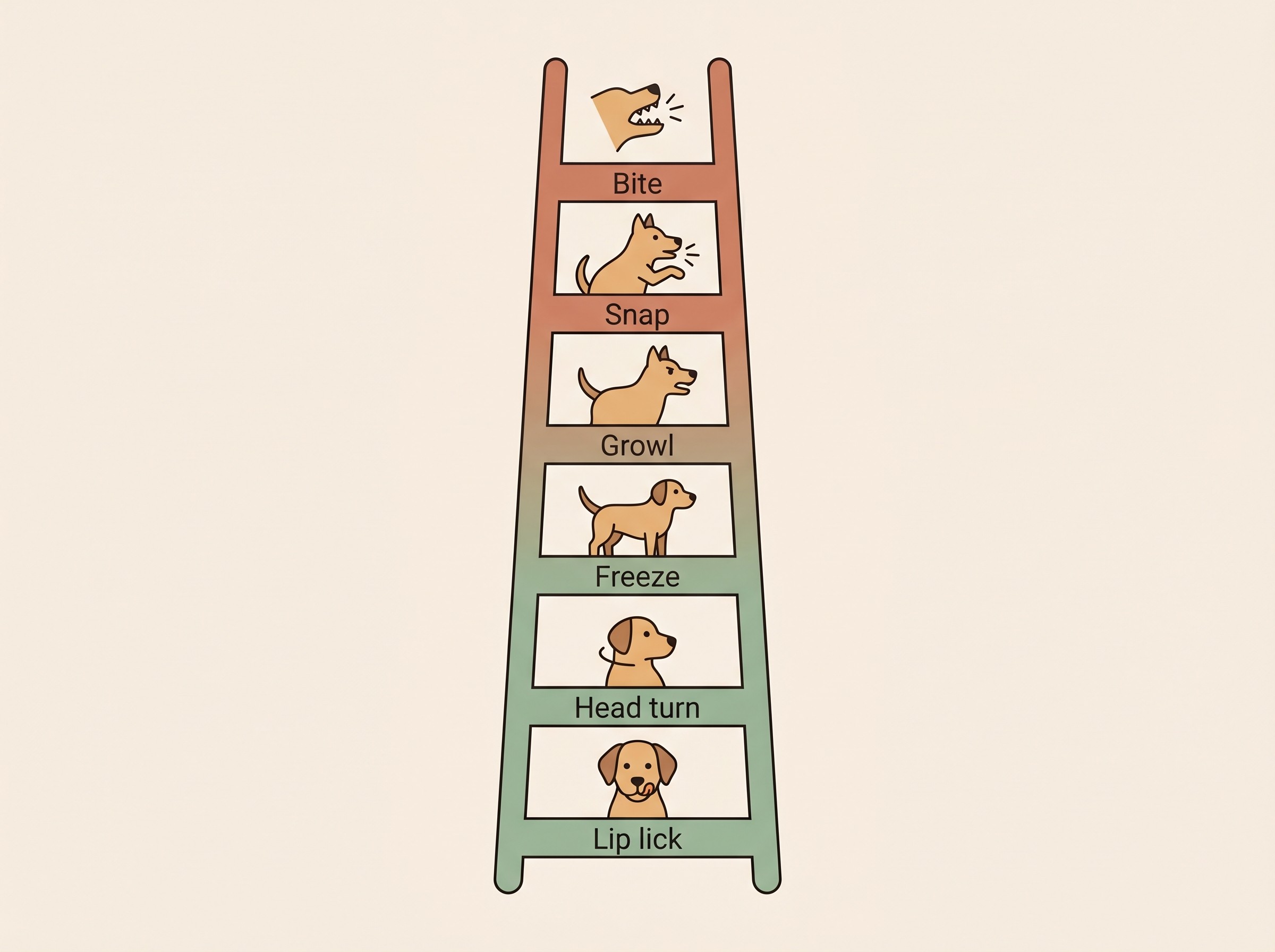
Dogs almost never bite out of the blue. They climb a ladder of warning signals first: a yawn, a lip-lick, a head-turn, freezing, then a growl, a snap and only then a bite (Shepherd, 2009). Punish the growl and you do not remove the feeling underneath, you teach the dog that growling gets it into trouble, so next time it goes straight to the bite with less warning. The American Veterinary Society of Animal Behavior is blunt: punishment can suppress those warning behaviours so that a fearful or aggressive animal suddenly acts with heightened aggression and fewer warning signs, and can itself elicit aggression and put any person nearby at risk of being bitten (AVSAB Position Statement on the Use of Punishment).
The same is true of confrontational, show-them-who-is-boss handling. When owners were surveyed about these techniques, a large minority of dogs responded with aggression: hitting or kicking provoked it in forty-three percent of dogs, growling back at the dog in forty-one percent, and the alpha roll in thirty-one percent (Herron, Shofer & Reisner, 2009). Dominance does not make a tense animal safe, it makes it dangerous; the safe move is always to de-escalate and create distance. Cats are no different: punishing a cat for toileting indoors or lashing out only creates stress, can lead to fear-related aggression and will almost always reduce the bond between you (Carney et al., 2014).
So across both species the principle is to remove the trigger, not punish the animal. Why these methods backfire is covered in how animals actually learn, and reading the early signals is the subject of reading your pet's body language.
In the moment: what to actually do
The guidance below is veterinary first-aid consensus, so treat it as sensible practice rather than proven-by-trial.
If two dogs are fighting, do not reach in with your hands or grab a collar between them. In high arousal a dog redirects and bites whatever is nearest, often the owner's hand (Herron, Shofer & Reisner, 2009). Instead, interrupt and separate from safety: a loud noise or air horn, a board pushed between them, a blast of water, or, with two people, the wheelbarrow method, where each person lifts one dog by the hind legs above the hocks and backs away in a curve so the dogs cannot turn on you. Then keep them in separate rooms and let the adrenaline drain.
A panicking cat needs the opposite of restraint: let it escape. A cornered or grabbed cat will redirect ferociously, and the injuries can be severe. Open a route to a hiding place, dim the lights, lower your voice and give it time to come down on its own. Do not chase, corner or scruff it.
After any fight or bite, check every animal involved for puncture wounds, even small ones, even if the animal seems fine. Tooth punctures seal over quickly and trap bacteria underneath, so they can look trivial yet still need veterinary care and often antibiotics. When a dog has bitten a person, the wound, who you must tell, and the law all matter and have their own full article: after a dog bite, the safety, the law and getting help. If a child has been bitten, seek medical advice promptly, as children are bitten disproportionately on the face and head (Reisner et al., 2011); the supervision and separation rules that prevent those bites are set out in children and dogs.
Comfort, hiding, and the muzzle that is a kindness
One more myth makes frightened owners do the wrong thing at the worst time: that comforting a scared animal "reinforces" the fear. It does not. Fear is an involuntary emotional state, and you cannot reward an emotion the way you reward a behaviour; in the research on noise events, allowing and providing comfort is protective rather than harmful, which is precisely why those studies did not stop owners comforting their dogs (Riemer, 2020). So in an acute fear crisis, stay calm, let the animal hide, and do not flood it with the very thing it fears in the hope it will "get used to it," which only makes things worse and can get you bitten. The firework-night version of this, with the den and the routine, lives in our firework night plan.
Once the crisis passes, good management is mostly separation and removing triggers: stair gates, crates as safe dens rather than punishment, leads indoors, and not putting the animal in the situation that sets it off. A muzzle belongs in that toolkit and is so often misunderstood. A well-fitted basket muzzle is not a cruelty or a sign of a "bad dog": it is a safety tool that lets a dog pant, drink and take treats while protecting people and other animals, and introduced gradually with positive associations it can be the very thing that lets a dog with a bite history keep going to the park and the vet safely (AVSAB, Introducing a Muzzle). The step-by-step of conditioning a dog to its muzzle, and when to use one after a bite, sits in our after a dog bite article. Serious aggression is not a DIY project from a website: it needs qualified help, often a veterinary referral and sometimes medication, and our guide to finding real behaviour help walks through who to trust and how to vet them.
The hardest conversation, handled plainly
Sometimes aggression is severe, the risk to people is real, and despite good management and good help the situation cannot be made safe enough to live with. In those rare cases behavioural euthanasia is genuinely on the table, and it deserves to be talked about without melodrama and without shame.
Two facts help. Behaviour problems, chiefly aggression, are a real cause of death in young dogs: in primary-care data from England, 33.7 percent of deaths in dogs under three years were attributed to undesirable behaviour, with aggression the most prevalent (Boyd et al., 2018). And when behavioural euthanasia is considered, it is overwhelmingly about safety: aggression toward people is the commonest driver, and most of those dogs have already bitten and broken skin at least once (Hitchcock et al., 2024). The researchers who study these decisions call for de-stigmatising them and supporting grieving owners, because the people facing this choice are usually devoted owners who tried hard, not people who gave up (Hitchcock et al., 2024).
If you are anywhere near this, do not carry it alone, and do not let an internet stranger tell you that you failed. Talk to your own vet and a clinical behaviourist first: there is often more to try, and you deserve a proper assessment of the risk and the options before any decision. But if, after real effort and real help, the kindest and safest path turns out to be the hardest one, that is a defensible and loving decision made for everyone's safety, the animal's own welfare included. For most households this conversation never comes. Wherever you are tonight, from a male cat at the tray to a dog you are no longer sure of, the next move is the same: keep everyone safe now, then get the right help for what comes next.
References
- Taylor S, Boysen S, Buffington T, et al. 2025 iCatCare consensus guidelines on the diagnosis and management of lower urinary tract diseases in cats. Journal of Feline Medicine and Surgery, 2025;27(2).
- Cornell Feline Health Center. Feline Lower Urinary Tract Disease. Cornell University College of Veterinary Medicine.
- St. Denis K. Managing Feline Urethral Obstruction. Today's Veterinary Practice, 2020.
- Mills DS, Demontigny-Bedard I, Gruen M, et al. Pain and Problem Behavior in Cats and Dogs. Animals, 2020;10(2):318.
- Shepherd K. Ladder of aggression. In: BSAVA Manual of Canine and Feline Behavioural Medicine, 2nd edn. Gloucester: British Small Animal Veterinary Association, 2009:13-16.
- American Veterinary Society of Animal Behavior. AVSAB Position Statement: The Use of Punishment for Behavior Modification in Animals.
- Herron ME, Shofer FS, Reisner IR. Survey of the use and outcome of confrontational and non-confrontational training methods in client-owned dogs showing undesired behaviors. Applied Animal Behaviour Science, 2009;117(1-2):47-54.
- Carney HC, Sadek TP, Curtis TM, et al. AAFP and ISFM Guidelines for Diagnosing and Solving House-Soiling Behavior in Cats. Journal of Feline Medicine and Surgery, 2014;16(7):579-598.
- Reisner IR, Nance ML, Zeller JS, et al. Behavioural characteristics associated with dog bites to children presenting to an urban trauma centre. Injury Prevention, 2011;17(5):348-353.
- Riemer S. Effectiveness of treatments for firework fears in dogs. Journal of Veterinary Behavior, 2020;37:61-70.
- American Veterinary Society of Animal Behavior. Introducing a Muzzle.
- Boyd C, Jarvis S, McGreevy PD, et al. Mortality resulting from undesirable behaviours in dogs aged under three years attending primary-care veterinary practices in England. Animal Welfare, 2018;27(3):251-262.
- Hitchcock M, Workman MK, Guthrie A, et al. Factors associated with behavioral euthanasia in pet dogs. Frontiers in Veterinary Science, 2024;11:1387076.
Keep track of how your pet is doing
The owners who cope best are the ones who notice changes early. A simple health log shows you what is working, and what is not, before the next vet visit.
Start tracking, freeYou're not doing this alone
Compare treatment journeys and talk to owners managing behaviour & anxiety. Free to join.
Join PetsLikeMine