

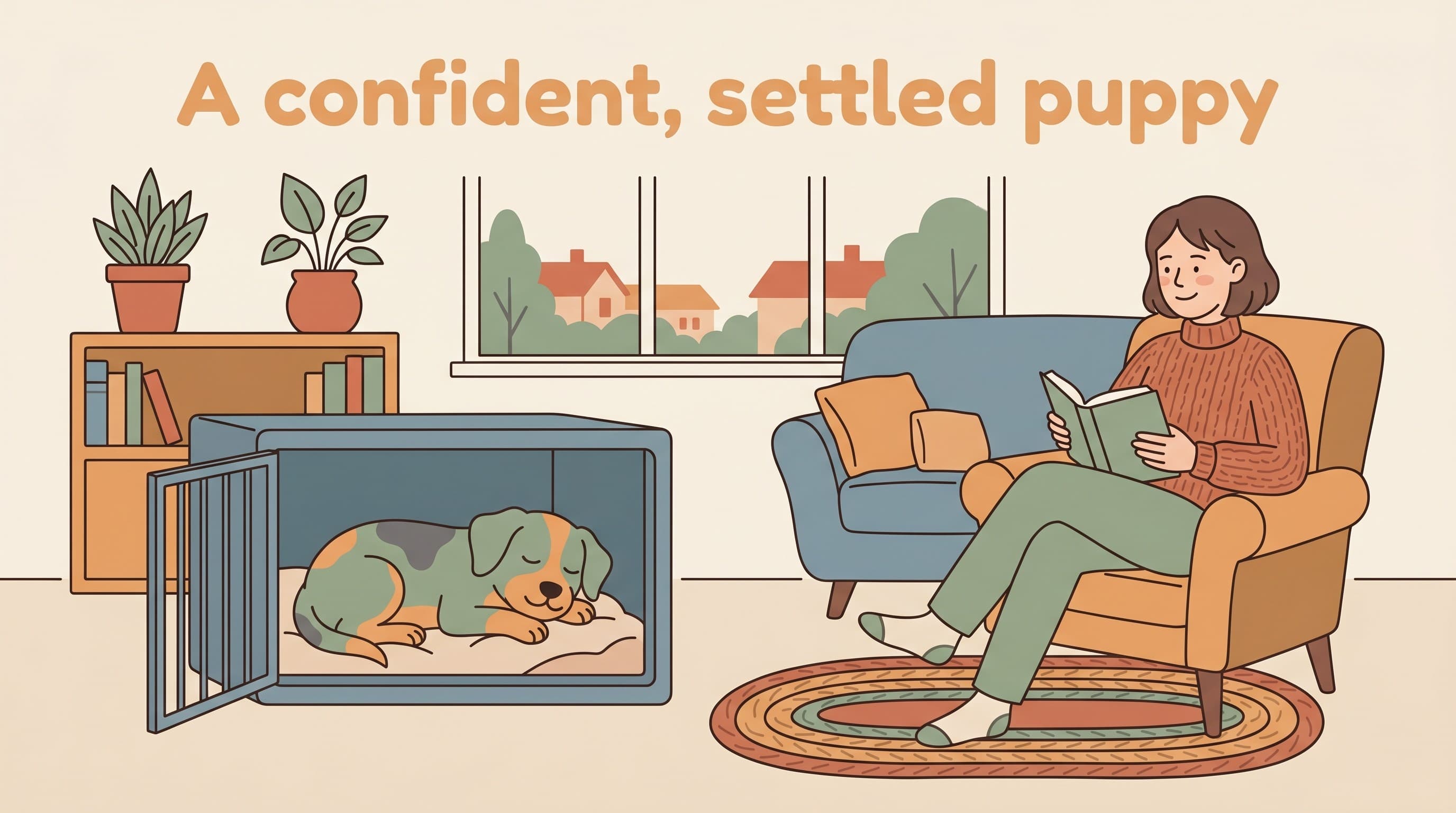
Puppies and prevention: building alone-time tolerance from the start
Alastair Greenway
BVM&S MRCVS
No puppy is born knowing how to be relaxed on its own. It is a skill, like toilet training or walking nicely on a lead, and like any skill it has to be learned, gently and early, before a problem ever forms. Almost no puppy class mentions this until it is too late. Most puppies never get taught it deliberately. They simply grow up either lucky, in a home where short, calm absences happen naturally, or unlucky, in a home where they are rarely apart from anyone until the day life suddenly changes and they are left for hours with no preparation at all.
The good news is that prevention is cheaper, kinder and more reliable than treatment, and it costs almost nothing but a little forethought. This article is about getting ahead of separation problems in a puppy: why alone-time has to be taught, what the early evidence shows helps, the traps well-meaning owners fall into, and how to spot the pup who is starting to struggle. If a problem has already taken hold, that is a different job, and we point you to the right place for it below. For now, let us build the foundation.
Why being alone is a skill, not a given
When researchers followed 1,807 UK dogs across the first COVID lockdown, almost one in ten that had never shown a separation problem before developed new separation-related behaviour once restrictions began to ease, and the dogs most at risk were precisely those whose alone-time had fallen the most (Harvey et al., 2022). The dogs that suddenly found themselves left after a long stretch of constant company were the ones who struggled. That is about the clearest signal you could ask for that tolerance of being alone is a learned, maintained skill, not a fixed trait, and that a sudden change in how much a dog is left is itself a driver of new problems.
This matters for your puppy because the default trajectory of modern puppy-rearing pushes against it. We bring a tiny dog home, rightly shower it with attention, carry it everywhere, and let it follow us from room to room. None of that is wrong, but if it never gives way to small, ordinary experiences of being apart, the pup never practises the thing it most needs to be good at. Prevention is mostly about weaving that practice in early, so that being alone becomes boring and normal rather than novel and frightening.
It is worth saying plainly that the evidence for preventing separation problems, as opposed to treating them, is still thin and largely observational: cohort studies that show associations, not trials that prove cause, and individual puppies vary enormously. So take what follows as well-reasoned, evidence-aligned principles rather than a guaranteed formula, and lean on the direction of the findings rather than any single number.
Building alone-time from day one
The practical core is simple and undramatic: from early on, let your puppy experience short, calm, successful absences, and build them up gradually so the pup never has cause to rehearse panic. You are not trying to toughen the dog up or let it "cry it out". You are letting it discover, in tiny, manageable doses, that you go away and you always come back, and that nothing bad happens in between.
Two pieces of evidence point to what helps most here, both from the same UK longitudinal study of puppies, Generation Pup. First, puppies given early experience of settling alone overnight in an enclosed space, a crate or a closed room, by sixteen weeks of age were markedly less likely to show separation-related behaviour at six months than those who were not (Dale et al., 2024). Second, and strikingly, puppies who got plenty of sleep, nine hours a night or more, were far less likely to develop problems than those getting only six to eight (Dale et al., 2024). These are associations in a single cohort of puppies, not proof, but the practical reading is gentle and clear: let a young pup learn to settle by itself overnight in a safe, cosy, appropriately sized space, and protect its sleep fiercely. An overtired puppy, like an overtired toddler, copes with nothing well.
A very important safety caveat sits alongside that overnight-enclosure finding, and I want to be unambiguous about it. This is about a young puppy gently learning to settle in a comfortable, suitably sized space it has good feelings about. It is emphatically not about shutting a distressed, panicking dog in a crate, using a crate for long daytime confinement, or containing an already-anxious escape-artist. A frightened dog forced into a crate can injure itself badly and will only learn that the crate, and being alone, are things to dread. The space has to be somewhere the pup chooses to relax, built up with food, comfort and good associations, never a place where panic happens.
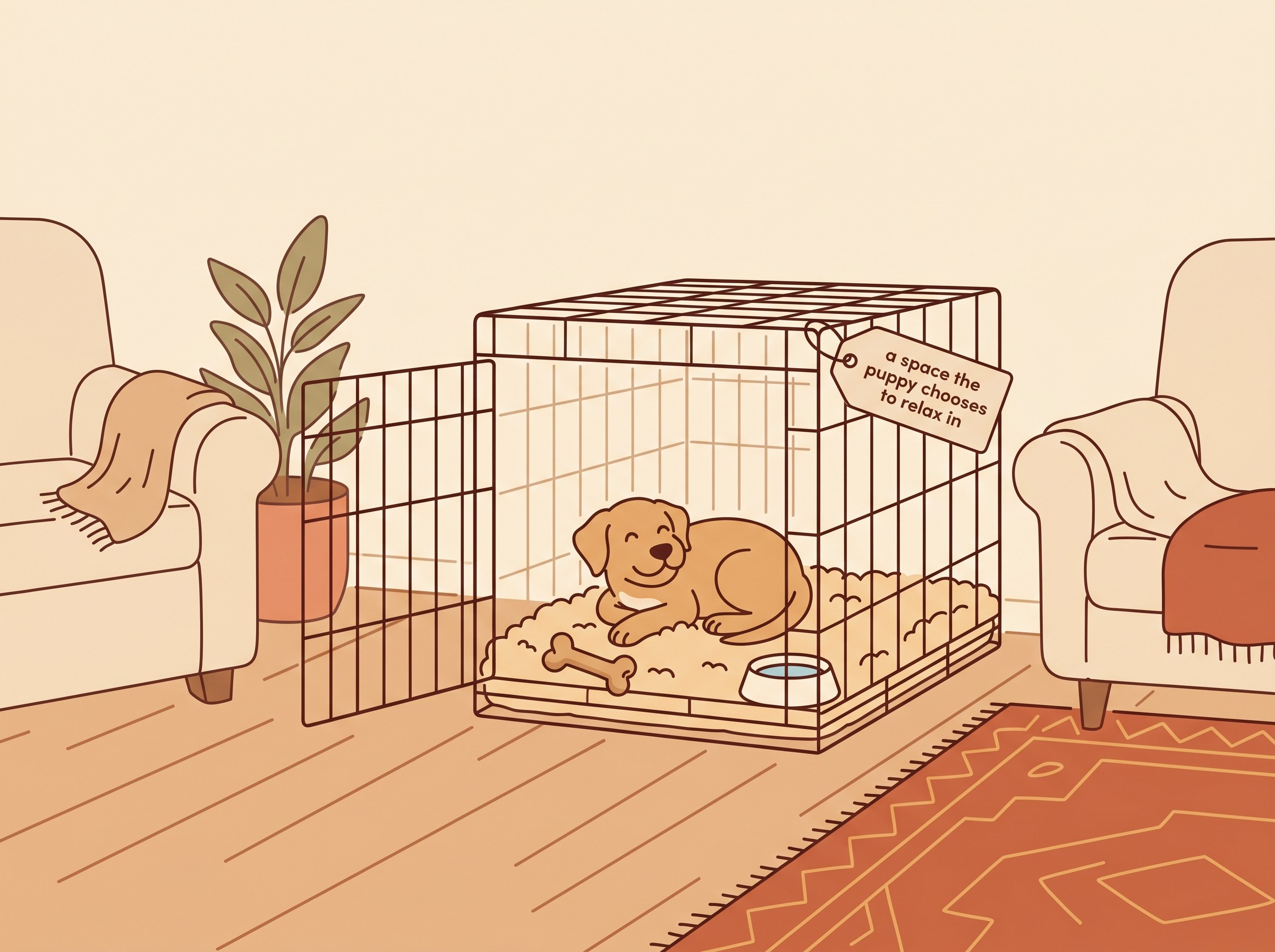
Beyond sleep and the settling space, the everyday work is small. Teach your puppy that it does not need to shadow you around the house: let it learn to settle on its own bed or mat while you are in another room, pop behind a baby gate or a closed door for a minute or two while the pup is content, and gradually, over days and weeks, let those ordinary separations stretch a little. Keep them short enough that the pup stays relaxed throughout, because a calm absence builds tolerance and a frightened one erodes it. There is no need for a rigid minute-by-minute schedule, and the lay advice that circulates online, "leave for ten seconds, then twenty, then forty", is mostly uncited and over-precise. The principle is what matters: short, calm, successful, gradually longer, and never let the pup tip over into distress.
Where good owners go wrong
Prevention is undermined less by neglect than by a handful of well-meaning mistakes, so they are worth naming.
The first is the most insidious: constant, unbroken contact. A puppy that is never, ever apart from a person has had no opportunity to learn the skill, and is set up to struggle the first time circumstances force a separation. The fix is not to be cold or withholding, it is simply to make sure ordinary, calm time apart is part of the puppy's normal week from the beginning.
The second concerns how you handle departures and homecomings, and here the popular advice and the actual evidence part ways, so let me be careful. You will have heard the rule that you must never make a fuss when you leave or arrive, that any affection around comings and goings "rewards the anxiety". It is not that simple, and the truth is more reassuring. A small pilot study of ten dogs found that petting a dog for one minute before a brief separation left it calmer, and showing a trend towards a lower heart rate, compared with no petting at all (Mariti et al., 2018). And a study of newly adopted adult dogs found no difference in whether separation problems developed between owners who used high-arousal, excitable greetings and departures and those who kept them low-key (Teixeira & Hall, 2021). You cannot, in any case, "reinforce" an emotion like fear with comfort the way you reinforce a trained behaviour, so do not feel you must ignore your puppy as you leave or coldly blank it when you walk back in. That advice is widely taught but weakly supported, and it risks making you behave in a way that feels unkind for no real benefit.
So what does matter? Two things. Keep the pup under threshold, calm rather than wound up, around your departures, and do not let your return become a big, emotionally charged event that the dog has to get frantic to earn. The Generation Pup data did flag that fussing over the dog on its return at six months, specifically as a reaction to unwanted behaviour, was associated with more separation-related behaviour (Dale et al., 2024), but that is about the tangled, high-arousal reunion that feeds off and amplifies the dog's own excitement, not about whether you say a warm hello. Greet your puppy kindly and calmly, then carry on with your day. The aim is to make absences and returns unremarkable, not to perform indifference.
The third trap is reaching for punishment when something goes wrong, a chewed shoe or a puddle by the door while you were out. This is both ineffective and actively counterproductive. Generation Pup found that puppies whose owners used aversive, punitive techniques in response to unwanted behaviour, including telling-off and time-outs, were considerably more likely to develop separation-related behaviour (Dale et al., 2024). That study could not show that any one training style was protective, and it fairly cautioned that some of its associations may be confounded, owners of an already-struggling pup may simply do more of everything. But the direction of harm from aversive handling is consistent with the wider evidence: reward-based training is the veterinary standard precisely because there is no evidence aversive methods are more effective, and they carry real costs to welfare and to your relationship with the dog (AVSAB, 2021). Punishing a puppy for what it did while distressed and alone only teaches it that your return, and being alone, are things to fear. We do not re-argue the whole case here; our guide on how pets actually learn lays out the reward-versus-punishment evidence in full.
How alone-time fits the bigger picture
Building alone-time tolerance is one strand of raising a confident dog, and it is worth seeing how it connects to the rest, because the strands reinforce each other.
The early weeks are also the prime socialisation window. The first three months of life are the most important period for socialisation, when a puppy's sociability outweighs its fear and it is primed to accept new experiences, and incomplete or poor socialisation in this window raises the risk of later fear, avoidance and aggression (AVSAB, 2008). A puppy that is broadly confident, that finds the world predictable and safe rather than threatening, has a far easier time being comfortable alone, because being alone is just one more thing it can take in its stride. The full detail of the socialisation window, and the genuine balancing act between socialising a young puppy and protecting it from disease before its vaccinations are complete, belongs to our dedicated article on the puppy and kitten socialisation window, so do read that alongside this one.
It is also worth a brief word on where a puppy comes from, because it is sometimes raised as a factor. A veterinary review has discussed early weaning, separation from the mother and littermates too soon, and the puppy's source as candidate contributors to separation anxiety later in life, while being clear that these early-life factors are understudied and the data are thin (Meneses et al., 2021). So I will put it no more strongly than this: choosing a well-run breeder or a reputable rescue, and not taking a puppy away from its litter too early, is sensible and may help, but it is not a guarantee in either direction and it is not something to agonise over after the fact.
Finally, it helps to know that "separation-related problems" are not one single condition. They are an umbrella covering several different emotional states, panic at being left, frustration, fear of true isolation, and so on (de Assis et al., 2020), which is exactly why prevention aims at building real comfort with being alone rather than just suppressing one outward sign. If you want to understand those subtypes, our article on separation anxiety, isolation distress or boredom untangles them.
Catching the pup who is struggling, and the dog who never learned
Prevention also means catching trouble early, while it is still small and very treatable. Watch for the puppy who cannot settle at all when separated even by a baby gate, who follows you so closely it cannot be left in another room for a moment, who vocalises, paces, salivates, toilets or becomes destructive specifically when alone, or who works itself into a state at the very signs you are about to leave. A single off day means little. A consistent, building pattern means it is time to get ahead of it rather than hope it passes. The first move, as with any change in behaviour, is to rule out a medical cause, because pain and illness can masquerade as or worsen anxiety; our piece on whether it is behaviour or medical covers that, and our behaviour check tool can help you work out whether what you are seeing warrants a vet visit. If a puppy is genuinely struggling despite good groundwork, that is not a failure on your part, it is a sign to involve your vet or a qualified clinical behaviourist early, while the problem is young.
Two groups deserve special mention because they so often missed the early window entirely. The first is the pandemic puppy, raised during lockdown in a house that was never empty. The risk here is real and documented: in a UK cohort of pandemic-acquired dogs assessed at twenty-one months, around 31% were showing separation-related behaviours, more than half had experienced an increase in time left alone since they were acquired, and the great majority of owners had at some point used aversive training methods (Brand et al., 2024). The second is the rescue dog with an unknown history, who may simply never have learned that being alone is safe. For both, the framing is the same: this dog may never have been taught alone-time, so you are not preventing a problem so much as building the skill from scratch, often in an adult who already has fixed worries. That is a treatment job, not a prevention one, and it is done with the same kindness but more structure.
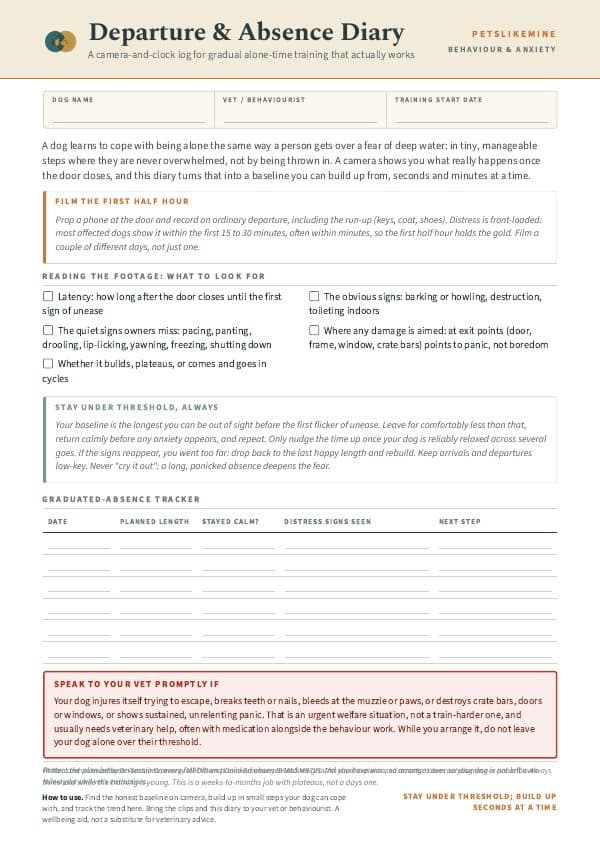
This is the point where prevention hands over to treatment. If a separation problem has already formed, in a puppy, a pandemic dog or a rescue, the structured, evidence-aligned approach to gradually rebuilding tolerance lives in our article on the departure plan, and the absence diary printable will help you film, measure and track real progress rather than guessing. For the under-socialised or rescue dog who finds the whole world, not just being alone, frightening, start with helping a fearful pet.
References
- Harvey ND, Christley RM, Giragosian K, Mead R, Murray JK, Samet L, Upjohn MM, Casey RA. Impact of changes in time left alone on separation-related behaviour in UK pet dogs. Animals, 2022; 12(4): 482.
- Dale FC, Burn CC, Murray J, Casey R. Canine separation-related behaviour at six months of age: dog, owner and early-life risk factors identified using the 'Generation Pup' longitudinal study. Animal Welfare, 2024; 33: e60.
- Mariti C, Carlone B, Protti M, Diverio S, Gazzano A. Effects of petting before a brief separation from the owner on dog behavior and physiology: a pilot study. Journal of Veterinary Behavior, 2018; 27: 41-46.
- Teixeira AR, Hall NJ. Effect of greeting and departure interactions on the development of increased separation-related behaviors in newly adopted adult dogs. Journal of Veterinary Behavior, 2021; 41: 22-32.
- American Veterinary Society of Animal Behavior. AVSAB Position Statement on Humane Dog Training. AVSAB, 2021.
- American Veterinary Society of Animal Behavior. AVSAB Position Statement on Puppy Socialization. AVSAB, 2008.
- Meneses T, Robinson J, Rose J, Vernick J, Overall KL. Review of epidemiological, pathological, genetic, and epigenetic factors that may contribute to the development of separation anxiety in dogs. Journal of the American Veterinary Medical Association, 2021; 259(10): 1118-1129.
- de Assis LS, Matos R, Pike TW, Burman OHP, Mills DS. Developing diagnostic frameworks in veterinary behavioral medicine: disambiguating separation related problems in dogs. Frontiers in Veterinary Science, 2020; 6: 499.
- Brand CL, O'Neill DG, Belshaw Z, Dale FC, Merritt BL, Clover KN, Tay MXM, Pegram CL, Packer RMA. Impacts of puppy early life experiences, puppy-purchasing practices, and owner characteristics on owner-reported problem behaviours in a UK pandemic puppies cohort at 21 months of age. Animals, 2024; 14(2): 336.
Free downloads
Companion worksheets to put what you've read into practice. Free PDFs, print at home.
Keep track of how your pet is doing
The owners who cope best are the ones who notice changes early. A simple health log shows you what is working, and what is not, before the next vet visit.
Start tracking, freeYou're not doing this alone
Compare treatment journeys and talk to owners managing behaviour & anxiety. Free to join.
Join PetsLikeMine