

When housemates fall out: dog-to-dog aggression in the home
Alastair Greenway
BVM&S MRCVS
Two dogs who live under the same roof and have started to fight is one of the quietly devastating behaviour problems we see. It is frightening in the moment, the wounds can be serious, and it carries a particular kind of grief, because these are not strangers meeting on a walk. They are your dogs, your family, hurting each other in the one place that was supposed to be safe for both. Owners often arrive at this point exhausted and ashamed, braced to be told that one dog is simply "the aggressive one" who has to go.
Fighting between household dogs is common, it has identifiable causes, and a great deal of it improves with the right safety-first plan. It is also genuinely serious, so this article stays tight on the housemate problem: why dogs who live together fall out, how to keep everyone safe today, what a real modification plan looks like, and how to think clearly about the harder outcomes if it comes to them. The broader picture of why aggression is communication rather than character belongs to understanding aggression. This is a dog article; the feline version of the same misery, cats who share a home and cannot settle, is its own topic in easing inter-cat tension at home.
Why dogs who live together fight
Housemate aggression is not one thing, and naming the driver is most of the work, because the plan follows from it. When veterinary behaviourists looked closely at pairs of household dogs referred for fighting, a clear picture emerged of what actually sets the fights off.
Competition over resources is the single biggest one. In a large case series of 305 fighting pairs, resource guarding was the most common fight trigger, present in nearly three-quarters of cases (Feltes et al., 2020). The "resource" is often obvious, a chew, the food bowl, a favourite toy, but it is just as often the things owners do not count: a doorway, the sofa, a narrow bit of hallway, and very commonly you, the owner, and your attention. A smaller earlier series found the recurring flashpoints were owner attention, food, excitement, and found items, in roughly that spirit (Wrubel et al., 2011). If your two dogs are fine until you walk in and sit down, the resource they are contesting is your lap.
Resources aside, the common drivers are fear, social tension between two individuals who are simply a poor fit, and redirected aggression, where a dog wound up by something it cannot reach, a cat through the window, a dog passing the fence, the doorbell, spins round and lands on the nearest target, which is the dog standing next to it (Overall, 2013). Redirected fights are some of the most distressing because they look like betrayal out of nowhere, when in fact they are a predictable overflow of arousal with no time to think.
Two changes in a household's life raise the risk more than almost anything else, and both are worth knowing. One is a new dog. In the referral data, the instigator was usually the younger of the pair and very often the newer arrival, the dog brought in to join an existing one (Wrubel et al., 2011), and aggressors were typically acquired after the dog they targeted (Feltes et al., 2020). A new dog introduction that went wrong, or was rushed, sits behind a lot of household conflict. The other is a change in one dog's body. Social relationships between dogs are not fixed, and they shift when an individual changes, classically when one dog ages, becomes unwell, or begins to hurt.
That last point is the one I never let owners skip, because pain belongs near the top of this list, not as a footnote. A dog in pain is a dog that is defensive of itself, slower, grumpier and quicker to escalate, and a hidden source of pain is one of the commonest and most missed drivers of canine aggression generally (Camps et al., 2019; Mills et al., 2020). When a previously settled pair suddenly starts fighting, or an older dog who used to tolerate the younger one stops tolerating anything, a veterinary check for pain and illness is not optional, it is the first move. We walk through exactly what that rules out in is it behaviour or is it medical, and the behaviour check tool will help you judge how urgently to act on a sudden change.
Safety first, training second
Nothing in a modification plan matters until the dogs are safe and the fighting has stopped happening, because every fight a pair rehearses makes the next one more likely and harder to undo. Management is not giving up on training. It is the foundation that makes training possible, and for some households it is most of the answer.
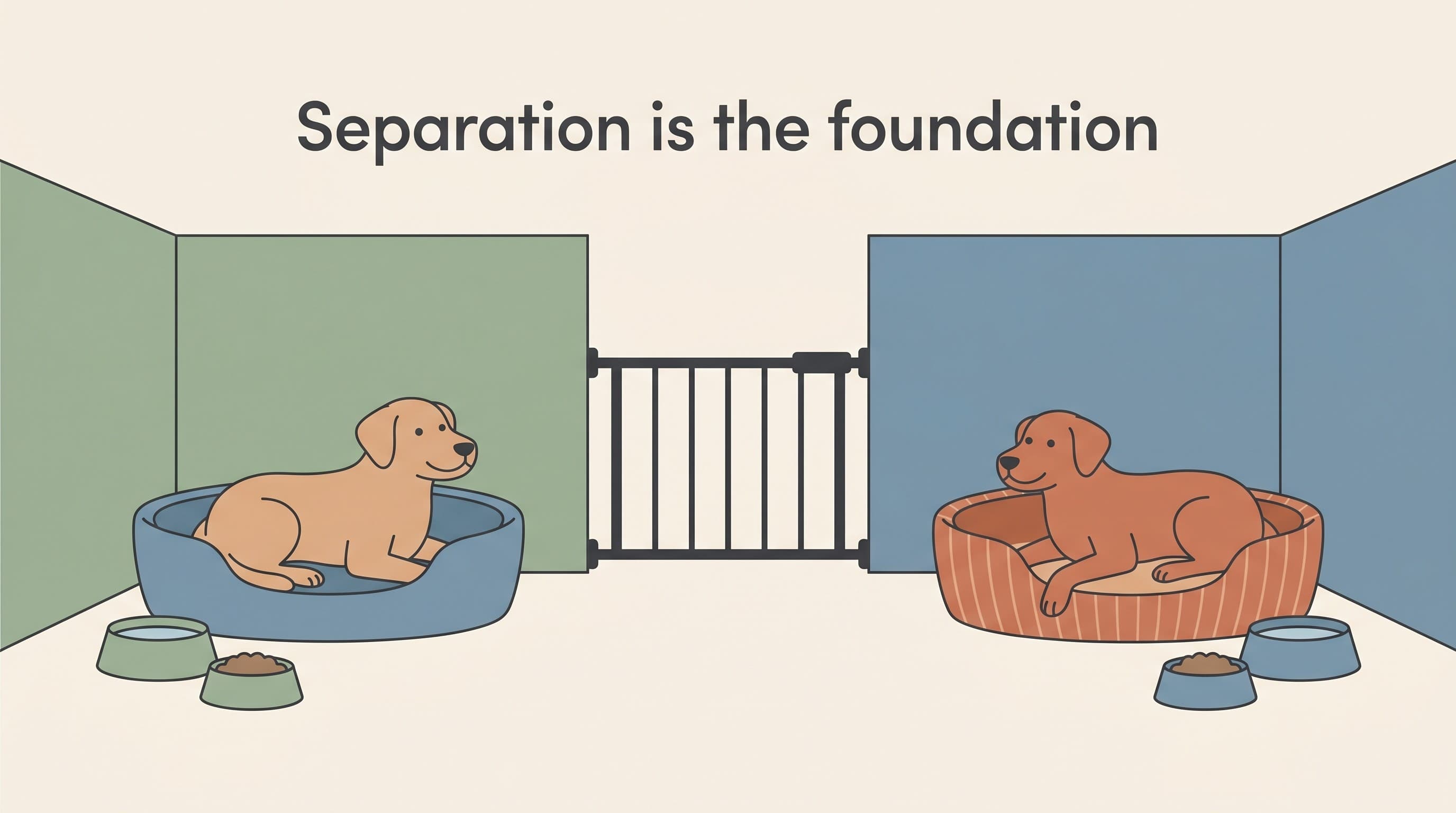
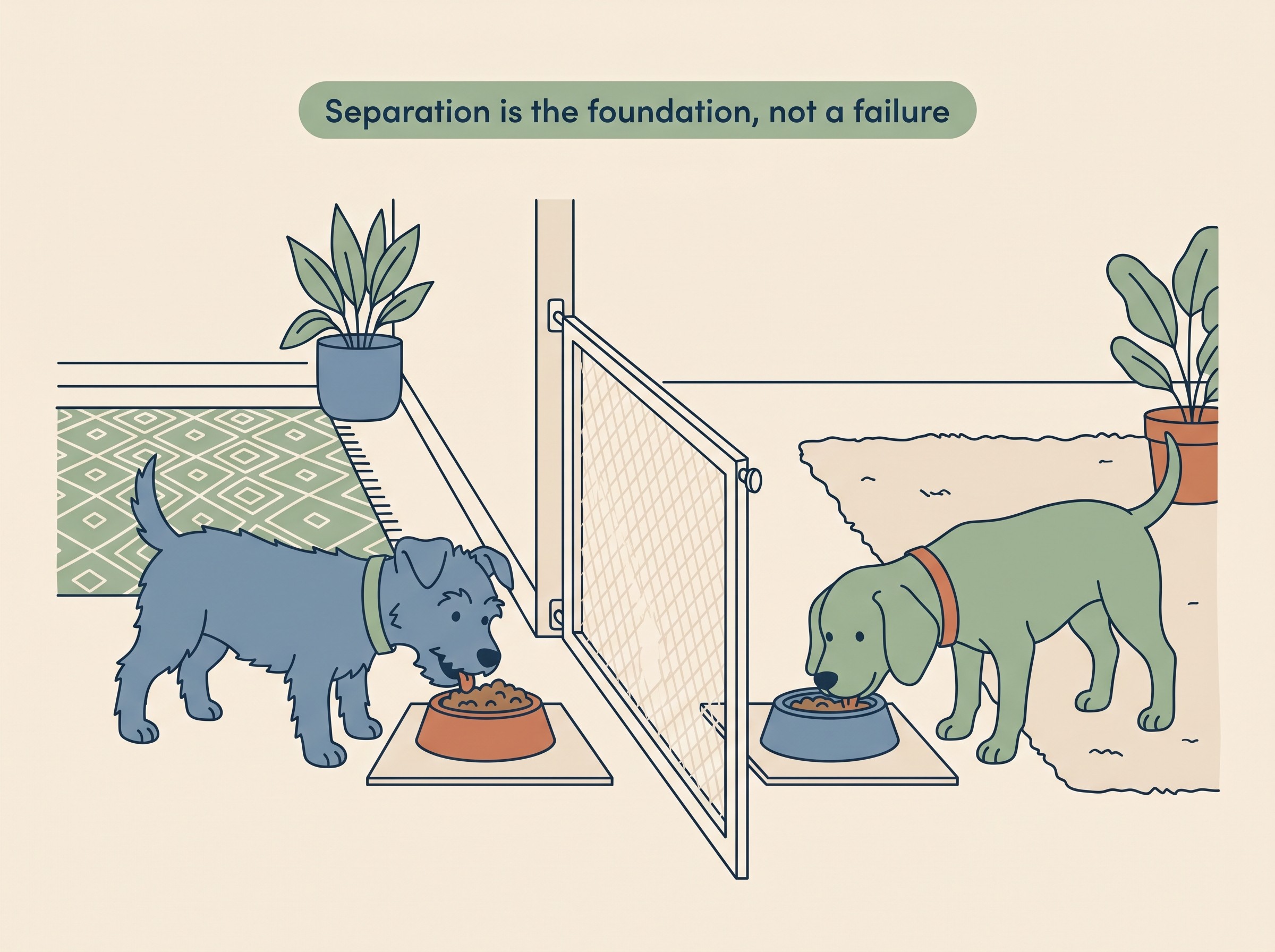
The principle is separation and prevention, not supervision and hope. In practice that means the two dogs are physically apart whenever you cannot actively manage them, using baby gates, a crate the dog already likes, or simply different rooms, and they are never left loose together unattended while things are raw. The flashpoints get engineered out of the day: feed them separately, every single time, in different rooms or behind a barrier; hand out chews and high-value items only when they are apart and pick up the leftovers before they are reunited; manage doorways and narrow spaces so there is no jostling at a pinch point; and be deliberate about how your own attention is shared, since that is so often the contested prize. The fine detail of safely managing things two dogs fight over belongs to our guide on resource guarding, which is worth reading alongside this one, because guarding is the engine under most of these fights.
Then there is the moment everyone dreads and most people get wrong: what to do when a fight actually breaks out. The single most important rule is never put your hands or your face between two fighting dogs. A dog in full arousal cannot tell your hand from the other dog and will redirect onto you in an instant, and a redirected bite to an owner is one of the most common ways people are seriously injured in these incidents (Overall, 2013). Reach for distraction and barriers instead: a sudden loud noise, a blanket thrown over both dogs to break the visual lock, a chair, a board or a bin lid pushed between them, or water if it is to hand. Where two people are present and the dogs cannot be startled apart, the safest physical method is to take a back leg each, high up near the hips, and walk the dogs backwards and away from one another without ever reaching for collars or heads. After any fight that broke skin, even a small puncture, the bitten dog needs a vet, because dog-bite wounds are deeper and more contaminated than they look. Keep the dogs fully separated afterwards while everyone calms down, and never punish either dog for fighting, which only adds fear to an already overloaded situation and can make the conflict worse.
Read the pattern, then build the plan
Once the household is safe, the work becomes detective work before it becomes training. Map the fights precisely: who starts it, who is on the receiving end, what was happening in the ten seconds before, where in the house, and what resource or trigger was in play. A simple written log of every incident, even a notes app, turns a frightening blur into a pattern you can plan around, and it is the most useful single thing you can hand a behaviourist. Watch the early, quiet signals too, the stiffening, the hard stare, the freeze, the lip-lift, because housemate fights almost never come from nowhere; they come from tension that has been building in signals owners learn to spot in reading your pet's body language.
The modification plan itself rests on the same humane principles as the rest of behaviour work, and it is built, not improvised. Broadly it has three strands. Management keeps the dogs under threshold so fights stop being rehearsed. Counter-conditioning gradually changes how each dog feels about the other's presence and about the contested triggers, so that the other dog near the food, or near you, comes to predict good things rather than loss, always worked where both dogs stay relaxed. And structure around resources reduces the things worth fighting over: in the referral studies, giving clear, calm, predictable access to resources, alongside professional guidance and, where needed, medication, produced real improvement, with owners reporting around a 69 percent overall reduction in fighting after treatment (Wrubel et al., 2011). The underlying technique, thresholds and gradients and how to build the ladder without tipping into flooding, is taught in full in desensitisation and counter-conditioning, and the reason this reward-based approach beats any "show them who is boss" instinct is laid out in how animals learn. Confrontational, dominance-based handling does not fix dog-dog conflict; it provokes aggression and worsens fear, which is exactly the wrong fuel to add (Herron et al., 2009; AVSAB, 2021).
Let me be straight about what to expect, because false hope helps no one. A great deal of household conflict becomes safely manageable, but "managed" often means a structured home with sensible separation built in for life, rather than two dogs who lounge together unsupervised as if nothing ever happened, and the realistic timeline is months, not days.
Real help, medication, and the hardest outcomes
This is not a do-it-yourself problem once dogs are drawing blood, and trying to muddle through alone tends to cost the dogs dearly. Housemate aggression that has caused injury, that is escalating, or that you cannot read warrants a proper assessment by your vet and, very often, referral to a qualified clinical behaviourist who can diagnose the driver and build the plan. Anti-anxiety medication, prescribed by your vet and working alongside the behaviour plan rather than instead of it, is frequently part of effective treatment for these cases, because a brain stuck in high arousal cannot learn (Wrubel et al., 2011); it is a vet decision, never something to source or dose yourself. How to find genuinely qualified help, and how to tell a real behaviourist from someone selling guarantees and dominance, is set out in finding real behaviour help.
It would be wrong to pretend every pairing can be saved, and certain features genuinely worsen the outlook: pairs of the same sex, a history of bites that broke the skin, and aggression that fires the instant the dogs see each other are all associated with a poorer prognosis (Feltes et al., 2020). When fights are severe, the warnings have gone, or the dogs cannot safely share a home despite a committed, well-run plan, then rehoming one dog into a household where it can be a beloved only dog is not a failure. It is sometimes the kindest, safest outcome for both animals, and choosing it after real effort is responsibility, not surrender. In the rarest cases, where a dog poses a danger that cannot be managed anywhere, there are harder conversations still, and those should always happen with your vet and behaviourist, gently and without shame. For the acute incidents and the wider household safety plan, including when a situation has tipped into an emergency, lean on behaviour emergencies and safety.
If you are living with this right now, do three things today, in order: book the veterinary check so pain and illness are ruled out, separate the dogs so the next fight cannot happen, and start writing down exactly what triggers each incident. That trio buys safety and buys time, and it is the ground every successful plan is built on.
References
- Feltes ESM, Stull JW, Herron ME, Haug LI. Characteristics of intrahousehold interdog aggression and dog and pair factors associated with a poor outcome. Journal of the American Veterinary Medical Association, 2020; 256(3): 349-361.
- Wrubel KM, Moon-Fanelli AA, Maranda LS, Dodman NH. Interdog household aggression: 38 cases (2006-2007). Journal of the American Veterinary Medical Association, 2011; 238(6): 731-740.
- Overall KL. Manual of Clinical Behavioral Medicine for Dogs and Cats. Elsevier Mosby, St Louis, 2013.
- Camps T, Amat M, Manteca X. A Review of Medical Conditions and Behavioral Problems in Dogs and Cats. Animals, 2019; 9(12): 1133.
- Mills DS, Demontigny-Bedard I, Gruen M, et al. Pain and Problem Behavior in Cats and Dogs. Animals, 2020; 10(2): 318.
- Herron ME, Shofer FS, Reisner IR. Survey of the use and outcome of confrontational and non-confrontational training methods in client-owned dogs showing undesired behaviors. Applied Animal Behaviour Science, 2009; 117(1-2): 47-54.
- American Veterinary Society of Animal Behavior (AVSAB). Position Statement on Humane Dog Training. AVSAB, 2021.
Keep track of how your pet is doing
The owners who cope best are the ones who notice changes early. A simple health log shows you what is working, and what is not, before the next vet visit.
Start tracking, freeYou're not doing this alone
Compare treatment journeys and talk to owners managing behaviour & anxiety. Free to join.
Join PetsLikeMine