

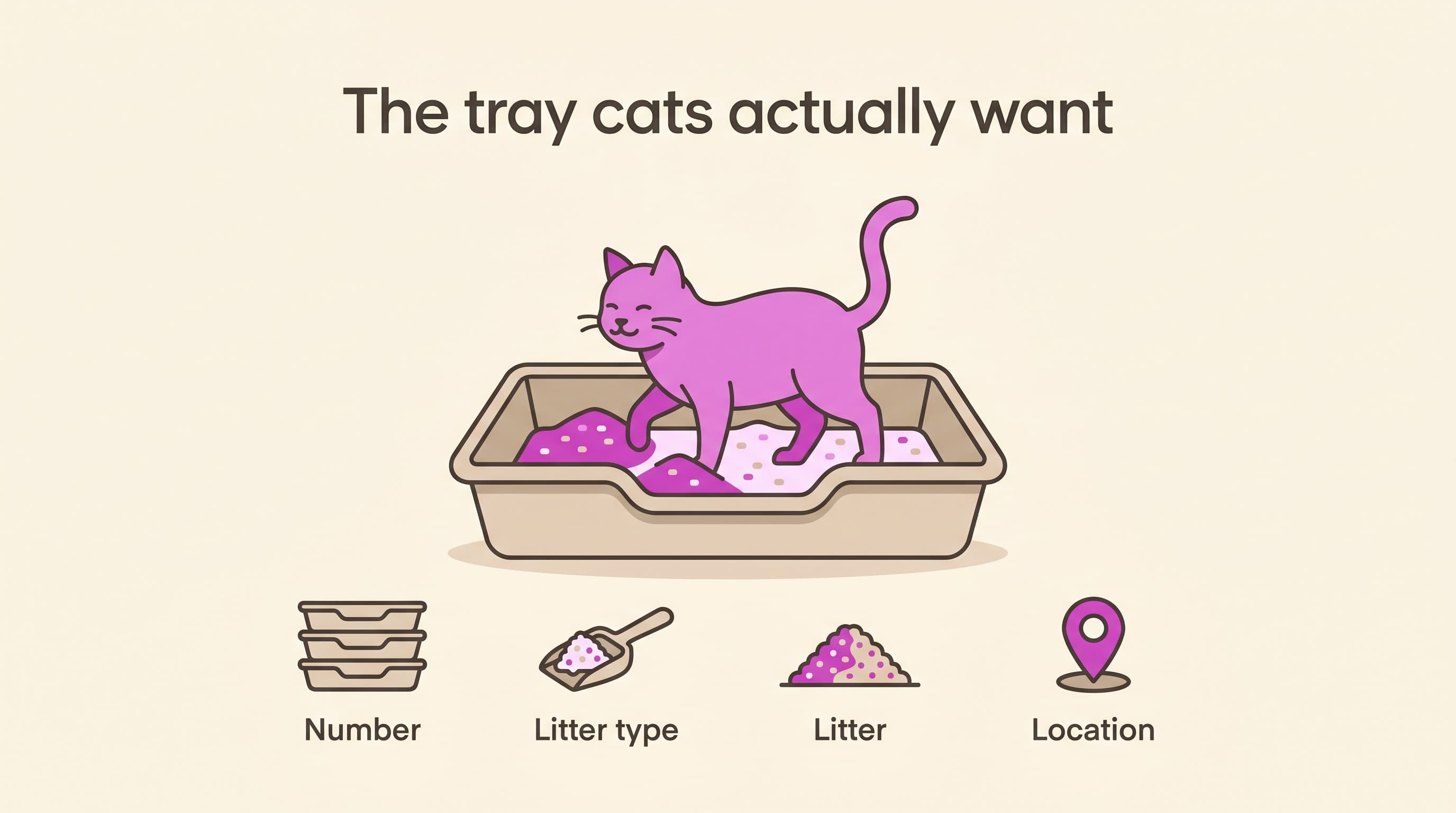
The litter-tray audit: number, type, litter and location cats actually want
Alastair Greenway
BVM&S MRCVS
Before we touch a single litter tray, one thing has to come first, because getting it wrong is the most common mistake owners make: rule out illness. A cat that suddenly stops using its tray is very often telling you it is unwell, not being difficult, and a male cat straining, crying, or producing little or no urine is a genuine emergency that needs a vet the same day. Our guide on ruling out the medical causes first covers all of that, and our behaviour check will help you decide whether you are looking at a medical problem or a husbandry one. This article picks up where that leaves off. Once your vet is happy nothing medical is driving it, the litter tray itself becomes the single highest-yield thing you can change, and it is worth doing properly.
The stakes here are higher than most people realise. House soiling is the most frequent behavioural reason cats are given up to shelters. In a landmark study across twelve American shelters, around twenty-eight per cent of relinquished cats were given up for a behavioural reason, and of those cats house soiling was the single commonest one, named in over forty per cent of cases, well ahead of conflict with other pets or aggression (Salman et al., 2000). A great many of those cats could have stayed in their homes. The reassuring flip side is that the fix is usually practical and within your control. So let us go through it one change at a time, and I will be straight throughout about which "rules" are genuinely proven and which are sensible best practice that everyone repeats as if it were law.
How many trays, and the mistake almost everyone makes
The familiar advice is "one tray per cat, plus one spare." For a single-cat home that means two trays, and for a multi-cat home at least one more tray than you have cats, ideally placed so each cat or social group has its own (AAFP/ISFM, 2014). It is good advice and worth following. But the guideline that gives us this rule says in the same breath that having more trays than cats is "not an absolute requirement" for cats that genuinely get on and are happy to share, so treat "n plus one" as rational best practice rather than a tested law (AAFP/ISFM, 2014). No controlled trial has proven the exact number. The principle behind it is sound, though: a cat should never have to queue, share, or pass another cat it dislikes to reach a tray.
Now for the part that catches almost everyone out, and it matters more than the raw number: do not line all your trays up side by side. Cats perceive trays placed right next to each other as one big toilet, so three in a row gives you no real extra choice and no escape from a housemate guarding the spot (AAFP/ISFM, 2014). The guideline even advises that the openings of separate trays should not face each other, but sit at right angles or around a corner, so each reads as its own private place (AAFP/ISFM, 2014). This separation is also your first defence against silent competition in a multi-cat home, where one cat blocks another's access without any obvious fighting, and our guide on easing tension between cats that do not get along covers that social side in full. The rule of thumb is simple: spread the trays around the house, on different floors and in different rooms, rather than clustering them in one convenient corner.
Bigger is better, and your trays are almost certainly too small
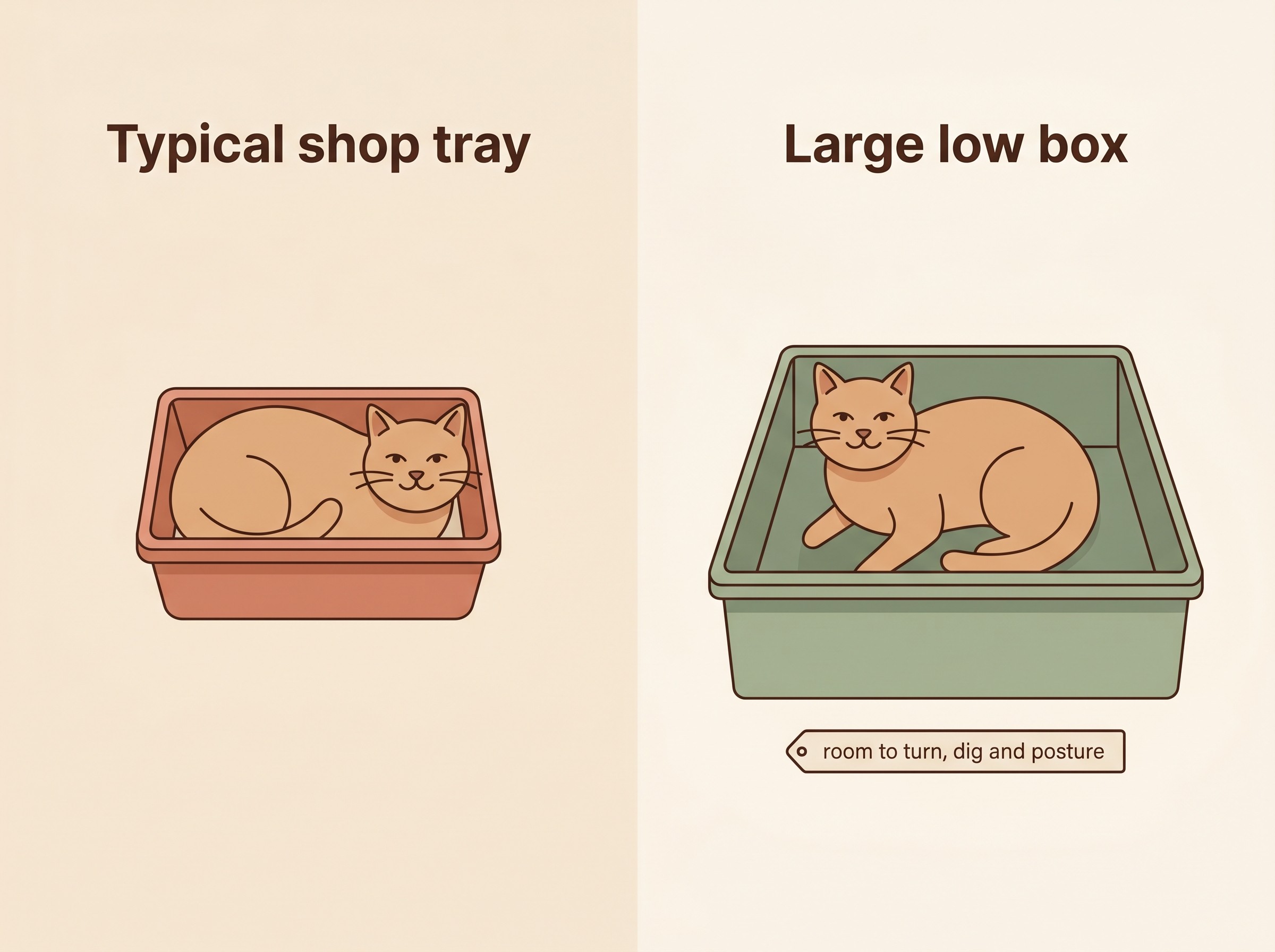
If you change only one thing after reading this, make it the size. This is one of the genuinely well-evidenced points, not consensus dressed up as fact. In a study of seventy-four cats across forty-three households, cats significantly preferred a large box, eighty-six centimetres long, which is bigger than almost anything you can buy off the shelf, over a regular-sized one, and they preferred it for both urinating and defecating (Guy et al., 2014). A more recent study found the same thing, with cats favouring trays of fifty centimetres or more and toileting better, with fewer signs of dissatisfaction, when given the size they preferred (Iwabuchi-Inoue et al., 2025). The practical translation the guidelines use is to aim for a rectangular tray about one and a half times the length of your cat from nose to the base of the tail (AAFP/ISFM, 2014).
Most commercial cat trays fail this test badly, which is why the easy fix here is to stop shopping in the cat aisle. A large, low storage box or under-bed box gives a cat far more room to turn around, dig, and posture properly without hanging its rear over the edge, and it costs very little. If your cat has been catching the side of the tray or going just beside it, an undersized box is one of the first things to suspect.
Covered or open? Most cats genuinely do not mind
Here is a popular rule worth overturning. You will often read that hooded trays are bad and should never be used. The evidence does not support that as a blanket statement. When researchers gave twenty-seven cats a fortnight to choose between a covered and an uncovered tray, both kept clean and well sized, there was no group preference at all: most cats showed no preference either way, and of the handful that did, they split evenly, four favouring covered and four uncovered (Grigg et al., 2013). The guidelines agree the population is "equally divided" on this (AAFP/ISFM, 2014). So a hood is not the villain it is made out to be, and some cats clearly like the privacy.
The real problem with covers is not the cat, it is you. A hood hides the contents, so you scoop less often and let waste build up, and it traps odour inside a small space the cat then has to step into. That is why the guidelines, while accepting cats do not care much, still nudge you towards open trays wherever possible, simply because they make it easier to monitor your cat and to scoop frequently (AAFP/ISFM, 2014). My advice is to offer both and let your cat vote, but if you keep a covered tray, commit to scooping it as faithfully as an open one.
Litter type and depth: fine, soft and unscented, with one caveat
For the substrate, the broad answer is a fine, soft, sand-like, clumping litter, unscented, at a depth of at least three centimetres so the cat can dig and cover (AAFP/ISFM, 2014). Where the evidence is strong, it points the same way: cats tend to prefer fine clumping clay over coarse pellets or silica-gel "crystals," and recent studies have found a clear population preference for unscented clumping clay for both functions (Iwabuchi-Inoue et al., 2025; Cassiday & Cassiday, 2025). The texture under the paw seems to matter to cats, which makes intuitive sense given they evolved to toilet in soft, diggable ground.
Now the caveat, on scent. The "never use scented litter" rule is repeated everywhere, but the actual evidence is more mixed than that certainty suggests. Scented and deodorised products are commonly flagged as a risk for cats going outside the tray, yet a controlled choice test that set scent against substrate found texture and familiarity drove the cats' decisions, with scent making little measurable difference (Cassiday & Cassiday, 2025). The defensible position, and the one I would give you, is this: cats vary, fine unscented clumping suits most of them, and for a cat that is already soiling you remove the variable by going unscented while you sort the problem out. Do not let anyone tell you it is a proven law, because it is not, but it is a sensible default. A couple of practical don'ts are firmer: skip plastic tray liners, slotted grills, and deodorising powders, all of which the guidelines advise against because cats often dislike the feel or the smell (AAFP/ISFM, 2014).
Cleaning is probably the biggest lever of all
If size is the most under-rated bit of kit, cleanliness is the most under-rated habit, and it may be the single most powerful variable of the lot. Scoop solids and clumps out at least once a day, every day, and wash the whole tray out every one to four weeks, using hot water and a mild, unscented soap rather than strong or ammonia-based chemicals, which can put a cat off (AAFP/ISFM, 2014). It is worth noticing that daily scooping was the background condition in the studies above: the cats that happily accepted either a covered or an open tray were given clean trays scooped every day (Grigg et al., 2013). A fastidious cat that has started avoiding its tray is very often simply telling you the tray is dirtier than it will tolerate, and some "behavioural" soiling cases ease on cleaning frequency alone.
The instinct to mask smells with strongly scented cleaners or air fresheners tends to backfire, because a cat's sense of smell is far more sensitive than yours and matters enormously to how it reads a space, which is exactly why the feline environmental guidelines make respecting that sense one of their core principles (Ellis et al., 2013). What reads as "fresh" to you can read as "tainted" to the cat, so plain, thorough, frequent cleaning beats heavy fragrance every time.
Where the tray goes, and the cat that cannot get to it
Location is the last big lever, and it is mostly common sense seen from a cat's point of view. The feline environmental guidelines build everything around giving a cat a safe place and keeping its key resources separated, the toilet included (Ellis et al., 2013). Applied to a litter tray, that means somewhere quiet, accessible and safe, where your cat can see what is coming and has a clear escape route rather than being cornered, and well away from anything that bangs or whirs, the washing machine, the boiler, the cat flap a neighbour's cat uses. A cat ambushed mid-wee, or startled by a spin cycle, learns quickly to toilet somewhere it feels safer, and that somewhere is often your carpet. In a multi-cat home, the same logic means siting trays so one cat can never trap another in a dead end, which links back to the resource mapping in our guide on inter-cat conflict.
You will also be told never to put the tray next to the food and water bowls, and here the guidance is firm: toileting areas should always be located away from food and water dishes (Ellis et al., 2013; AAFP/ISFM, 2014). Cats naturally keep their eating and toileting areas apart, so keeping a little distance between the dinner spot and the loo costs you nothing and respects how cats are wired.
One group needs special thought here: older and arthritic cats. Degenerative joint disease is extremely common in mature cats and badly under-recognised, and a stiff, sore cat may simply be unable to climb into a high-sided tray, or to crouch and posture without pain, so waste ends up over the edge or off-target. For these cats the guidelines specifically advise a tray with a very shallow, low cut-down opening, so getting in does not hurt (AAFP/ISFM, 2014). A larger footprint, softer fine litter, and a tray on every floor so there is never a staircase between your cat and the toilet all help too. The arthritis angle dovetails with the medical rule-out, so if you suspect pain is part of the picture, our medical causes guide covers it alongside your vet's assessment.
Let the cat be the judge: the litter cafeteria
So what does the winning default look like? Pull it all together and you get this: a large, open, scrupulously clean tray, filled three centimetres deep with fine unscented clumping litter, in a quiet safe spot away from food and noise, with one more tray than you have cats, spread around the house. That setup suits most cats most of the time, and for many soiling cases simply moving to it fixes the problem.
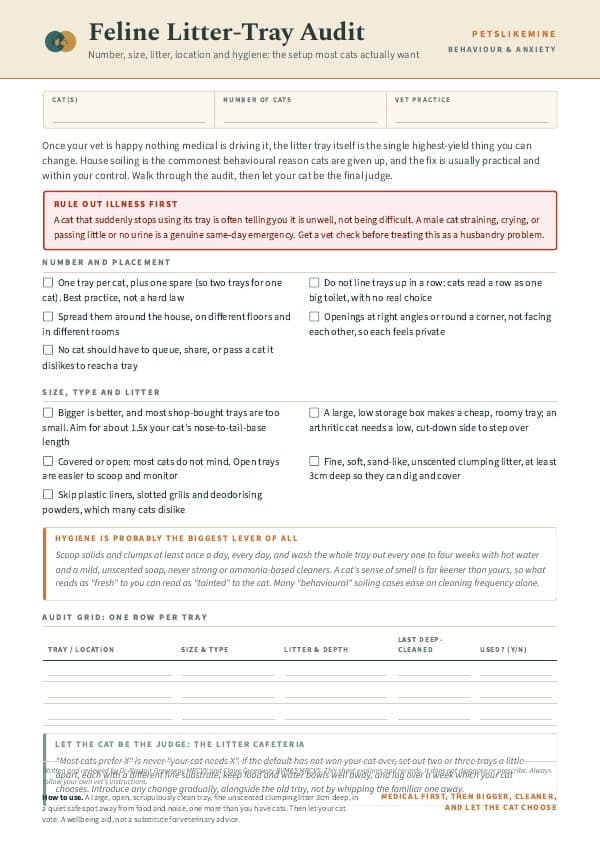
But "most cats" is not "your cat," and one thread runs through all the research worth keeping in view: the studies are small, single-test designs, and a population preference always hides real individual variation (Grigg et al., 2013; Cassiday & Cassiday, 2025). The defensible claim is always "most cats prefer X," never "cats need X." So when a particular cat is already soiling and the default has not won it over, stop guessing and run a litter cafeteria. Set out two or three trays a little apart, each with a different fine substrate, and simply log which your cat actually chooses to use over a week or so. The cat's own behaviour, where it genuinely decides to go, is a better guide than any rule in this article, mine included. Our printable litter-tray audit walks you through the checklist and gives you somewhere to record the results.
A last word on changing things over, because cats hate sudden change: introduce a new litter or tray gradually rather than whipping the familiar one away. Mix a little of the new litter into the old over a week or two, or far simpler, just run the new tray alongside the existing one and let your cat migrate at its own pace. Forced cold onto an unfamiliar substrate, a fussy cat may simply refuse and go elsewhere, which is the very thing you are trying to stop. Make the change feel like an option rather than an ambush, give the cafeteria a week to tell you what your cat wants, and you will usually have your answer written, plainly, in the tray it chooses.
References
- Salman MD, Hutchison J, Ruch-Gallie R, et al. Behavioral reasons for relinquishment of dogs and cats to 12 shelters. Journal of Applied Animal Welfare Science, 2000; 3(2): 93-106.
- Carney HC, Sadek TP, Curtis TM, et al. AAFP and ISFM Guidelines for Diagnosing and Solving House-Soiling Behavior in Cats. Journal of Feline Medicine and Surgery, 2014; 16(7): 579-598.
- Guy NC, Hopson M, Vanderstichel R. Litterbox size preference in domestic cats (Felis catus). Journal of Veterinary Behavior, 2014; 9(2): 78-82.
- Iwabuchi-Inoue Y, Hattori Y, Kikusui T. Litter box size and litter type preference and their associated behavioral changes in cats. Journal of Veterinary Medical Science, 2025; 87(6): 614-620.
- Grigg EK, Pick L, Nibblett B. Litter box preference in domestic cats: covered versus uncovered. Journal of Feline Medicine and Surgery, 2013; 15(4): 280-284.
- Cassiday L, Cassiday CJ. Evaluating litter substrate preferences in a population of cats. IAABC Foundation Journal, 2025; Issue 31.
- Ellis SLH, Rodan I, Carney HC, et al. AAFP and ISFM Feline Environmental Needs Guidelines. Journal of Feline Medicine and Surgery, 2013; 15(3): 219-230.
Free downloads
Companion worksheets to put what you've read into practice. Free PDFs, print at home.
Keep track of how your pet is doing
The owners who cope best are the ones who notice changes early. A simple health log shows you what is working, and what is not, before the next vet visit.
Start tracking, freeYou're not doing this alone
Compare treatment journeys and talk to owners managing behaviour & anxiety. Free to join.
Join PetsLikeMine