Pica and wool-sucking: why pets eat what they should not
Alastair Greenway
BVM&S MRCVS
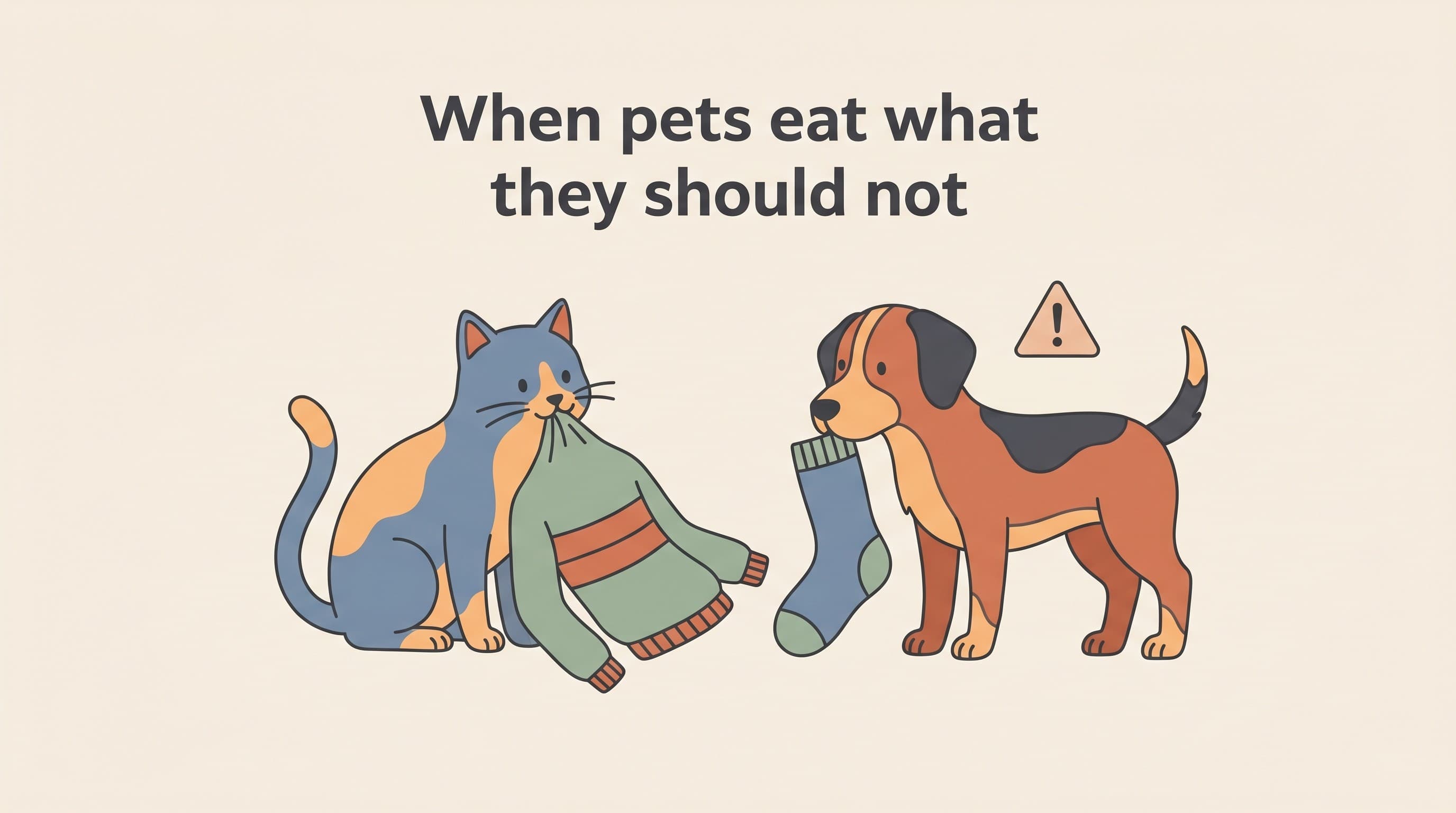
A cat suckles the corner of a jumper. A dog keeps swallowing socks. A kitten gets through a length of wool. These look like quirks or passing phases, and sometimes they nearly are. But pica, the eating of things that are not food, sits in an awkward place. It spans a genuine behavioural problem at one end and a genuine medical danger at the other, and the same cat who seems to have a funny little fixation on fabric can, on the same afternoon, swallow something that needs emergency surgery.
This article takes two things seriously that competitor pages tend to gloss over: the medical side, because pica is far more tangled up with gut disease than the word "habit" suggests, and the danger, because the most useful thing you can take away is how to spot an obstruction before it becomes a crisis. Wool-sucking, the milder cousin where a cat mouths and chews fabric without always swallowing it, belongs in the same conversation, because sucking and ingesting fabric are linked behaviours, not separate ones (Demontigny-Bedard et al., 2016).
Pica and wool-sucking, defined
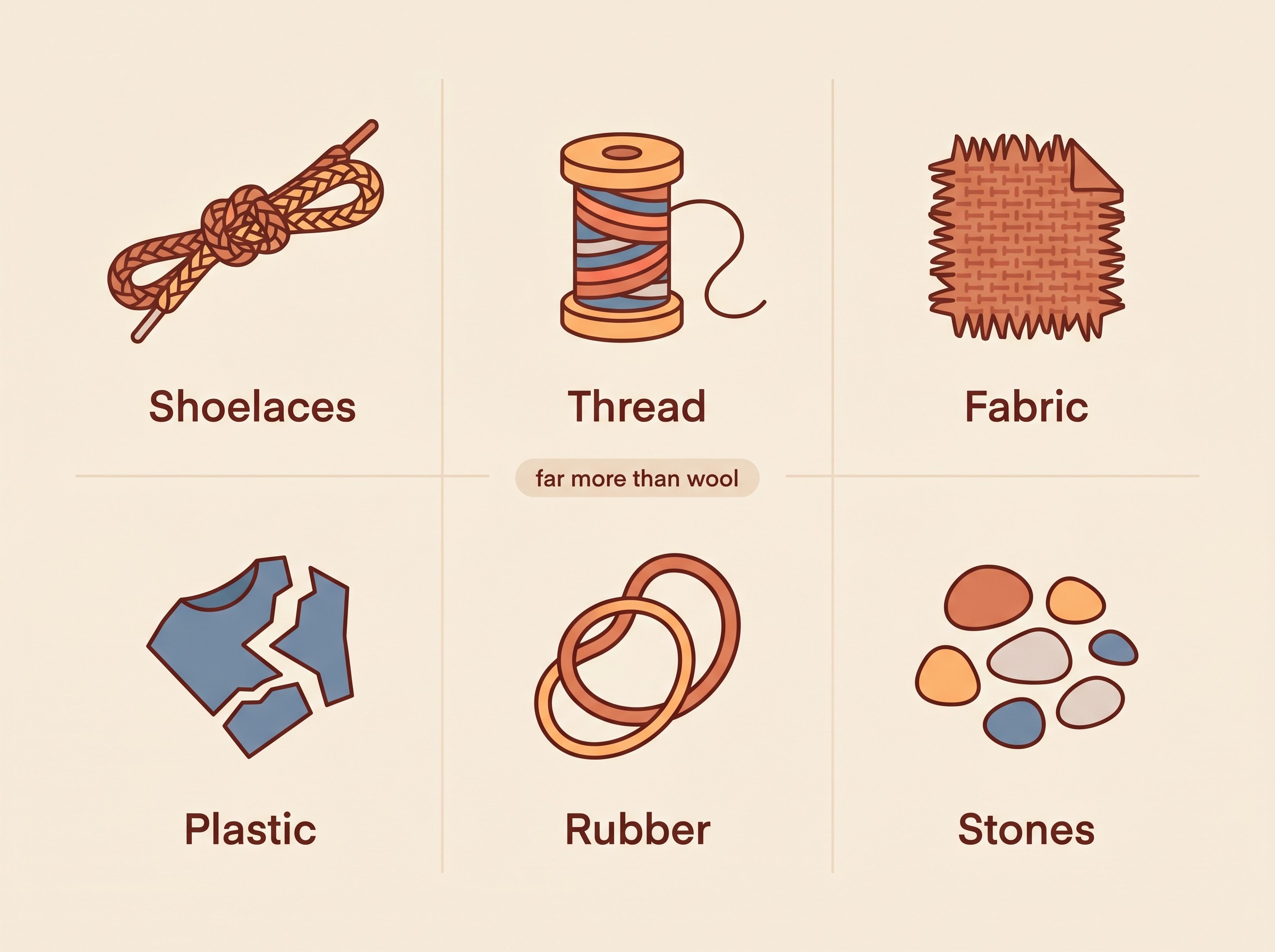
Pica is the persistent eating of non-food material. The classic image is a Siamese chewing wool, but that undersells the modern range. In a case-control study of cats with pica, the behaviour was directed most commonly at shoelaces or threads, then plastic, then fabric, then a long tail of other items including rubber, paper, cardboard and wood (Demontigny-Bedard et al., 2016). Dogs, for their part, swallow socks, underwear, stones, soil, gravel, cloth and a remarkable variety of small household objects. The common thread is not the material but the impulse to ingest things the body cannot use.
Wool-sucking is best understood as one part of this spectrum rather than a tidy separate condition. A cat may begin by suckling, kneading and mouthing a soft fabric, and for some cats it stops there. For others it progresses to tearing off and swallowing pieces. The two are connected: in cats with pica there was a significant association between sucking fabric and ingesting it, and self-sucking was significantly more common in cats with pica than in those without (Demontigny-Bedard et al., 2016). So a sucking habit you might be tempted to find endearing can be the visible edge of a swallowing problem you cannot see.
One line is worth drawing clearly, because owners conflate these things constantly. A dog cropping grass on a walk is not doing pica, and it is not a sign that something is wrong. In a web-based survey of owners of 1,571 plant-eating dogs, only a small minority reported their dog seemed unwell beforehand or vomited afterwards, and the authors found no support for the popular idea that grass-eating signals a deficient diet or a sick stomach (Sueda et al., 2008). The persistent ingestion of fabric, plastic, string, litter, soil or stones is the thing that warrants a vet visit.
Why this is so often medical, not just behavioural
Pica is disproportionately tied to underlying illness, and that should change how you respond to it.
The headline finding comes from a clinical pilot of eight cats with chronic fabric-eating. Every single one had a gastrointestinal abnormality on work-up. Six had eosinophilic infiltrates in the stomach or intestine, four had suspected delayed gastric emptying, seven had mildly raised cholesterol, and there were single cases of suspected reflux and of Giardia (Demontigny-Bedard et al., 2019). Eight is a small number, but a clean run of eight out of eight is hard to dismiss as coincidence. A much larger and more recent study points the same way: among 133 dogs and cats presented for endoscopic removal of a gastric foreign body, around two-thirds had chronic gastrointestinal signs, and of those biopsied, all had histological chronic enteritis and most had chronic gastritis, leading the authors to frame pica as a possible sign of underlying chronic enteropathy (Perez et al., 2025).
Gut disease is not the only medical driver. Pica is a recognised sign of anaemia, and the development of pica is in fact considered fairly specific to iron-deficiency anaemia (Naigamwalla et al., 2012); in indoor cats this often shows as eating litter, and it tends to ease once the anaemia is corrected. That matters because anaemia is common in feline chronic kidney disease, where roughly 30 to 65% of affected cats become anaemic, the proportion rising as the disease advances (IRIS, 2025). This is why a sensible work-up for a pica cat or dog is not just a behavioural questionnaire. It is a proper veterinary assessment, typically including a faecal examination and blood tests for anaemia and for liver, kidney and pancreatic disease, alongside thinking about the gut.
We will not re-run the whole medical rule-out here: our guide to whether a change is behaviour or medical covers the principle that you investigate the body before you blame the mind, and the behaviour check tool will help you triage whether what you are seeing warrants a vet visit. For pica specifically, do not assume it is "just behavioural" until a vet has looked for a medical cause, because the odds that one is lurking are higher than most owners expect.
Breed and upbringing, with the myths removed
There is a real genetic and developmental story here, but it is narrower than the folklore suggests.
Oriental breeds are genuinely over-represented in fabric-eating. A postal survey of 152 cats with pica, most of them Oriental, found 55% were Siamese and 28% Burmese, wool was the commonest material at 93%, and, tellingly, 58% of owners who knew the cat's litter reported a sibling that also ate fabric, which points towards heritability (Bradshaw et al., 1997). A separate case-control study of 204 Siamese and Birman cats found breed-specific risk factors: in Birmans, early weaning and a small litter size raised the risk of wool-sucking; in Siamese, it was the presence of a medical condition; and an abnormally intense appetite ran across all affected cats (Borns-Weil et al., 2015).
Two myths need retiring. The first is that fabric-eating proves a cat was weaned too early or raised in a deprived home. In the larger of the two case-control studies, early weaning raised the risk only in Birmans, and an intense appetite, not a deprived upbringing, was the thread common to affected cats (Borns-Weil et al., 2015). If you adopted a fabric-eater, this is not a verdict on how they were reared. The second myth is that pica is purely an Oriental-breed problem. It is not: in the pilot study of fabric-eating cats, six of the eight were domestic shorthairs or longhairs and only two were purebred (Demontigny-Bedard et al., 2019). Moggies do this too. The fuller picture is a familial signal that loads onto certain breeds, layered on top of medical and emotional drivers that affect any cat or dog.
Stress, boredom and compulsion are real drivers, but part of a bigger picture rather than the whole of it. Pica is one recognised form within the family of repetitive and compulsive behaviours, and our overview of compulsive behaviour in dogs and cats explains when a repetitive habit crosses into a disorder. If feline stress or environmental frustration looks like a driver in your cat, our article on feline stress, FIC and enrichment goes into the environmental side properly.
The real danger: gut obstruction
The most serious risk of pica is not the eating, it is what a swallowed object does once it is inside.
Linear foreign bodies, meaning string, thread, tinsel and strands of fabric, are especially dangerous. Once one end becomes anchored, commonly under a cat's tongue or at the outflow of the stomach, the normal squeezing motion of the bowel keeps trying to push the rest along. The intestine bunches up along the string like fabric gathered on a thread, and the taut string can slowly saw through the wall, leading to perforation, leakage of gut contents into the abdomen and life-threatening peritonitis (ACVS, undated). This is why a piece of string is not trivial for a cat to have swallowed, and why you must never pull on a thread you can see hanging from your cat's mouth or back end. If it is anchored deep inside, pulling can tear the gut, so freeing it is a vet's job, not a kitchen-table one.
The encouraging counterpoint is that this is very treatable when caught early. In a retrospective study of 56 cats operated on for gastrointestinal foreign bodies, every cat survived to discharge, only three needed a section of bowel removed, and there were no cases of the surgical wound breaking down or of septic peritonitis, although surgical-site infection was commoner in the linear group (Gollnick et al., 2023). The grim outcomes come from delay and perforation; the good ones come from acting in time, so the practical skill is recognising the warning signs early. Seek urgent veterinary assessment if you see repeated vomiting, a pet going off their food, lethargy or dullness, signs of abdominal pain, or signs of dehydration (Merck Veterinary Manual, undated; ACVS, undated). Abdominal pain can show as a hunched stance or a "praying" posture, with the chest and front legs down and the back end raised. Any of these in a known fabric-or-string-eater should be treated as a possible obstruction until proven otherwise.
This is the point at which pica stops being a behaviour topic and becomes an emergency one, and our guide to behaviour emergencies and safety covers urgent situations more broadly. If your pet is currently well, the most powerful preventive step is the simplest: remove access to the things they target. Tidy away string, hair ties and sewing thread, store laundry out of reach, and treat your pica-prone pet a little like you would a curious toddler.
What treatment realistically looks like
I want to be straight with you about outcomes, because false promises help nobody. There is no quick fix for established pica, and the evidence for "curing" it is thin. In that pilot study of eight fabric-eating cats, even with tailored medical and behavioural treatment, no cat had complete resolution and only four of the eight achieved a meaningful reduction in how often they ate fabric (Demontigny-Bedard et al., 2019). That is real improvement worth having, but a far cry from a guaranteed cure, so go into this expecting diligent long-term management rather than a single intervention that makes it vanish.
That management rests on three legs. First, treat any medical cause your vet finds, because if there is an underlying gut disease or anaemia, the behaviour may ease as the illness is controlled, though we do not yet know how reliably treating a chronic enteropathy resolves the pica itself (Perez et al., 2025). Second, manage the environment relentlessly: remove access to target items and meet the animal's needs for appropriate activity. Enrichment genuinely belongs in the plan, and our guide to boredom and enrichment for pets lays out how to provide foraging, hunting-style play and mental challenge properly. Third, where there is a genuine compulsive component confirmed by your vet, behavioural medication can help. The drugs used are the same daily anti-anxiety medicines used elsewhere in behavioural medicine, fluoxetine or clomipramine, which act over several weeks alongside management rather than instead of it (Denenberg & Bräm Dubé, 2018). Both are licensed in the UK for behavioural use in dogs, fluoxetine as Reconcile and clomipramine as Clomicalm, but the licence is for separation-related problems, and neither is licensed in cats, so using either drug for pica is off-licence in both species. That is a decision only your vet can make and monitor, never something to source or dose yourself. We keep the dosing and monitoring detail in our article on medication for separation anxiety. Naming the drug is easy; using it well needs your vet.
A thread of uncertainty runs through all of this. We do not know the true prevalence of pica, we cannot always say how much of an individual case is compulsion and how much is gut disease, and we do not yet know whether fixing the gut reliably fixes the behaviour. What we do know is solid enough to act on: look for the medical cause first, take the obstruction risk seriously, manage the environment, and treat the behaviour patiently with professional help. If your cat's "habit" shares the lesson of feline overgrooming, where most apparently behavioural cases prove to have a medical driver, that is no coincidence, and our article on feline overgrooming and psychogenic alopecia is its close cousin. The next move, almost always, is a veterinary check that takes the body seriously before anyone reaches for a behavioural label.
References
- Demontigny-Bedard I, Beauchamp G, Belanger M-C, Frank D. Characterization of pica and chewing behaviors in privately owned cats: a case-control study. Journal of Feline Medicine and Surgery, 2016;18(8):652-657.
- Sueda KLC, Hart BL, Cliff KD. Characterisation of plant eating in dogs. Applied Animal Behaviour Science, 2008;111(1-2):120-132.
- Demontigny-Bedard I, Belanger M-C, Helie P, Frank D. Medical and behavioral evaluation of 8 cats presenting with fabric ingestion: an exploratory pilot study. The Canadian Veterinary Journal, 2019;60(10):1081-1088.
- Perez J, et al. Pica as a clinical sign of a chronic enteropathy in dogs and cats. Journal of the American Veterinary Medical Association, 2025;263(8):1073-1081.
- Naigamwalla DZ, Webb JA, Giger U. Iron deficiency anemia. The Canadian Veterinary Journal, 2012;53(3):250-256.
- International Renal Interest Society (IRIS). New therapeutic approaches to management of anemia and iron metabolism in chronic kidney disease. iris-kidney.com, 2025.
- Bradshaw JWS, Neville PF, Sawyer D. Factors affecting pica in the domestic cat. Applied Animal Behaviour Science, 1997;52(3-4):373-379.
- Borns-Weil S, Emmanuel C, Longo J, et al. A case-control study of compulsive wool-sucking in Siamese and Birman cats (n = 204). Journal of Veterinary Behavior: Clinical Applications and Research, 2015;10(6):543-548.
- American College of Veterinary Surgeons (ACVS). Gastrointestinal Foreign Bodies (small animal owner education).
- Gollnick HR, Schmiedt CW, Wallace ML, Sutherland BJ, Grimes JA. Retrospective evaluation of surgical treatment of linear and discrete gastrointestinal foreign bodies in cats: 2009-2021. Journal of Feline Medicine and Surgery, 2023;25(7):1098612X231178140.
- Merck Veterinary Manual. Gastrointestinal Obstruction in Small Animals. Merck & Co.
- Denenberg S, Bram Dube M. Tools for managing feline problem behaviours: psychoactive medications. Journal of Feline Medicine and Surgery, 2018;20(11):1034-1045.
Keep track of how your pet is doing
The owners who cope best are the ones who notice changes early. A simple health log shows you what is working, and what is not, before the next vet visit.
Start tracking, freeYou're not doing this alone
Compare treatment journeys and talk to owners managing behaviour & anxiety. Free to join.
Join PetsLikeMine