

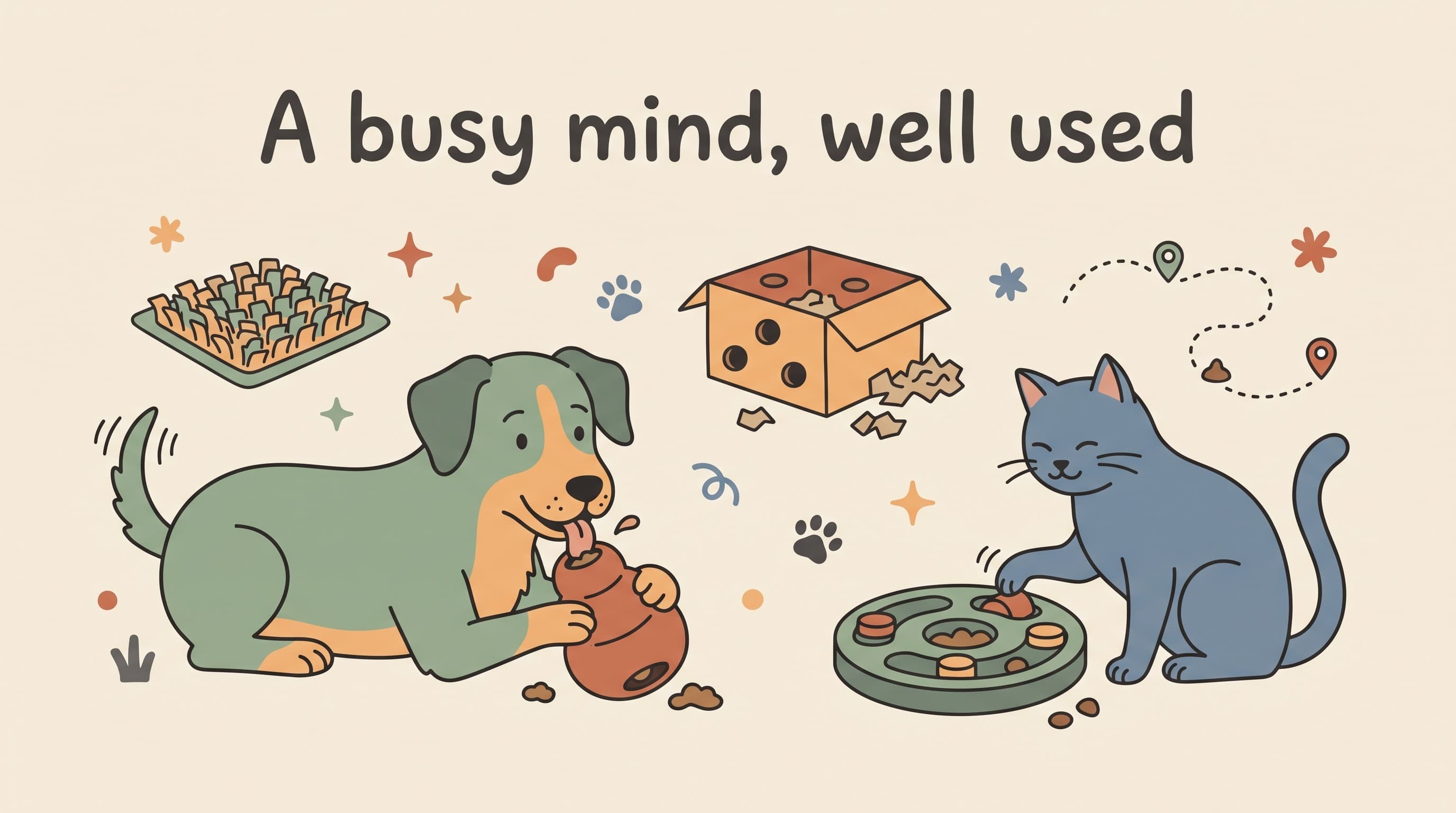
Boredom, under-stimulation and the role of enrichment
Alastair Greenway
BVM&S MRCVS
A dog that shreds the post the moment your back is turned, or a cat that has taken up a 3am sprint up the curtains, tends to get called "naughty." It is almost always the wrong word. A great deal of the repetitive, destructive, frustrating behaviour that owners describe to us is not defiance at all. It is a clever, active animal with nothing useful to do, and a nervous system built for hunting, foraging and problem-solving that is being asked to switch off for hours at a time. That is what under-stimulation looks like from the inside, and enrichment is how you fix it.
This article is about that fix in the round, for dogs and for cats equally, because cats are not a footnote here. I want to be straight with you from the start, though, because the enrichment world is full of overstated promises. Enrichment genuinely helps, and the evidence for it is real and growing, but it is a support, not a cure. It does not replace a behaviour plan for an established problem, and it never replaces a vet check, because the first job with any sudden change is to rule out pain or illness, which our guide on whether it is behaviour or medical covers in full (/articles/is-it-behaviour-or-medical). With that said, let us look at what under-stimulation does, and what actually helps.
What boredom does to behaviour
The link between too little to do and problem behaviour is real, but it is worth stating precisely rather than overselling it. In a survey of around 4,500 Finnish pet dogs, those given a low amount of daily exercise had a higher probability of repetitive behaviour, as did dogs living without other dogs, and the authors frame these repetitive patterns as often arising from frustration, boredom or stress (Sulkama et al., 2022). That is a large and useful finding, but it is a cross-sectional survey, which means it shows an association, not proof that boredom causes the behaviour. I flag that not to undermine it but because the precision matters: under-stimulation is plainly part of the picture, yet it sits alongside genetics, early experience, pain and learning, and you should be wary of anyone who tells you a snuffle mat alone will resolve a fixed habit.
Where under-stimulation does its damage is in the gap between what an animal is built to do and what its day allows. Dogs are foragers and scenting animals; cats are obligate hunters wired to stalk, chase, pounce and catch many small meals a day. Deny those outlets entirely and the drive does not vanish, it leaks out sideways, into chewing, pacing, over-grooming, attention-seeking or, at the far end, the repetitive patterns that can tip into a genuine compulsive disorder. That tipping point, when a habit becomes a clinical problem, belongs to our dedicated article on compulsive behaviour (/articles/compulsive-behaviour-dogs-cats); your job is to understand how poor stimulation feeds the early stages and to head it off.
Why a basket of toys misses the point
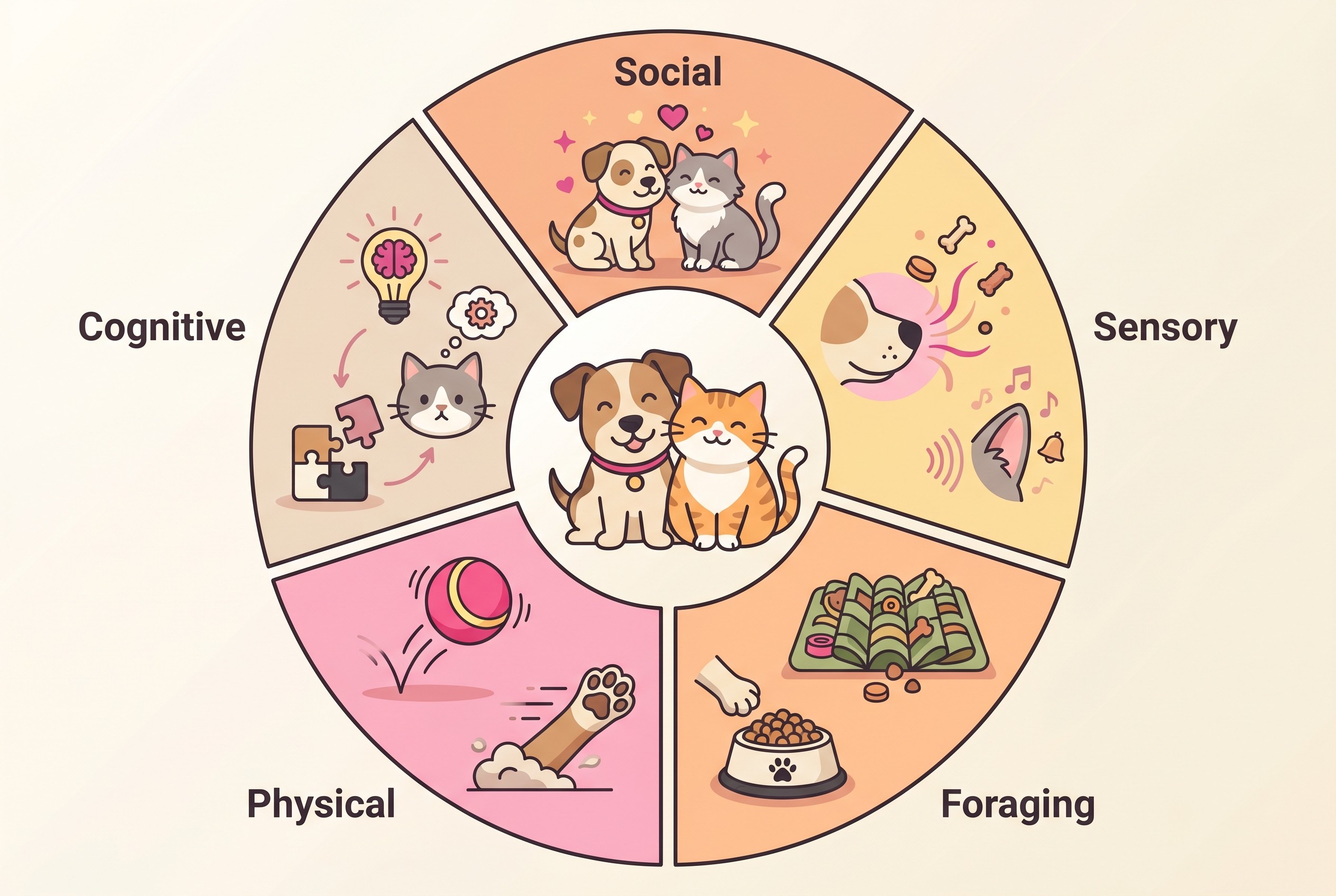
Enrichment is not a basket of toys you buy once. It is a deliberate effort to let an animal express its natural behaviour, and the veterinary framing divides it into several distinct types: social enrichment (contact with people and, where appropriate, other animals), occupational and cognitive challenge, sensory input across smell, sound and sight, physical or structural changes to the space, and feeding or nutritional enrichment (Heath & Wilson, 2014). A landmark review of kennelled dogs split this same territory into the "animate" world of social contact and the "inanimate" world of toys, scents and sounds, and concluded that getting it right reduces stress and abnormal repetitive behaviour and improves welfare, while noting that social contact, particularly with people, tends to matter most of all (Wells, 2004).
That this works is more than theory. A controlled pilot study in office-based assistance dogs found that adding enrichment significantly increased relaxed behaviour and significantly reduced alert and stress behaviours, and interestingly, social and play enrichment outperformed food toys in that setting (Hunt et al., 2022). It was a small study, just ten dogs, so treat it as indicative rather than the final word, but it points the same way as the larger reviews: variety and the right type matter more than quantity. The practical takeaway is to think in categories. If your pet only ever gets walked or only ever gets a food toy, you are working one muscle and leaving the rest idle.
Letting a dog use its nose
If you do one thing for a dog, let it use its nose. "Letting a dog be a dog" sounds like a slogan, but there is decent evidence behind it. In one study, two weeks of nosework, but not the same period of heelwork, made dogs measurably more "optimistic" on a cognitive bias test, approaching an ambiguous food bowl faster, and the authors linked this partly to nosework letting the dog work independently and use its natural sense (Duranton & Horowitz, 2019). A more recent scoping review of scent-based activities concluded they are associated with positive behavioural and physiological changes and are a practical, low-cost, welfare-friendly form of enrichment, while fairly noting the evidence base is still young (Fountain et al., 2024). In plain terms, a sniffy, meandering walk where your dog chooses where to investigate is doing real psychological work, often more than a brisk march on a tight lead.
You can build foraging in cheaply. Scatter part of the daily food in the garden or across a snuffle mat, hide treats around a room for a "find it" game, or freeze a stuffed food toy. A weekly enrichment plan or a simple foraging-ideas sheet, which you will find in our printables, makes this easy to rotate so it stays novel. One safety note worth carrying: introduce any food puzzle gradually and start it easy, because a puzzle that is too hard too soon just creates frustration and gets abandoned. And supervise chews and destructible toys, since the line between enrichment and a swallowed object that needs surgery is thinner than people think, which is exactly the territory of our article on pica and wool-sucking (/articles/pica-and-wool-sucking).
Cats need to hunt, not just to play
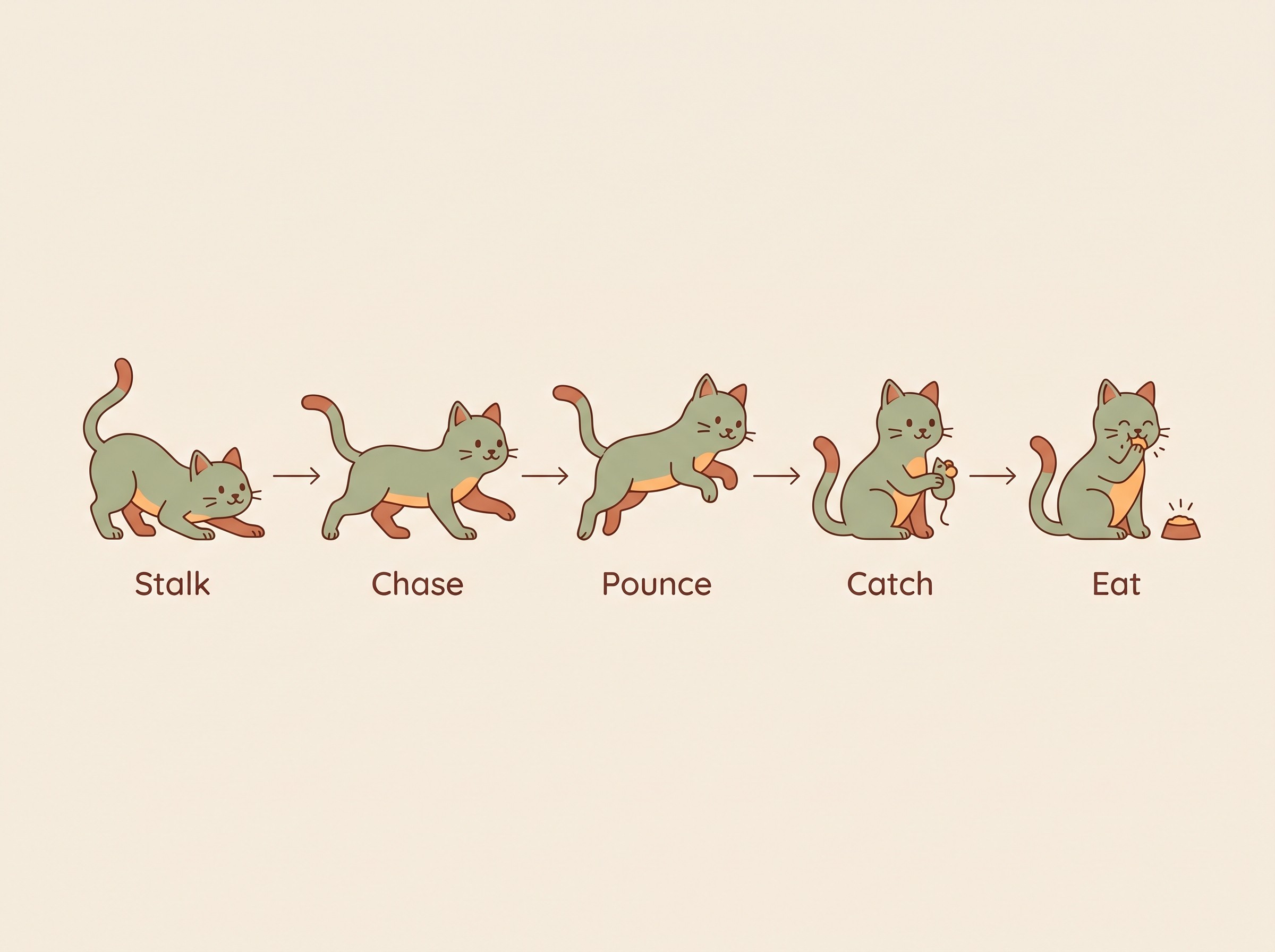
Cat enrichment deserves the same seriousness, because an under-stimulated indoor cat is not a calmer cat, it is a more stressed one. The thing to design around is the predatory sequence: stalk, chase, pounce, catch, then eat. A wand toy dragged and flicked so your cat can chase and finally "catch" it, several short hunts a day rather than one long one, each ideally ending in a small food reward, mimics that natural rhythm far better than a laser dot that can never be caught and can leave some cats frustrated. Opportunity for play and predatory behaviour is recognised as a core feline welfare need, and indoor life without it is linked to stress and stress-related disease (Ellis, 2009). The deeper framework for the indoor cat's environment, including the well-known Five Pillars and the link between stress and feline cystitis, is owned by our companion article on feline stress and FIC (/articles/feline-stress-fic-enrichment), so I will hand you there for that rather than repeat it.
Feeding enrichment matters for cats too. Food puzzles take advantage of a cat's natural drive to work for food and have been reported to help a range of indoor-cat problems, including chronic lower urinary tract signs and problem behaviours (Dantas et al., 2016). Add vertical territory, since shelves, cat trees and high perches turn a flat, contested floor into a richer world, and do not forget scent and texture, with cat-safe plants, scratching surfaces and the odd cardboard box.
A myth worth correcting: pets do not actually prefer to work
You will read everywhere that "all animals prefer to work for their food," a phenomenon called contrafreeloading, usually offered as the clinching argument for puzzle feeders. It is a lovely idea, and for pet dogs and cats it is largely not true, so I would rather you heard it straight from us than felt misled later. When cats were given a food puzzle alongside an identical tray of freely available food, they ate more from the free tray, spent more time at it and went to it first (Delgado et al., 2021). Pet dogs, offered the same choice between a snuffle mat and a free tray, showed a willingness but not a preference to work for their food (Rothkoff, Feng & Byosiere, 2024).
Does that make puzzle feeders pointless? No, and this is the nuance that matters. As the researchers themselves point out, a lack of preference does not mean a lack of benefit (Delgado et al., 2021). Most pets, given a free choice, will take the easy option, but offering foraging and puzzle feeding still provides valuable mental work and a constructive outlet, especially for an animal whose day is otherwise empty. The framing is simply this: do not present puzzle feeders as something your pet is desperate for and being denied. Present them as one good tool among many, worth using, easy to start, and not the whole answer.
Matching the enrichment to the animal in front of you
The other reason "just buy a puzzle feeder" falls short is that enrichment is not one-size-fits-all, and the same activity can help one animal and wind up another. The sensible approach is to match what you offer to the individual and to the problem you are actually trying to solve. A young, driven working-breed dog left alone all day needs a different week from an arthritic senior who finds a scatter-fed lawn more rewarding than a long walk, and a confident cat who patrols the whole house needs different things from a timid one who never leaves the bedroom. Start by watching: what does your animal gravitate towards, chewing, sniffing, chasing, shredding, climbing, and build more of that legitimate outlet rather than imposing your idea of fun. The studies bear this out, since the office-dog work found social and play enrichment did more than food toys for those particular dogs, while the nosework benefit came specifically from letting dogs use their nose independently (Hunt et al., 2022; Duranton & Horowitz, 2019). Match it to the problem, too: a dog that chews from boredom needs legal things to chew and a fuller day, whereas a dog that paces from anxiety needs the anxiety addressed first, because no amount of enrichment fixes a fear you have not named. And keep rotating, since novelty is part of what makes enrichment work and yesterday's thrilling puzzle is today's furniture.
Where enrichment stops, and what it can never replace
Two final cautions will save you a lot of wasted effort. The first is that more arousal is not the same as more enrichment. It is easy to assume that a knackered dog is a content one, so you reach for the ball launcher and fire it forty times. But repetitive high-arousal chase can wind a dog up rather than settle it, building frustration and a poor "off-switch," whereas sniffing, foraging and chewing tend to promote calm, which is precisely why the relaxation gains in the studies above came from those quieter activities (Duranton & Horowitz, 2019; Hunt et al., 2022). Good enrichment builds choice and calm, not adrenaline.
The second caution is the most important. Enrichment supports a behaviour plan, it does not replace one, and it never replaces medical care. For a dog in genuine separation panic, a stuffed food toy will not touch the underlying distress and may sit untouched, which is why interim management for those cases is its own careful subject (/articles/separation-anxiety-managing-meantime). For a fearful or reactive animal, enrichment has to stay under threshold, gently and on the animal's terms, never forced, as our guide to the fearful pet explains (/articles/helping-a-fearful-pet). And if a repetitive behaviour is intense, hard to interrupt, or new, the next step is not another puzzle feeder but a check on whether it is medical or behavioural, which is what our behaviour check tool is for (/tools/behaviour-check). Get the foundations right, add enrichment as the rich, varied backbone it deserves to be, and you give every other plan its best chance to work.
References
- Sulkama S, Salonen M, Mikkola S, et al. Aggressiveness, ADHD-like behaviour, and environment influence repetitive behaviour in dogs. Scientific Reports, 2022.
- Heath S, Wilson C. Canine and feline enrichment in the home and kennel: a guide for practitioners. Veterinary Clinics of North America: Small Animal Practice, 2014.
- Wells DL. A review of environmental enrichment for kennelled dogs, Canis familiaris. Applied Animal Behaviour Science, 2004.
- Hunt RL, Whiteside H, Prankel S. Effects of environmental enrichment on dog behaviour: pilot study. Animals, 2022.
- Duranton C, Horowitz A. Let me sniff! Nosework induces positive judgment bias in pet dogs. Applied Animal Behaviour Science, 2019.
- Fountain J, Fernandez EJ, McWhorter TJ, Hazel SJ. The value of sniffing: a scoping review of scent activities for canines. Applied Animal Behaviour Science, 2024.
- Ellis SLH. Environmental enrichment: practical strategies for improving feline welfare. Journal of Feline Medicine and Surgery, 2009.
- Dantas LMS, Delgado MM, Johnson I, Buffington CAT. Food puzzles for cats: feeding for physical and emotional wellbeing. Journal of Feline Medicine and Surgery, 2016.
- Delgado MM, Han BSG, Bain MJ. Domestic cats (Felis catus) prefer freely available food over food that requires effort. Animal Cognition, 2021.
- Rothkoff L, Feng L, Byosiere SE. Domestic pet dogs (Canis lupus familiaris) do not show a preference to contrafreeload, but are willing. Scientific Reports, 2024.
Keep track of how your pet is doing
The owners who cope best are the ones who notice changes early. A simple health log shows you what is working, and what is not, before the next vet visit.
Start tracking, freeYou're not doing this alone
Compare treatment journeys and talk to owners managing behaviour & anxiety. Free to join.
Join PetsLikeMine