

The camera test: what your dog actually does when you leave
Alastair Greenway
BVM&S MRCVS
A separation problem is, almost by definition, a problem you never see. The behaviour shows up when you are out, the one window in which you cannot know what your dog is doing (Harvey et al., 2022). So most owners are working from fragments. A chewed door frame. A neighbour's note about the barking. A puddle by the back door you tell yourself was a one-off. From those scraps it is genuinely hard to tell whether your dog is mildly bored, frustrated at being shut out of the action, or in real distress, and those are not the same problem with the same answer.
A camera changes that. A recording of what your dog actually does once the door closes is the single most useful piece of evidence you can gather, far more reliable than guesswork or your memory of the morning, and the thing your vet or behaviourist will most want to see (Bain, 2025). It costs nothing but a phone propped against a mug and one ordinary departure. This guide is about how to film it well, what to look for, and how to turn it into a baseline you can measure progress against. We will not work out from the footage which subtype of separation problem your dog has; that is its own detective work, and it lives in our guide to separation anxiety, isolation distress or boredom. Here we are simply gathering the evidence, cleanly and carefully.
Why the footage beats your hunch
Owner reports systematically underestimate how common separation problems are, and the reason is mechanical rather than careless: the behaviour happens unwitnessed, so it never makes it into the report (Harvey et al., 2022). When researchers want an accurate picture, they reach for objective video scoring to get around the subjectivity of what owners think they saw, coding the footage frame by frame rather than trusting a recollection (Lenkei et al., 2021). The gap is real. In one questionnaire of 94 dogs, 27 were showing separation-related behaviour at the time and another 20 had shown it in the past, close to half affected at some point in their lives (Bradshaw et al., 2002). Many of those dogs live with owners who have no idea, because the only evidence is happening behind a closed door.
Footage closes that gap. It replaces "I think he's fine, he's quiet when I get back" with something you can actually look at. And it routinely surprises people, because the quiet dog, as we will see, is one of the most under-recognised presentations of all.
Filming a departure that actually tells you something
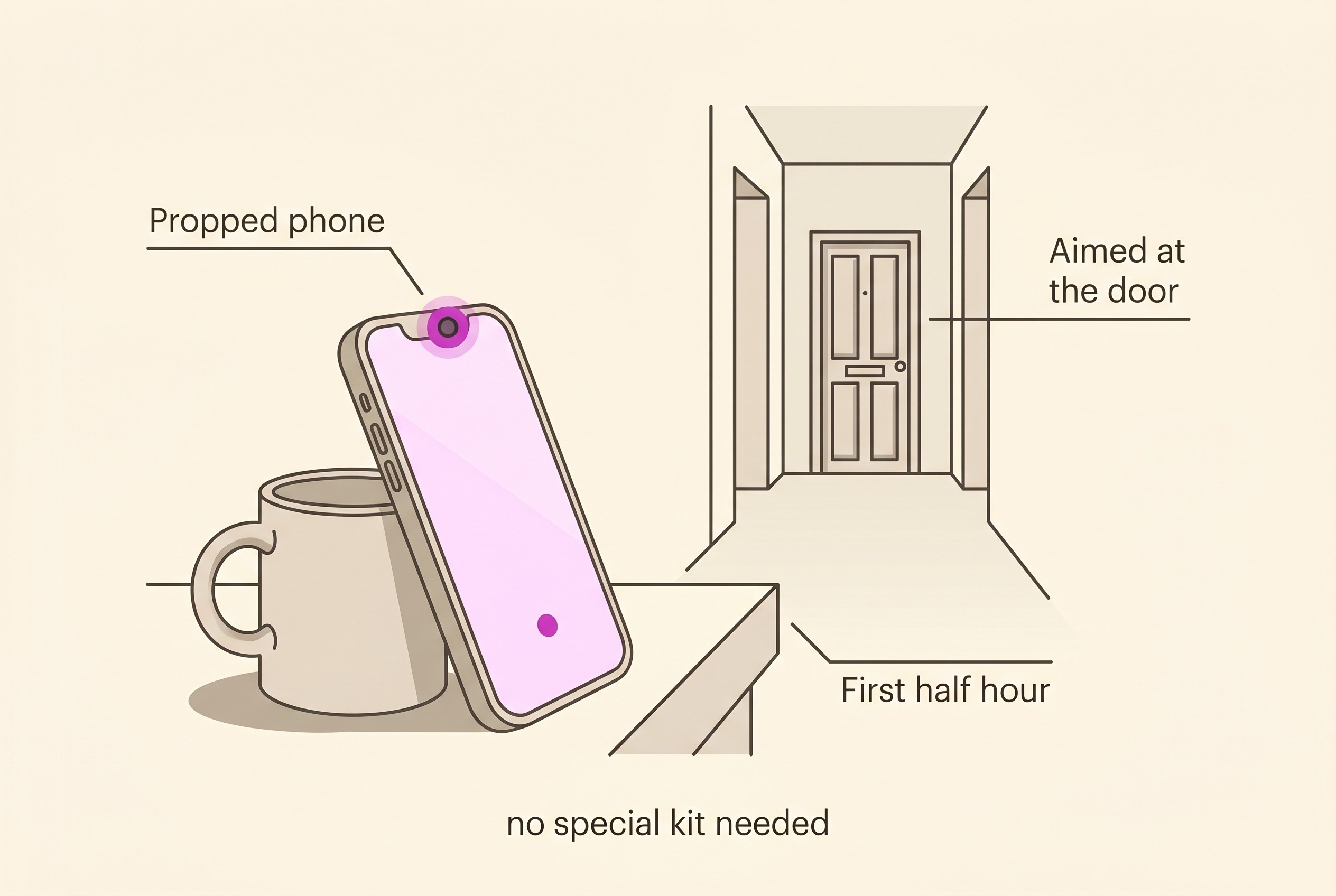
You do not need special equipment. A phone balanced against a stack of books, a laptop with the camera on, an old tablet, or a cheap pet camera all work fine. What matters is not the kit but the framing and the timing.
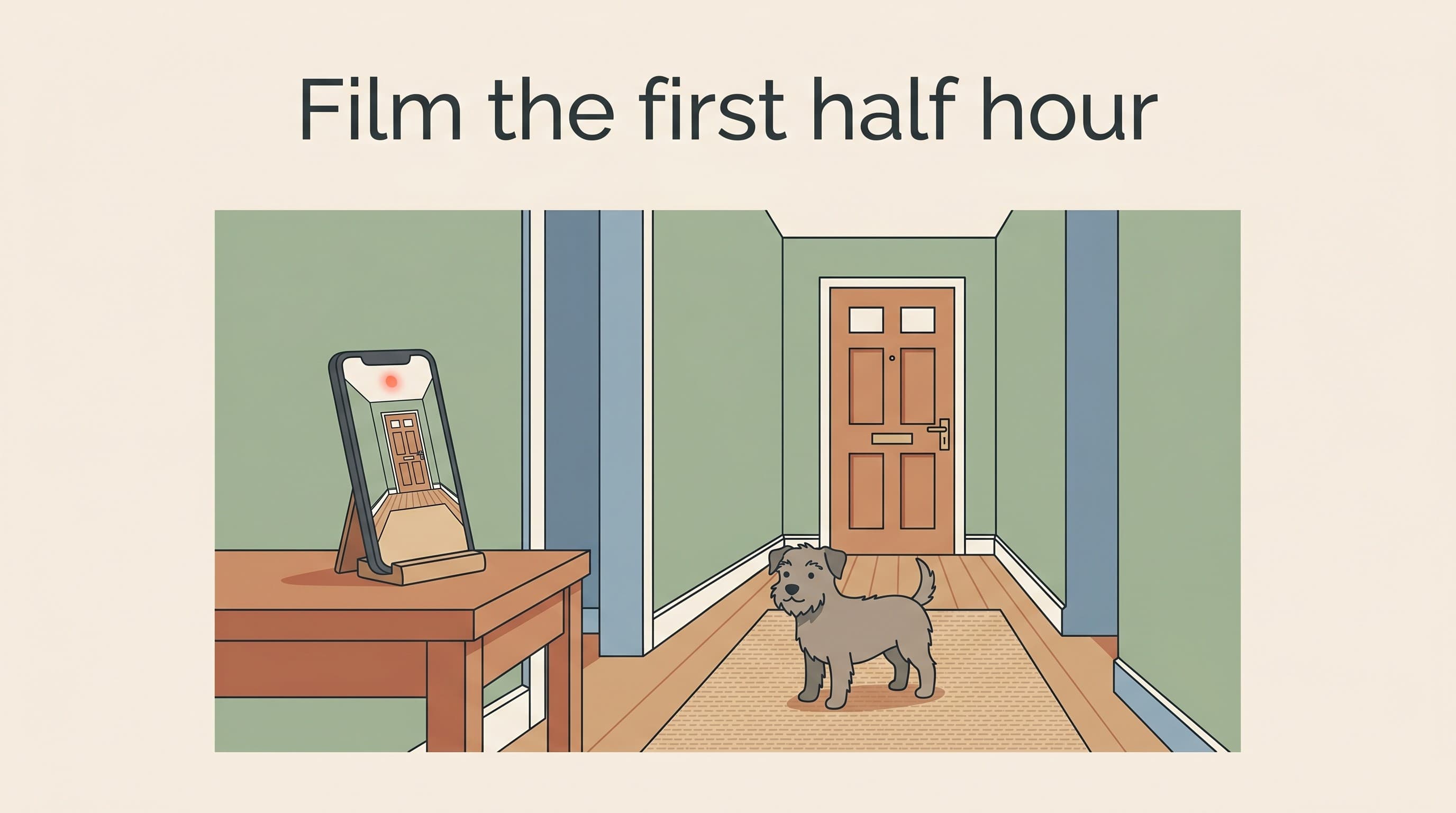
Point the camera at the place your dog actually spends the departure: the door you leave by, wherever they settle, or the crate if they are crated. If you can catch the run-up too, the keys, the coat, the shoes, do, because the pre-departure ritual often shows when the anxiety starts to build, sometimes well before you have left. Then leave as you normally would and let it record.
How long to film is the decision that matters most, and the answer is counter-intuitive: you are not trying to capture a long absence, you are trying to capture the first part of one. In dogs with a genuine separation problem, distress tends to be front-loaded. Most affected dogs show signs within the first 15 to 30 minutes, often within the first few minutes, with the heaviest distress soon after you leave (Bain, 2025; Palestrini et al., 2010). So the first half hour holds the diagnostic gold. Record at least 30 minutes, longer if your storage allows.
Do this on a couple of different days rather than reading everything into one recording. Dogs have bad mornings and oddly settled mornings just as we do, so two or three departures give you a truer picture than any single clip.
Reading the footage back
When you watch it back, answer a few specific questions rather than just forming an impression. Note the time the door closes, then watch for four things: how long until the first sign of distress, what that sign is, where any destruction is aimed, and whether the behaviour builds, plateaus or comes and goes.
The signs fall into a recognisable pattern. The classic, hard-to-miss group is vocalisation (barking, howling, whining), destruction, and inappropriate toileting. In a large study of 762 dogs, vocalisation was commonest at around 78 per cent and destructiveness affected just under half, while inappropriate urination or soiling was less common but far from rare (de Assis et al., 2020). Alongside that obvious trio sit the markers owners overlook: pacing and restlessness, panting, drooling and salivation, hypervigilance, owner-searching, repetitive behaviour, and outright escape attempts (Harvey et al., 2022).
Where destruction is aimed is one of the most useful discriminators on the whole recording. Damage concentrated at exit points, the door, the door frame, the window, the bars of the crate, and starting within minutes of your leaving, points towards panic or frustration at being shut in, not towards a dog amusing itself. The shorthand that "destruction equals boredom" misses this: a bored dog potters and chews at leisure, whereas a dog frantically working at the one spot you disappeared through is telling you something quite different. The location and the timing are the clues, and a camera gives you both. What that pattern means for the subtype, and why "he did it for attention" or "out of spite" is the wrong reading entirely, is what our guide to the different separation subtypes is for.
The quiet dog, and the signs you would miss without footage
This is the reason a camera so often earns its keep. The absence of barking and destruction does not mean the absence of distress. Plenty of dogs do not howl or wreck the place. They pant, they lick their lips over and over, they yawn repeatedly, they salivate until there is a wet patch on the bed, they pace a tight little circuit, they freeze, or they simply shut down into a flat, "depressed" stillness in one spot (Palestrini et al., 2010; Harvey et al., 2022). This passive, switched-off presentation is a recognised form of separation distress, and one of the easiest to dismiss, because a still, silent dog looks for all the world like a calm one (Palestrini et al., 2010).
Detailed video studies bear this out. Filmed and scored frame by frame, dogs with separation problems show recordings full of low-key anxiety body language: ears pulled back, repeated lip-licking and yawning, a raised forepaw, trembling, freezing (Palestrini et al., 2010). None of it is loud; all of it matters, and none of it can be inferred from a chewed cushion. Reading these signals, across both the subtle and the obvious, is its own skill, and our guide to reading your pet's body language walks through the full ladder so you can recognise stress before it tips into panic.
A particular caution about crates, since many owners assume a crate settles things. In one video study, crated dogs actually showed more conflict and anxiety behaviour, more yawning and lip-licking, than dogs left loose (Palestrini et al., 2010). A crate is not automatically calming, and a genuinely panicked dog can injure itself against the bars, so do not read a crated dog's quietness as proof the crate has solved anything. Watch what the footage actually shows.
What the shape of the half hour reveals
The most telling thing a recording reveals is often not any single behaviour but how it changes over time. Distress is typically heaviest early and then shifts: in the filmed studies, barking and orienting to the environment tended to decrease as the absence went on, whereas panting tended to increase (Palestrini et al., 2010). The emotional state may move too, with one early study of the noises dogs make reading the barking of the frantic first phase as arousal and frustration, and the howling and whining that follow as a marker of fear (Lund & Jorgensen, 1999).
It is not always a simple decline, either. Some dogs cycle, settling and then rousing again in a rough rhythm; one analysis modelled exactly this, a repeating component on roughly a 23 to 28 minute cycle laid over a slower overall easing (Lund & Jorgensen, 1999). So resist reading too much into the last minute of a clip: a dog gone quiet by minute 28 has not necessarily coped, it may simply be in the trough of a cycle, or exhausted. It is also why the "15 to 30 minute" rule is best held loosely. It is a sound generalisation, not a stopwatch law, and a minority show delayed or drawn-out distress that only a longer recording reveals.
Red flags, the vet, and what not to do with what you learn
Some things on a recording should prompt action, not just observation. Genuine escape attempts with self-injury, broken nails or teeth, a bleeding muzzle or paws, damage to crate bars, doors or windows, are a welfare red flag (Bain, 2025), and so is sustained, unrelenting panic. If your footage shows any of that, speak to your vet promptly and, while you arrange help, stop leaving your dog alone over their threshold in the meantime, which our guide to managing the meantime covers practically.
Two firm boundaries on what to do with what you see. First, footage informs a diagnosis, it does not make one, and it does not justify medicating off your own judgement; for a severe picture, escape-injury footage may well open a conversation with your vet about whether anti-anxiety medication would help, but that is a conversation with a prescribing vet, not a conclusion you reach alone. Second, never punish a dog for what the recording shows. The dog on that footage is panicking, not misbehaving, and punishment will only deepen the fear it is reacting to.
Rule out the body before you settle on the mind, especially if this started suddenly or your dog is older. Pain, sensory decline and age-related cognitive change can all drive or mimic separation distress, and they need a veterinary check, not a training plan, which is what our guide on whether it is behaviour or medical is for, and what the behaviour check tool will help you triage before you share your findings. One note on species: this whole evidence base, the filming, the latencies, the time-course, is built on dogs, because that is where the research sits. Cats have separation-related problems too, but are far less studied and tend to show up differently, often as house-soiling, over-grooming, hiding, pacing, not eating, or unusual vocalisation. The same idea applies, film the first stretch and watch for those signs, but treat any specific numbers as canine until the feline evidence catches up. And for a cat toileting outside the tray the first move is always a vet check, since house soiling is medical until proven otherwise.
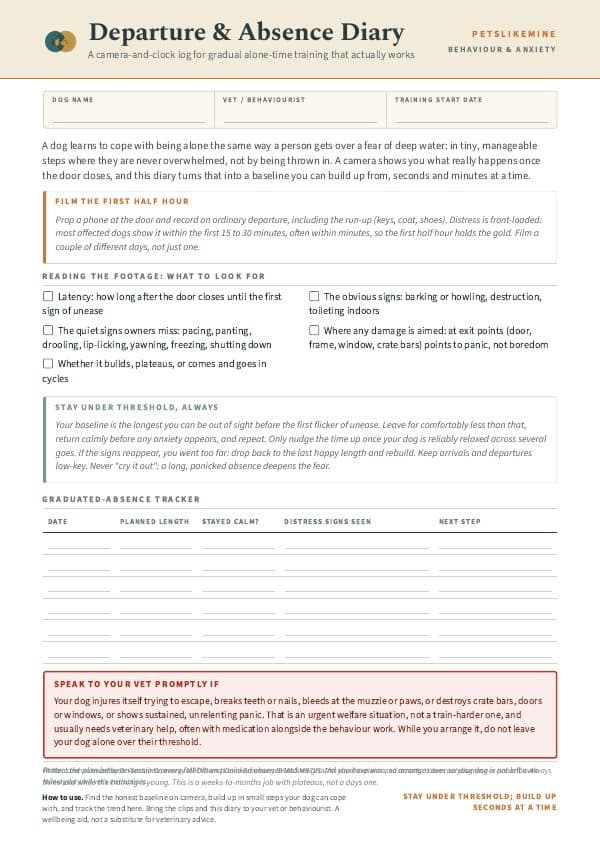
Once you have a clip or two, write it down before the detail fades: the latency to the first sign, what it was, where any damage was aimed, whether it escalated or cycled. That short note is your baseline, the "this is where we started" picture, and the absence diary printable is built to hold it and track it over the weeks so progress becomes visible rather than remembered. It is also what the training itself will measure against, and when you are ready our guide to the departure plan turns this evidence into a graded, kind, genuinely workable way to rebuild your dog's tolerance of being alone. Bring the clips and the notes to your vet or behaviourist: of everything you could carry into that appointment, this is the one artefact that tells them the most (Bain, 2025).
References
- Harvey ND, Christley RM, Giragosian K, et al. Impact of Changes in Time Left Alone on Separation-Related Behaviour in UK Pet Dogs. Animals, 2022; 12(4): 482.
- Bain M. Algorithmic Approach: Separation Anxiety in Dogs. Today's Veterinary Practice, 2025.
- Lenkei R, Farago T, Bakos V, Pongracz P. Separation-related behavior of dogs shows association with their reactions to everyday situations that may elicit frustration or fear. Scientific Reports, 2021; 11: 19207.
- Bradshaw JWS, McPherson JA, Casey RA, Larter IS. Aetiology of separation-related behaviour in domestic dogs. Veterinary Record, 2002; 151(2): 43-46.
- Palestrini C, Minero M, Cannas S, Rossi E, Frank D. Video analysis of dogs with separation-related behaviors. Applied Animal Behaviour Science, 2010; 124(1-2): 61-67.
- de Assis LS, Matos R, Pike TW, Burman OHP, Mills DS. Developing Diagnostic Frameworks in Veterinary Behavioral Medicine: Disambiguating Separation Related Problems in Dogs. Frontiers in Veterinary Science, 2020; 6: 499.
- Lund JD, Jorgensen MC. Behaviour patterns and time course of activity in dogs with separation problems. Applied Animal Behaviour Science, 1999; 63(3): 219-236.
Free downloads
Companion worksheets to put what you've read into practice. Free PDFs, print at home.
Keep track of how your pet is doing
The owners who cope best are the ones who notice changes early. A simple health log shows you what is working, and what is not, before the next vet visit.
Start tracking, freeYou're not doing this alone
Compare treatment journeys and talk to owners managing behaviour & anxiety. Free to join.
Join PetsLikeMine