

The 12-Week Recovery Roadmap After Cruciate Surgery
Alastair Greenway
BVM&S MRCVS
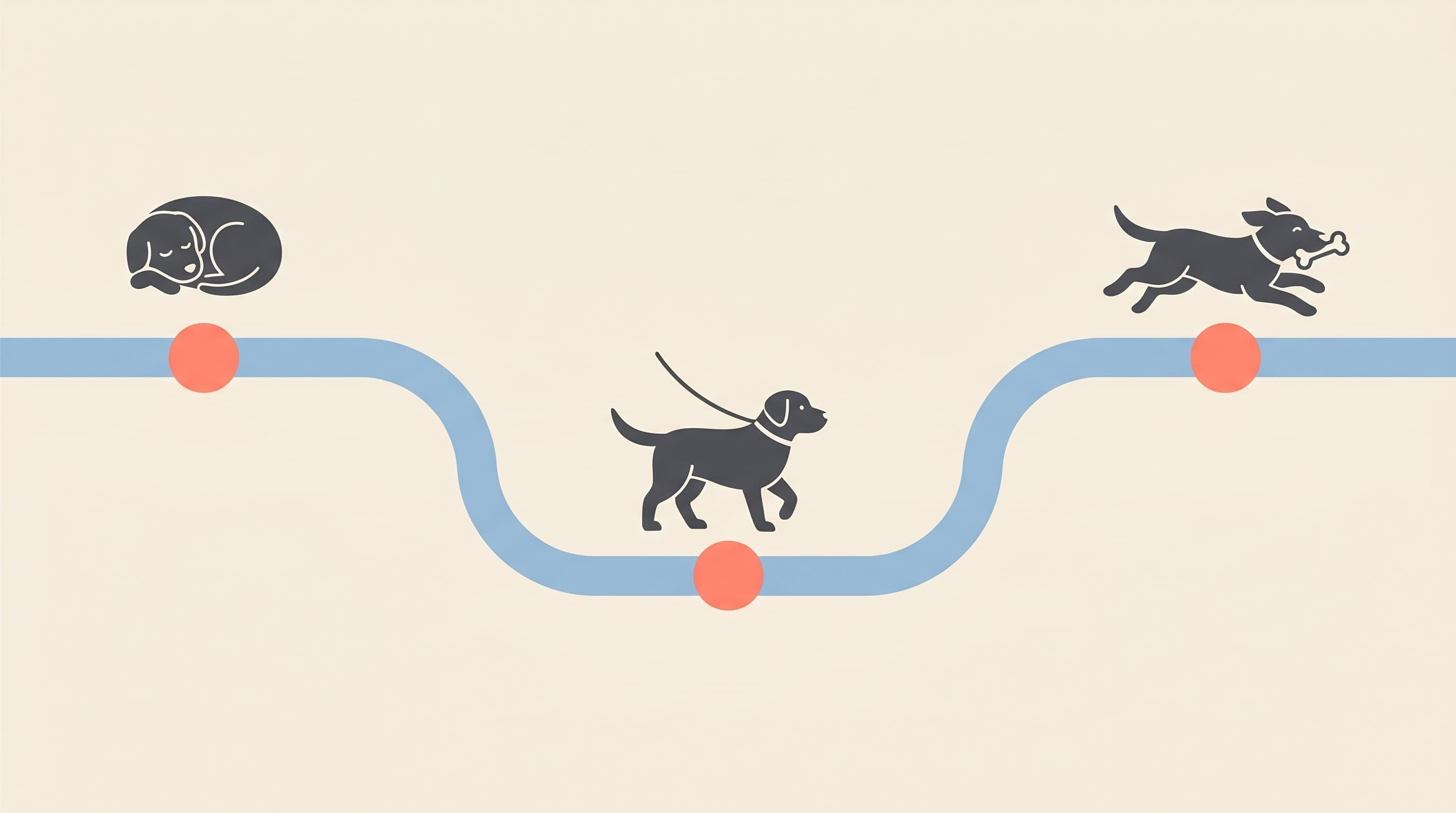
The surgery takes one day. The recovery takes around twelve weeks, and it's the recovery, far more than the operation, that decides how well your dog ends up. So this page isn't a single instruction sheet for tonight. It's the whole road mapped out, so you know not just what to do this week but where the next twelve are heading.
A beautifully done procedure can be undone by a fortnight of too much too soon, and a fairly ordinary one can turn out wonderfully on patient rehabilitation. That's the part nobody says loudly enough before the operation. And the rehabilitation is the bit you control.
One thing to settle before we start. Treat the weeks below as a guide curve, not a contract: every dog heals at its own pace and every surgeon has their own protocol, so where yours differs from mine, your surgeon's instructions always win. This roadmap assumes surgery, which the evidence does favour for most large, active dogs, though conservative management is real medicine for the right dog and has its own guide (Surgery or Not?).
Why the recovery matters so much
When the cruciate fails the knee becomes unstable, and surgery's whole job is to make it stable again so the joint can work more normally. That stability is fragile in the early weeks, and what you're protecting depends on which operation your dog had.
With the bone-cutting procedures, the TPLO and TTA, your dog isn't recovering from a soft-tissue repair at all. The surgeon has cut and re-set a bone and held it with a plate, and that bone has to knit. Restricted, controlled activity for several weeks is standard of care precisely to protect that healing and the implant (ACVS): push too hard too early and you're loading a bone that hasn't finished mending. With a lateral suture there's no bone cut, but the early scar tissue and fibrous stability around the joint need time to mature before they're asked to do real work. How those operations differ is covered in the procedure guides (TPLO Explained).
Either way the principle is the same: rushing the rest phase is the commonest cause of setbacks. Almost every recovery that goes wrong does so because a dog who felt brilliant did something a healing knee wasn't ready for.
There's one more thing worth holding from the start. Cruciate disease is a degeneration, not a one-off injury, so the sofa-jump that seemed to start it was the trigger, not the cause (Why It's Degeneration, Not an Injury). That matters here because the other knee carries a real risk of going the same way, around a third to a half within one to two years: worth planning for, not worrying about today (Will the Other Leg Go Too?).
Weeks 0 to 2: strict rest
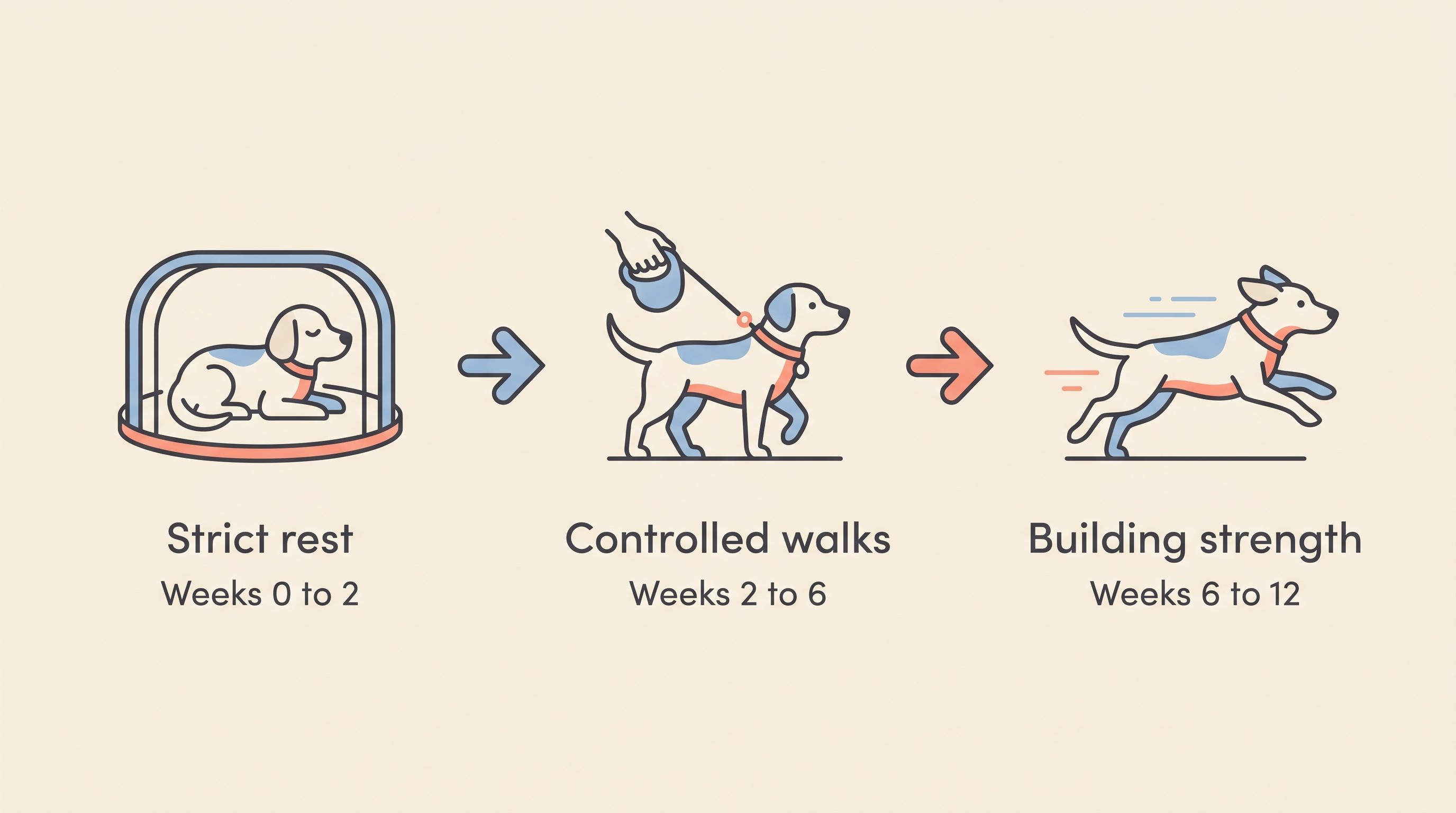
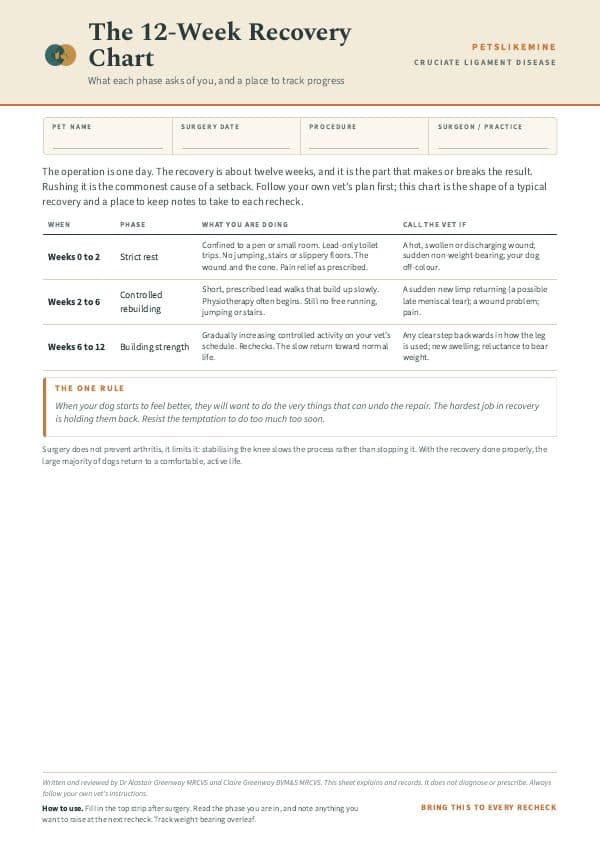
This is the most restricted and the most anxious fortnight. Your dog lives in a confined space, goes out only on the lead for toilet trips, and stays calm while the wound heals under its cone. The detail of all that, from what a normal incision looks like to managing the cone and the day-to-day of pain relief, lives in its own companion piece (The First Two Weeks at Home), and keeping a bouncy dog quiet once they feel better has a whole guide of its own (Strict Rest Without Losing Your Mind).
Two things are worth saying loudly, though, because the old advice on both was wrong.
The first is that rehabilitation now starts straight away, not at the old six-to-eight-week recheck. Gentle range-of-motion work matters early because stifle movement, especially full extension, is best regained in the first two weeks before healing tissue starts to limit it (RCVS Knowledge; Monk et al., 2006). Your surgeon or physio will show you what's safe; the actual moves belong to the home-exercise guide (Home Exercises).
The second is the cheapest and best-evidenced thing you can do all recovery: cold compression in the first day or so. In a blinded, placebo-controlled trial it lowered pain, lameness and swelling scores and improved range of motion at 24 hours after TPLO (Drygas et al., 2011), and in the systematic review of cruciate rehab it was the only modality backed by two high-quality, low-bias studies (Alvarez et al., 2022). Ask your vet how they'd like you to apply it.
Weeks 2 to 6: controlled rebuilding
Around the two-week mark, once the wound is checked, the picture starts to open up. This is the phase of gradual, prescribed lead walks built up from just a few minutes, and the start of formal physiotherapy. The key word is prescribed: you're not deciding how far to walk, you're following a schedule that climbs in small, deliberate steps.
This is also where lost muscle starts coming back, and it doesn't return on its own as well as it does with help. Six weeks after TPLO, dogs in a structured physiotherapy programme had significantly greater thigh circumference and stifle range of motion than dogs simply walked at home, and in the physio group the operated limb's girth matched the sound leg (Monk et al., 2006). What physiotherapy and hydrotherapy involve, and how to find a good practitioner, is its own guide (Physiotherapy and Hydrotherapy), as are the specific exercises for this phase (Home Exercises by Recovery Phase).
Let me be straight with you about the evidence. Six of the seven exercise studies in the systematic review found a benefit, so the direction of travel is encouraging, but every one carried a high risk of bias, and the Monk trial above, for all its clear result, was only eight dogs (Alvarez et al., 2022). So rehab is standard of care and worth doing, with genuinely supportive evidence for muscle and range of motion. It just isn't a dial you can turn to a guaranteed number, and anyone who promises one is guessing.
Weeks 6 to 12: building strength
The back third is the slow, satisfying climb back toward normal. Controlled activity keeps increasing, and there's usually a recheck around now. For the osteotomy procedures that often means repeat X-rays to confirm the bone has healed before your dog does more, which is why a TPLO or TTA can feel more cautious than a suture repair at this stage.
There's one mistake owners make more than any other here, so I'll flag it clearly. Off-lead, free running is usually not reintroduced until around 10 to 14 weeks, because even when your dog looks fully recovered the stifle is still relatively weak and lacks the fine neuromuscular control that stops a sudden twist doing damage (RCVS Knowledge). That gap between looking ready and being ready is where good recoveries get undone, and it's the real reason "around twelve weeks" is the headline, with full return to unrestricted life tailing into three to four months for many dogs.
A word about arthritis too, because you'll read scary things. Surgery limits but does not prevent it. Once a knee has been unstable some joint change is already underway, and stabilising it slows that progression rather than erasing it. That's the nature of the condition rather than a sign anything has failed, and the lifelong picture is its own guide for when you're ready (Cruciate Disease and Arthritis).
Tracking progress
A recovery you can see is a recovery you can trust, and the way to see it is to read three simple things against the week you're in: how much weight your dog puts through the leg, how lame they look, and how swollen the knee feels. Not a neurological grade, not an arthritis score, just weight-bearing, lameness and swelling against the post-op week. The trend should climb week on week.
That's exactly what the Recovery Tracker is built to do. You log mobility, weight-bearing, knee swelling and exercise tolerance, and it plots your dog's curve against the expected one, so a good week reassures you and a stalled one gets your attention early.
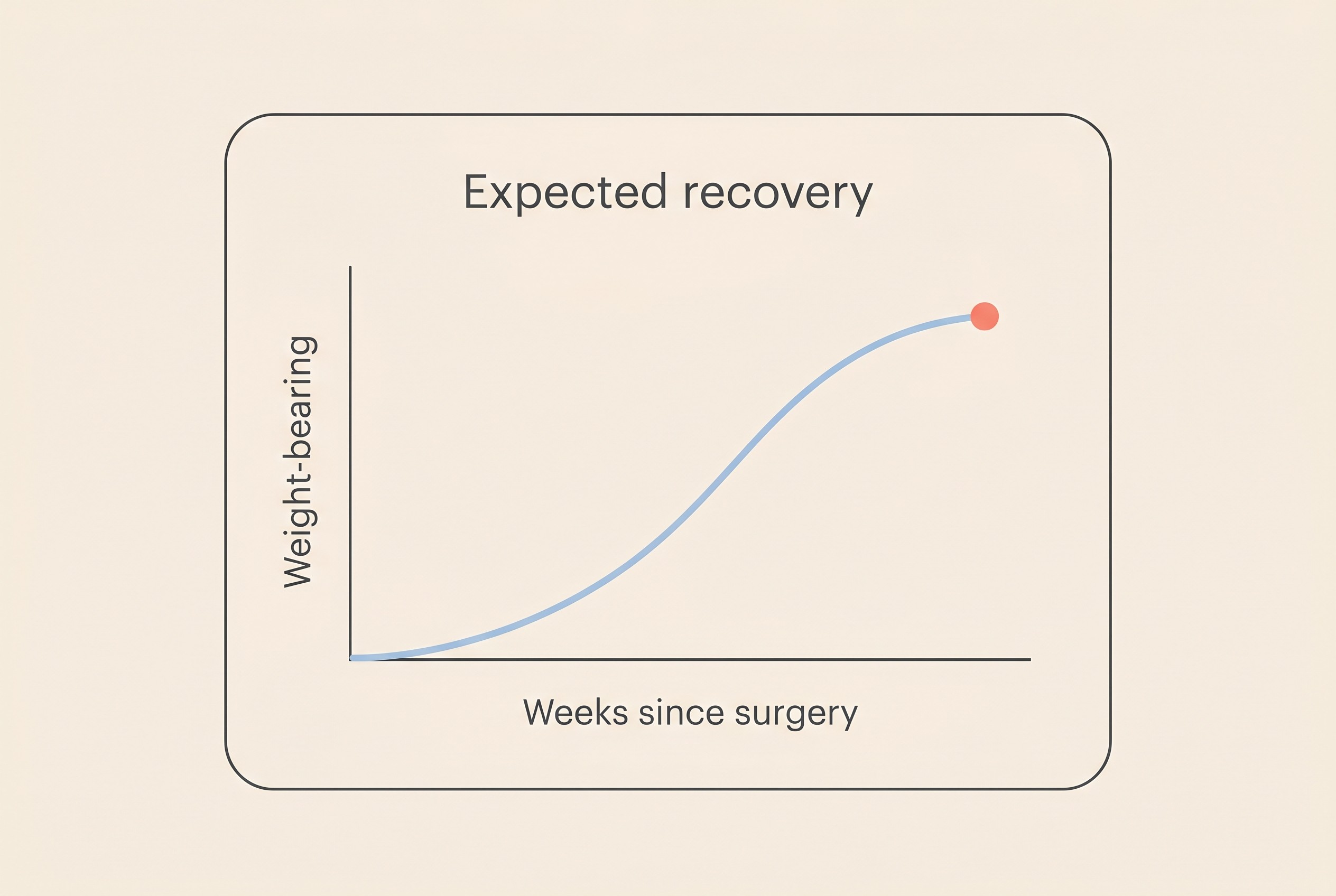
The reason a chart earns its keep is the stall. A recovery that's trending nicely and then plateaus, or a dog doing beautifully who abruptly turns lame, or a knee that goes hot and swollen, is telling you something. A late meniscal tear, for one, is a recognised complication, affecting around 6.7 percent of cases at a median of roughly 5.8 months after surgery (Ritzo et al., 2014), and a sudden backward step can be its first sign (The Meniscus). I'm not telling you this to frighten you, but so you know a stalled curve is a reason to ring your vet, not to wait and hope. The full list of what to watch for, and when to call, is its own guide (Red Flags During Cruciate Recovery).
Where this is heading
Let me leave you with the numbers, because the close of this story is a good one. With surgical stabilisation and proper rehabilitation, most dogs come back to a comfortable, active life. In a randomised trial in overweight large and giant-breed dogs, 92.6 percent of the surgically treated dogs met a strict success bar at 24 weeks, and 75 percent still met that demanding standard at 52 weeks (Wucherer et al., 2013). Of the procedures, TPLO has the strongest evidence for returning dogs to normal function (Bergh et al., 2014), and by twelve months dogs treated with TTA walked indistinguishably from normal on force-plate testing, though at a faster trot neither TTA nor lateral suture quite reached normal (Krotscheck et al., 2016). The fair headline is that most dogs reach good function with good surgery and committed rehab: not a guarantee for every dog, but a very encouraging place to start.
So follow the curve, resist the strong and loving temptation to let your dog do too much too soon, and use the tracker to keep yourself on track week by week. Twelve weeks is a long time in the middle of it and a blink once it's behind you. When you're through, and thinking about keeping that knee, and the other one, sound for the long haul, the arthritis library is where the next chapter lives (the osteoarthritis space). I'll meet you there.
References
- Alvarez LX, Repac JA, Kirkby Shaw K, Compton N. Systematic review of postoperative rehabilitation interventions after cranial cruciate ligament surgery in dogs. Vet Surg. 2022;51(2):233-243.
- American College of Veterinary Surgeons (ACVS). Cranial Cruciate Ligament Disease (patient/owner resource). Accessed 9 June 2026.
- Bergh MS, Sullivan C, Ferrell CL, Troy J, Budsberg SC. Systematic review of surgical treatments for cranial cruciate ligament disease in dogs. J Am Anim Hosp Assoc. 2014;50(5):315-321.
- Drygas KA, McClure SR, Goring RL, Pozzi A, Robertson SA, Wang C. Effect of cold compression therapy on postoperative pain, swelling, range of motion, and lameness after tibial plateau leveling osteotomy in dogs. J Am Vet Med Assoc. 2011;238(10):1284-1291.
- Krotscheck U, Nelson SA, Todhunter RJ, Stone M, Zhang Z. Long-term functional outcome of tibial tuberosity advancement vs. tibial plateau leveling osteotomy and extracapsular repair in a heterogeneous population of dogs. Vet Surg. 2016;45(2):261-268.
- Monk ML, Preston CA, McGowan CM. Effects of early intensive postoperative physiotherapy on limb function after tibial plateau leveling osteotomy in dogs with deficiency of the cranial cruciate ligament. Am J Vet Res. 2006;67(3):529-536.
- Ritzo ME, Ritzo BA, Siddens AD, Summerlott S, Cook JL. Incidence and type of meniscal injury and associated long-term clinical outcomes in dogs treated surgically for cranial cruciate ligament disease. Vet Surg. 2014;43(8):952-958.
- RCVS Knowledge. Rehabilitation (dog-owner guidance), Canine Cruciate Registry. Accessed 9 June 2026.
- Wucherer KL, Conzemius MG, Evans R, Wilke VL. Short-term and long-term outcomes for overweight dogs with cranial cruciate ligament rupture treated surgically or nonsurgically. J Am Vet Med Assoc. 2013;242(10):1364-1372.
Free downloads
Companion worksheets to put what you've read into practice. Free PDFs, print at home.
Sister tool · Sightline
Track whether treatment is working
Sightline, a separate ConciergeVet tool, runs a short weekly check-in built on validated pain and mobility instruments, turns it into a single Sightline Score you can watch trend over weeks rather than judge on one bad day, and produces a report you can bring to your vet.
A written log, or our printable trackers, does much the same job.
See how Sightline tracks treatmentKeep track of how your pet is doing
The owners who cope best are the ones who notice changes early. A simple health log shows you what is working, and what is not, before the next vet visit.
Start tracking, freeYou're not doing this alone
Compare treatment journeys and talk to owners managing cruciate ligament disease. Free to join.
Join PetsLikeMine