

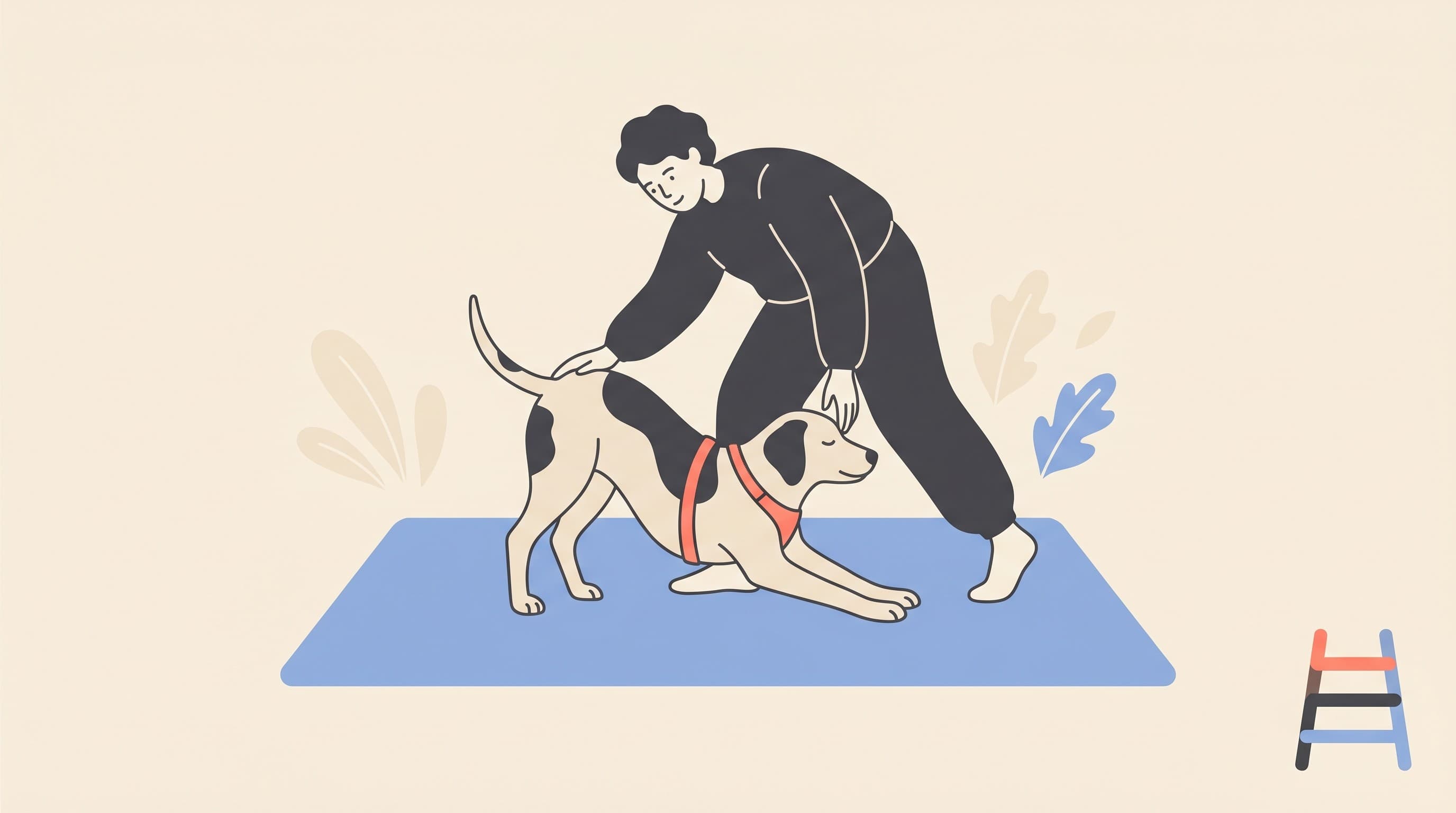
Home Exercises by Recovery Phase
Alastair Greenway
BVM&S MRCVS
The discharge sheet says "gentle controlled exercise", or "we can show you some physio", and leaves it there. What that means at home, with your own dog on your own kitchen floor, is anyone's guess. Most owners want to help and are quietly terrified of doing the wrong thing, because every time the dog shifts its weight it looks like the moment a fortnight of worry and a serious vet bill comes undone.
Let me settle that fear first, then put something useful in your hands. With your own vet's or physiotherapist's sign-off, there's a great deal you can safely do at home to help that leg come back, and doing it well genuinely matters to the result. The single most important thing isn't an exercise at all. It's a rule, so you'll get that first, then the phased exercises, then how to do them without coming to grief. (A 2026 JAVMA analysis found the online information owners are given about cruciate recovery doesn't meet basic health-literacy standards, reading several school grades above the recommended level (Kanarsky et al., 2026).)
This is the hands-on companion to the rest of stage four. The week-by-week map of recovery lives in The 12-Week Recovery Roadmap; what formal physiotherapy and hydrotherapy actually are, and how to find a good practitioner, lives in Physiotherapy and Hydrotherapy After Cruciate Surgery. This one owns the moves.
The golden rule
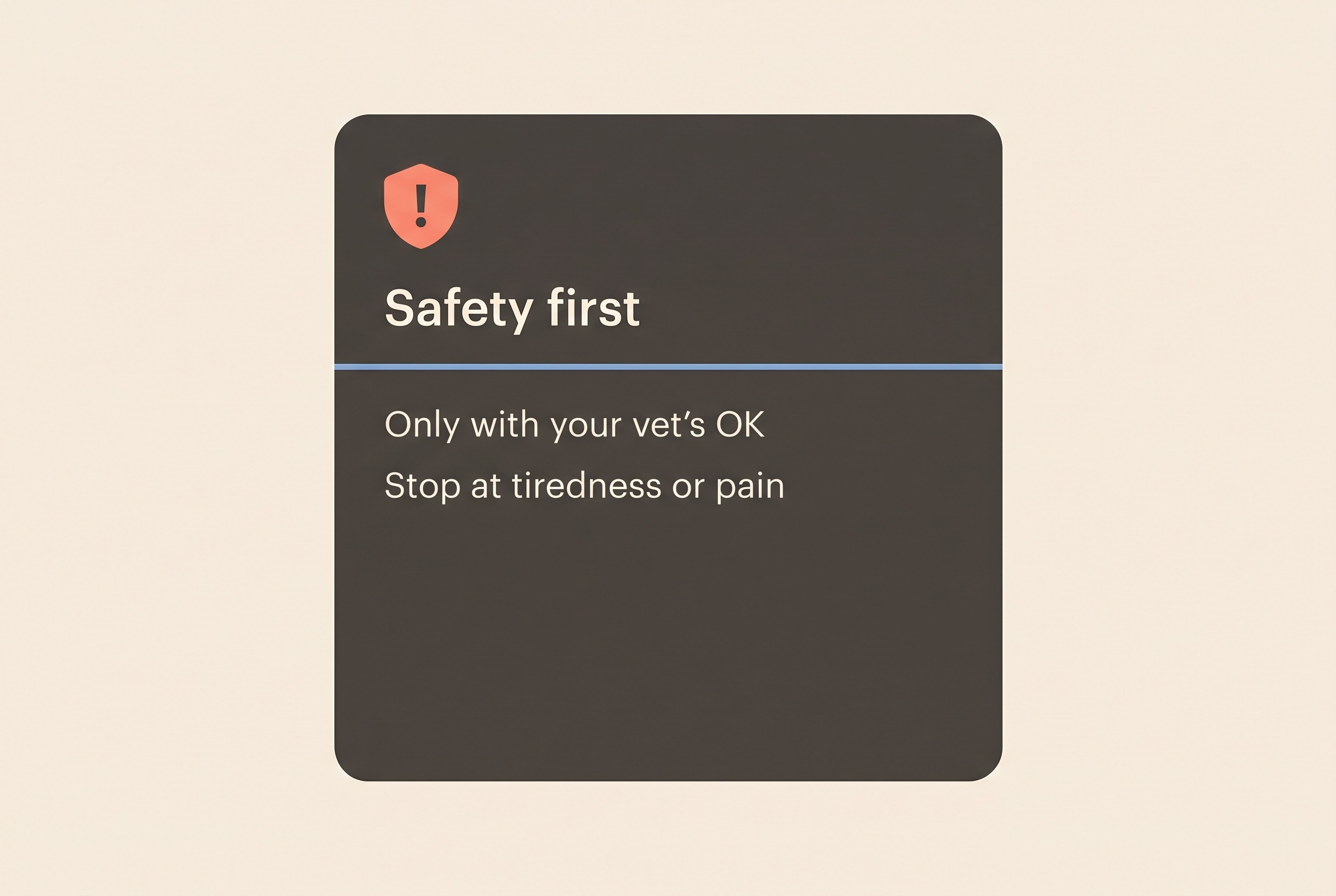
Every exercise on this page is only ever done after your own vet or a qualified physiotherapist has signed it off for your dog, at the right phase of recovery. That isn't a disclaimer I'm tacking on to cover myself.
Post-surgical rehabilitation is patient-centred: it's tailored to the stage of tissue repair and to how your individual dog is progressing, which is precisely why it relies on re-examination and graded progression rather than a fixed programme posted online (RCVS Knowledge, 2024). A generic exercise list applied to the wrong dog at the wrong week is how a repair gets overloaded. The phase your dog is in is set by its tissues, not your kitchen calendar, and only someone with hands on the joint can tell you where the line is this week.
There's a reassuring flip side, and it's the strongest argument for the rule. In a study of 236 dogs after TPLO, those who received rehabilitation from a certified practitioner were 1.9 times more likely to reach full function by eight weeks, with no increase in complications compared with cage rest and lead walking alone (Romano & Cook, 2015). Well-pitched, qualified rehab helps and does not add risk, and both the benefit and the safety come from the same place: it being matched to the dog. So when in doubt, don't, and ask. A two-minute call to your physio is never a waste of time.
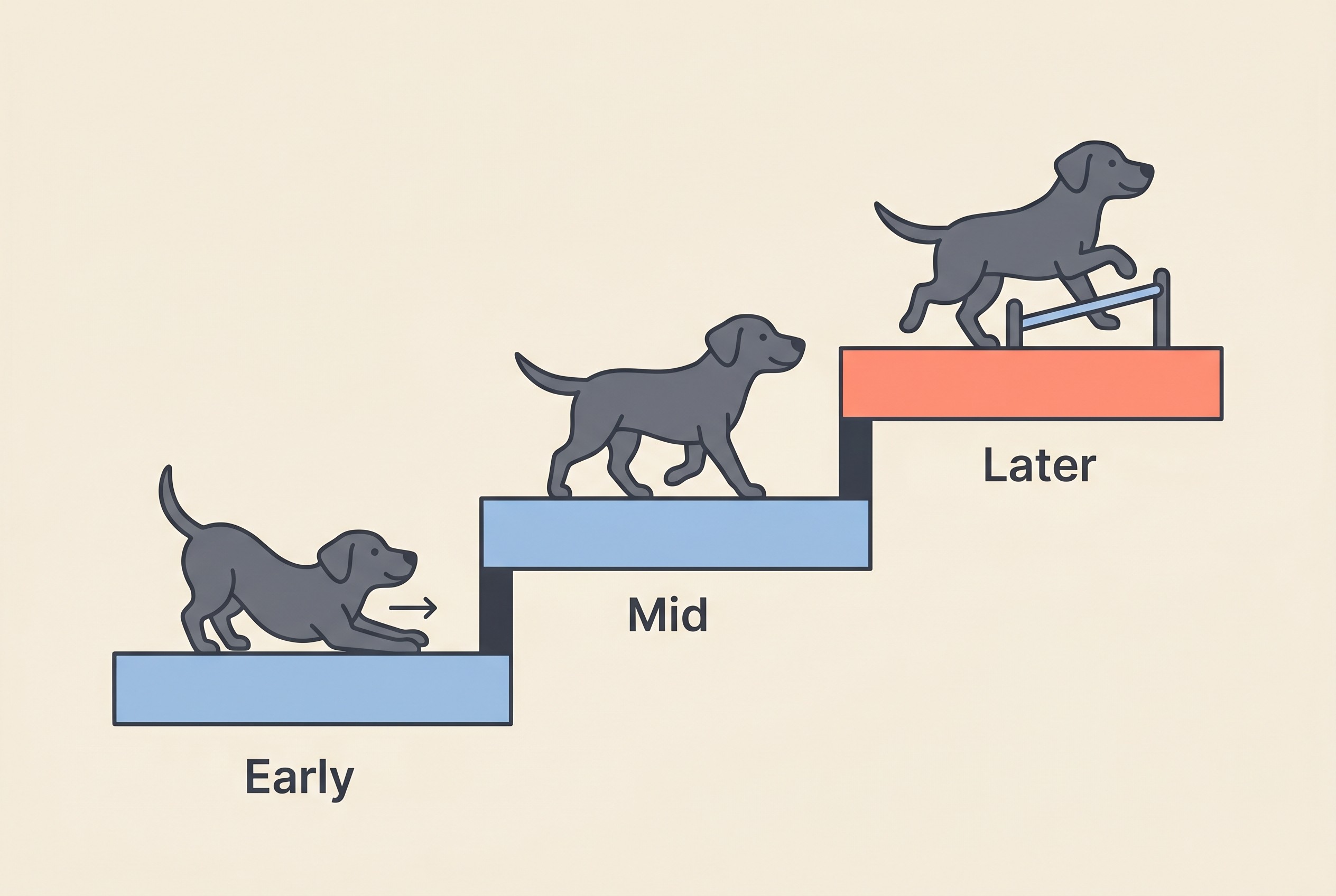
Early phase
One thing has genuinely changed in good rehab practice, and it's worth knowing up front: the old advice to do nothing for six to eight weeks is gone. Borrowing from human ACL surgery, the modern standard is that physiotherapy begins straight after the operation, because stifle range of motion, and extension in particular, is best regained within the first two weeks, before changes in the healing tissue start to limit it (RCVS Knowledge, 2024). So this early fortnight is real, gentle work, not a waiting room.
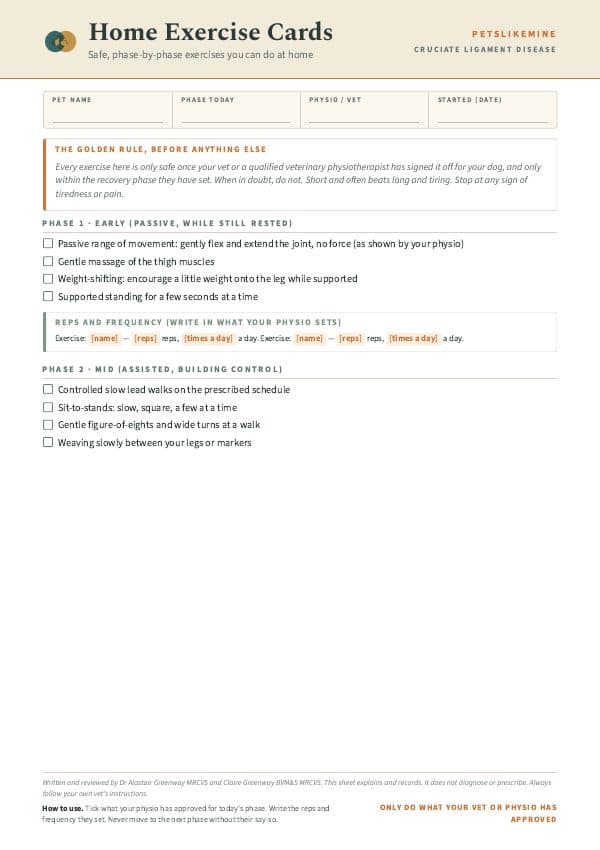
What it looks like is quiet and undramatic. Passive range of motion, or PROM, means you very gently flex and extend the knee while your dog lies relaxed, moving the joint through a comfortable range without your dog doing any of the work. There's gentle massage of the thigh, weight-shifting to load the operated leg a little, and supported standing for short spells.
The point of all this is to keep the hinge moving. PROM helps preserve flexion and extension and keeps the joint capsule and soft tissues supple (Alvarez et al., 2022; Millis & Levine, 2014). What it does not do, so you don't expect too much of it, is build muscle: the muscle isn't working during a passive movement, so this is a "keep things mobile" measure, not a strengthening one (Millis & Levine, 2014). The strength comes later. And every part of this phase is owner-delivered only after a physio or vet has put their hands over yours and shown you the technique. The right amount of flex is something you have to feel, not read.
Mid phase
As the weeks pass and your rehab team confirms the tissues are ready, the work becomes active: your dog starts doing the moving, under control. Prescribed slow lead walks are the backbone of this phase, built up incrementally over roughly the first six weeks, never in a sudden jump (RCVS Knowledge, 2024). Then there are sit-to-stands, quietly one of the best exercises in the whole programme. Asking your dog to sit and stand slowly, repeatedly and with control, targets the muscles that extend the hip and stifle and improves active range of motion (Millis & Levine, 2014). The watchword is control, not speed, and a straight sit matters so the operated leg does its share rather than swinging out to cheat.
Gentle figure-of-eights and weaving come in here too, walking your dog slowly around your legs or a couple of cones, for controlled turning and balanced loading of both hind limbs. If anyone gives you a rep count, treat it as a typical starting point, not a proven dose: there's no peer-reviewed number of sit-to-stands, and your physio's number for your dog beats anything online.
Later phase
The final phase, broadly from around six to twelve weeks and always at your rehab team's say-so, is about rebuilding real strength and coordination. This is where the leg stops merely working and starts working well.
Active strengthening and fuller-range work belong here for a reason: their job is to return your dog toward normal function, and you don't load a leg hard until it has the foundation to take it (Millis & Levine, 2014).
Cavaletti, or low-pole stepping, is the signature exercise here. Walking your dog over a line of low poles encourages a greater active range of motion and longer strides, and it challenges proprioception, balance and coordination, your dog's sense of where its leg is in space, which a recovering stifle loses along with its strength; the poles start low and are raised only as your dog progresses (Millis & Levine, 2014). Gentle inclines, walking slowly up a mild slope, ask the hind end to push a little harder, again only when the leg is ready.
If your dog had an osteotomy such as a TPLO, the surgeon is also waiting on cut bone to heal and may want recheck radiographs before clearing the harder work, so let their timeline lead (see TPLO Explained).
Off-lead, free running is the finish line, not a mid-recovery reward. Most protocols reintroduce off-lead exercise between ten and fourteen weeks, when the stifle is still relatively weak and lacks neuromotor control, which is precisely why the controlled phases come first (RCVS Knowledge, 2024). For the full week-by-week version of the arc, see The 12-Week Recovery Roadmap.
Doing it safely
A handful of practical rules sit over every exercise above, and they're what separate rehab that helps from rehab that backfires. Short and often beats long and occasional: a few minutes of controlled work several times a day is kinder to a healing leg than one long session, and the plan is adjusted to your dog's progress by tweaking duration, speed or frequency (Millis & Levine, 2014). Footing matters more than people expect, so work on non-slip surfaces, because slipping on a hard floor can injure a recovering leg in a heartbeat (Millis & Levine, 2014). Stop at fatigue or pain: if the leg starts to flag or the gait gets ragged, that's the session over, not a moment to push through. And stay inside the phase your vet has authorised, because skipping ahead when your dog "seems fine" is the most common way good owners come unstuck.
Pitch every session to the recovery axis, not a single good or bad moment. Progress here means weight-bearing improving, lameness reducing and swelling settling against the post-op week. An exercise that sets weight-bearing back, where your dog uses the leg less after a session than before, is a move to stop and report. That's the line between a normal off day and a setback worth a phone call, covered in Is This Normal? Red Flags During Cruciate Recovery. Logging each session against that curve with the Recovery Tracker means a move that's quietly costing your dog progress shows up early, while it's easy to fix.
One last word on the evidence, because I'd rather you trusted me than oversold this. The home work is genuinely worth doing: after TPLO, an early intensive physiotherapy programme of massage, PROM and weight-bearing exercises three times a week produced significantly greater thigh circumference and stifle range of motion than home walking by six weeks, with the operated leg's muscle bulk no longer differing from the sound leg (Monk et al., 2006). Structured rehab after lateral-suture repair likewise improved measured limb function at six months (Marsolais et al., 2002). But the field is candid about its limits: six of seven exercise studies support formal programmes, yet many carried a high risk of bias, so no single best exercise dose can yet be claimed (Alvarez et al., 2022). That's why I've described these as the kind of moves your physio will guide, at the pace they'll set, rather than a fixed recipe. Underwater treadmill work, a mainstay of qualified rehab, sits alongside them, and free swimming in your own pond or bath is no home substitute for it (Romano & Cook, 2015); that side of things is covered in Physiotherapy and Hydrotherapy After Cruciate Surgery.
None of this is something you have to memorise. The whole point is little and often, guided by the rehab team who knows your dog's joint, slowly rebuilding a leg that will carry your dog for years. Print the phase cards, keep them on the fridge, and work to the week your physio has signed off, not the one your dog wishes it were on. The leg comes back faster when you aren't racing it.
References
- Alvarez LX, Repac JA, Kirkby Shaw K, Compton N. Systematic review of postoperative rehabilitation interventions after cranial cruciate ligament surgery in dogs. Vet Surg. 2022;51(2):233-243. doi:10.1111/vsu.13755.
- Kanarsky AM, Levine D, Marcellin-Little DJ, Garcia TC. Online information for dog owners regarding cranial cruciate ligament injury and recovery does not meet health literacy recommendations. J Am Vet Med Assoc. 2026;264(4). doi:10.2460/javma.25.10.0680.
- Marsolais GS, Dvorak G, Conzemius MG. Effects of postoperative rehabilitation on limb function after cranial cruciate ligament repair in dogs. J Am Vet Med Assoc. 2002;220(9):1325-1330. doi:10.2460/javma.2002.220.1325.
- Millis DL, Levine D, eds. Canine Rehabilitation and Physical Therapy. 2nd ed. St Louis: Elsevier/Saunders; 2014.
- Monk ML, Preston CA, McGowan CM. Effects of early intensive postoperative physiotherapy on limb function after tibial plateau leveling osteotomy in dogs with deficiency of the cranial cruciate ligament. Am J Vet Res. 2006;67(3):529-536. doi:10.2460/ajvr.67.3.529.
- RCVS Knowledge Canine Cruciate Registry. Rehabilitation (dog-owner guidance). Accessed 9 June 2026.
- Romano LS, Cook JL. Safety and functional outcomes associated with short-term rehabilitation therapy in the post-operative management of tibial plateau leveling osteotomy. Can Vet J. 2015;56(9):942-946. PMID:26347395.
Free downloads
Companion worksheets to put what you've read into practice. Free PDFs, print at home.
Sister tool · Sightline
Track whether treatment is working
Sightline, a separate ConciergeVet tool, runs a short weekly check-in built on validated pain and mobility instruments, turns it into a single Sightline Score you can watch trend over weeks rather than judge on one bad day, and produces a report you can bring to your vet.
A written log, or our printable trackers, does much the same job.
See how Sightline tracks treatmentKeep track of how your pet is doing
The owners who cope best are the ones who notice changes early. A simple health log shows you what is working, and what is not, before the next vet visit.
Start tracking, freeYou're not doing this alone
Compare treatment journeys and talk to owners managing cruciate ligament disease. Free to join.
Join PetsLikeMine