

Physiotherapy and Hydrotherapy After Cruciate Surgery
Alastair Greenway
BVM&S MRCVS
Somewhere in the discharge conversation, between the wound care and the rest rules, somebody said the word "physio." Maybe they handed you a leaflet, maybe they just said your dog would "need some rehab" and moved on. The questions tend to land once you're home. What does it actually do? When can it start? Is it just a swim, or something more? And, if I'm frank about the one most owners are too polite to ask out loud, is it worth the money?
Let me take those in turn. Rehabilitation, the proper name for the physiotherapy and hydrotherapy that follow cruciate surgery, isn't an optional extra. It's how strength and normal movement actually come back. The surgeon stabilises the joint, but a stabilised joint sitting on a wasted thigh and a leg the dog has spent weeks learning not to trust doesn't, on its own, get your dog back to itself. Rehab is the part that does. I'll be straight about how much it helps and how much it doesn't, because the real picture is more useful than the brochure one. This article is about what professional rehab is and when it's safe to start. What you can safely do yourself between sessions is a guide of its own, Home Exercises by Recovery Phase, which I'll point you to at the end.
What physiotherapy does
Think about what's happened to that leg. For weeks or months before surgery, while the cruciate was failing, your dog was offloading it: shifting weight to the good leg, shortening their stride, and the thigh muscle on the bad side quietly wasted away. Then surgery, then strict rest. By the time the wound has healed, the operated leg is weaker and stiffer, and the dog has an ingrained habit of not trusting it. Physiotherapy works on all three at once. It rebuilds the muscle. It restores the stifle's range of motion, the joint's ability to bend and straighten fully, which stiffens after surgery if nothing coaxes it back. And it re-trains the dog out of the limp-compensation pattern it learned before the operation, so it relearns to load the leg properly rather than hopping along on three.
Let me be candid rather than salesy, because this is exactly where competitor pages go vague. The evidence that rehab helps is real, but it's modest. The most thorough review of the field concluded that therapeutic exercise had the most studies showing benefit, on muscle mass, range of motion and weight-bearing, but that the field lacks high-quality evidence and many studies carried a high risk of bias (Alvarez et al., 2022). So when I tell you rehab works, I mean the mechanism makes good sense and the best available evidence supports it, not that a gold-standard trial proves it speeds up every recovery. That's the truthful frame, and the one I'd want if it were my dog.
The single most-quoted trial gives you the texture of it. In a group of dogs after TPLO, a structured physiotherapy programme three times a week, passive range-of-motion work, massage, weight-shifting, underwater treadmill and controlled exercise, regained the thigh muscle so well that by six weeks the operated leg matched the sound leg in circumference, while dogs sent home to just walk on the lead had not caught up. Range of motion recovered better too (Monk et al., 2006). It's a small study, only eight dogs, but the direction of travel is the point: guided rehab rebuilt the leg faster and more completely than walking alone.
This is also where a qualified practitioner earns their fee. A good animal physiotherapist doesn't just run your dog through exercises. They assess gait, find the asymmetries you can't see, progress the work at the right pace, and spot when something isn't healing as it should. The skill is in the judgement, knowing when to push and when to hold, and that's what you're paying for.
Hydrotherapy
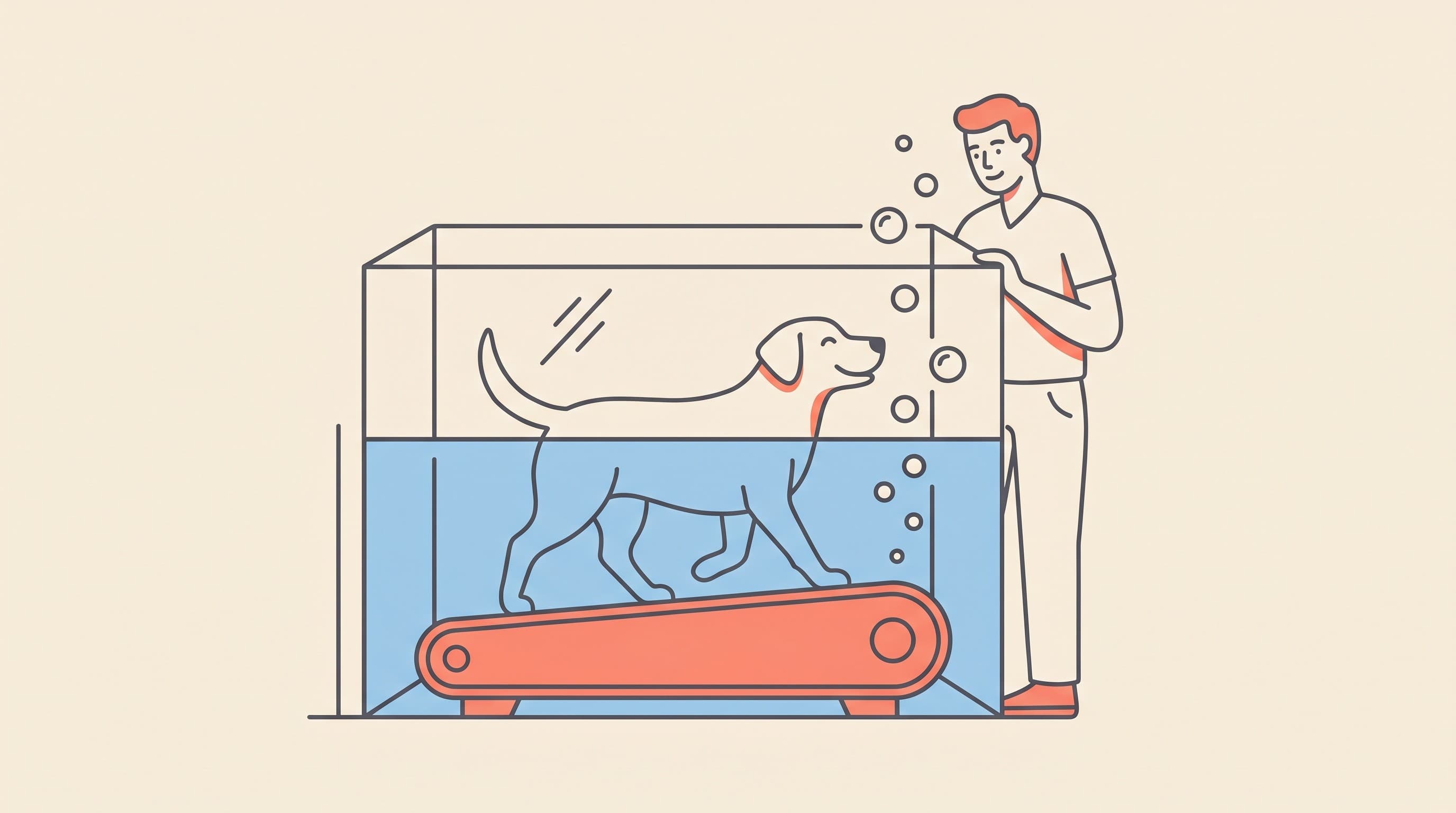
Hydrotherapy is the word that confuses people most, partly because it gets used to mean two quite different things. For a recovering cruciate, the one that matters is the underwater treadmill, not the swimming pool, and the distinction is not a minor one.
The principle is buoyancy. When a dog stands in water, the water carries a large share of its bodyweight, so the leg can move and bear weight with far less load going through the healing joint (Carr, Levine & Marcellin-Little, 2025). That's the magic of it: the dog gets to use the leg, building muscle and confidence and a normal walking rhythm, long before it could safely do the same work on dry land at full weight.
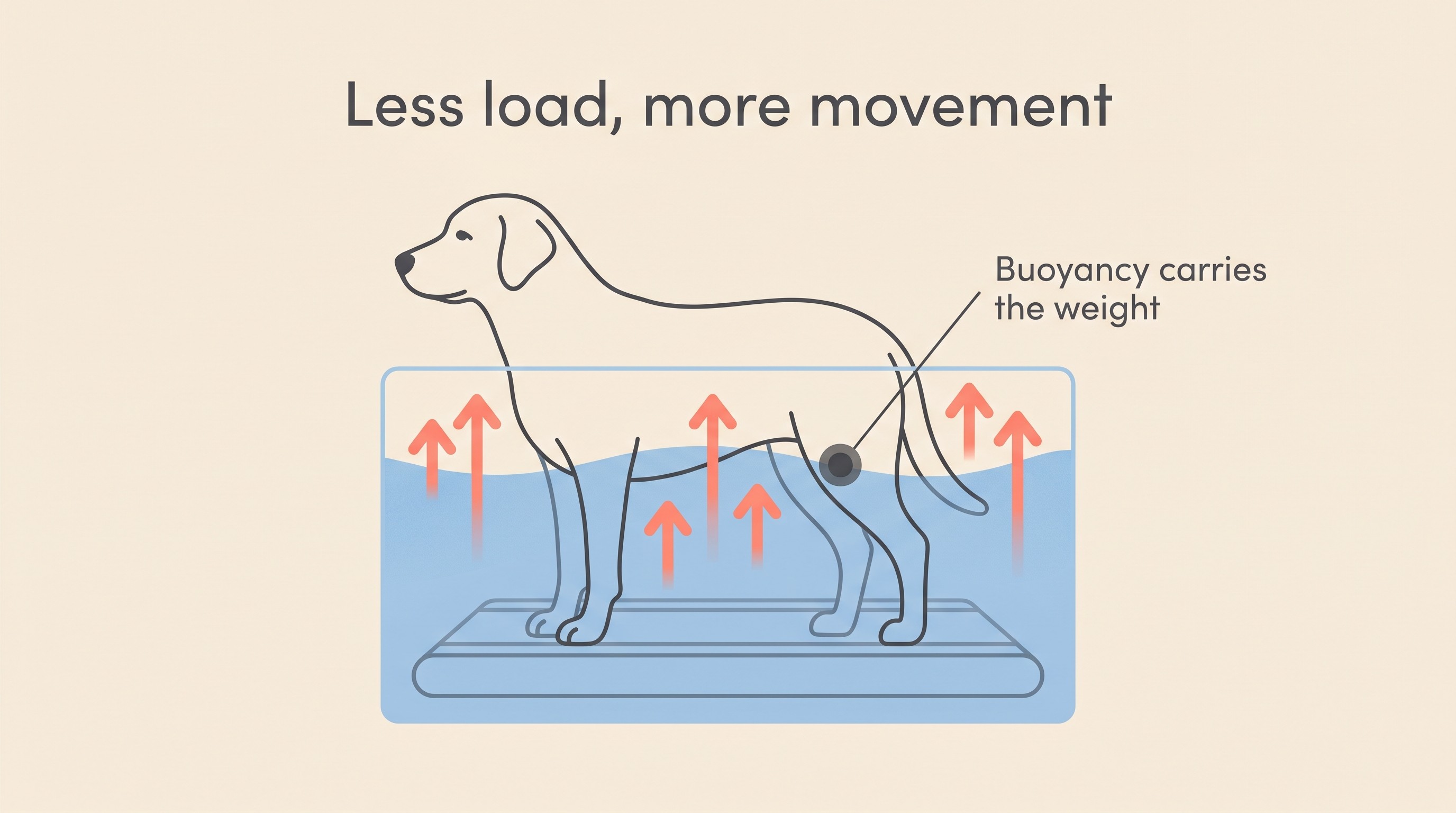
Now the bit owners get wrong, understandably, because "hydrotherapy" sounds like swimming. For rebuilding a stifle, free swimming is usually not what you want. A swimming dog is completely non-weight-bearing, paddling and over-flexing the joints, which trains a movement pattern quite unlike walking. The underwater treadmill does the opposite: controlled, progressive, partial weight-bearing with a normal walking gait, exactly the loading the joint needs to relearn (Carr, Levine & Marcellin-Little, 2025). As the leg gets stronger, the practitioner lowers the water level so more weight goes through it, dialling the load up step by step. That's why most rehab centres reach for the treadmill, not the pool, for post-op cruciate dogs.
Getting the timing right
This is where timing genuinely matters, so let me be clear about the rule. The land-based, hands-on side of rehab, gentle passive movement and the like, can often begin softly and early, but only on your vet's direction, because early controlled motion helps keep the joint mobile, nourishes the cartilage through movement, and limits the stiffness and scar-tissue restriction that set in while the dog can't yet load the leg normally (Carr, Levine & Marcellin-Little, 2025). Water work is different, and it waits.
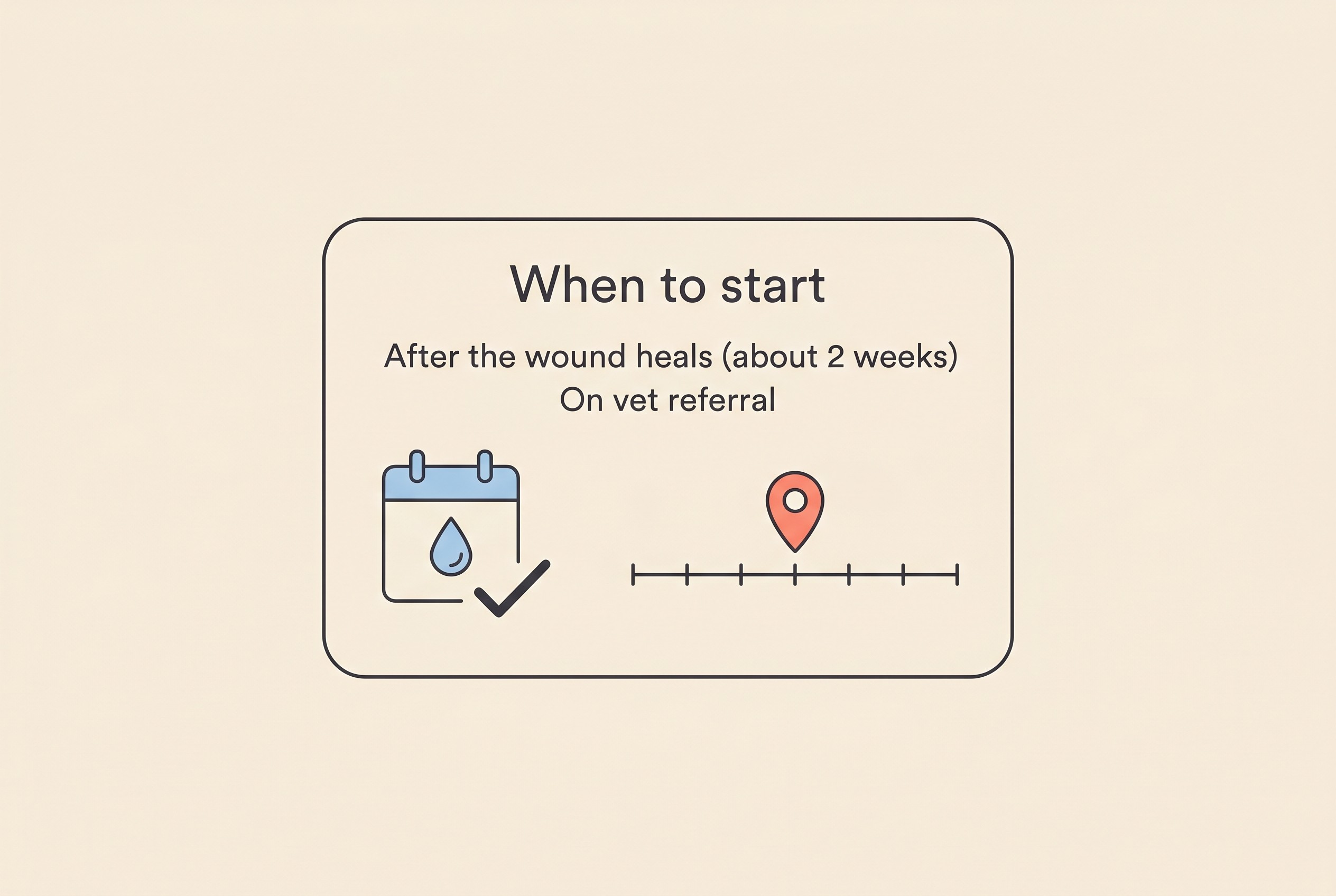
Hydrotherapy must not start before the surgical wound has fully healed, because putting an unhealed incision into water invites infection and wound breakdown. Reputable centres wait until the skin has closed over completely, usually around twelve to fourteen days, and never go ahead without the vet's say-so. Your surgeon has the final word, and if the wound is slow to close, water work waits longer, whatever the calendar says.
One more thing belongs here, because I see it misunderstood. Rehab doesn't replace the rest your surgeon prescribed. It sits inside the recovery plan, not over the top of it. The confinement of those early weeks is still strict, and the structured exercise your physio adds is the controlled, gradual loading that the 12-Week Recovery Roadmap builds in deliberately, not a licence to let the dog do more on its own. The wound, the first fortnight and the early comfort measures, including the cold compression that eases pain and swelling in the first day after surgery (Drygas et al., 2011), have their own home in The First Two Weeks at Home, and that's where I'd point you for the days before water work can begin.
Finding and funding it
Here's something competitor pages tend to gloss over, and it actually matters: rehab in the UK is vet-led by law, not as a courtesy. Under the Veterinary Surgery (Exemptions) Order 1962, physiotherapy on an animal may only be given under the direction of a veterinary surgeon who has examined the animal (RCVS, Veterinary Surgery (Exemptions) Order 1962). Registered canine hydrotherapists will not take your dog without a written referral or signed consent from your vet, even for a simple fitness swim, and they provide a referral form for exactly that purpose (NARCH). This isn't box-ticking. It's a safety feature: the practitioner needs to know what the surgeon did inside the joint, and what they will and won't allow yet, before they put a single load through that leg.
So the route is always the same: ask your vet for a referral. They'll often have a centre they work with, which is ideal, because the physio and the surgeon can then talk to each other. When you're choosing a practitioner, the thing to know is that "animal physiotherapist" isn't a protected title, so anyone can technically use it. The way you check competence is the register. Look for membership of a recognised body: the Association of Chartered Physiotherapists in Animal Therapy (ACPAT), whose members are chartered human physiotherapists who've further-qualified in animal work (ACPAT); the Register of Animal Musculoskeletal Practitioners (RAMP), a voluntary register setting standards for conduct, training and insurance, developed with input from the human statutory regulators (RAMP); or, for water work specifically, the National Association of Registered Canine Hydrotherapists (NARCH).
On cost, let me give you a practical figure and flag it plainly for what it is: this is our experience of UK pricing, not peer-reviewed data, and it varies by region and centre. As a rough guide, sessions commonly run around thirty to sixty pounds each, with a course of several across the recovery. Encouragingly, many pet insurance policies cover rehabilitation when it's vet-referred, so before you assume it's out of pocket, check your policy. The fuller picture on costs and insurance is in What Cruciate Surgery Costs in the UK, and Insurance.
There's one caveat I owe you, because it's the kind of thing the brochure leaves out. Rehab supports surgery; it doesn't replace it in the big active dog. In the trial that compared surgical and non-surgical treatment of overweight dogs with a ruptured cruciate, both groups received physiotherapy, weight loss and an anti-inflammatory, and surgery still gave the better outcome, although around two-thirds of the non-surgical dogs also did well (Wucherer et al., 2013). So well-delivered rehab belongs in every recovery path, but in a large, active dog it's the partner to stabilisation, not an alternative to it. If you're still weighing the non-surgical road for the right kind of dog, that fuller conversation lives in Conservative Management: When It's a Real Option.
Where this fits in the long game
Get the timing right, go through your vet, choose a registered practitioner, and rehab does something genuinely valuable: it gives your dog back the muscle, the movement and the confidence that surgery alone can't restore. Track it the way recovery is actually judged, by weight-bearing, lameness and swelling against the post-op week rather than by how the leg looks on one good day. The Recovery Tracker is built to log exactly those, so a strong week reassures you and a stalled one prompts a check.
And keep one thing in view for later. Surgery limits the arthritis in that knee but doesn't prevent it entirely, because the joint has already been unstable. Keeping muscle on the leg and the joint moving, which is exactly what rehab does, is one of the best long-term things you can do for the arthritic joint underneath, a thread the arthritis library picks up for the years ahead.
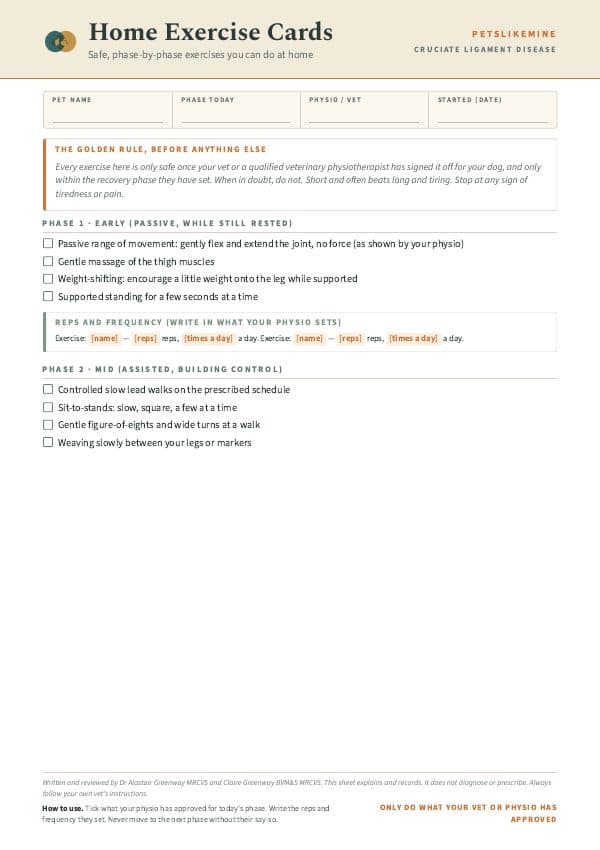
For now, though, the most useful next step is practical. Between professional sessions there's a lot you can safely do at home, with your vet or physio's sign-off, and the order of operations is the thing to hold on to: vet first, registered practitioner second, water only once the wound has closed. Home Exercises by Recovery Phase walks you through what's safe in each phase, so the work carries on between appointments and your dog keeps gaining ground.
References
- Alvarez LX, Repac JA, Kirkby Shaw K, Compton N. Systematic review of postoperative rehabilitation interventions after cranial cruciate ligament surgery in dogs. Vet Surg. 2022;51(2):233-243.
- Association of Chartered Physiotherapists in Animal Therapy (ACPAT). About ACPAT and finding a chartered animal physiotherapist. Accessed 9 June 2026.
- Carr BJ, Levine D, Marcellin-Little DJ. Best practices in physical rehabilitation after cranial cruciate ligament injury in dogs. Adv Small Anim Care. 2025.
- Drygas KA, McClure SR, Goring RL, Pozzi A, Robertson SA, Wang C. Effect of cold compression therapy on postoperative pain, swelling, range of motion, and lameness after tibial plateau leveling osteotomy in dogs. J Am Vet Med Assoc. 2011;238(10):1284-1291.
- Monk ML, Preston CA, McGowan CM. Effects of early intensive postoperative physiotherapy on limb function after tibial plateau leveling osteotomy in dogs with deficiency of the cranial cruciate ligament. Am J Vet Res. 2006;67(3):529-536.
- National Association of Registered Canine Hydrotherapists (NARCH). Frequently asked questions: veterinary referral and consent. Accessed 9 June 2026.
- Register of Animal Musculoskeletal Practitioners (RAMP). About the register and standards. Accessed 9 June 2026.
- Royal College of Veterinary Surgeons / Veterinary Surgery (Exemptions) Order 1962. Treatment of animals by non-veterinary surgeons under the Veterinary Surgeons Act 1966. Accessed 9 June 2026.
- Wucherer KL, Conzemius MG, Evans R, Wilke VL. Short-term and long-term outcomes for overweight dogs with cranial cruciate ligament rupture treated surgically or nonsurgically. J Am Vet Med Assoc. 2013;242(10):1364-1372.
Free downloads
Companion worksheets to put what you've read into practice. Free PDFs, print at home.
Sister tool · Sightline
Track whether treatment is working
Sightline, a separate ConciergeVet tool, runs a short weekly check-in built on validated pain and mobility instruments, turns it into a single Sightline Score you can watch trend over weeks rather than judge on one bad day, and produces a report you can bring to your vet.
A written log, or our printable trackers, does much the same job.
See how Sightline tracks treatmentKeep track of how your pet is doing
The owners who cope best are the ones who notice changes early. A simple health log shows you what is working, and what is not, before the next vet visit.
Start tracking, freeYou're not doing this alone
Compare treatment journeys and talk to owners managing cruciate ligament disease. Free to join.
Join PetsLikeMine