

Conservative Management: When It's a Real Option (and When It Isn't)
Alastair Greenway
BVM&S MRCVS
Surgery gets mentioned, and a quieter question tends to follow close behind: do we actually have to? Sometimes the operation costs more than a family can stretch to. Sometimes the dog is fourteen and the thought of an anaesthetic is unbearable. Sometimes it's a little terrier who already seems to be coping. Whatever the reason, what owners want is a straight answer to one question: is managing a cruciate without surgery real medicine, or wishful thinking dressed up to make everyone feel better?
I'll level with you, because that's the whole point. Conservative management is real medicine for the right dog. It isn't a consolation prize, and it isn't "doing nothing". It also isn't the right answer for every dog, and the evidence is genuinely encouraging for some and sobering for others. What follows is the close look at one arm of the decision: who it really suits, what the evidence says, and where it falls short. If you haven't yet weighed up the choice as a whole, the surgery-or-not guide lays out the full map, and the complete guide covers the basics this piece assumes.
Start with what we're actually managing. The cruciate didn't snap because your dog jumped off the sofa. It failed because the ligament had been slowly degenerating for months, often years, until one ordinary movement finished the job (Comerford et al., 2011). The jump was the trigger, not the cause. That matters enormously, because we aren't waiting for a torn ligament to heal. It won't. We're managing the consequences of an unstable knee, which is a different and more achievable task. If the degeneration story is new to you, why it's degeneration, not an injury is the place to start.
Who it suits
Candidate selection is the whole game. Get it right and conservative management can give a dog a comfortable, functional life. Get it wrong and you'll spend months chasing an outcome that was never realistic.
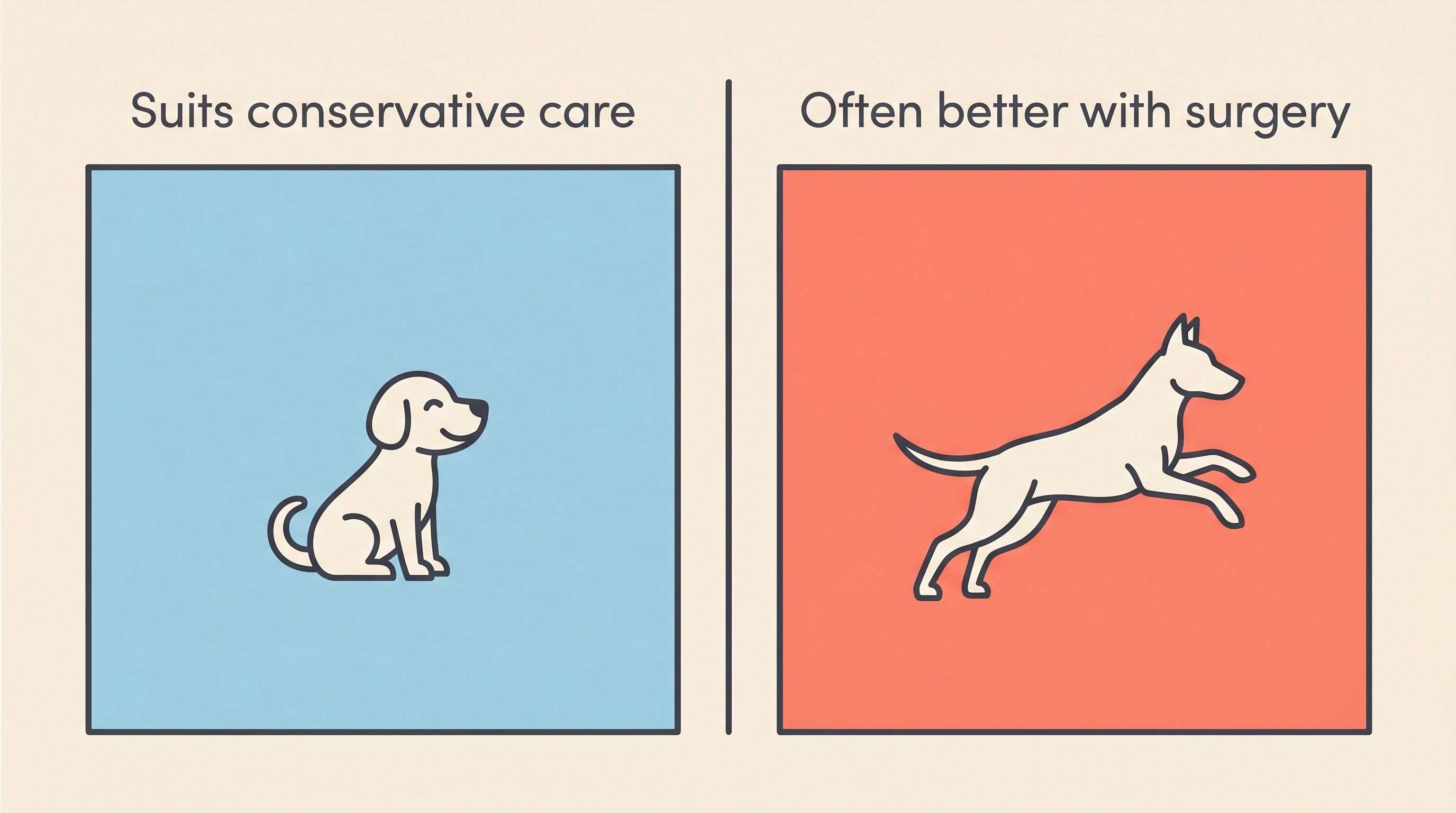
It suits smaller, lighter dogs best. A 7 kg terrier puts far less load through that knee than a 35 kg Labrador, which gives the body's own stabilising scar tissue a fighting chance. It suits older, quieter dogs, and dogs who were never especially athletic. It suits dogs with a partial tear rather than a complete rupture, where some stability remains. And it's the clear first choice where surgery genuinely isn't on the table: because an anaesthetic carries too much risk, because another health problem complicates things, or because the cost simply isn't there. If money is the sticking point, please read the cost and insurance guide first. There are often more options than people realise, and choosing conservative care for the right reasons is medicine, not abandonment.
It suits less well the large, heavy, young, active dog. For that dog, the weight of evidence favours surgical stabilisation for a more reliable and faster return to function, and I'll show you why in a moment. I'm not going to soften that, because pretending a 40 kg working dog will do as well without surgery helps no one.
What it actually involves
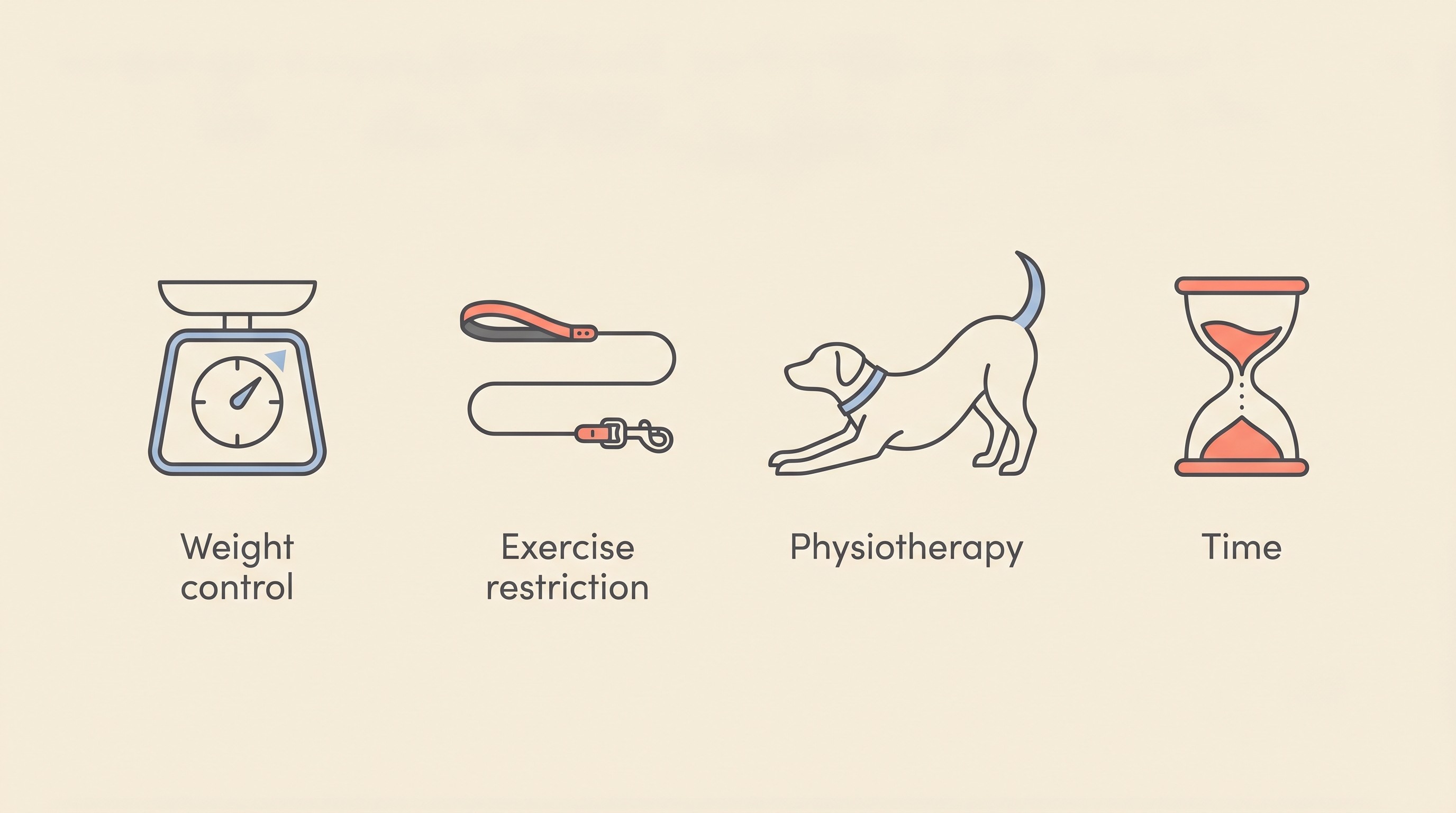
The phrase "non-surgical" misleads people, because it sounds passive. It's anything but. Conservative management asks four real things of you, and consistency over months is what separates it working from not.
The first is strict weight control, the single highest-value lever you hold. If your dog is carrying extra weight, this isn't optional padding around the edges of treatment. It is treatment, and the evidence below shows why.
The second is a long stretch of controlled, restricted exercise: weeks to months of lead-only walking, no leaping, no skidding turns, no stairs at speed, while the joint settles and scar tissue builds. It's slower and arguably more demanding than the twelve weeks a surgical dog needs, precisely because no operation is forcing the issue.
The third is structured physiotherapy, ideally with hydrotherapy, to keep muscle on the leg and rebuild it as you go. Letting the muscle waste is one of the easiest ways to lose ground.
The fourth is appropriate pain relief: a vet-prescribed anti-inflammatory licensed for dogs, never a human painkiller from your cupboard, since paracetamol and ibuprofen can be genuinely dangerous to dogs. And underpinning all four is patience, because progress here is rarely a straight line.
I won't walk you through the week-by-week mechanics here, because that belongs in its own guide. The day-to-day companion, Conservative Management, Day to Day, is where the restriction routine, the specific UK pain-relief options and the rebuild live in detail. The Recovery Tracker lets you log weight-bearing, lameness and swelling so you see the curve rather than guess at it. Bracing sometimes comes up as an adjunct, and whether the evidence supports it is covered in the braces and orthoses guide.
What the evidence shows
This is the part where most pages go vague, and I'd rather just give you the numbers. The best trial we have followed overweight dogs, randomly assigned either to surgery plus the conservative basics or to those basics alone (Wucherer et al., 2013). Worth holding onto: this compared surgery on top of weight loss, physiotherapy and pain relief against the same foundations without the operation, not surgery against doing nothing. A successful outcome meant the leg carried near-normal load (above 85% of a healthy dog's ground reaction force) and the owner reported real improvement. The surgical group did better overall across the year. But sit with where it landed: at one year, almost two-thirds of the dogs managed without surgery had reached a successful outcome, 63.6% against 75.0% for the surgical group (Wucherer et al., 2013).
That's the figure to take away, because it's the real case for conservative management as a genuine option: roughly two in three non-surgical dogs got to a good place at twelve months. That's why this path deserves respect rather than apology. The catch is the route, not the destination. Getting there was slower and less reliable than surgery, with a real mid-recovery dip you need to expect. I've kept the week-by-week curve in Conservative Management, Day to Day, because that's where knowing how to ride the slump rather than panic at it actually helps.
In small dogs the picture looks more even still. A 2024 comparison of TPLO against non-surgical management in small-breed dogs under 10 kg found no significant difference in short-term clinical outcome between the groups, with both improving (Kwananocha et al., 2024). The one measurable edge for surgery was a gain in thigh muscle circumference by day 70 that the conservative dogs didn't show, a reminder of how much the muscle side matters. The study was small and the dogs weren't randomly assigned, nine stifles in each, so I'd call it supportive rather than definitive. But it matches what we see in little dogs in practice.
Now the other side, stated plainly so you trust me on the first. For large, active dogs the strongest functional-recovery evidence sits with surgery, and the TPLO in particular: a systematic review of the surgical options concluded the evidence most strongly supports the TPLO's ability to return dogs to normal function (Bergh et al., 2014). Those dogs get there more reliably and faster than the conservative route can promise. So the small-dog reassurance above isn't an endorsement for a big young Labrador. Different dog, different evidence, different answer. The even-handed run through the operations themselves is the TPLO vs TTA vs lateral suture comparison, and which one suits your dog is your surgeon's judgement, never mine.
A word on weight, as promised. In arthritic dogs, even modest weight loss meaningfully reduces lameness (Marshall et al., 2010), and in the cruciate trial both groups lost body fat and both improved (Wucherer et al., 2013). Whichever path your dog takes, getting the weight off helps; on the conservative path, with no rebuilt mechanism doing the heavy lifting, it may be the single most powerful thing you do. The method and the muscle side sit in Weight, Muscle and the Long Game, which underpins this whole effort.
The hard limits
Let me set out plainly what conservative management cannot promise.
The knee, however well it settles, is never as mechanically stable as a well-stabilised surgical joint, because it relies on scar tissue rather than a rebuilt mechanism. In bigger, more active dogs that gap shows up as a slower, less reliable recovery (Wucherer et al., 2013).
Arthritis still develops, and here I want to be especially careful, because it's where owners get oversold. Neither surgery nor conservative care stops arthritis. Once the joint has been unstable, some stifle osteoarthritis is already underway. Stabilising it, surgically or more slowly through scar tissue, slows that progression but does not switch it off. Anyone who tells you either route "prevents" arthritis is overselling it. So pain relief and joint care become a lifelong conversation, and the arthritis library is where the long view lives.
There's also the meniscus, the cartilage cushion in the knee that's often damaged alongside the cruciate. An unstabilised joint with a meniscal injury can stay sore despite everything you do, one of the genuine reasons a conservative plan sometimes stalls. That's covered in the meniscus guide. And the whole thing asks for sustained commitment of time, money and consistency over months, a real cost even when it isn't a financial one.
One more planning fact, not a doom prophecy. Because this is a degenerative disease, the other cruciate is often affected too, whichever path you choose for the first knee. Across the better studies the risk sits broadly in the region of a third to a half over the following one to two years, a band rather than a single figure. In one of the larger studies just over half the dogs (54%) ruptured the second ligament during follow-up, at a median of around 947 days, closer to two and a half years than two months (Muir et al., 2011). So it's worth budgeting and watching for, not panicking about. The full picture, including how to spot the early signs, is in the bilateral risk guide.
The single most important limit to hold onto: if your dog isn't following the expected curve, surgery should be revisited, not endured around. Choosing conservative management isn't a vow. It's a reasonable first plan you keep checking against reality.
So, where does that leave you? If your dog is small, light, older, quieter, or one for whom surgery genuinely isn't possible, conservative management is a legitimate, evidence-informed choice with a real chance of a comfortable life, and it deserves to be taken seriously rather than offered as a fallback. The next step is to see what running it well looks like day to day in Conservative Management, Day to Day, and to start logging progress with the Recovery Tracker. And if, a few weeks in, the curve isn't bending the way it should, going back to your vet to reconsider surgery isn't a defeat. It's good medicine, the same as everything else here.
References
- Bergh MS, Sullivan C, Ferrell CL, Troy J, Budsberg SC. Systematic review of surgical treatments for cranial cruciate ligament disease in dogs. Journal of the American Animal Hospital Association. 2014;50(5):315-321.
- Comerford EJ, Smith K, Hayashi K. Update on the aetiopathogenesis of canine cranial cruciate ligament disease. Veterinary and Comparative Orthopaedics and Traumatology. 2011;24(2):91-98.
- Kwananocha I, Akaraphutiporn E, Upariputti R, Lekcharoensuk C, Wangdee C. Short-term outcomes of cranial cruciate ligament rupture treated surgically with tibial plateau leveling osteotomy or non-surgically in small-breed dogs weighing less than 10 kg. Journal of Veterinary Medical Science. 2024;86(4):428-435.
- Marshall WG, Hazewinkel HAW, Mullen D, De Meyer G, Baert K, Carmichael S. The effect of weight loss on lameness in obese dogs with osteoarthritis. Veterinary Research Communications. 2010;34(3):241-253.
- Muir P, Schwartz Z, Malek S, Kreeger J, Cabrera SY, Buote NJ, Bleedorn JA, Schaefer SL, Holzman G, Hao Z. Contralateral cruciate survival in dogs with unilateral non-contact cranial cruciate ligament rupture. PLoS One. 2011;6(10):e25331.
- Wucherer KL, Conzemius MG, Evans R, Wilke VL. Short-term and long-term outcomes for overweight dogs with cranial cruciate ligament rupture treated surgically or nonsurgically. Journal of the American Veterinary Medical Association. 2013;242(10):1364-1372.
Sister tool · Sightline
Track whether treatment is working
Sightline, a separate ConciergeVet tool, runs a short weekly check-in built on validated pain and mobility instruments, turns it into a single Sightline Score you can watch trend over weeks rather than judge on one bad day, and produces a report you can bring to your vet.
A written log, or our printable trackers, does much the same job.
See how Sightline tracks treatmentKeep track of how your pet is doing
The owners who cope best are the ones who notice changes early. A simple health log shows you what is working, and what is not, before the next vet visit.
Start tracking, freeYou're not doing this alone
Compare treatment journeys and talk to owners managing cruciate ligament disease. Free to join.
Join PetsLikeMine