

Will the Other Leg Go Too? The Bilateral Risk
Alastair Greenway
BVM&S MRCVS
Once the first knee has been fixed and the limp has settled, a lot of owners arrive at the same quiet question: what about the other leg? Maybe a friend mentioned it, maybe you read it somewhere, or maybe nobody warned you at all and you're meeting the idea right now, a few weeks or a few months in, just as life starts to feel normal again.
I want to turn that question into something useful. The honest answer is yes, the other knee is genuinely at risk, and I'm not going to soften that. But a risk is not a sentence, and this is one of the few moments in your dog's care where knowing the number hands you a plan rather than just a fright. This page sets out what the studies really show, why the second knee is vulnerable, and the handful of things that genuinely tilt the odds back in your favour.
The most important thing to hold in your head is this: cruciate disease in dogs is a degeneration of the dog, not bad luck in one joint.
Why the other knee is at risk
When your dog's cruciate finally gave way, it was tempting to blame the moment it happened: the jump off the sofa, the skid on the wet patio, the turn after a squirrel. But in dogs, those moments are almost never the cause. They're the trigger that finishes off a ligament that has been quietly weakening for months or years. The older idea of a one-off sporting tear has been firmly set aside, replaced by an understanding of cruciate disease as a systemic, progressive process linked to degenerative joint disease across the whole dog (Niebauer & Restucci, 2023).
That word, systemic, is the crux of the bilateral question. The process that degraded the first ligament is, in most dogs, a feature of that dog's biology, immune signalling and conformation, not a localised accident. A dog has two knees built to the same blueprint, loaded by the same body, shaped by the same genetics. Whatever predisposed the first stifle is, by definition, present on the other side too.
Conformation makes this concrete. A steep slope to the top of the shin bone, what surgeons call the tibial plateau angle, and a narrow tibial tuberosity are recognised conformational risk factors, aggravated by excess body weight, and obesity on its own roughly quadruples the risk of rupture (Niebauer & Restucci, 2023). Your dog's tibial plateau angle is the same on both legs, and its body weight loads both. So the question was never whether the second knee shares the risk factors. It does, completely. The real question is how likely those factors are to declare themselves on the second side, and that's where the numbers come in.
I go much deeper into the genetics and immune-mediated joint inflammation behind this in why it's degeneration, not an injury. If that framing is new to you, it's the engine underneath everything on this page.
The real odds
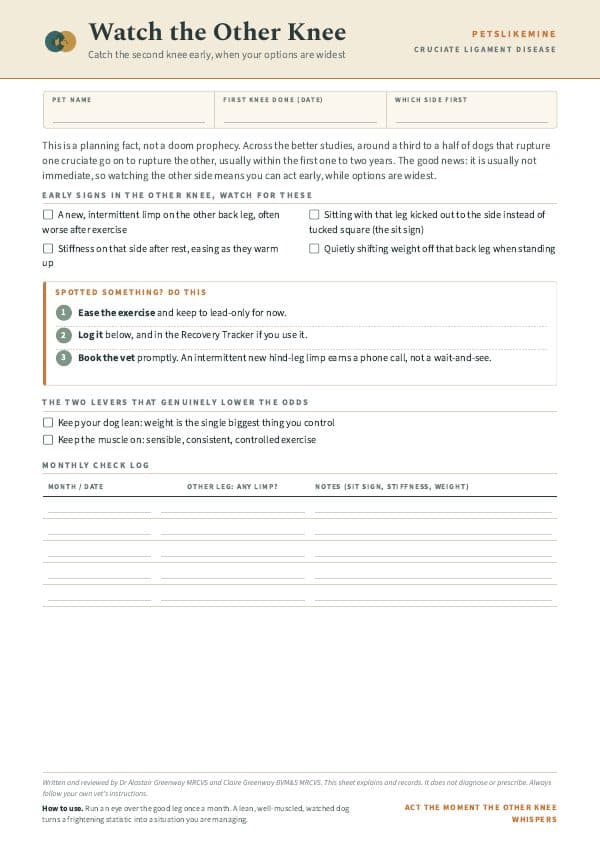
Here's the number you came for, stated as plainly as I can. Across the better studies, somewhere in the region of a third to a half of dogs that rupture one cruciate go on to rupture the other, usually within the first one to two years. Read that as a range, not a single magic figure, because the truth is genuinely spread across that band rather than pinned to one point.
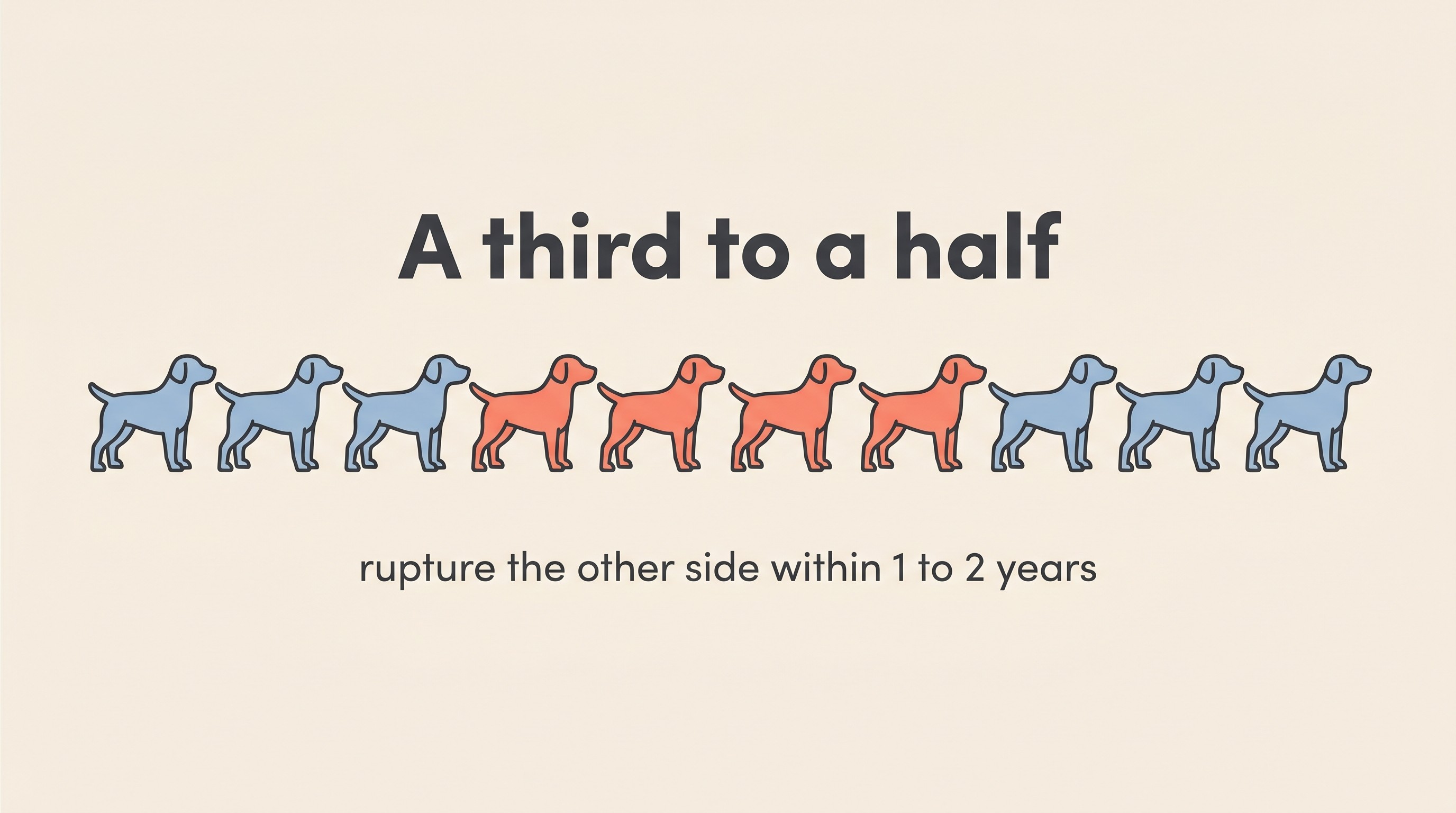
Let me show you the working. In one of the larger studies, 204 of 380 dogs, that's 54 percent, ruptured the second cruciate during follow-up (Muir et al., 2011). In a study of Labradors, a breed that gets more than its share of this disease, 45 of 94 dogs (48 percent) ruptured the contralateral side later, with a further 10.6 percent having already done both knees when first seen (Buote et al., 2009). A scoping review puts it at roughly 40 to 50 percent within one to two years, with around a third going inside the first year (Niebauer & Restucci, 2023). And from closer to home, a UK study of 511 dogs at the Royal Veterinary College found 38.7 percent developed bilateral disease (Grierson et al., 2011).
Two things matter about how you read those figures. First, "a real risk, up to about a half over a couple of years" is a fair summary for many dogs, while still leaving a meaningful minority who never rupture the second side at all. Treat it as a fact to plan around, not a doom prophecy. Second is the timing, and it's easy to miss: this is usually not immediate. The median time to the second rupture in the Muir study was 947 days, around two and a half years (Muir et al., 2011), while the UK study averaged about 13 months, with some dogs going within weeks and others not for several years (Grierson et al., 2011). That spread is a window, the months and years in which the things below can do their work.
One more finding turns a population statistic into something specific about your dog. When the other stifle already shows changes on an X-ray at the first diagnosis, the picture shifts: dogs with severe fluid swelling visible in the contralateral knee were far more likely to rupture it, carrying an odds ratio of 13.4 at one year and 11.4 at two years (Chuang et al., 2014). In plain terms, the second knee often tells on itself on imaging before it ever limps. That makes a quiet case for asking your vet to image both stifles, so you have a baseline for the side that hasn't failed yet.
Turning the odds into a plan
If the second knee is more likely than not to need attention over the next couple of years, the sensible response isn't panic. It's preparation, which is calmer than worry because it gives you something to do.
The practical heart of this is budgeting for the possibility of two surgeries rather than one. I won't put pound figures on this page, because cruciate costs vary enormously with the procedure, your region and your dog's size; we've written a clear, current breakdown of what cruciate surgery costs in the UK, and insurance to read with a calculator. The one thing I'd flag is timing. If your dog is insured, the second knee can be the moment a pre-existing-condition clause bites, because once one cruciate has gone, many insurers treat the other as related. Far better to understand that now, while you can check your policy wording, than to discover it the week the second leg gives way.
The other half of planning is emotional, and I don't think that's soft. If the second knee does go, you'll already have done your grieving and your sums. You won't be blindsided, you'll recognise the limp for what it is, and you'll move faster and more calmly than you did the first time.
One guardrail, in case the second side does need stabilising. Surgery limits arthritis but does not prevent it. Once a knee has been unstable, some degree of osteoarthritis is already underway, and stabilising the joint slows that process rather than erasing it. If you reach that point, the procedure is your surgeon's individualised judgement, not a verdict handed down by a website.
What lowers the odds
You cannot reverse your dog's ligament biology or reshape its conformation, so no intervention abolishes the risk entirely. But a lean, well-muscled, watched dog stacks the odds, and three levers do most of the work.
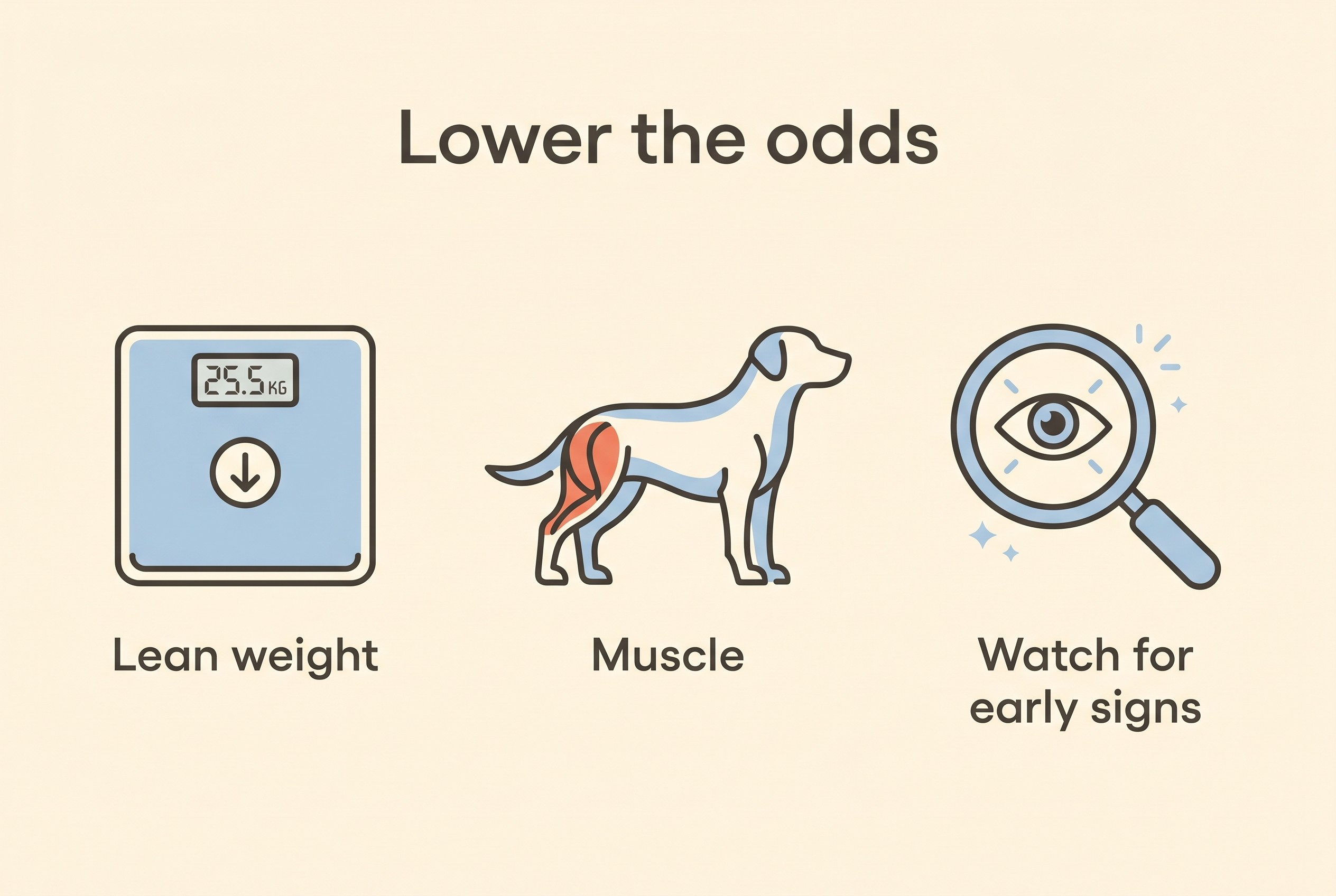
Weight is the biggest lever, by a distance. Excess body weight both raises the risk of rupture and worsens the arthritis on both sides, and it's the single thing most owners can actually change. Obesity roughly quadruples cruciate risk (Niebauer & Restucci, 2023), and overweight dogs were more likely to have bilateral disease in the UK study (Grierson et al., 2011). Getting your dog lean, and keeping it lean, is the most powerful protective thing you will ever do for the second knee. Body-condition scoring and the weight-loss method deserve proper space, and we give them that in weight, muscle and the long game and across the Arthritis and Mobility hub. Start with the principle: lean dog, protected knee.
Muscle and sensible, consistent activity come next. A well-muscled hindlimb supports and steadies the joint. What helps is regular, controlled, moderate exercise, the same amount most days. What hurts is the two extremes: cotton-wool rest that lets muscle waste away, and the weekend-warrior pattern of a sedentary week then a hard Sunday hike that asks a degenerating ligament for everything at once. The programming lives in weight, muscle and the long game.
Watch the other side, and act early. This is where the timing window pays off. Because the second rupture usually isn't immediate, and the knee often shows subtle signs before it fails outright, you have a real chance to catch a partial tear while options are widest (more on that tricky stage in partial cruciate tears). I'm not writing the symptom checklist here, because catching the early signs earns its own article: spotting early signs in the other knee, and that's the one to read next. The short version is that an intermittent new hind-limb limp, stiffness after rest, or your dog quietly offloading weight from one back leg all earn a phone call, not a wait-and-see.
A simple way to keep track of all three over the months ahead is to log them. The Recovery Tracker lets you note the other leg's weight, condition and any early niggles over time, so a slow change you'd miss day to day shows up as a trend you can take to your vet.
You can't guarantee the other knee, and I won't pretend you can. But you can make your dog lean, keep it well-muscled, and watch the side that hasn't failed so you act the moment it whispers rather than the moment it shouts. Do those three things and you've turned a frightening statistic about dogs in general into a situation you're managing for your dog in particular. The next step is to learn what early looks like: spotting early signs in the other knee picks it up from here.
References
- Buote N, Fusco J, Radasch R. Age, tibial plateau angle, sex, and weight as risk factors for contralateral rupture of the cranial cruciate ligament in Labradors. Veterinary Surgery. 2009;38(4):481-489.
- Chuang C, Ramaker MA, Kaur S, Csomos RA, Kroner KT, Bleedorn JA, Schaefer SL, Muir P. Radiographic risk factors for contralateral rupture in dogs with unilateral cranial cruciate ligament rupture. PLoS ONE. 2014;9(9):e106389.
- Grierson J, Asher L, Grainger K. An investigation into risk factors for bilateral canine cruciate ligament rupture. Veterinary and Comparative Orthopaedics and Traumatology (VCOT). 2011;24(3):192-196.
- Muir P, Schwartz Z, Malek S, Kreines A, Cabrera SY, Buote NJ, Bleedorn JA, Schaefer SL, Holzman G, Hao Z. Contralateral cruciate survival in dogs with unilateral non-contact cranial cruciate ligament rupture. PLoS ONE. 2011;6(10):e25331.
- Niebauer GW, Restucci B. Etiopathogenesis of canine cruciate ligament disease: a scoping review. Animals (Basel). 2023;13(2):187.
Free downloads
Companion worksheets to put what you've read into practice. Free PDFs, print at home.
Sister tool · Sightline
Track whether treatment is working
Sightline, a separate ConciergeVet tool, runs a short weekly check-in built on validated pain and mobility instruments, turns it into a single Sightline Score you can watch trend over weeks rather than judge on one bad day, and produces a report you can bring to your vet.
A written log, or our printable trackers, does much the same job.
See how Sightline tracks treatmentKeep track of how your pet is doing
The owners who cope best are the ones who notice changes early. A simple health log shows you what is working, and what is not, before the next vet visit.
Start tracking, freeYou're not doing this alone
Compare treatment journeys and talk to owners managing cruciate ligament disease. Free to join.
Join PetsLikeMine