

Spotting Early Signs in the Other Knee
Alastair Greenway
BVM&S MRCVS
Once a dog has been through a cruciate on one side, most owners start watching the other leg. You've learned to read your dog's back end in a way you never used to: the pause before the jump, the way they shift their weight at the food bowl, the morning they're a little slow off the bed. And one question tends to sit at the back of your mind, the one almost nobody warns you about until it's already happened. Is the other one going to go too?
Let me be straight about what this article can and can't do. It can't hand you a test that catches the second knee before it fails. There isn't one. What it can do is tell you what to watch for, why those small signs matter, and what to do the moment something looks off, so that if the other knee does start to go, you catch it early rather than at the dramatic, non-weight-bearing crisis you remember from last time. That difference, early versus late, is one of the few things here that's genuinely in your hands.
It's worth a quick word on why the second knee is even at risk, because it changes how you should think about all of this. Cruciate disease in dogs isn't a one-off injury to a single joint. It's a slow degeneration of the ligament, and in most dogs it's a process happening across the whole animal, not bad luck in one knee. We know this in a way that's almost uncomfortable: when surgeons look inside the good knee of a dog who has ruptured the other side, the apparently healthy stifle already shows inflammation of the joint lining at the time of diagnosis (Muir et al., 2011). The other knee isn't a fresh accident waiting to happen. It's a joint already quietly travelling the same road, just further back. That's the engine behind everything below. For the full picture of how likely the second knee is to go, and over what timescale, I cover the odds in Will the Other Leg Go Too? The Bilateral Risk. This piece is its practical companion: not the chances, but what to look for and what to do.
The subtle early signs
Here's where you, the owner, are genuinely good at this job. You already know what your dog's first cruciate looked like. You've seen the whole arc once, and that lived memory is a better early-warning system than any checklist I can write, so lean on it. The catch is that the second knee, in its early stages, often looks far less dramatic than the first one did by the time you reached the vet. You're not watching for a sudden three-legged dog. You're watching for whispers.
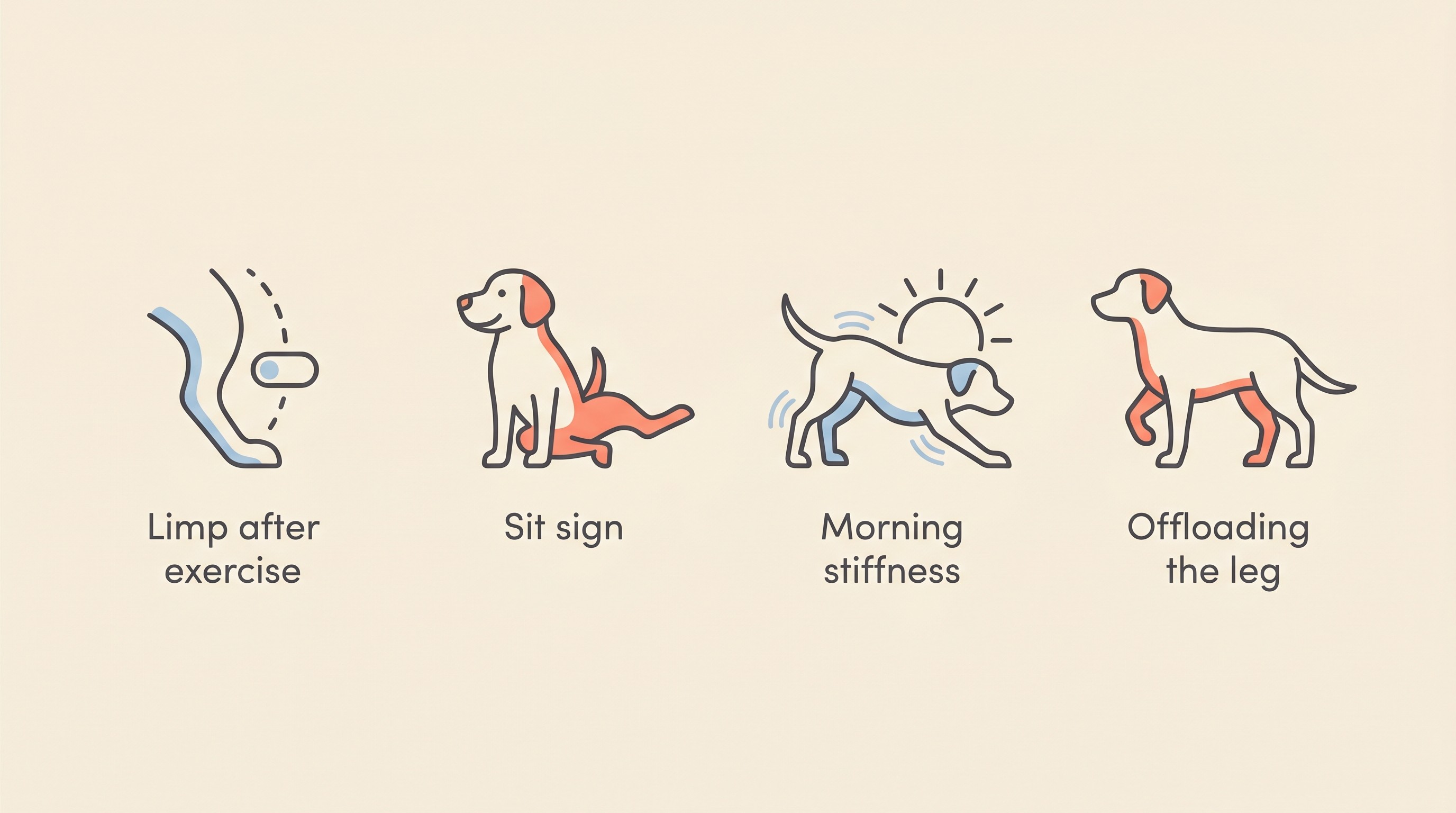
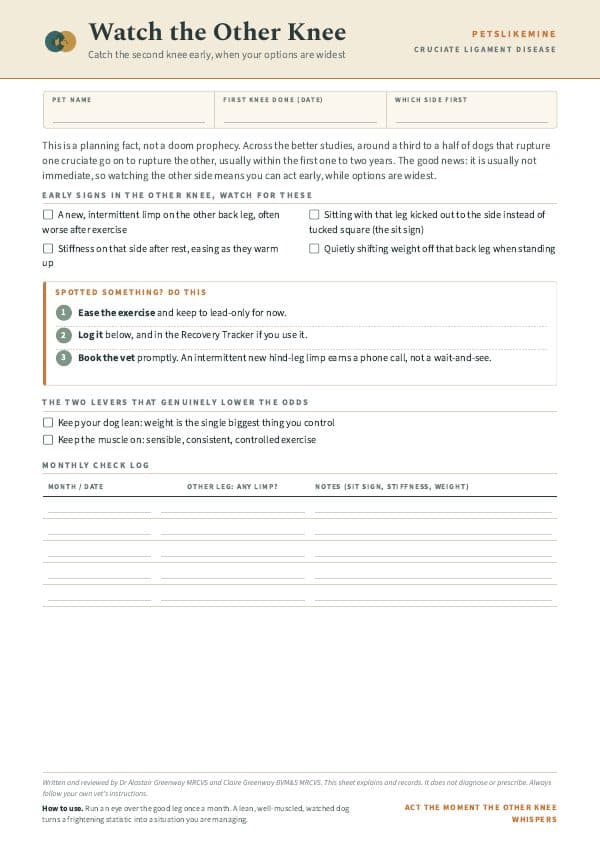
A new, intermittent limp on the previously good leg. This is the classic one. A limp that shows up after a longer walk or an enthusiastic jump, eases off with rest, then comes back. The come-and-go pattern is exactly what you'd expect, because a cruciate doesn't usually snap in one moment. It frays and fails in stages, so the lameness waxes and wanes as the joint has good days and bad days. If you find yourself thinking "she was a bit lame on the right yesterday but she's fine today," don't file that under fine. File it under early.
The "sit sign" on the other side. Watch how your dog sits. A normal, square sit needs the knee to fold all the way up underneath. A sore cruciate knee doesn't want to bend that far, so the dog cheats: they kick the leg out to the side, or slide it forwards, rather than tucking it neatly under the hip. If your dog has started sitting lopsided with one back leg splayed out, that's worth noting. I'll be candid about its limits, though. When researchers tested a formal sit-to-stand assessment as a stand-alone test, it didn't reliably pick up every dog with cruciate disease (Triviño et al., 2024). So treat the sit sign as one useful flag among several, a tell rather than a diagnosis.
Stiffness getting up, especially in the morning or after a rest. A joint with low-grade inflammation tends to be at its worst when it's been still. If one back leg is slow and creaky for the first few steps after a nap and then loosens up, that's the inflamed joint talking.
Weight quietly shifting off the leg. When a dog stands, watch whether they're loading both back legs evenly or subtly favouring one. Over time, a dog offloading a sore knee loses muscle bulk over that thigh, because they're using it less. This creeps up so gradually it's genuinely hard to spot day to day. A useful trick is to run a flat hand over both thighs every so often and compare: a knee that's been quietly sore for weeks often sits on a noticeably slimmer leg.
Let me be clear about the ceiling on all of this. Owner observation is genuinely informative, but it isn't perfect. Early cruciate change is subtle and intermittent by nature, and even objective force-plate testing in the consulting room can miss the milder cases that the gold-standard walk test still picks up (Triviño et al., 2024). If a precise pressure-plate can be fooled by a quiet limp, so can a busy household. A dog can be wagging, eating, weight-bearing and apparently happy and still have early disease ticking along in that joint. That isn't a reason to feel you've failed at watching. It's the reason the rule has to be: act on suspicion, and let your vet confirm. You don't need to be certain, only to notice and hand it on.
Why early matters
It's fair to ask whether catching the second knee a few weeks or months sooner actually changes anything, given that you can't reverse the degeneration. It's a good question, and I won't oversell the answer. Catching it early does not save the ligament or cure the joint. The process is already underway and, left alone, a partial cruciate tear in dogs tends to progress to a complete rupture, usually within months to a year. I unpack why that progression happens in Partial Cruciate Tears: The Tricky Early Stage, the best next read if you want the biology.
So what does early actually buy you? Three real things.
First, time to plan. You remember how the first one went: the suddenness, the scramble, the cost landing all at once. Catching the second knee at the early, partial-tear stage means the conversation about finances, surgery dates, time off work and recovery logistics happens on your timeline, not in a crisis.
Second, a head start on the levers that genuinely help. The moment you suspect the second knee, you can begin controlling weight and impact, the two things most within your power to slow the joint's decline. I won't re-teach that here, because I cover it properly in Weight, Muscle and the Long Game.
Third, a calmer decision. There's evidence that changes in the second knee can be detected before it gives way: in one study, dogs whose contralateral stifle already showed significant joint changes at diagnosis were far more likely to go on to rupture that side (Chuang et al., 2014). The second knee often declares itself, quietly, if someone is looking. Catching it in that window means you make a considered decision with your vet, not a reaction to a dog who can't put a foot down.
So hold a true expectation rather than a hopeful one: early detection buys you options and a steadier decision, not a cure.
If you spot something, here's the sequence
Say you've noticed a whisper. There's an order to what comes next, and it's deliberately not "wait and see," because the lesson of the first knee is that the dramatic episode is rarely the start of the problem. It's the middle of it.
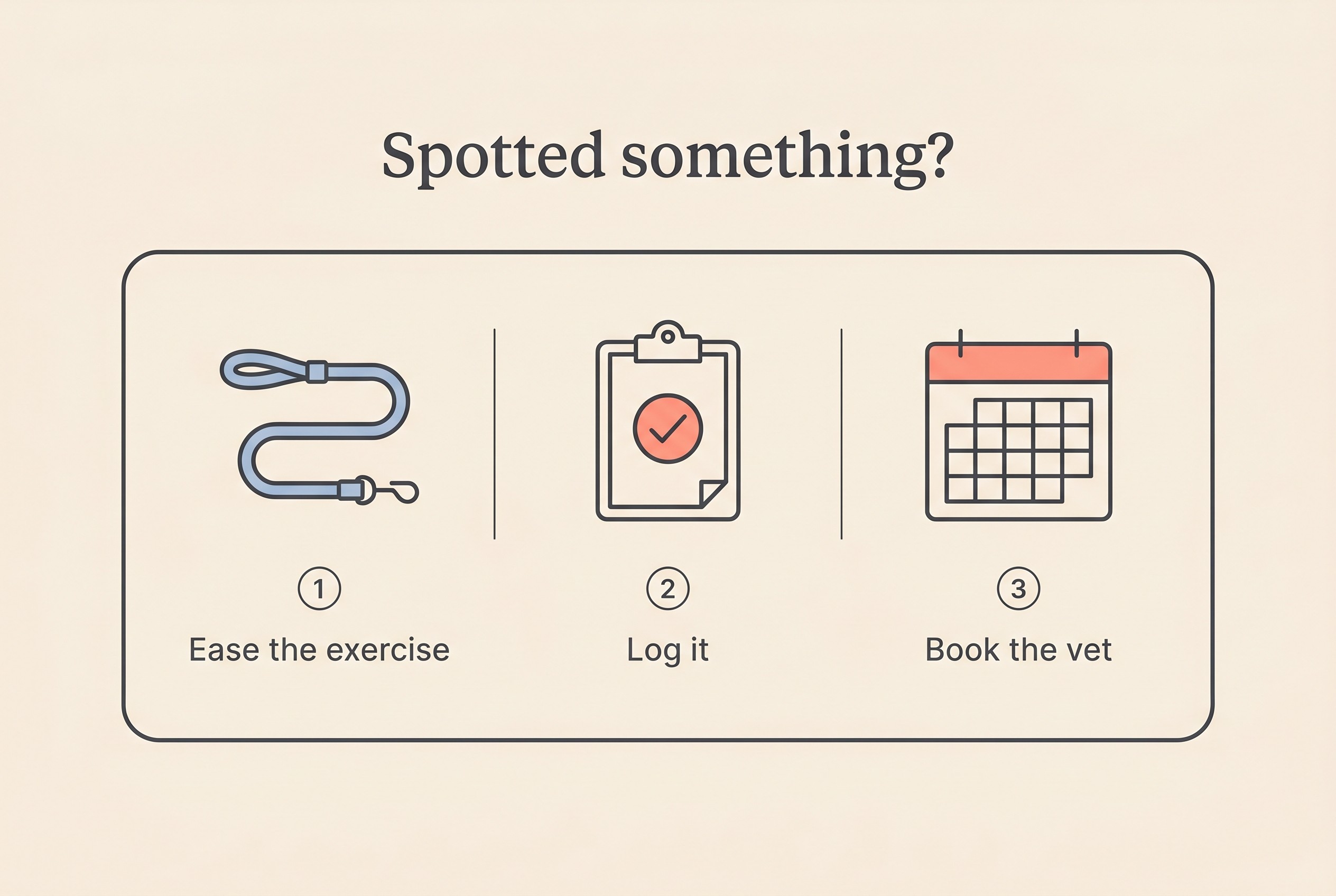
Ease the load straightaway. While you're arranging to be seen, take the pressure off that knee. Lead walks only, no jumping in or out of the car, no twisting ball games or skidding turns, nothing that asks the joint to do the very thing a failing cruciate hates. You're not putting the dog on bed rest, just taking the spikes of impact out of the next week or two while you get a proper opinion.
Log it. This is the bit owners skip and then regret. Note when the limp started, what brings it on, whether it's better or worse than yesterday, how the leg looks when your dog stands. A few lines a day turns a vague "she's been a bit off lately" into a real timeline your vet can use. Our Recovery Tracker is built for exactly this: its three axes are weight-bearing, lameness and swelling, precisely what you're watching for in the other knee. Even if this knee never needs surgery, that record makes the vet visit sharper.
Book the vet. This is where suspicion becomes diagnosis, and it's the step that matters most. A proper orthopaedic examination, feeling for the abnormal joint movement and the swelling, sometimes with imaging, is the only way to confirm what's going on, and it's not something you can do from the sofa. I won't walk you through the tests here, because I cover how the diagnosis is reached in How Cruciate Disease Is Diagnosed. Your job isn't to diagnose it. It's to get the dog in front of someone who can.
One last note on timing. There's no validated home screening test that catches a second cruciate before it ruptures, and the studies show the second knee can go fairly quickly once it declares itself: in one series of Labradors, among the dogs that did rupture the other side, the median time to that second rupture was only about five and a half months (Buote et al., 2009). So the highest-vigilance window is roughly the first one to two years after the first knee, though the watchfulness is really lifelong. None of that should make you anxious every time your dog trots oddly across the kitchen. It should just lower your threshold for acting, in that window especially.
You've done this once. You already know, better than any article, what the start of trouble looks like in your own dog, and that's exactly what makes you the best early-warning system this knee has. Trust the small signs over the temptation to wait for a big one, ease the load, write it down, and let your vet confirm. And if it turns out to be nothing this time, that's not a wasted visit. That's a clear knee and a calmer you. When you're ready to think about the bigger lifelong picture, protecting both knees through the years your dog has left, Weight, Muscle and the Long Game is where the journey picks back up.
References
- Buote N, Fusco J, Radasch R. Age, tibial plateau angle, sex, and weight as risk factors for contralateral rupture of the cranial cruciate ligament in Labradors. Veterinary Surgery. 2009;38(4):481-489.
- Chuang C, Ramaker MA, Kaur S, et al. Radiographic risk factors for contralateral rupture in dogs with unilateral cranial cruciate ligament rupture. PLOS ONE. 2014;9(9):e106389. doi:10.1371/journal.pone.0106389
- Muir P, Schwartz Z, Malek S, et al. Contralateral cruciate survival in dogs with unilateral non-contact cranial cruciate ligament rupture. PLoS ONE. 2011;6(10):e25331. doi:10.1371/journal.pone.0025331
- Triviño A, Davidson C, Clements DN, Ryan JM. Objective comparison of a sit to stand test to the walk test for the identification of unilateral lameness caused by cranial cruciate ligament disease in dogs. Journal of Small Animal Practice. 2024;65(1):24-29.
Free downloads
Companion worksheets to put what you've read into practice. Free PDFs, print at home.
Sister tool · Sightline
Track whether treatment is working
Sightline, a separate ConciergeVet tool, runs a short weekly check-in built on validated pain and mobility instruments, turns it into a single Sightline Score you can watch trend over weeks rather than judge on one bad day, and produces a report you can bring to your vet.
A written log, or our printable trackers, does much the same job.
See how Sightline tracks treatmentKeep track of how your pet is doing
The owners who cope best are the ones who notice changes early. A simple health log shows you what is working, and what is not, before the next vet visit.
Start tracking, freeYou're not doing this alone
Compare treatment journeys and talk to owners managing cruciate ligament disease. Free to join.
Join PetsLikeMine