

What Cruciate Surgery Costs in the UK, and Insurance
Alastair Greenway
BVM&S MRCVS
Most pages about cruciate surgery dance around the money. I'd rather not. Someone has probably said a number out loud, you've got a quote in front of you, and what you want is the actual figures laid out plainly, plus the bits about insurance that almost nobody mentions until it's too late. That's what this page is for.
One thing first, because it changes how you carry this. Cruciate disease in dogs is a degeneration, not a one-off accident: the ligament had been quietly weakening for months before your dog hopped off the sofa and came up lame. So whatever this costs, please don't carry it as guilt about a moment of bad luck. The jump was the trigger, not the cause, and the full story is in why it's degeneration, not an injury.
A word on the numbers. Everything I quote in pounds is a practical estimate, not peer-reviewed data, because there is no single research-backed "UK price" for this surgery. Prices vary widely by region, dog size, surgeon, the implants used, how much imaging is needed and whether anything goes wrong. I'll give ranges and a couple of real published packages, all stamped as 2024 to 2025 pricing that will already be drifting upward. Treat them as a sense of the territory, then get an exact quote from your own practice.
Roughly what each procedure costs
The price is tied closely to which operation your dog needs, and that's driven mostly by size and activity, not by anyone upselling you.
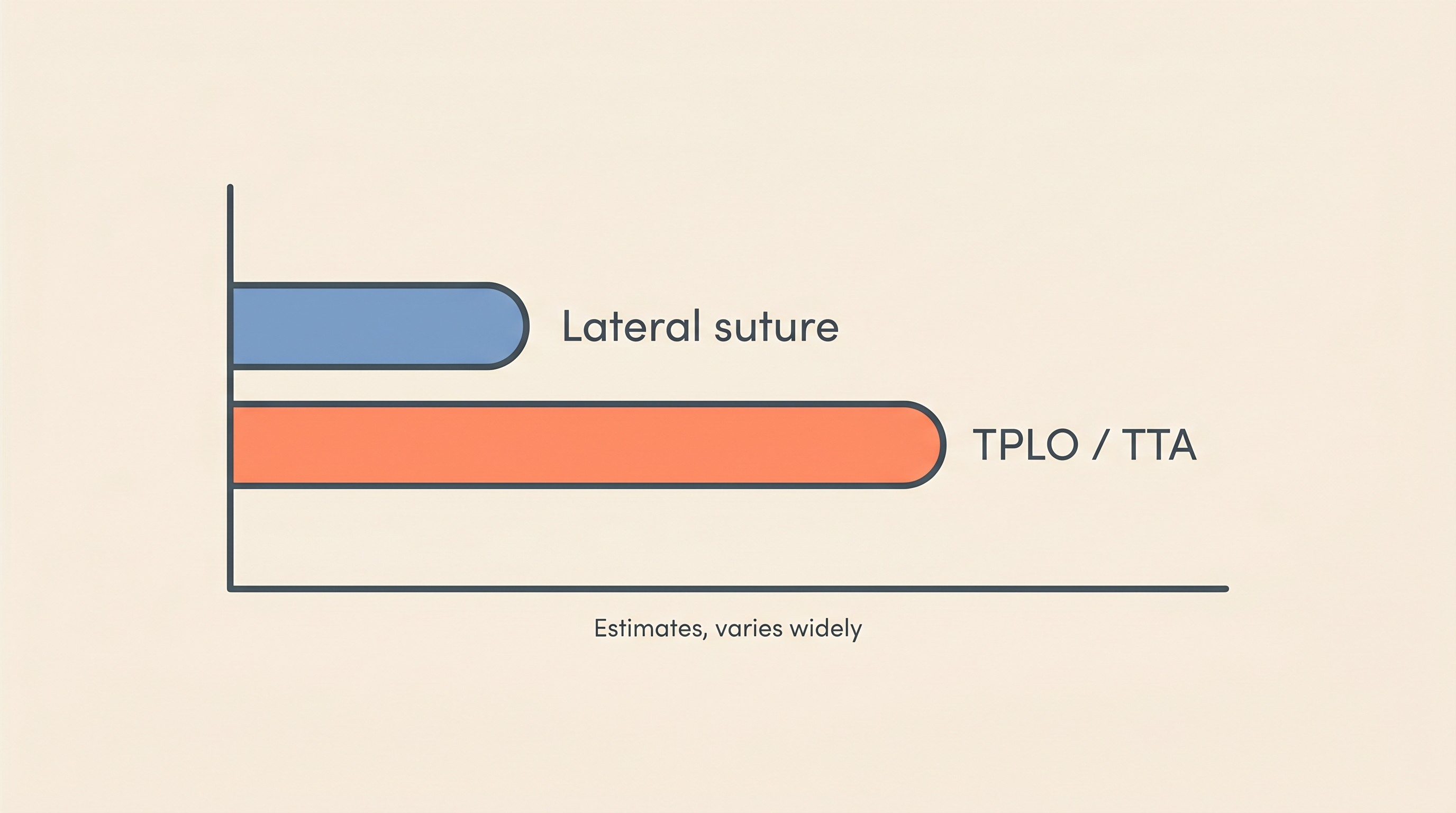
For smaller, lighter dogs, a lateral suture (or extracapsular repair) is often the procedure of choice, frequently done in good first-opinion practice rather than at a referral centre. It places a synthetic suture outside the joint to do the cruciate's job while the dog's own scar tissue builds up. There's no bone cut, and it's the less expensive route, broadly £1,000 to £2,500. It's generally reserved for smaller dogs, many sources capping suitability around 15 to 18 kg, roughly 35 lb.
For larger, more active dogs, the better-supported options are the bone-cutting osteotomies, the TPLO (tibial plateau levelling osteotomy) and the TTA (tibial tuberosity advancement), which reshape the knee so it no longer relies on the failed ligament. These are usually done at referral or specialist centres, and cost more, broadly £3,000 to £5,000 or more per knee.
These aren't plucked from the air: two published UK referral prices land in that band and show what a real package includes. Davies Veterinary Specialists quoted a fixed £4,750 for a TPLO regardless of the dog's size, bundling in the consultation and orthopaedic assessment, pre- and post-operative radiographs, specialist-led anaesthesia, the surgery including all implants, up to three days' hospitalisation and routine medications (Davies Veterinary Specialists, 2024). Pets'n'Vets quoted a fixed TPLO at £3,580 for dogs under 40 kg and £3,880 over 40 kg, including the consultation, assessment, surgery and a six-week rehabilitation plan (Pets'n'Vets, 2024). General UK cost guides put cruciate surgery broadly in the £1,500 to £4,000-plus range (Waggel, 2025). That's 2024 to 2025 pricing, and it will have moved.
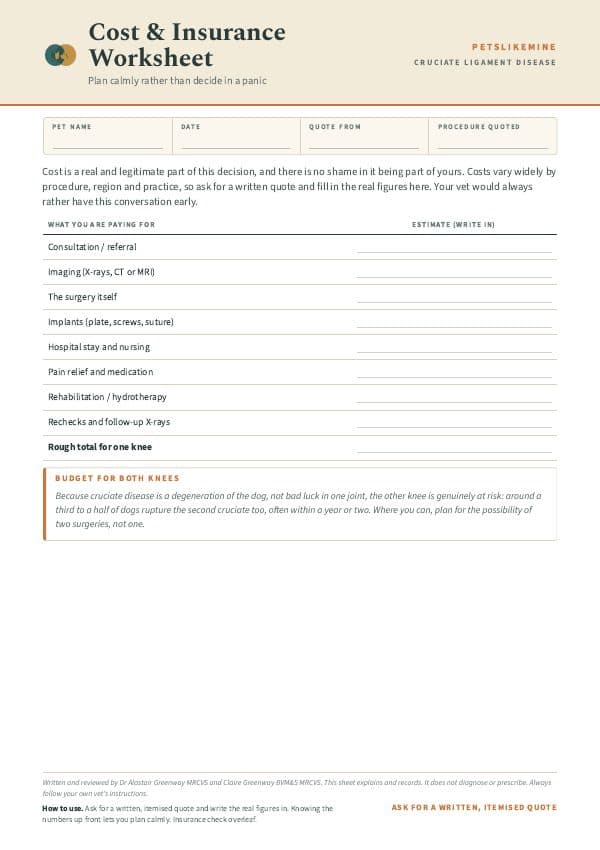
The real bill-shock, though, usually doesn't come from the headline figure. It comes from what that figure does and doesn't cover. A fixed-price package bundles most things so you know where you stand; an itemised quote may not, and the extras add up. So when you get a price, ask what's included and run down this list: the consultation, the sedated orthopaedic exam, imaging (radiographs, sometimes a CT scan), the procedure, the implant, the anaesthetic, hospitalisation, take-home medication, the buster collar, the post-operative radiographs, the recheck appointments, and rehab. That last one is no optional extra: physiotherapy and hydrotherapy across the roughly twelve weeks of recovery genuinely affect the outcome, so budget for them from the start (more here). Complications and any other health problems can attract supplements on top, so ask how those would be handled.
One thing I won't do on a cost page is tell you which procedure is "best". That's the surgeon's individualised judgement, made with hands on the knee and eyes on the X-rays, never a verdict I can hand down from here. The lateral suture and the osteotomies differ in price and in who they suit, and that's all I'm distinguishing them by. The even-handed comparison is in TPLO vs TTA vs lateral suture, and whether your dog needs referral is in does my dog need an orthopaedic specialist?.
Budget for the other leg
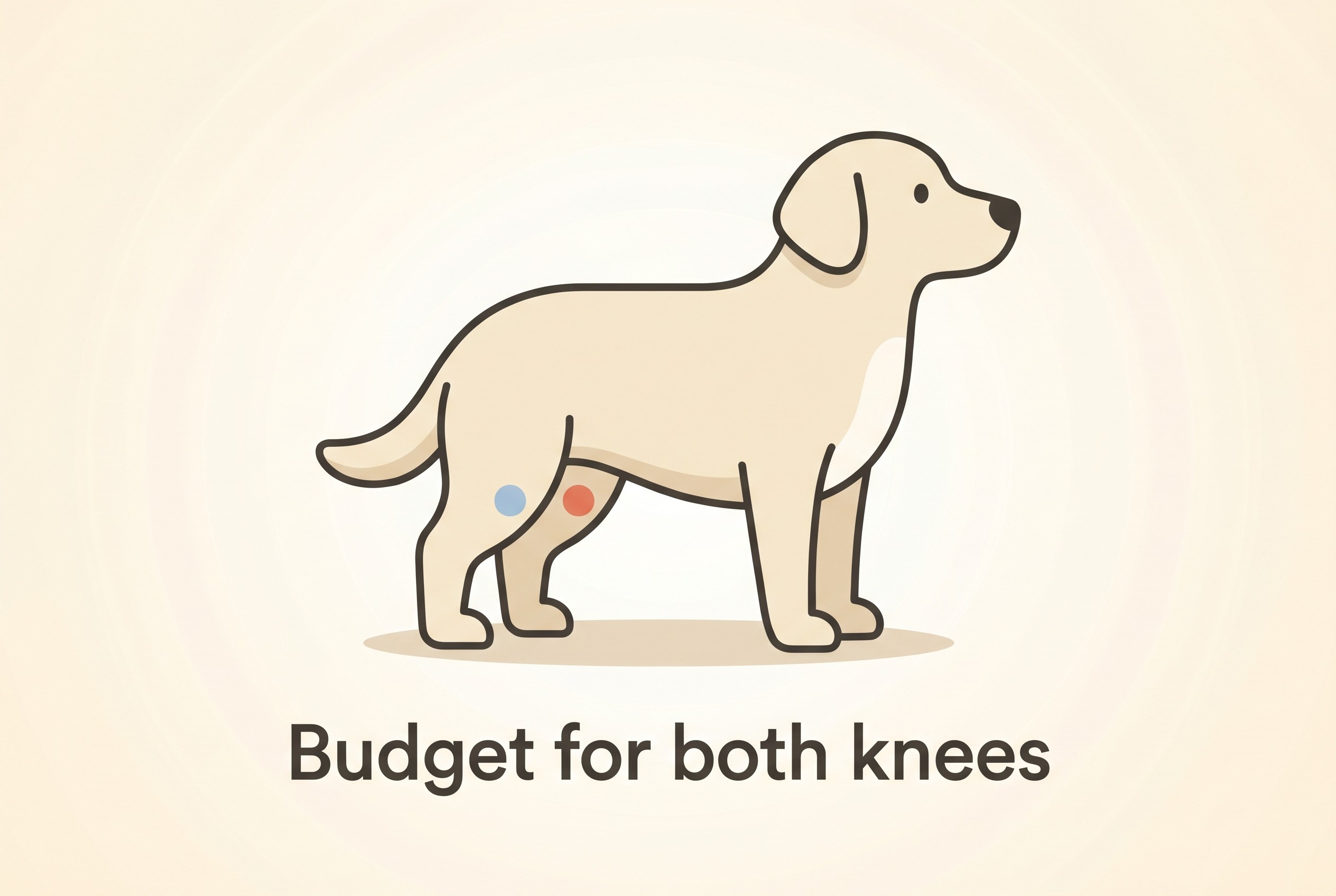
This is the part I most wish more owners were told up front, because it's the difference between planning calmly and being blindsided. Because cruciate disease is a degeneration of the dog rather than bad luck in a single joint, the other knee is genuinely at risk. A large proportion of dogs, around a third to a half, go on to rupture the cruciate in the second leg too, often within a couple of years of the first (Muir et al., 2011). That doesn't mean it will happen to your dog, but the sensible planning consequence is simple: where you can, budget for two surgeries, not one.
The biology of why both knees go, the odds and how to watch the second leg are covered in will the other leg go too?. Here it's a budgeting fact and, as you're about to see, an insurance one too.
Insurance, plainly
If your dog is insured, this is where a bit of knowledge is worth real money, and where the wording you skimmed past at sign-up matters.
Start with policy type, because for cruciate disease it matters more than for almost any other condition. Lifetime policies reset the cover limit for the same condition each year, for as long as you keep renewing, which is exactly the structure a long, recurring, both-knees condition needs. Annual, time-limited and "per condition" policies can exhaust the cover or stop covering it at renewal, leaving you exposed when the second knee goes.
Then there's the trap that catches good, careful owners out: pre-existing conditions. Insurers will not cover an illness or injury your pet had, was treated for, or showed signs of before the policy started or during its waiting period, and, importantly, that "usually includes illnesses and injuries that can happen again or may appear in different parts of your pet's body" (Association of British Insurers, 2024). That extends even to signs a vet merely noted, without a formal diagnosis. So the date cruciate disease goes on your dog's record matters hugely: once it's there, switching insurer almost always means the new policy excludes it. This is not the moment to shop for a cheaper premium.
And here's the specific cruciate sting, the bilateral exclusion. Many insurers treat the two knees as one condition. So a claim on the second cruciate can be regarded as related to the first, and some reporting suggests insurers may decline it as pre-existing if you'd switched providers in between, while even on the same policy the per-condition limit may be shared (Waggel, 2025). The principle behind this, that recurring problems and ones in "different parts of your pet's body" count as the same condition, is the industry's own (Association of British Insurers, 2024). The wording varies between insurers and this isn't a universal rule, which is exactly why the action is to read your policy wording, ideally before a diagnosis is on the record, and ask how they'd treat the second knee. It's also why "budget for the other leg" and the insurance question are really one conversation.
A few claiming tips. Ask whether your practice offers direct claims, where the insurer pays the vet, rather than you paying up front and claiming back, because that cash-flow difference is significant on a four-figure bill. Check your excess and any co-payment percentage, as both come off what you get back. And confirm whether rehab and hydrotherapy are covered, as many policies do pay for them when vet-referred.
If money is tight
If the numbers simply don't work, I want to be clear: choosing the route you can afford and sustain is real medicine, not failure, and nothing to be ashamed of. The most useful thing you can do is talk to your vet openly and early. We would always rather have the cost conversation up front than discover later that you've been struggling. A good vet can often stage the investigations so you're not hit with everything at once, offer a first-opinion lateral suture where it suits a smaller dog, or set up a payment plan or veterinary finance. There's also charitable help for owners on qualifying benefits, through the PDSA, Blue Cross and RSPCA, though eligibility is specific, so treat that as a signpost rather than a promise.
And then there's conservative, non-surgical management, a legitimate, evidence-informed route for the right dog. I'll be straight about the evidence. In a trial of overweight dogs, TPLO surgery plus conservative care gave a successful outcome in 75.0% of dogs at one year, compared with 63.6% for conservative care alone (Wucherer et al., 2013). So the evidence does favour surgical stabilisation in large, active dogs. But notice the other half: most of the conservatively managed dogs still reached a successful outcome in the long run. For a small, light, older or otherwise complicated dog, that's a real and reasonable path, and for a big athletic dog it shouldn't be oversold. The full appraisal is in conservative management: when it's a real option.
One last line, in case you're weighing up whether surgery is "worth it". Stabilising the knee limits the arthritis that follows, it doesn't prevent it; some stifle osteoarthritis is inevitable once the joint has been unstable, and surgery slows that process rather than switching it off. The lifelong picture is in cruciate disease and arthritis and the wider arthritis library. For context, this is one of the biggest orthopaedic problems in dogs: the estimated annual cost of treating it in the United States in 2003 was around $1.32 billion (Wilke et al., 2005). That tells you nothing about your bill, but it does tell you that you are very far from alone.
Knowing the numbers up front is what lets you plan calmly instead of deciding in a panic in the consult room. So take a breath, get a written itemised quote, read your insurance wording before anything goes on the record, and have the money conversation with your vet early. From there, the natural next step is to weigh cost against the other deciding factors in surgery or not? how to think about the cruciate decision, and the decision helper can organise your thoughts before the appointment.
References
- Association of British Insurers (2024). What pet insurance does not cover. ABI Pet Insurance Guide. Available at:
- Davies Veterinary Specialists (2024). Fixed Price TPLO. Available at:
- Muir, P., Schwartz, Z., Malek, S., Kreines, A., Cabrera, S.Y., Buote, N.J., Bleedorn, J.A., Schaefer, S.L., Holzman, G. and Hao, Z. (2011). Contralateral cruciate survival in dogs with unilateral non-contact cranial cruciate ligament rupture. PLoS ONE, 6(10), e25331.
- Pets'n'Vets (2024). Cruciate Surgery: Fixed Price TPLO. Available at:
- Waggel (2025). Dog cruciate ligament surgery cost in the UK. Available at:
- Wilke, V.L., Robinson, D.A., Evans, R.B., Rothschild, M.F. and Conzemius, M.G. (2005). Estimate of the annual economic impact of treatment of cranial cruciate ligament injury in dogs in the United States. Journal of the American Veterinary Medical Association, 227(10), 1604-1607.
- Wucherer, K.L., Conzemius, M.G., Evans, R. and Wilke, V.L. (2013). Short-term and long-term outcomes for overweight dogs with cranial cruciate ligament rupture treated surgically or nonsurgically. Journal of the American Veterinary Medical Association, 242(10), 1364-1372.
Free downloads
Companion worksheets to put what you've read into practice. Free PDFs, print at home.
Sister tool · Sightline
Track whether treatment is working
Sightline, a separate ConciergeVet tool, runs a short weekly check-in built on validated pain and mobility instruments, turns it into a single Sightline Score you can watch trend over weeks rather than judge on one bad day, and produces a report you can bring to your vet.
A written log, or our printable trackers, does much the same job.
See how Sightline tracks treatmentKeep track of how your pet is doing
The owners who cope best are the ones who notice changes early. A simple health log shows you what is working, and what is not, before the next vet visit.
Start tracking, freeYou're not doing this alone
Compare treatment journeys and talk to owners managing cruciate ligament disease. Free to join.
Join PetsLikeMine