

Cruciate Disease and Arthritis: The Lifelong Picture
Alastair Greenway
BVM&S MRCVS
There's a question that almost never gets asked in the consult room, because by the time the leg is working again the appointment is over and everyone's relieved. The diagnosis landed, you made a decision about surgery or conservative care, you got through the recovery or the long slow build of it, and your dog is using the leg. Then, in the quiet afterwards, the real question surfaces: what does the rest of his life actually look like?
Let me answer that one straight, because it's the most important question of the lot and it deserves a clear reply rather than a reassuring shrug. Whatever path you took, the affected knee is going to carry some arthritis for the rest of your dog's life. That is not a failure of the treatment and it is not bad luck. It was baked in from before you ever walked through my door. The bit that matters far more, though, is this: arthritis you can see on an X-ray is a very different thing from a dog who is in pain, and the day-to-day reality for most well-managed post-cruciate dogs is a genuinely good, active life for years. This piece is about holding both of those truths at once.
Why arthritis is near-universal here
To understand why arthritis is part of this story from the start, you have to let go of the idea that your dog "injured" its cruciate. In people, an ACL tear is usually a sudden sporting accident in an otherwise healthy knee. In dogs it almost never works like that. Cruciate disease is a progressive degeneration: the ligament weakens and frays from the inside over months or years, and the same degenerative process that rots the ligament is already inflaming and damaging the joint around it long before the ligament finally gives way (Comerford et al., 2011). The jump off the sofa that you keep replaying in your head was the trigger that exposed the problem, not the cause of it. The arthritis didn't start the day the leg went. It had a head start.
That's why, by the time most dogs are diagnosed, there is already early arthritic change in the joint. If you've read Why It's Degeneration, Not an Injury or the complete guide, you'll have met this idea already, and it's the single most useful thing to carry into the years ahead. Arthritis here is the expected companion of cruciate disease, not a complication that means something went wrong.
So where does surgery fit? This is where I have to be careful, because a lot of well-meaning advice online slides into a claim it can't support. Stabilising the knee does not give you back a normal, arthritis-free joint. Radiographic arthritis keeps progressing after a TPLO and after a TTA, and in a systematic review of dozens of surgical studies not one technique was shown to leave a stifle with no detectable arthritis (Wemmers et al., 2022). A large study of 295 dogs found a small but real increase in arthritis scores in the weeks after a TPLO compared with before it, and, interestingly, the dogs who started with the least arthritis were the ones who progressed the most (Hurley et al., 2007). Surgery limits arthritis, it does not prevent it. The fair framing is that stabilising the joint slows the process and protects how the leg works, but it cannot erase what the degeneration already started. Which procedure does that job best is a separate question, and an individual one for your surgeon rather than a verdict I'd ever hand down from here. I've laid the options out even-handedly in TPLO vs TTA vs Lateral Suture, and the one consistent thread across all of them is exactly this: they limit, they don't prevent.
Arthritis on a radiograph does not track neatly with how your dog feels. In one long-term study, arthritis scores climbed over the three years of follow-up, and yet the weight the dogs put through the operated leg, measured properly on a force plate, recovered by around six months after surgery and was maintained all the way out to thirty-six months (Shimada et al., 2020). The X-ray got worse while the dog got better and stayed better. That gap between the picture and the patient is the whole reason a "lifelong arthritis" diagnosis is not a sentence. With good surgery followed by proper rehab, the large majority of dogs return to good function and show no lameness at long-term follow-up (Bergh et al., 2014; Wemmers et al., 2022). Most dogs walk, trot, play and live well. The arthritis is real, and so is the good life alongside it.
One more thing worth saying plainly. Dogs managed conservatively carry arthritis too, for exactly the same reason: the instability and the degeneration started the process regardless of which road you chose. In the trial that compared the two approaches most rigorously, every dog in both arms received the same arthritis groundwork, weight loss, physiotherapy and pain relief, and only the surgical dogs had a TPLO added on top (Wucherer et al., 2013). That same trial is a useful reality check on conservative care: it favoured surgery for these large, overweight dogs, and yet close to two thirds of the conservatively managed dogs still reached a successful outcome (Wucherer et al., 2013). Conservative management is real medicine for the right dog, not a consolation prize, but in a big, active dog the evidence does lean surgical, which is why that decision belongs in its own article rather than here. The lifelong picture, in other words, is shared. The starting point differs and the road differs, but the destination, a knee carrying manageable arthritis for life, is common to both. I won't re-argue the surgery-versus-conservative decision here, Surgery or Not? owns that conversation, but it's worth knowing that whichever way you went, the years ahead look broadly the same and the tools are the same. (This is overwhelmingly a dog's disease, incidentally. Cats do rupture cruciates, but it's uncommon and usually follows genuine trauma, so the lifelong arthritis story here is really about dogs.)
The four levers you'll be pulling for years
If arthritis is the long-term companion, then managing arthritis well is the long-term job, and reassuringly it's a job you're largely equipped to do at home. I think of it as four levers, and the two with the biggest grip on the outcome are the two you control most.
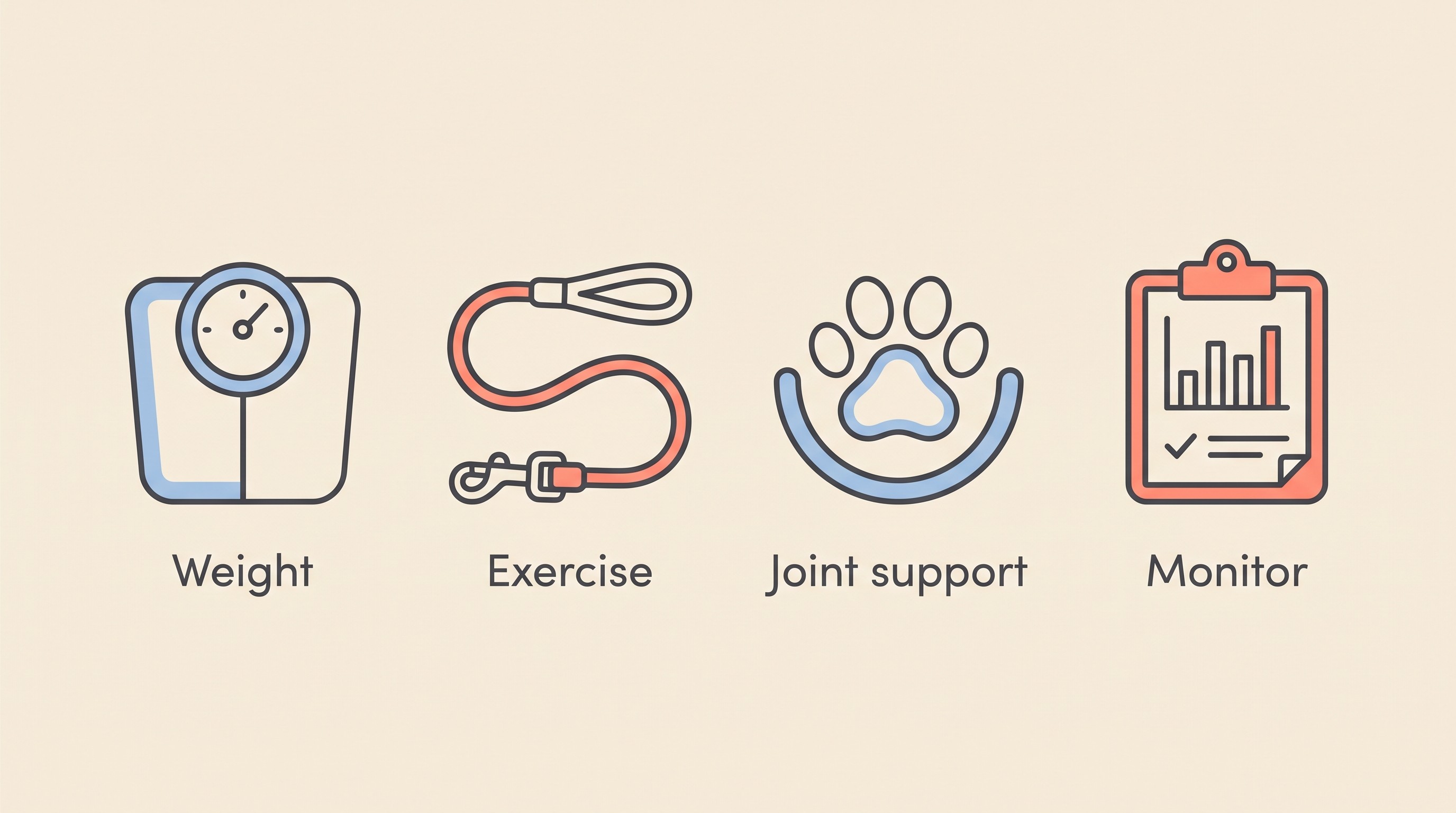
Weight is the single highest-impact, lowest-cost thing you will ever do for a post-cruciate dog, and it's free. Every extra kilo loads the arthritic joint mechanically and, because fat is an active inflammatory tissue rather than inert padding, stokes the very inflammation that drives the arthritis. Keeping your dog genuinely lean protects the operated knee, and it protects the other one too. Muscle is the close second: the thigh muscle around the stifle is the joint's natural brace, and a well-muscled leg shields the joint in a way no supplement can. These two together do more than anything else once the surgical decision is behind you, which is precisely why they have a whole article of their own. For the actual how-to, the feeding, the body-condition scoring, the exercise that builds muscle without flaring the joint, go to Weight, Muscle and the Long Game. I'm naming the levers here. That piece pulls them.
Joint support is the third lever, and it's a broad one: the right diet, the joint supplements that have decent evidence behind them, and the small environmental changes that take load off a sore knee, ramps instead of jumps, rugs over slippery floors, a supportive bed. Pain relief is the fourth, and this is where your vet comes in. Arthritis is not constant, it flares and settles, and there will be days and seasons when your dog needs medication to stay comfortable. When that's needed, and which medication, is a clinical judgement for your vet, not something to improvise from a forum. Needing pain relief at times is normal and expected in an arthritic dog, not a sign of decline.
The fourth strand, threaded through all of it, is monitoring. Arthritis moves slowly, which is exactly what makes it easy to miss; the dog who is a little stiffer this winter than last is hard to spot when you see him every day. Keeping a light, regular eye on how he moves, how he rises and how he is after a longer walk lets you and your vet stay ahead of it rather than reacting to a bad flare. If you used our Recovery Tracker through the post-op period, the same habit of noting mobility now and then carries usefully into the long game. And do keep half an eye on the other knee, which carries its own risk over the years: Will the Other Leg Go Too? covers that properly and I won't restate the numbers here.
None of this is dramatic. It's steady, sensible, mostly free, and it works. A post-cruciate dog whose weight is kept down, whose muscle is kept up, whose joint is supported and whose pain is treated when needed can be a comfortable, active, happy dog for years. This is a manage-it-well story, not a decline story, and I want you to hold onto that.
Where to go deeper
Let me be plain: it isn't really cruciate management any more, it's arthritis management, and arthritis is a bigger subject than one corner of one space can do justice to. The full library lives in our Arthritis and Mobility hub, and that's where I'd send you for the depth: the pain-relief options compared properly, the physiotherapy and hydrotherapy that keep an arthritic dog mobile, the supplements worth the money and the ones that aren't, and the long view of living alongside arthritis as your dog ages.
That hub is built for exactly the dog you now have: one with established arthritis in a joint, asking for thoughtful lifelong care. Your dog reached it by a particular road, a ruptured cruciate, but from here the care is the same as it is for any arthritic dog, and that's a more hopeful place to be than it sounds.
So that's the lifelong picture, told straight. The knee carries some arthritis, it always was going to, and a well-managed post-cruciate dog can still have a genuinely great life for years to come. From here, two doors. For the practical week-to-week rhythm of keeping your dog comfortable, go to Keeping a Post-Cruciate Dog Comfortable for Life. And for the full arthritis toolkit, make the Arthritis and Mobility hub your ongoing home. Your dog has the rest of his life ahead of him, so let's make it a comfortable one.
References
- Bergh, M. S., Sullivan, C., Ferrell, C. L., Troy, J., & Budsberg, S. C. (2014). Systematic review of surgical treatments for cranial cruciate ligament disease in dogs. Journal of the American Animal Hospital Association, 50(5), 315–321.
- Comerford, E. J., Smith, K., & Hayashi, K. (2011). Update on the aetiopathogenesis of canine cranial cruciate ligament disease. Veterinary and Comparative Orthopaedics and Traumatology, 24(2), 91–98.
- Hurley, C. R., Hammer, D. L., & Shott, S. (2007). Progression of radiographic evidence of osteoarthritis following tibial plateau leveling osteotomy in dogs with cranial cruciate ligament rupture: 295 cases (2001–2005). Journal of the American Veterinary Medical Association, 230(11), 1674–1679.
- Shimada, M., Mizokami, N., Ichinohe, T., Kanno, N., Suzuki, S., Yogo, T., Harada, Y., & Hara, Y. (2020). Long-term outcome and progression of osteoarthritis in uncomplicated cases of cranial cruciate ligament rupture treated by tibial plateau leveling osteotomy in dogs. Journal of Veterinary Medical Science, 82(7), 908–916.
- Wemmers, A. C., Charalambous, M., Harms, O., & Volk, H. A. (2022). Surgical treatment of cranial cruciate ligament disease in dogs using tibial plateau leveling osteotomy or tibial tuberosity advancement: A systematic review with a meta-analytic approach. Frontiers in Veterinary Science, 9, 1004637.
- Wucherer, K. L., Conzemius, M. G., Evans, R., & Wilke, V. L. (2013). Short-term and long-term outcomes for overweight dogs with cranial cruciate ligament rupture treated surgically or nonsurgically. Journal of the American Veterinary Medical Association, 242(10), 1364–1372.
Sister tool · Sightline
Track whether treatment is working
Sightline, a separate ConciergeVet tool, runs a short weekly check-in built on validated pain and mobility instruments, turns it into a single Sightline Score you can watch trend over weeks rather than judge on one bad day, and produces a report you can bring to your vet.
A written log, or our printable trackers, does much the same job.
See how Sightline tracks treatmentKeep track of how your pet is doing
The owners who cope best are the ones who notice changes early. A simple health log shows you what is working, and what is not, before the next vet visit.
Start tracking, freeYou're not doing this alone
Compare treatment journeys and talk to owners managing cruciate ligament disease. Free to join.
Join PetsLikeMine