

Surgery or Not? How to Think About the Cruciate Decision
Alastair Greenway
BVM&S MRCVS
Your dog has done its cruciate, someone has said the word surgery, and there's almost certainly a number attached to all of it. So the question now is whether you're about to do the right thing or the wrong thing by them, and it's a heavy one to be sitting with, often a day or two after the diagnosis at some unsociable hour.
Let me take some of the heat out of it straight away. There's rarely one single right answer here, and there's genuinely more than one road to a good outcome. Plenty of dogs do well after surgery, and some do well without it. My job isn't to tell you what to do, because I can't put my hands on your dog's knee from here. It's to give you a clear way to think about it, so that when you sit down with your own vet you're an informed partner rather than a frightened passenger.
If you haven't yet read the complete guide to cruciate disease, that's the best place to start for the full picture. This article sits beneath it and stays focused on the single biggest question: surgery, or not.
What you're actually deciding
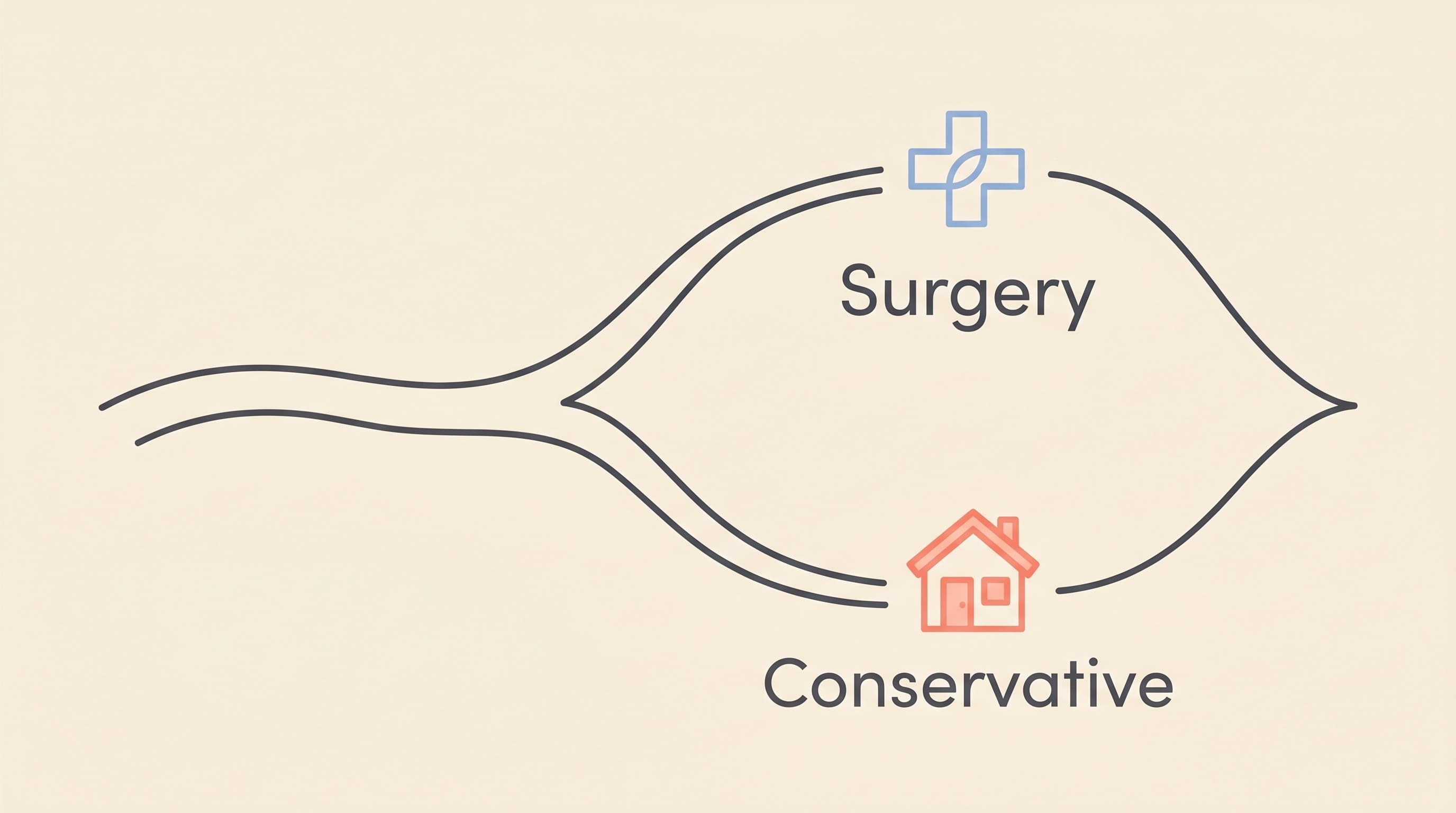
Most people picture the choice as "surgery or nothing". It isn't.
The cranial cruciate ligament is one of the main stabilisers of the knee. Once it has failed, the joint is unstable: every time your dog bears weight on that leg, the shin bone slides forward against the thigh bone in a way it was never designed to. That abnormal movement is what hurts, and it's what drives the arthritis that follows. So the real question isn't "do we treat this or leave it", it's "how do we deal with an unstable knee", and there are broadly two ways to answer that.
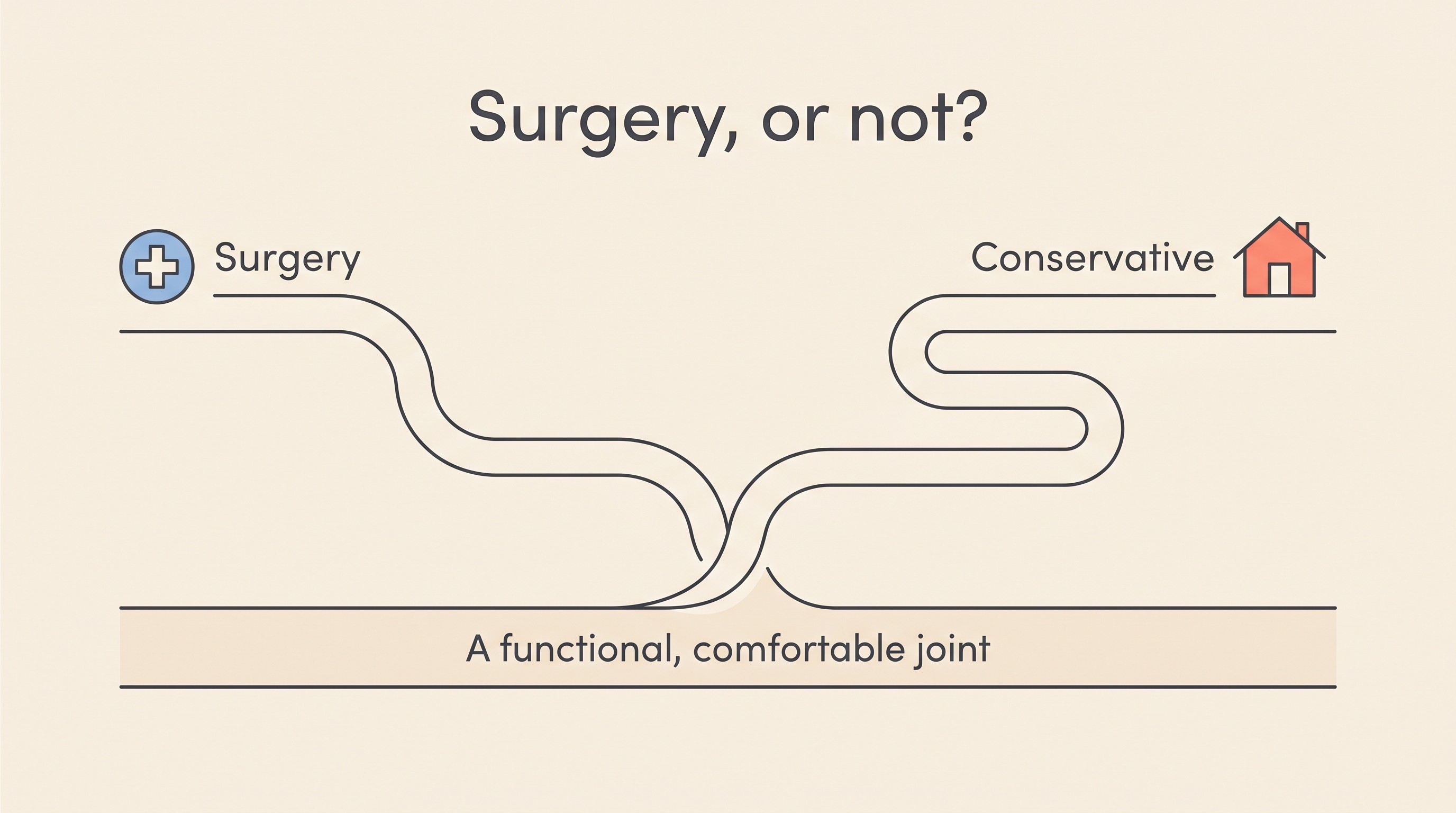
You can stabilise it surgically, which directly addresses the instability and lets the joint work more normally while it settles. Or you can manage it conservatively, giving the body time and the right conditions to build its own stability out of scar tissue (periarticular fibrosis), supported by weight control, controlled exercise, physiotherapy and pain relief. Both routes aim at the same destination, a leg your dog can use comfortably for life, and they simply suit different dogs. Holding that in mind stops the decision feeling like a choice between the proper fix and giving up, because neither half of that framing is true.
It also helps to know why I call this a disease rather than an accident. In dogs, cruciate rupture is overwhelmingly the end point of a slow degeneration of the ligament, not a one-off sporting tear: the jump off the sofa is the trigger, not the cause, and the ligament had been quietly weakening for months (Comerford et al., 2011). That single fact underpins much of what follows, from why the other knee is at risk to why conservative management is legitimate at all. The full story lives in why it's degeneration, not an injury.
What tips the balance
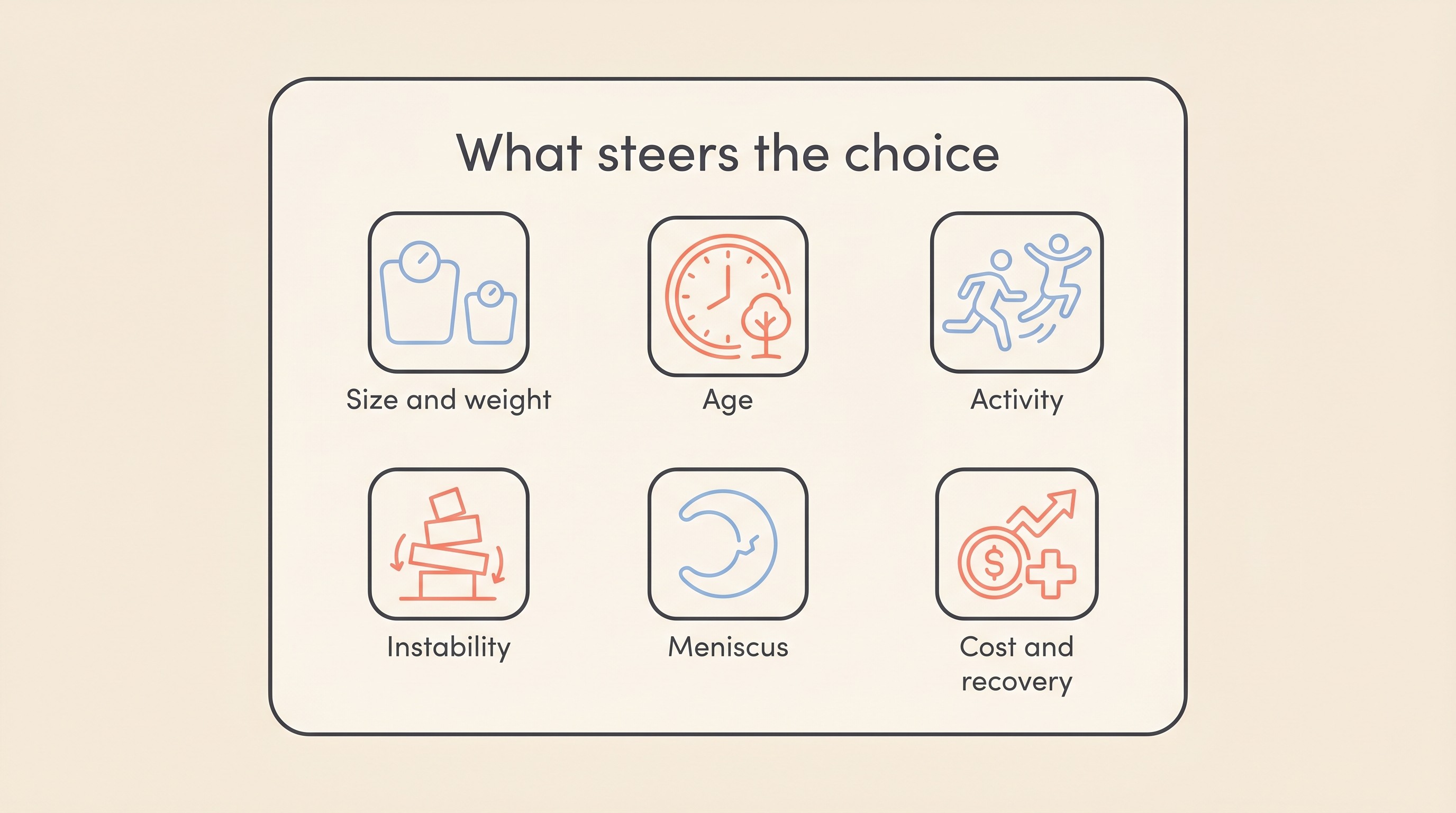
This is where it stops being a generic question and becomes a question about your specific dog. A handful of things genuinely move the needle, and your vet will be weighing them all at once.
Size and weight. This is the big one. A large, heavy dog puts enormous load through that knee, and the evidence I'll come to shortly is reasonably clear that bigger, heavier dogs tend to do better with surgical stabilisation. A small, light dog asks far less of the joint, so conservative management becomes a much more realistic proposition.
Activity level and lifestyle. A young, bouncy, athletic dog that lives to run and jump asks a great deal of a knee trying to heal on its own, whereas a quieter, older, pottering dog is a more natural fit for the conservative path.
Age and general health. Age alone is no reason to rule out surgery, and plenty of older dogs sail through it. But other health problems that make an anaesthetic riskier legitimately weigh on the decision.
How much of the ligament has gone. A complete rupture and a partial tear aren't quite the same problem. Partial tears sit in an awkward middle ground where the degree of instability changes how the options stack up, and they get their own treatment in partial cruciate tears.
Whether the meniscus is involved. The meniscus is a cartilage cushion inside the knee, commonly damaged alongside the cruciate. In one series of 1,000 consecutive dogs operated on for cruciate disease, a meniscal injury was found in a third of the knees (33.2%) at surgery (Fitzpatrick & Solano, 2010). A torn meniscus is painful and usually needs treating directly, which pushes the balance towards a procedure that opens or inspects the joint. The meniscus has its own guide, the other injury in the knee.
Cost and your capacity for the recovery. Cost is a real and legitimate part of this decision, not a moral failing: surgery, particularly the bone-cutting procedures, is a significant expense, and the UK costs and insurance guide flags the often-overlooked point that you may want to budget for both knees. Just as underrated is the recovery. Surgery means roughly twelve weeks of strict rest and carefully rebuilt activity, and conservative management asks for an even longer stretch of restriction, so be realistic about what your household can manage. The 12-week recovery roadmap and the Recovery Tracker show exactly what you'd be signing up to.
These factors don't behave like a checklist. Your vet weighs them as a single picture, which is why a small, fit, older terrier and a large, overweight, young Labrador can leave with very different recommendations from the same disease.
Where the evidence points
I want to be straight with you here, because this is where a lot of online advice goes soft. For large, active dogs, the evidence does favour surgical stabilisation, and two pieces of research anchor that. The broadest look is a systematic review by Bergh and colleagues, who screened hundreds of studies and found the strongest evidence supports the TPLO for returning dogs to normal function (Bergh et al., 2014).
The most useful single trial comes from Wucherer and colleagues, and its design is the key to reading it. They took forty overweight large and giant-breed dogs with a ruptured cruciate, gave every one of them the conservative foundations of weight loss, physiotherapy and anti-inflammatory pain relief, then added surgery (a TPLO) for half. By twelve weeks the surgical dogs already had a successful outcome 67.7% of the time against 47.1% for the group managed without it, and by twenty-four weeks that gap had widened to 92.6% versus 33.3% (Wucherer et al., 2013). Note what that compares: not surgery instead of conservative care, but surgery on top of it, with weight loss helping both groups. So the fair takeaway is that surgery plus rehabilitation beats rehabilitation alone in big dogs, not that surgery beats doing nothing. For a big athletic dog, surgery isn't over-treatment; it's the option most likely to get them reliably back to themselves.
Now the other half of that same trial, and it matters just as much. Even in these big, overweight dogs (the group conservative care suits least), close to half of those managed without surgery still reached a successful outcome (Wucherer et al., 2013). That's not a footnote. For a small, light, older or otherwise unsuitable dog, where the joint is asked to do far less, conservative management is a genuinely reasonable path with a good chance of a comfortable result. It's slower, less reliable in big active dogs, and demanding of real commitment, but it's legitimate medicine and not a consolation prize. I've set out who it really suits, and who it doesn't, in conservative management: when it's a real option.
One last caveat on either path. Surgery limits arthritis, it does not prevent it: once a joint has been unstable, some stifle osteoarthritis is inevitable, and stabilising the knee slows that progression rather than stopping it (Comerford et al., 2011). I never write "surgery prevents arthritis", and you should be wary of anyone who does. Even so, outcomes after good surgery and rehabilitation are generally very good, with most large active dogs returning to comfortable, functional life (Bergh et al., 2014). That reassurance is real, it just isn't a guarantee. The lifelong view is covered in cruciate disease and arthritis.
Making it your decision
So how do you arrive at an answer with confidence rather than dread?
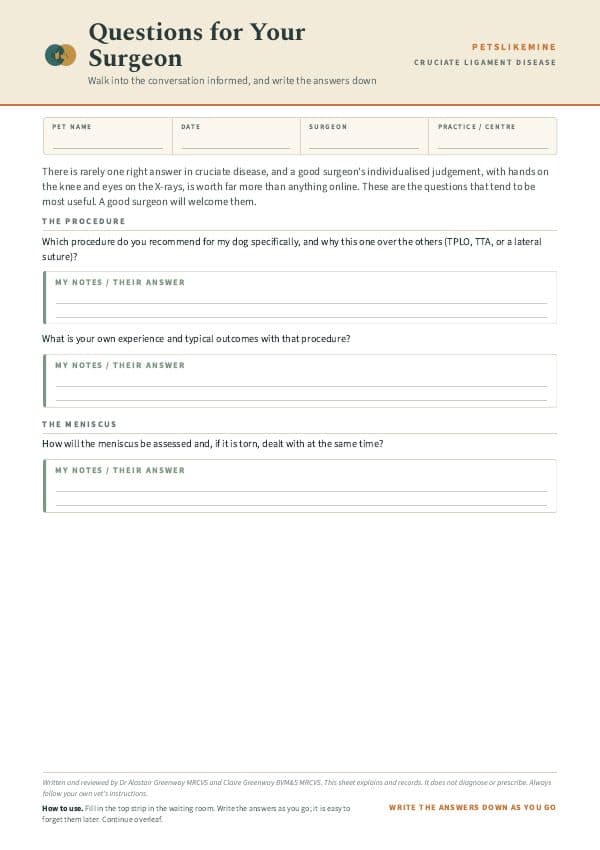
Ask your vet why. A good vet will gladly explain their reasoning in terms of your dog's size, age, activity and the state of the joint, and if the answer is just "this is what we do", it's fair to ask for more. A second opinion is always reasonable for a decision of this size, and no good clinician will be offended by one.
Consider whether specialist input would help. The bone-cutting procedures are usually done by orthopaedic specialists, and a referral is completely normal rather than a slight on your own vet. Does my dog need an orthopaedic specialist? walks through when it's worth it.
Don't ask us, or anyone online, which operation. Which procedure is best for your dog is the surgeon's individualised judgement, made with hands on the joint and eyes on the X-rays, not a verdict I'll hand down from here. The strongest evidence happens to favour the TPLO for return to function, but the right operation still depends on the dog, the surgeon and the specific knee (Bergh et al., 2014). To weigh the trade-offs beforehand, TPLO vs TTA vs lateral suture lays them out even-handedly. The same caution applies to any online tool or forum, ours included: nothing online can feel that knee, and the most our Decision Helper can do is help you organise your thinking and arrive with the right questions.
One last planning point, raised for your timeline rather than for worry: because this is a bilateral degenerative disease, the other cruciate carries a real ongoing risk of going too. Across studies the reported risk ranges widely, with one large series finding 54% rupture the second side and the median second ligament lasting under three years (Muir et al., 2011) and another putting the figure nearer a third (Chuang et al., 2014). So a sensible planning assumption is something like a third to a half within the first year or two: not a certainty, but not nothing. The other knee gets its own full treatment in will the other leg go too?.
There are good lives waiting down more than one of these roads. The right one is simply the one that fits your dog, your circumstances and what you can genuinely manage, decided with the vet who has the case in front of them. Once you have a direction, the next guides pick the journey up: the candid case for conservative management, and what the recovery will really ask of you both.
References
- Bergh, M. S., Sullivan, C., Ferrell, C. L., Troy, J., & Budsberg, S. C. (2014). Systematic review of surgical treatments for cranial cruciate ligament disease in dogs. Journal of the American Animal Hospital Association, 50(5), 315–321.
- Chuang, C., Ramaker, M. A., Kaur, S., Csomos, R. A., Kroner, K. T., Bleedorn, J. A., Schaefer, S. L., & Muir, P. (2014). Radiographic risk factors for contralateral rupture in dogs with unilateral cranial cruciate ligament rupture. PLoS ONE, 9(9), e106389.
- Comerford, E. J., Smith, K., & Hayashi, K. (2011). Update on the aetiopathogenesis of canine cranial cruciate ligament disease. Veterinary and Comparative Orthopaedics and Traumatology, 24(2), 91–98.
- Fitzpatrick, N., & Solano, M. A. (2010). Predictive variables for complications after TPLO with stifle inspection by arthrotomy in 1,000 consecutive dogs. Veterinary Surgery, 39(4), 460–474.
- Muir, P., Schwartz, Z., Malek, S., Kreines, A., Cabrera, S. Y., Buote, N. J., Bleedorn, J. A., Schaefer, S. L., Holzman, G., & Hao, Z. (2011). Contralateral cruciate survival in dogs with unilateral non-contact cranial cruciate ligament rupture. PLoS ONE, 6(10), e25331.
- Wucherer, K. L., Conzemius, M. G., Evans, R., & Wilke, V. L. (2013). Short-term and long-term outcomes for overweight dogs with cranial cruciate ligament rupture treated surgically or nonsurgically. Journal of the American Veterinary Medical Association, 242(10), 1364–1372.
Free downloads
Companion worksheets to put what you've read into practice. Free PDFs, print at home.
Sister tool · Sightline
Track whether treatment is working
Sightline, a separate ConciergeVet tool, runs a short weekly check-in built on validated pain and mobility instruments, turns it into a single Sightline Score you can watch trend over weeks rather than judge on one bad day, and produces a report you can bring to your vet.
A written log, or our printable trackers, does much the same job.
See how Sightline tracks treatmentKeep track of how your pet is doing
The owners who cope best are the ones who notice changes early. A simple health log shows you what is working, and what is not, before the next vet visit.
Start tracking, freeYou're not doing this alone
Compare treatment journeys and talk to owners managing cruciate ligament disease. Free to join.
Join PetsLikeMine