

Does My Dog Need an Orthopaedic Specialist?
Alastair Greenway
BVM&S MRCVS
Being offered a referral for cruciate surgery sets two questions running in most owners' heads at once: is my dog's knee worse than I was told, and did my own vet just admit they're out of their depth. I see that flicker across the consult-room table all the time, and I want to take the heat out of it straight away. A referral here is routine. It isn't a verdict on how bad the knee is, and it isn't a slight on the vet who has looked after your dog for years.
Cruciate surgery in the UK is done well in two quite different places: in good first-opinion practices, and at orthopaedic referral centres. Which setting fits your dog depends mostly on your dog's size and the operation being recommended, not on prestige. This article is here to demystify that choice, give you the questions that actually matter, and tell you the true state of the evidence on who should hold the drill. I'm going to assume the bigger decision, surgery or conservative care, is already settled or close to it. If it isn't, that belongs in how to think about the cruciate decision and when conservative management is a real option, and I'd read those first.
What "specialist" actually means in the UK
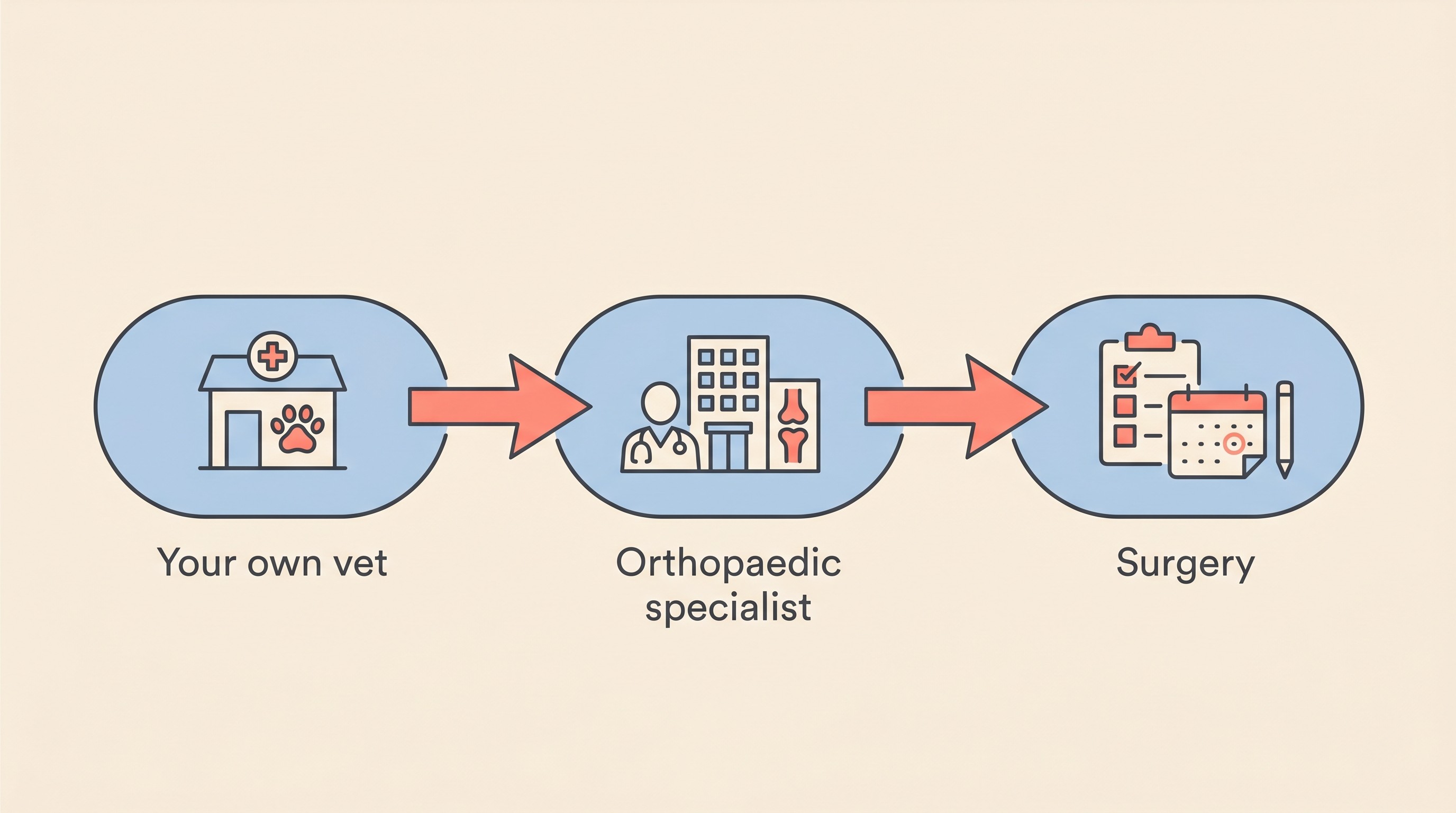
A lot of the worry comes from one word. "Specialist" gets used loosely in everyday speech, but here it means something specific, and there are three rungs to it. The first is your first-opinion vet: the GP of the veterinary world, fully qualified and licensed to perform surgery, including some cruciate operations. The second is the RCVS Advanced Practitioner. To use that title a vet must hold a relevant postgraduate qualification and keep up at least 250 hours of continuing professional development over five years, with 125 of those hours in their declared field (RCVS, Advanced Practitioner status). The third and highest is the RCVS Recognised Specialist, who has typically completed a residency of around three years under existing specialists, passed a Diploma-level examination of a recognised College, and must keep making an active, ongoing contribution to their field, with the national or international recognition and recent publications to show for it (RCVS, Specialist status).
The detail that should reassure you is that neither title can simply be claimed. Of the two, "Specialist" is the one the RCVS protects most tightly: to use it a vet must satisfy the College and appear on its Specialist List. "Advanced Practitioner" is itself an accredited status you have to apply for, be granted, and keep by reapplying every five years (RCVS, Specialist status; RCVS, Advanced Practitioner status). Both are held to a published standard you can check on the RCVS "Find a Vet" tool. So when your vet says they're sending you to a specialist, that word carries real, verifiable weight, and nothing about it is marketing.
What a specialist setting brings
A referral centre isn't just a vet with a fancier title. It's usually a different kind of building doing a different volume of work, and that's the substance of what you're being offered. The big one is the bone-cutting procedures, the osteotomies. Operations such as the TPLO (tibial plateau levelling osteotomy) and the TTA (tibial tuberosity advancement) deliberately change the geometry of the knee so it no longer relies on the failed ligament to stay stable. They're technically demanding, and overwhelmingly done in referral or advanced-practice settings. Alongside that you tend to get higher case volume, advanced imaging, arthroscopy (keyhole inspection of the inside of the joint), and the back-up of 24-hour hospitalisation if your dog needs watching overnight.
I'll not go into how each operation works here, because that has its own home: the even-handed comparison of TPLO, TTA and the lateral suture, and the closer look at TPLO specifically. The thing to hold onto is that the osteotomies are the usual reason a referral gets suggested, because they're most often kept to higher-volume hands.
When your own vet is the right choice
Here's the half of the picture that the referral-centre brochures tend to skip, and it matters just as much. Plenty of cruciate dogs need no osteotomy, and plenty of cruciate operations belong nowhere near a referral hospital. The lateral suture, also called the extracapsular repair, places a strong synthetic suture outside the joint to do the failed ligament's job while the dog's own scar tissue builds up around the knee. It involves no cut to the bone, it's less technically demanding than the osteotomies, and it's competently performed by a great many first-opinion vets. It tends to suit smaller, lighter, older or less active dogs, and the detail of how it works sits in the lateral suture.
The simplest way I can put it is this. The operation that suits a 6 kg terrier is not the operation that suits a 40 kg Labrador, and that difference is what drives where the surgery is best done. A small, light dog having a lateral suture in the practice it knows, with a vet who knows the dog, can be exactly the right call, and there's nothing second-rate about it. The procedure and the patient lead, and the setting follows from there. So if your vet recommends doing the surgery themselves, that can be the considered choice rather than a compromise, and it's entirely fair to ask them to talk you through why.
Does the surgeon's experience change the outcome?
I want to be straight here, because this is the question owners most want answered and the one where it's easiest to overclaim. What we can say with confidence is that experienced, high-volume surgeons achieve low complication rates. In the largest single-surgeon TPLO series ever published, covering 1,000 dogs and 1,146 stifles, the overall complication rate was 14.8%, and only 6.6% were major complications (Fitzpatrick & Solano, 2010). Across the wider literature the picture is broader: reported overall TPLO complication rates range from 9.7% to 27.8%, and surgical site infection from 2.9% to 17.3% (Husi et al., 2023). That's a wide spread, and surgeon experience is among the factors repeatedly proposed as influencing infection risk after TPLO, alongside others like body weight and breed, though it doesn't always reach statistical significance in any single study (Husi et al., 2023).
So the case that experience matters is suggestive rather than ironclad: a very low major-complication rate in a high-volume surgeon's hands, and experience being one of the factors the literature keeps returning to. That points in a sensible direction without pretending to be a clean proof.
But I won't dress it up as more than it is. There's no good head-to-head study that takes the same operation and proves "specialist beats GP vet" on outcome, so anyone who quotes you a tidy number for that is inventing it. The sensible reading is that experience with the specific procedure helps, particularly for the harder osteotomies, while a competent vet doing an operation they perform regularly and well is a perfectly good place for the right dog to be. None of this is cause for fear: outcomes for cruciate surgery, done in the right setting, are generally very good.
It also helps to remember why this is never a simple "fix the injury" job. Cruciate disease is a degeneration rather than a one-off tear, which is why the ligament had been quietly failing for months before your dog hopped off the sofa, as why it's degeneration, not an injury explains. No operation, in anyone's hands, fully prevents the arthritis that follows an unstable knee. The best surgery limits and slows it; it doesn't abolish it. A surgeon who tells you that plainly is doing you a favour, not underselling themselves.
The questions worth asking
The single most useful thing I can give you is a short list of fair questions, and the reassurance that a good clinician, in either setting, will welcome every one of them. Asking them doesn't make you difficult. It makes you a thoughtful owner, and it shows.
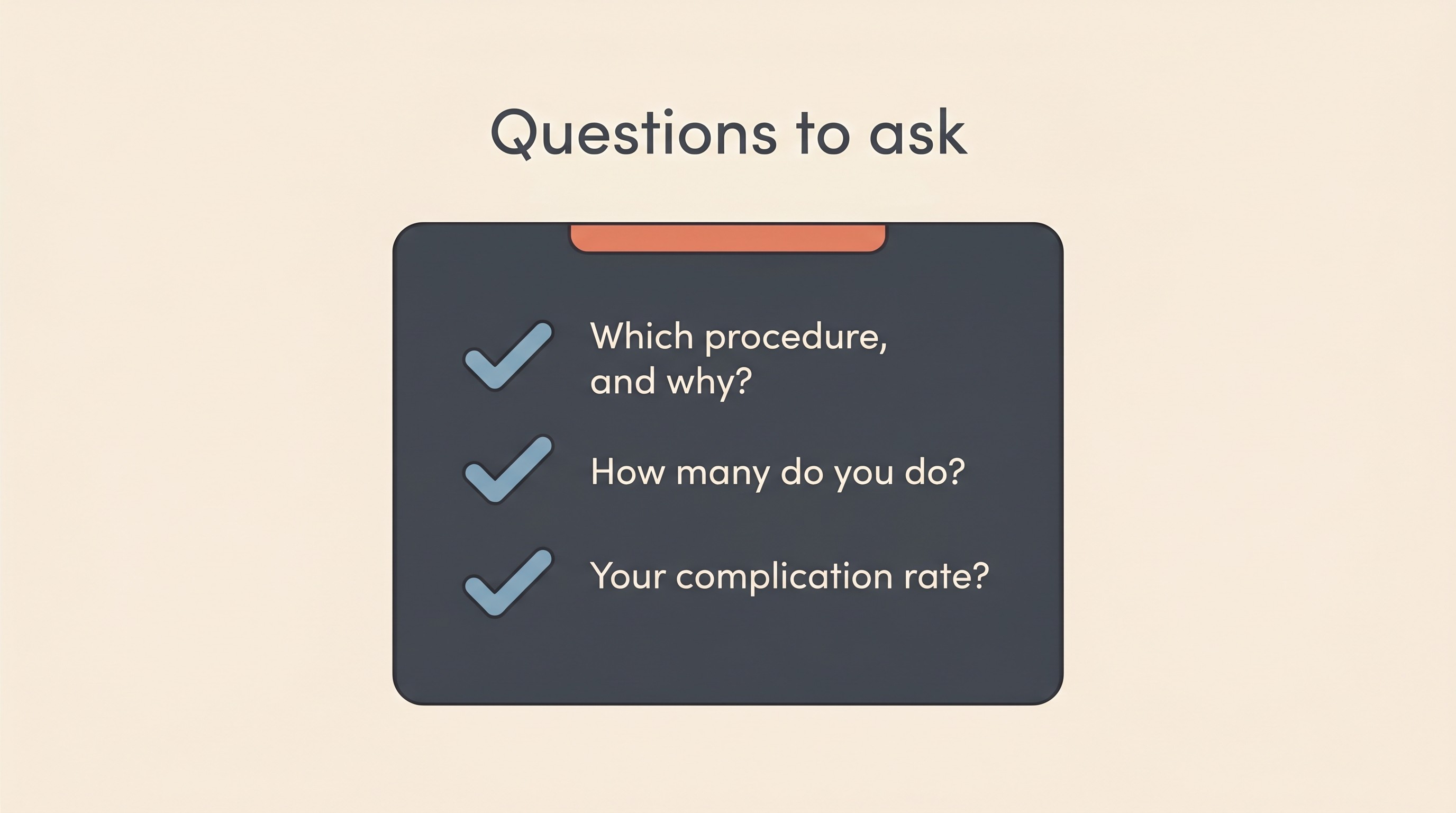
- Which procedure are you recommending, and why this one? The answer should be about your dog's size, activity, knee anatomy and age, not just "this is what we do."
- How many of this exact procedure do you do? A regular, current caseload of the specific operation matters more than a long-ago qualification.
- What's your own complication and infection rate? A good surgeon knows their numbers and shares them without bristling.
- What's included in the price? Imaging, implants, hospitalisation, rehabilitation, and, importantly, what happens if a complication needs a revision. The actual figures belong in what cruciate surgery costs in the UK, but what the quote does and doesn't cover is worth asking out loud.
- What's the plan if something goes wrong? Knowing in advance who you call turns a frightening situation into a managed one.
If you'd like a structured way to bring these to the consult, our Decision Helper can lay them out for you. I'd say the same of it as of any online tool, though: it organises your thinking, it cannot examine your dog.
How referral works in practice
If you're heading down the referral route, the mechanics are simpler than they sound. Your own vet writes a referral and sends your dog's history and imaging across to the specialist centre. The centre reviews it, then books you in for a consultation where they examine your dog and confirm the plan. A useful thing you can do is make sure your diagnosis and imaging have been sent ahead, because the specialist will want to see exactly how the tear was confirmed and what the films show. The detail of how that diagnosis is made lives in how cruciate disease is diagnosed.
Two practical notes round this off. First, costs rise at referral level. That's expected, not a rip-off, and the real numbers and how insurance handles them sit in the costs and insurance guide. Do check, before you commit, that your policy covers referral specifically, because many do but some don't. Second, budget with one eye on the other leg. Because this is a degenerative condition rather than bad luck in a single joint, a contralateral rupture is genuinely common: in one large study, 54% of dogs went on to rupture the opposite cruciate, the second ligament surviving a median of 947 days (Muir et al., 2011). That isn't meant to frighten you, and the full picture lives in will the other leg go too. It just means a second operation is a real possibility worth planning the budget around.
So ask your vet why they're recommending this particular path, and listen for an answer that's about your dog rather than about which option sounds most impressive. A good vet, whether keeping the operation in-house or sending you onward, will explain that reasoning gladly. Once you know where the surgery will happen, the natural next step is understanding the operation itself, and the even-handed comparison of TPLO, TTA and the lateral suture picks the journey up from here.
References
- Fitzpatrick, N., & Solano, M. A. (2010). Predictive variables for complications after TPLO with stifle inspection by arthrotomy in 1,000 consecutive dogs. Veterinary Surgery, 39(4), 460-474.
- Husi, B., Overesch, G., Forterre, F., & Rytz, U. (2023). Surgical site infection after 769 tibial plateau levelling osteotomies. Frontiers in Veterinary Science, 10, 1133813.
- Muir, P., Schwartz, Z., Malek, S., Kreines, A., Cabrera, S. Y., Buote, N. J., Bleedorn, J. A., Schaefer, S. L., Holzman, G., & Hao, Z. (2011). Contralateral cruciate survival in dogs with unilateral non-contact cranial cruciate ligament rupture. PLoS ONE, 6(10), e25331.
- Royal College of Veterinary Surgeons. (n.d.). Advanced Practitioner status.
- Royal College of Veterinary Surgeons. (n.d.). Specialist status.
Free downloads
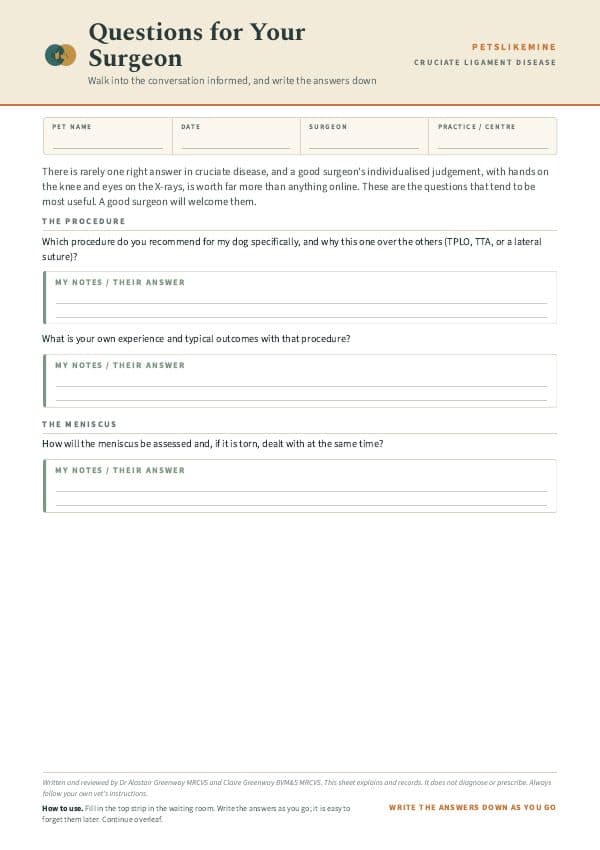
Companion worksheets to put what you've read into practice. Free PDFs, print at home.
Sister tool · Sightline
Track whether treatment is working
Sightline, a separate ConciergeVet tool, runs a short weekly check-in built on validated pain and mobility instruments, turns it into a single Sightline Score you can watch trend over weeks rather than judge on one bad day, and produces a report you can bring to your vet.
A written log, or our printable trackers, does much the same job.
See how Sightline tracks treatmentKeep track of how your pet is doing
The owners who cope best are the ones who notice changes early. A simple health log shows you what is working, and what is not, before the next vet visit.
Start tracking, freeYou're not doing this alone
Compare treatment journeys and talk to owners managing cruciate ligament disease. Free to join.
Join PetsLikeMine