

Keeping a Post-Cruciate Dog Comfortable for Life
Alastair Greenway
BVM&S MRCVS
The crate rest is over, the limp has gone, and the dog who couldn't put a foot to the floor is trotting around the kitchen again. Whether you chose surgery or managed the knee without it, the hard part really is behind you. What most owners want to know at this point is simply what happens now. Do you carry on as before? And what about the arthritis everyone kept mentioning?
Let me settle that, because it's the right question and the answer is more reassuring than you might fear. Keeping a post-cruciate dog comfortable for the rest of its life is not a dramatic medical project. It's mostly steady, sensible maintenance: a lean body, predictable daily exercise, a comfortable home, an eye on the other knee, and a vet you check in with when the picture shifts. Done consistently, that routine keeps the large majority of these dogs comfortable and active for years.
I'll say a short word on the arthritis first, then the routine, because the routine is what you actually do every day.
The knee carries its history, and that's all right
Some degree of osteoarthritis in that stifle is, realistically, a lifelong companion now, whichever path you took. This isn't a failure of the surgery or a sign anything went wrong. The instability that came with the ruptured ligament started the degenerative process, and even an excellent operation slows that process rather than erasing it: after TPLO, the most studied stabilising procedure, mean arthritis scores still rise measurably over the years that follow (Hurley et al., 2007). Stabilising the knee limits and slows the arthritis. It does not prevent it.
What matters far more for the dog in front of you is this. Radiographic arthritis and a comfortable, happily mobile dog routinely coexist. In those same TPLO follow-up studies, dogs are typically not visibly lame at walk or trot a year or more after surgery, even as the X-ray quietly shows a little more wear (Hurley et al., 2007). Across the wider surgical literature, good surgery followed by proper rehabilitation returns somewhere around 85 to 95 percent of normal function. The picture on the X-ray is not the dog on the lawn. I've handed many an owner a radiograph that looks worse than their bright, bouncing dog, and the dog is the truth of it.
The companion piece, Cruciate Disease and Arthritis: The Lifelong Picture, goes properly into why arthritis is so near-universal after cruciate disease. This article sits beside it and answers the practical question: knowing all that, what's the routine that keeps the dog comfortable?
The daily and monthly rhythm
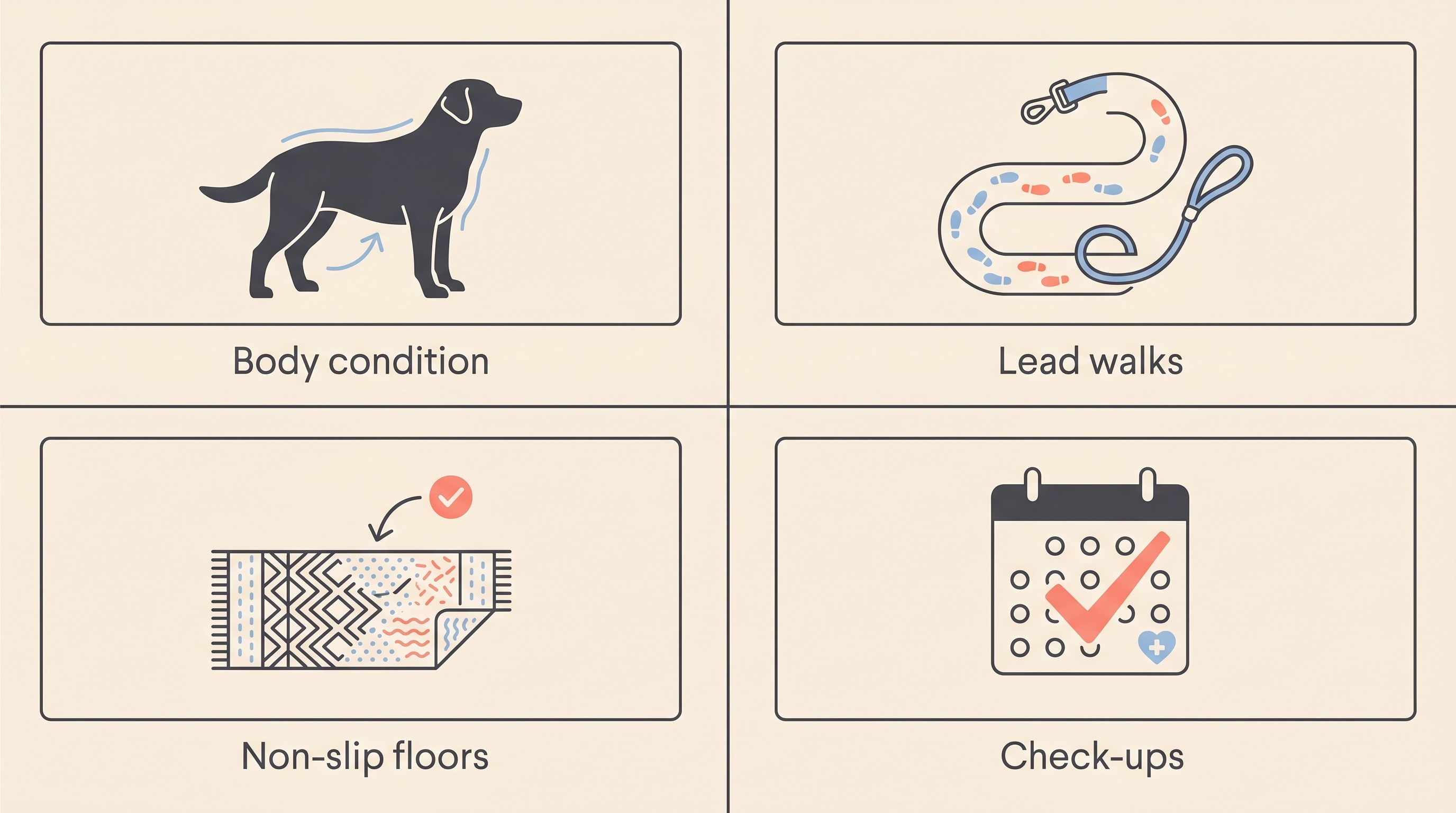
Keep the dog lean. This is the single biggest lever you control, and it's not motivational fluff. In overweight dogs with osteoarthritis, lameness measurably decreases once they've lost as little as 6.10 percent of their body weight, with objective gait-analysis confirming the improvement from 8.85 percent (Marshall et al., 2010). For a dog that needs to shed a couple of kilos, that's a genuinely achievable target with a real, visible payoff. Lifelong leanness does more still: in a famous lifetime study of Labradors, the lean-fed dogs developed arthritis later and lived a median of around 1.8 years longer than their slightly heavier littermates (Kealy et al., 2002). For a post-cruciate dog this protects three things at once: the operated knee, the arthritis that lives in it, and the other knee that you're keeping an eye on. There is nothing else on this list that does so much for so little.
I won't relitigate the how-to of weight management here, because I cover diet, body-condition scoring and the long game properly in Weight, Muscle and the Long Game. The one thing I'll insist on is this: judge the body, not the bathroom scales alone. Run your hands over the ribs. You want to feel them easily under a thin layer, like the back of your knuckles, and a waist you can see from above. A lean, well-muscled dog is the maintenance goal.
Keep exercise consistent and controlled. Rhythm beats heroics. Regular, breed-appropriate, daily activity is a foundation of managing arthritis at every stage, not an optional extra (Cachon et al., 2023). What I'm steering you away from is the boom-and-bust pattern that does these knees no favours: the dog that lies about all week, then sprints flat-out around the garden or charges up a hillside at the weekend, then pays for it with three sore, stiff days. Steady, predictable lead walks and sensible, controlled off-lead time keep the muscle on and the joint moving without the spikes of overload. Little and often, most days, is the shape you're after.
Make the home easy on the joints. It's low-cost and high-impact. Put runners or non-slip mats down on hard floors, so a dog who's a touch arthritic isn't scrabbling for grip every time it stands. Give it a supportive, properly padded bed. Use a ramp into the car and consider a small step at the sofa, so the dog isn't repeatedly jumping down onto that knee, which, remember, is the very movement that often unmasks cruciate disease in the first place. Keep the nails short, because long nails change how a dog stands and loads its legs. None of these are trial-proven miracles and I won't dress them up as such, but they're sensible, joint-sparing good sense, in keeping with the environmental side of modern arthritis care (Cachon et al., 2023).
Keep half an eye on the other knee. This is a planning fact for life, not a doom prophecy, so I'll be plain about it and then move on. After one cruciate goes, the other ruptures in a substantial proportion of dogs, around a third to a half. In one large study, 54 percent of dogs ruptured the second side, at a median of around 2.6 years (Muir et al., 2011); in a referral population, 33 percent did, with the earliest quarter going within about 1.4 years (Chuang et al., 2014). The message for a maintenance routine is calm vigilance, not anxiety: keeping the dog lean and well-muscled genuinely lowers the odds, and the rest is simply knowing what to watch for. That ground is covered in detail elsewhere, so I'll hand you straight over. Will the Other Leg Go Too? The Bilateral Risk gives the full picture, and Spotting Early Signs in the Other Knee shows you exactly what an early limp on the other side looks like so you catch it sooner.
Pain relief and joint support, in brief
Managing arthritis well is multimodal and built in layers, what the veterinary consensus calls "base and build" (Cachon et al., 2023). The base, the foundation under every dog, is everything in the section above: education and monitoring, keeping the weight right, good nutrition including omega-3s, and sensible exercise and physical therapy. Medication is layered on top of that foundation when the clinical signs call for it, not used as a substitute for it. So the home routine isn't the thing you do until the real treatment starts. It is the real treatment, and the drugs build on it.
When pain relief is needed, the first-line medication for arthritis is a non-steroidal anti-inflammatory, an NSAID, prescribed and monitored by your vet (Cachon et al., 2023). In the UK and Europe these go by names like meloxicam, carprofen, robenacoxib, mavacoxib and firocoxib. Grapiprant is a related but slightly different option (an EP4 antagonist rather than a classical NSAID). I'm naming the category rather than picking one for your dog, because the right drug, dose and monitoring are genuine veterinary decisions, and the arthritis hub carries the full comparison.
One safety line I will not soften: never give your dog human painkillers. Ibuprofen, paracetamol (acetaminophen), naproxen and aspirin can all be toxic to dogs, and the dose that helps a person can harm a dog. If your dog is sore, that's a phone call to your vet, not a reach for the bathroom cabinet.
There are newer options worth a sentence. Bedinvetmab (sold as Librela in the UK and EU) is a once-monthly injection, an anti-nerve-growth-factor antibody, licensed specifically for arthritis pain in dogs (Corral et al., 2021). I mention it not as a recommendation but as a real, vet-administered option to ask about if the standard route isn't suiting your dog.
On joint supplements, let me be straight, because the shelves are crowded and the marketing is loud. The one with the strongest controlled evidence is omega-3 fish oil: in a randomised trial, weight-bearing improved in 82 percent of dogs on omega-3 versus 38 percent of controls (Roush et al., 2010). The evidence for glucosamine and chondroitin is weaker, and I'd rather tell you that than oversell a tub. If you spend on one thing, a good fish oil is the better-evidenced bet.
This is, deliberately, only the headline. The full NSAID comparison, the supplement nuance, the physiotherapy and hydrotherapy, all of it lives in the arthritis hub, the ongoing home for the depth of all this. Start there when you want more than a brief: the Arthritis & Mobility library.
Monitoring over time
The quiet skill of looking after a post-cruciate dog for years is steady, structured watching, measured against this dog's own normal rather than any textbook. Keep up the regular weight and body-condition checks. Watch the consistency of the mobility: not just whether the dog is sore today, but the trend over weeks. Learn what a genuinely good day looks like for your dog and what a bad one looks like, because you're the person best placed to spot the slow drift that means it's time to talk to the vet again. Arthritis is a long, slow story, and reassessing when the trend shifts, a little more stiffness rising from the bed, a shorter tolerance on the walk, a new reluctance at the stairs, is how you stay ahead of it.
A practical note on tools, so I don't point you in the wrong direction. The Cruciate Recovery Tracker we built is a recovery instrument: it plots weight-bearing, lameness and swelling against the expected post-op week, exactly what you want in the weeks after surgery and not what you need years later. For lifelong arthritis monitoring, the mobility tracking in the arthritis hub is the better fit, built for the long view rather than the recovery curve.
A post-cruciate dog with a steady routine, a lean body, consistent controlled exercise, a joint-friendly home and vet-guided pain relief when it's needed, can stay comfortable and active for a very long time. The arthritis is part of the picture, but it doesn't have to be the loudest part. Keep the foundations in place, watch the trend, lean on the Arthritis & Mobility library when you want depth, and most of these dogs go on being themselves for years.
References
- Cachon, T., Frykman, O., Innes, J. F., Lascelles, B. D. X., Okumura, M., Sousa, P., Staffieri, F., Steagall, P. V., & Van Ryssen, B. (2023). Face validity of a proposed tool for staging canine osteoarthritis: Canine OsteoArthritis Staging Tool (COAST). Frontiers in Veterinary Science, 10, 1137888.
- Chuang, C., Ramaker, M. A., Kaur, S., Csomos, R. A., Kroner, K. T., Bleedorn, J. A., Schaefer, S. L., & Muir, P. (2014). Radiographic risk factors for contralateral rupture in dogs with unilateral cranial cruciate ligament rupture. PLoS ONE, 9(9), e106389.
- Corral, M. J., Moyaert, H., Fernandes, T., Escalada, M., Tena, J.-K. S., Walters, R. R., & Stegemann, M. R. (2021). A prospective, randomised, blinded, placebo-controlled multisite clinical study of bedinvetmab, a canine monoclonal antibody targeting nerve growth factor, in dogs with osteoarthritis. Veterinary Anaesthesia and Analgesia, 48(6), 943-955.
- Hurley, C. R., Hammer, D. L., & Shott, S. (2007). Progression of radiographic evidence of osteoarthritis following tibial plateau leveling osteotomy in dogs with cranial cruciate ligament rupture: 295 cases (2001-2005). Journal of the American Veterinary Medical Association, 230(11), 1674-1679.
- Kealy, R. D., Lawler, D. F., Ballam, J. M., Mantz, S. L., Biery, D. N., Greeley, E. H., Lust, G., Segre, M., Smith, G. K., & Stowe, H. D. (2002). Effects of diet restriction on life span and age-related changes in dogs. Journal of the American Veterinary Medical Association, 220(9), 1315-1320.
- Marshall, W. G., Hazewinkel, H. A. W., Mullen, D., De Meyer, G., Baert, K., & Carmichael, S. (2010). The effect of weight loss on lameness in obese dogs with osteoarthritis. Veterinary Research Communications, 34(3), 241-253.
- Muir, P., Schwartz, Z., Malek, S., Kreeger, J., Cabrera, S. Y., Buote, N. J., Bleedorn, J. A., Schaefer, S. L., Holzman, G., & Hao, Z. (2011). Contralateral cranial cruciate ligament rupture in dogs after unilateral rupture: A retrospective study of 380 dogs. PLoS ONE, 6(10), e25331.
- Roush, J. K., Cross, A. R., Renberg, W. C., Dodd, C. E., Sixby, K. A., Fritsch, D. A., Allen, T. A., Jewell, D. E., Richardson, D. C., Leventhal, P. S., & Hahn, K. A. (2010). Evaluation of the effects of dietary supplementation with fish oil omega-3 fatty acids on weight bearing in dogs with osteoarthritis. Journal of the American Veterinary Medical Association, 236(1), 67-73.
Sister tool · Sightline
Track whether treatment is working
Sightline, a separate ConciergeVet tool, runs a short weekly check-in built on validated pain and mobility instruments, turns it into a single Sightline Score you can watch trend over weeks rather than judge on one bad day, and produces a report you can bring to your vet.
A written log, or our printable trackers, does much the same job.
See how Sightline tracks treatmentKeep track of how your pet is doing
The owners who cope best are the ones who notice changes early. A simple health log shows you what is working, and what is not, before the next vet visit.
Start tracking, freeYou're not doing this alone
Compare treatment journeys and talk to owners managing cruciate ligament disease. Free to join.
Join PetsLikeMine