

Conservative Management, Day to Day
Alastair Greenway
BVM&S MRCVS
The decision is made. Perhaps you and your vet weighed it up together and conservative management was the sensible call. Perhaps surgery was never realistically on the table, for health or financial reasons, and this is simply the road you're on. Either way, you've probably hit the same frustration: nearly every page that says "you can manage this conservatively" stops dead right there, as if the words alone were a plan. Almost nobody tells you what Tuesday actually looks like.
I'm going to walk you through the real day-to-day work of managing a cruciate knee without surgery, because that is exactly what it is: work, with a routine, run over weeks and months. The single most important thing I can tell you up front is that conservative management is not "doing nothing" and waiting for nature to sort it out. In the best study we have, the non-surgical dogs weren't simply left alone. They were put on an active programme of physical therapy, weight loss and anti-inflammatory pain relief (Wucherer et al., 2013). That is the job, and if you treat it as a real job, your dog has a real chance.
Hold onto one thing before we start. The reason the daily routine matters so much is that your dog's cruciate didn't snap like a guitar string in an accident. Canine cruciate disease is a slow degeneration of the ligament that usually plays out over months or years before the knee finally gives way (Comerford et al., 2011). The jump off the sofa was the trigger, not the cause. So you're not nursing a sprain back to how it was. You're managing a joint that is now permanently unstable, for the long term. That sounds heavier than it is in practice, but it explains why every part of the plan below is about controlling load rather than waiting for healing.
If you're still genuinely unsure whether this is the right path for your dog at all, that question belongs to a different article. The full case for and against, who it suits and who it really doesn't, lives in Conservative Management: When It's a Real Option (and When It Isn't). This piece assumes you've made the call. Now let's do it well.
The restriction period
The first phase is the hardest, and it's the one people underestimate most. Without an operation there is nothing holding the joint steady from the inside, so the early weeks are about radically reducing the load on that knee and giving the body the conditions to lay down its own scar tissue around the joint, the peri-articular fibrosis that will eventually provide some natural stability.
In practice this means lead-only activity, no jumping, no stairs, no off-lead running and no rough play, for a sustained stretch at the start. Short, controlled lead walks are the near-universal core of this: in a study of how vets actually manage cruciate disease in smaller dogs, 91.1% used short leash walks as part of the plan, while only about a quarter reached for strict cage rest (Comerford et al., 2013). So the spine of it is controlled, gentle, lead-held movement, not weeks shut in a box.
Let me be straight about time here, because this is where a lot of pages quietly mislead. Surgical recovery has a fairly well-defined shape, often summarised as around twelve weeks, and we map it out in The 12-Week Recovery Roadmap After Cruciate Surgery. The conservative timeline is deliberately slower. There's no plate holding the bone, so the joint settles on its own schedule: several weeks of genuinely strict, lead-only restriction at the front, then a gradual build that can run over months. I won't give you a hard week count, because dogs vary enormously and a falsely precise number would only set you up to feel like you've failed. The shape is what matters: strict at first, slow to loosen, measured in months not days.
The emotional side of confinement, keeping a dog who's starting to feel better from undoing the work, is a whole skill of its own, and we've given it its own home in Strict Rest Without Losing Your Mind. Go and read that one when the walls start closing in. They will.
Weight, the biggest lever
If you do only one thing on this list outstandingly well, make it this one. Of everything in the daily plan, weight is the single biggest lever you personally control, and it does more than almost any other measure to take pain out of that knee.
The evidence here is genuinely striking. In a study of overweight, arthritic dogs, owners could see the lameness improve significantly once the dog had lost only about 6.10% of its body weight, and objective gait analysis confirmed measurable improvement from around 8.85% (Marshall et al., 2010). That's a small, achievable amount: for a 30 kg dog, 6% is under 2 kg. I should be straight that this study was in dogs with general osteoarthritis rather than cruciate disease specifically, but the mechanics are the same: less load through a sore, unstable joint means less pain and better function. In the cruciate trial itself, both the surgical and non-surgical dogs lost body fat and both improved, which tells you getting weight off helps every dog on either path (Wucherer et al., 2013). It's no accident that 89.0% of vets managing these cases conservatively put weight loss in the plan (Comerford et al., 2013).
I won't hand you a diet plan here, partly because the detail deserves more room than a paragraph and partly because it's genuinely a long game that runs well beyond this recovery. The how, the body-condition scoring, the meal maths and the muscle side of it, is covered in Weight, Muscle and the Long Game, and there's a deep well of practical guidance in the arthritis library. Start there for the method. Start today for the result.
Building activity back
Once your dog is through the strict phase and weight-bearing comfortably, you begin to rebuild, and the golden rule is that you increase activity against function, not against the calendar. You're watching the dog, not the diary. There are three things to watch, and they're the same three the Recovery Tracker is built around: how well the leg takes weight, how lame the dog looks, and whether there's any swelling around the knee. If those are stable or improving, you nudge the activity up a little. If any of them goes the wrong way, you ease back. Keep the increments small: slightly longer lead walks, then gentle controlled exercise, never a sudden leap because the dog seemed fine for a day.
This is also where physiotherapy and hydrotherapy earn their place. They help maintain thigh muscle and keep the joint moving, and there's good reason to think a structured programme does this better than home pottering alone: in dogs recovering from cruciate surgery, a formal physiotherapy programme rebuilt thigh circumference and stifle range of motion significantly better than home exercise by itself (Monk et al., 2006). That was a post-surgical study, so treat it as the general rehab principle rather than a promise for the conservative path, but the principle holds: hands-on, structured rehab maintains the muscle that protects the joint. The actual protocols, what a session involves, how often, when to start, belong to Physiotherapy and Hydrotherapy After Cruciate Surgery, and the home exercises between sessions are in Home Exercises by Recovery Phase. Use those as your manual.
Pain relief and monitoring
Your dog needs pain relief through this, and it has to be the right kind. Appropriate analgesia means a vet-prescribed anti-inflammatory licensed for dogs, in the UK most often meloxicam, carprofen or robenacoxib. Anti-inflammatory use was the most common single ingredient in real-world conservative management, used in 91.1% of cases (Comerford et al., 2013), and for good reason. What it must never be is a human painkiller from your own cupboard. Paracetamol and ibuprofen are dangerous, even toxic, to dogs, and you reach for one only ever on your vet's explicit instruction. Because this knee is going to carry some arthritis for the rest of your dog's life, pain relief is an ongoing conversation with your vet rather than a single course you finish and forget. The lifelong side of that is covered in the arthritis library.
Now the monitoring. Judge progress by weight-bearing, lameness and swelling against the expected curve, not by a grade and not by a date. And you need to know in advance that the curve is bumpy. In the Wucherer trial, the non-surgical dogs were doing reasonably at twelve weeks, with about 47.1% counted as successful, then things dipped: success fell to 33.3% at twenty-four weeks before climbing back to 63.6% by one year (Wucherer et al., 2013). That mid-recovery slump is the part almost nobody warns owners about. If, a few months in, your dog seems to be treading water or even slipping back a little, that may be a normal part of the curve rather than a sign the whole thing has failed. Don't panic at the dip.
But, and this is the balancing truth, don't endure around a genuine failure either. The evidence is that conservative recovery is slower and less reliable than surgery, particularly in bigger, more active dogs, for whom surgical stabilisation remains the stronger bet (Wucherer et al., 2013). If your dog plateaus badly and stays there, or clearly deteriorates rather than dipping and recovering, revisiting the surgical option is sensible and grown-up, not an admission of defeat. That conversation goes back to your vet and, if needed, into the surgical decision and procedure articles, where which operation suits your dog is the surgeon's individual judgement, never mine to call from here. (For acute warning signs, a hot, painful or suddenly non-weight-bearing leg, that's a different and more urgent question, covered in Is This Normal? Red Flags During Cruciate Recovery.)
One last thing to fold into the routine without letting it loom: because this is a degeneration of the dog rather than bad luck in one joint, the other cruciate is genuinely at risk too, somewhere around a third to a half over the following one to two years (Muir et al., 2011). That's a reason to keep both knees lean and half an eye on the good leg, not a reason to lie awake. We give it the calm, non-alarmist treatment it deserves in Will the Other Leg Go Too?.
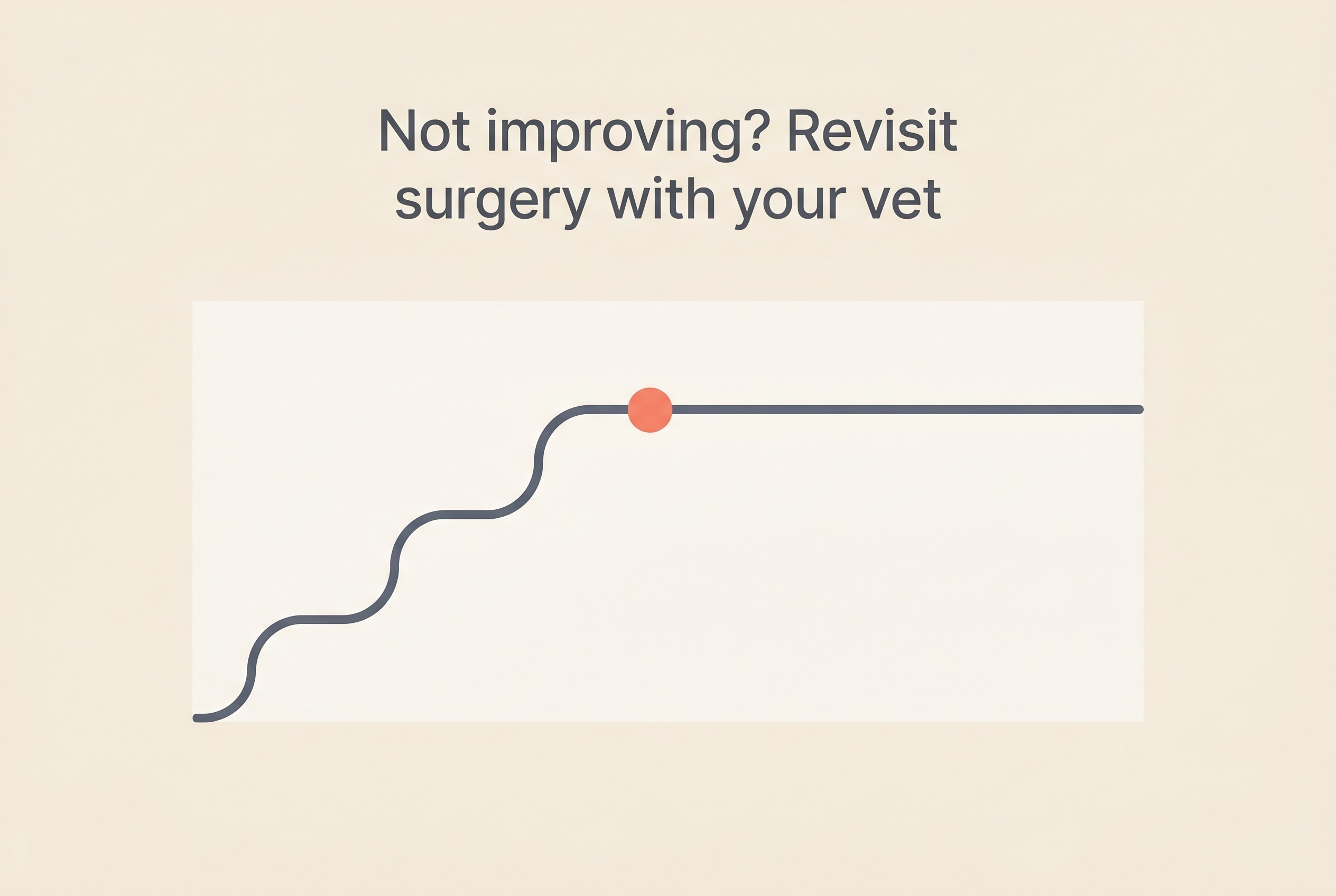
Done properly, this works for a great many dogs. Roughly two-thirds of the non-surgical dogs in the best trial reached a successful outcome by a year (Wucherer et al., 2013), and that wasn't luck, it was the routine above done patiently and well. So log the three things that matter on the Recovery Tracker, week by week, so you can see the curve instead of guessing at it. A slow week is not a failed one. But you'll also know, because you've been watching closely, if the line genuinely stops climbing, and that is exactly when to pick the surgical conversation back up with your vet.
And when the knee has settled and the question becomes keeping a slightly arthritic joint comfortable for the next decade, that's a happier chapter, and it has its own guide waiting in Keeping a Post-Cruciate Dog Comfortable for Life.
References
- Comerford EJ, Smith K, Hayashi K. Update on the aetiopathogenesis of canine cranial cruciate ligament disease. Veterinary and Comparative Orthopaedics and Traumatology (VCOT). 2011;24(2):91-98.
- Comerford E, Forster K, Gorton K, Maddox T. Management of cranial cruciate ligament rupture in small dogs: a questionnaire study. Veterinary and Comparative Orthopaedics and Traumatology (VCOT). 2013;26(6):493-497.
- Marshall WG, Hazewinkel HAW, Mullen D, De Meyer G, Baert K, Carmichael S. The effect of weight loss on lameness in obese dogs with osteoarthritis. Veterinary Research Communications. 2010;34(3):241-253.
- Monk ML, Preston CA, McGowan CM. Effects of early intensive postoperative physiotherapy on limb function after tibial plateau leveling osteotomy in dogs with deficiency of the cranial cruciate ligament. American Journal of Veterinary Research. 2006;67(3):529-536.
- Muir P, Schwartz Z, Malek S, Kreines A, Cabrera SY, Buote NJ, Bleedorn JA, Schaefer SL, Holzman G, Hao Z. Contralateral cruciate survival in dogs with unilateral non-contact cranial cruciate ligament rupture. PLoS One. 2011;6(10):e25331.
- Wucherer KL, Conzemius MG, Evans R, Wilke VL. Short-term and long-term outcomes for overweight dogs with cranial cruciate ligament rupture treated surgically or nonsurgically. Journal of the American Veterinary Medical Association. 2013;242(10):1364-1372.
Sister tool · Sightline
Track whether treatment is working
Sightline, a separate ConciergeVet tool, runs a short weekly check-in built on validated pain and mobility instruments, turns it into a single Sightline Score you can watch trend over weeks rather than judge on one bad day, and produces a report you can bring to your vet.
A written log, or our printable trackers, does much the same job.
See how Sightline tracks treatmentKeep track of how your pet is doing
The owners who cope best are the ones who notice changes early. A simple health log shows you what is working, and what is not, before the next vet visit.
Start tracking, freeYou're not doing this alone
Compare treatment journeys and talk to owners managing cruciate ligament disease. Free to join.
Join PetsLikeMine