

Is This Normal? Red Flags During Cruciate Recovery
Alastair Greenway
BVM&S MRCVS
Most of the worried phone calls I take in the weeks after cruciate surgery end the same way: the dog is fine. The leg looked a bit puffier than yesterday, there was an off day, and an owner sat by the crate late at night talking themselves into the worst. I've taken those calls for twenty years, and the first thing I say is the same every time. You are not being a nuisance, and most of what frightens owners in the recovery weeks turns out to be ordinary.
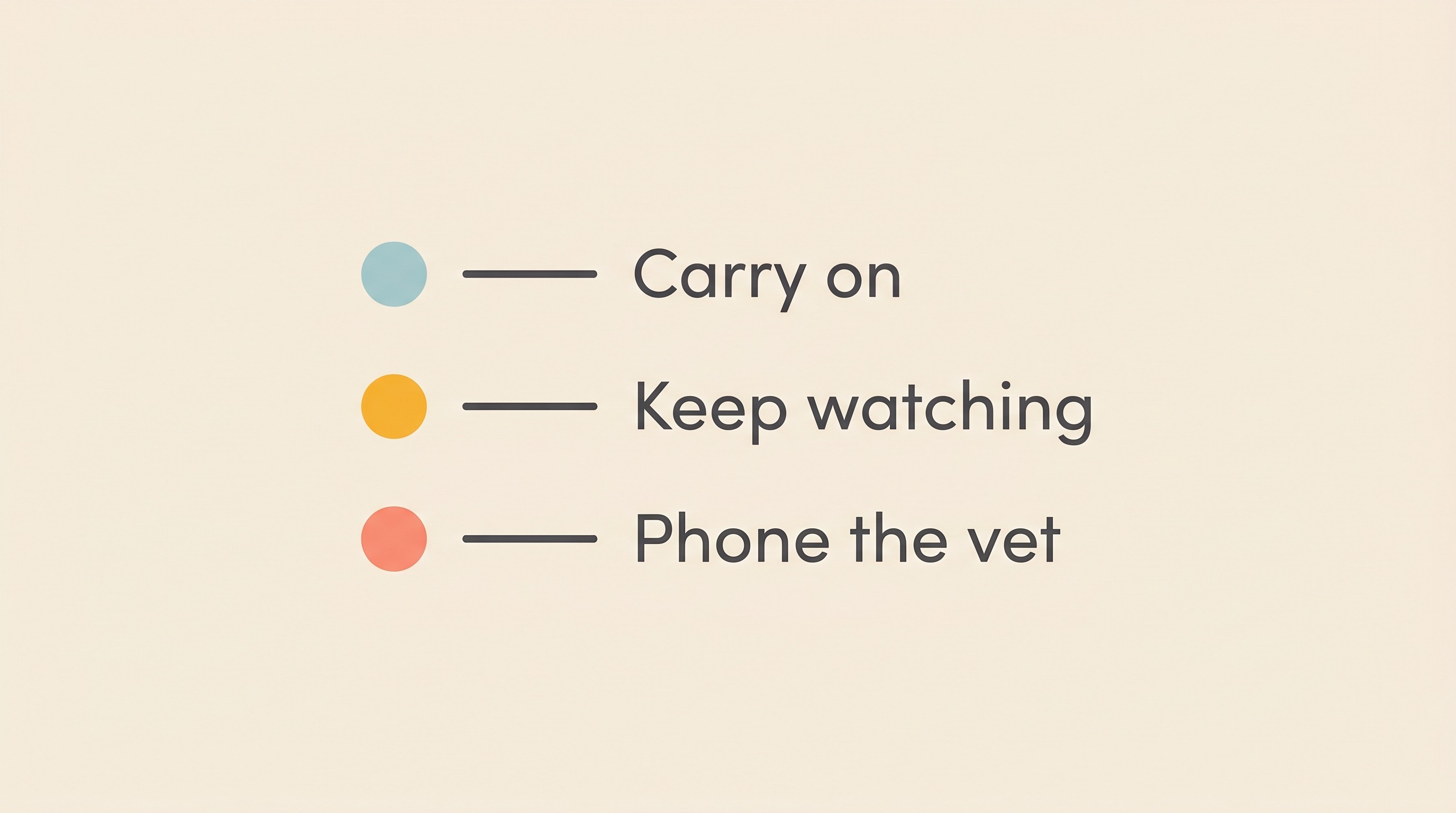
But not all of it. A handful of signs genuinely do mean pick up the phone, and the trick is telling the two apart without either panicking over a stiff afternoon or sitting on something that needs seeing. The week-by-week roadmap lives in The 12-Week Recovery Roadmap, and what a normal incision looks like lives in The First Two Weeks at Home. This article does one job: it consolidates "carry on versus call now" for the whole recovery.
Normal bumps in the road
Recovery is not a straight line, and that's the single most useful thing I can tell you. Energy, willingness and how much weight your dog puts through the leg all fluctuate from week to week. Dogs have good days and flat days for the same reasons we do, and after a busier physio session or a long sleep in an awkward position they can look worse the next morning and then quietly improve again.
A stiff day on its own is a normal bump. So is a plateau, a week where nothing seems to move forward, which is part of how healing goes rather than a sign it's gone wrong. Some firm swelling and thickening around the surgical area in the early weeks is expected too, and owners tend to over-read it. After a TPLO, for instance, the patellar tendon thickens on imaging in roughly 80 to 100% of dogs, almost always without ever causing a problem; genuinely symptomatic patellar tendinosis turns up in only around 7% (Hemmings & Tinga, 2023). A firm lump you can feel near the surgical site is, far more often than not, ordinary healing tissue.
What tells you anything is never the mere presence of a lump or a bad afternoon. It's the trend. Swelling that's settling week on week is fine, and so is a leg being used more, even with ups and downs. What you're watching for is a pattern of getting worse, read against the expected curve: weight-bearing, lameness and swelling measured against the post-op week, which is exactly the axis the Recovery Tracker uses. Structured rehabilitation genuinely helps recovery along, so when you hit a flat week the right move is usually to stick with your rehab team's plan rather than improvise around it (Alvarez et al., 2022).
One more thing catches a lot of people out. A healed-looking wound does not mean a healed leg. The skin incision typically closes over in about 10 to 14 days, but in a bone-cutting procedure like a TPLO or TTA the bone is nowhere near united at two weeks; bony union is usually only confirmed on X-ray at around eight weeks. That gap is exactly why a dog who "looks fine" and is happily using the leg still needs strict rest. The roadmap covers the full bone-healing timeline; here, just hold the principle: looks fixed is not the same as is fixed.
Red flags: call promptly
Now the other column, and I'll be specific, because vagueness here helps nobody. None of these are common, but all of them are reasons to phone the practice the same day.
A wound or implant area that's getting worse, not better. This is the big one, because surgical-site infection is the commonest meaningful complication after cruciate surgery. Reported rates after TPLO vary widely with how studies define infection, from around 1.3% up to 25.6%, and sat at about 8.5% in one large series of 769 procedures (Hemmings & Tinga, 2023; Husi et al., 2023). What matters at home is the pattern. Normal post-op bruising and swelling should be improving after the first few days, so the red flags are the opposite of that: a wound or implant area that's increasingly hot, swollen, red or painful rather than less so; any discharge, especially if it's thick, cloudy or smelly; a wound that opens or gapes; or your dog being unwell with it. In that same series the median time from surgery to diagnosis was 14 days, but the range ran from 4 days out to 855 (Husi et al., 2023). In plain terms, most infections show up in the first two to three weeks, but a deep infection around the implant can declare itself months later, so a wound or hardware area that turns angry long after you thought you were home and dry is still worth a call.
A sudden return of marked or non-weight-bearing lameness in a dog that had been improving. This one always earns a phone call today. A leg that goes from being used to being refused is never a "wait and see," because it can mean a few different things, all of which want assessing. The classic cause is a late meniscal tear. The meniscus is a cartilage cushion in the knee, and one that looked intact at the time of surgery can still tear weeks or months later. It isn't common: in a series of 476 TPLOs, a later tear in a meniscus that had been normal at surgery turned up in about 2.1% of knees, at a median of around 9.5 months afterwards (Gatineau et al., 2011). To you it looks like a dog who'd been doing well suddenly going markedly or completely non-weight-bearing again, sometimes with a click you can hear or feel, and the lameness may come and go. The reassuring part is that it's fixable, by re-inspecting the joint and removing the torn portion, so it's a reason to phone, not to despair. Why it happens and how it's dealt with belongs to The Meniscus; your job is simply to recognise the sign and ring up.
Sudden severe pain, or a hot, tender swelling over the implant. Implant and osteotomy problems are uncommon but real, and they tend to announce themselves as pain and lost function, not subtle stiffness. Implant-associated infection turns up in around 3.4% of TPLO cases, and mechanical issues such as a screw or plate problem, or rarely a fracture, present as new or worsening lameness, focal heat and swelling over the metalwork, or sudden severe pain (Hemmings & Tinga, 2023; Fitzpatrick & Solano, 2010). A dog who cries out, refuses to put the leg down, or has a hot, tender lump over the plate needs a same-day call.
A dog who's unwell in themselves. Being off-colour is a red flag in its own right, separate from anything you can see on the leg. Not eating, repeated vomiting, marked lethargy, or pain the prescribed medication clearly isn't controlling all warrant a prompt call: they can be an early sign of infection, or signal a reaction to medication. If your dog's pain isn't being held by what your vet sent you home with, that's a reason to ring, not a reason to reach for anything from your own cupboard. Which painkillers are safe, and why human ones never are, is covered in The First Two Weeks at Home.
A new limp on the other back leg. Cruciate disease is a degeneration of the dog rather than bad luck in one joint, so the other knee carries a real risk over the following year or two. A new lameness on the opposite hind leg is worth flagging to your vet. The full picture of that risk, and what you can do about it, is the whole subject of Will the Other Leg Go Too?, so I'll hand you there rather than scare you here.
A simple rule to hold onto
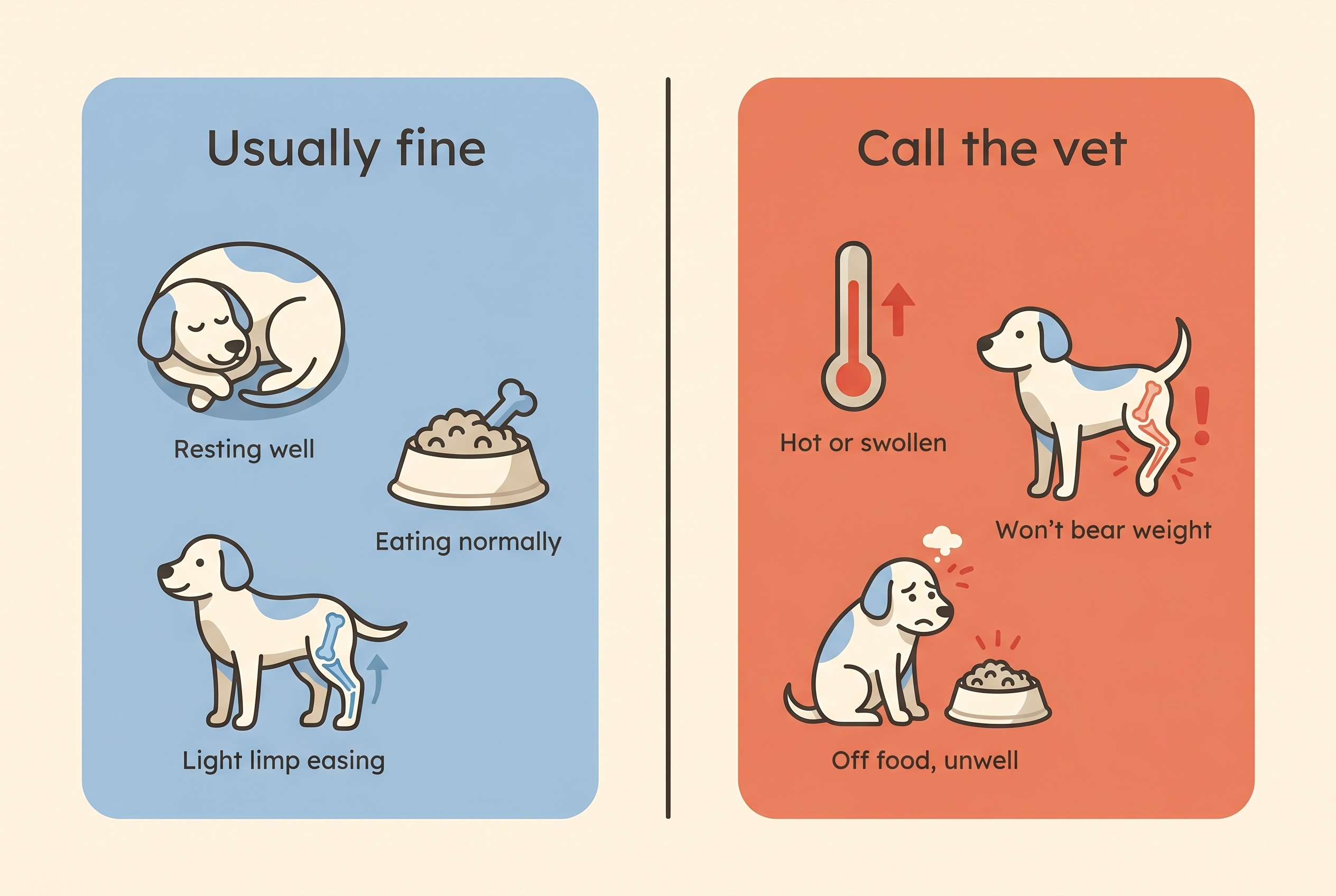
If you remember nothing else from this page, remember this. Getting worse rather than better, or you're worried, phone. That's it. It doesn't ask you to be a clinician at the kitchen table. It asks you to compare today against the trend of the last week, and if the line is heading the wrong way, to make the call.
I'd rather be straight about why this matters than dress it up. Complications after cruciate surgery aren't vanishingly rare: overall TPLO complication rates run somewhere around 10 to 34% of dogs, with up to roughly 4% eventually needing a revision procedure (Hemmings & Tinga, 2023). The great majority are minor and settle, but a meaningful minority are not, and the difference between a small problem and a big one is very often how early it's caught. That's why your practice would genuinely rather hear from you over nothing than have you sit on something that's brewing. Phone calls after surgery are expected, not an imposition.
It helps enormously, when you do ring, to describe things precisely. "He's a bit off" is harder to act on than "he was bearing full weight on Tuesday, he's been toe-touching since Thursday, and the swelling's gone from settling to clearly bigger and warmer." That's what the Recovery Tracker is for: you log weight-bearing, lameness and swelling against the post-op week, so you see a trend rather than react to a single day, and read it straight down the phone if you need to.
Where this very likely ends
Let me leave you with the reassurance, and it's a truthful one rather than a pat on the head. The outcomes after cruciate surgery are genuinely good. When the evidence was pooled and graded, surgical stabilisation came out as the approach most strongly supported for returning dogs to normal function (Bergh et al., 2014). Some of the work behind that is striking: by a year after a TPLO, force-plate studies have found operated limbs essentially indistinguishable from those of normal dogs, and owners report high satisfaction, with one head-to-head study putting it at 93% for TPLO (Tan et al., 2019). So a snag in recovery is far more often a detour than a catastrophe, and most dogs who hit a bump come through it well once it's spotted and dealt with.
So keep the vet's number where you can find it at 2am, keep logging in the Recovery Tracker so a worrying change is a fact you can describe rather than a feeling you can't, and lean on the simple rule: worse not better, or worried, phone. When you're ready to lift your eyes from the day to day, The 12-Week Recovery Roadmap sets out where the whole thing is heading, and once the leg is solidly under your dog again the long view of joint health picks up in Cruciate Disease and Arthritis. You're doing the watchful, unglamorous part that makes the result, and it's very likely heading somewhere good.
References
- Alvarez LX, Repac JA, Kirkby Shaw K, Compton N. Systematic review of postoperative rehabilitation interventions after cranial cruciate ligament surgery in dogs. Vet Surg. 2022;51(2):233-243.
- Bergh MS, Sullivan C, Ferrell CL, Troy J, Budsberg SC. Systematic review of surgical treatments for cranial cruciate ligament disease in dogs. J Am Anim Hosp Assoc. 2014;50(5):315-321.
- Fitzpatrick N, Solano MA. Predictive variables for complications after tibial plateau leveling osteotomy with stifle inspection by arthrotomy in 1000 consecutive dogs. Vet Surg. 2010;39(4):460-474.
- Gatineau M, Dupuis J, Plante J, Moreau M. Retrospective study of 476 tibial plateau levelling osteotomy procedures. Rate of subsequent 'pivot shift', meniscal tear and other complications. Vet Comp Orthop Traumatol. 2011;24(5):333-341.
- Hemmings D, Tinga S. Common tibial plateau-leveling osteotomy complications. Clinician's Brief. 2023.
- Husi B, Overesch G, Forterre F, Rytz U. Surgical site infection after 769 tibial plateau leveling osteotomies. Front Vet Sci. 2023;10:1133813.
- Tan CJ, Lipscombe VJ, et al. Tibial plateau leveling osteotomy for cranial cruciate ligament rupture in canines: patient selection and reported outcomes. Vet Med (Auckl). 2019;10:191-203.
Sister tool · Sightline
Track whether treatment is working
Sightline, a separate ConciergeVet tool, runs a short weekly check-in built on validated pain and mobility instruments, turns it into a single Sightline Score you can watch trend over weeks rather than judge on one bad day, and produces a report you can bring to your vet.
A written log, or our printable trackers, does much the same job.
See how Sightline tracks treatmentKeep track of how your pet is doing
The owners who cope best are the ones who notice changes early. A simple health log shows you what is working, and what is not, before the next vet visit.
Start tracking, freeYou're not doing this alone
Compare treatment journeys and talk to owners managing cruciate ligament disease. Free to join.
Join PetsLikeMine