

The First Two Weeks at Home After Surgery
Alastair Greenway
BVM&S MRCVS
The shaved leg, the cone catching on the door frame, the wound that looks more dramatic than you'd braced for: that's what most dogs come home looking like, and most owners spend that first evening watching for every wince and quietly dreading that they'll undo a very expensive operation. This is the most restricted and the most worrying fortnight of the whole recovery, and almost everything that looks frightening in it is normal.
What follows is a walk through these first two weeks: the wound, the cone, the confinement, the pain relief, and how to tell what's normal from what warrants a phone call. This is the opening fortnight of a roughly twelve-week course; the week-by-week milestones are mapped out in The 12-Week Recovery Roadmap, and the operation itself in the procedure guides (TPLO Explained). Tonight is just about the part you're in.
The wound and the cone
Start with the thing you keep looking at. A normal surgical incision is a clean, closed line that in the first few days can look slightly red, mildly swollen and bruised, none of which means something has gone wrong (VCA, Care of Surgical Incisions). In pale-skinned dogs the bruising can be alarming, because blood tracks under the skin and spreads below and beyond the cut. It looks worse than it is, and should fade and lighten over the following days rather than darken or spread. That early redness, bruising and swelling settles over about five to seven days, and the skin itself usually heals over roughly ten to fourteen (VCA, Care of Surgical Incisions).
That timeline matters for a reason owners often miss: a wound that looks healed on the outside does not mean the leg is fixed. With the bone-cutting operations, a TPLO or TTA, the surgeon has made a cut in the bone that takes far longer to knit than the skin, which is why strict rest must continue well past the point where the incision looks tidy. The bone-healing milestones belong to the recovery roadmap; here, just hold that a neat wound is not a finish line. Keep the incision clean and dry: no bathing, no swimming, no creams or ointments unless your surgeon has prescribed them, and no poking at it.
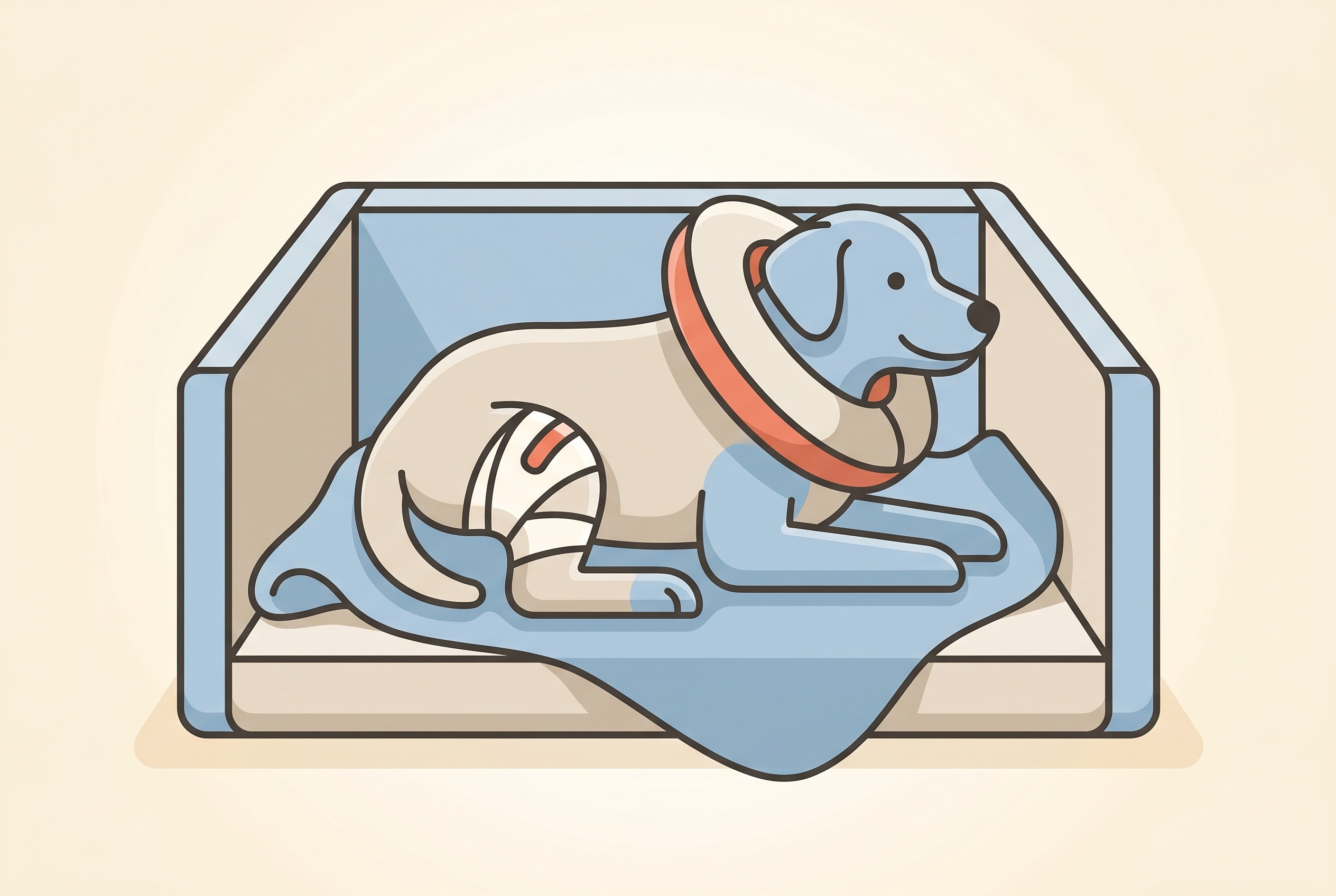
Now the cone, which I know your dog hates and you feel guilty about. It stays on. A dog's mouth carries bacteria, and a few seconds of licking or chewing can pull out sutures and open the wound, a complication called dehiscence that often means a second sedation to re-close (VCA, Care of Surgical Incisions). An Elizabethan collar, or a vet-approved equivalent like an inflatable collar or a recovery suit, needs to be worn essentially full-time, including unsupervised moments and overnight, for around ten to fourteen days until your recheck. "He only licks when I'm not looking" is precisely the problem the cone solves, and if your dog has learned to get past it, ring the practice for a better-fitting one.
There's a solid reason all this fuss is justified. Surgical site infection is the commonest meaningful complication after cruciate surgery, and it isn't rare: across the literature, reported infection rates after TPLO run around 2.9 to 17.3 percent, sitting within overall complication rates of roughly 9.7 to 27.8 percent (Husi et al., 2023), and the landmark 1,000-dog TPLO series found infection to be the single most important complication, with postoperative antibiotic therapy protective against it (Fitzpatrick & Solano, 2010). I give you those numbers not to frighten you, but so the cone and the clean wound feel like what they are: two of the simple things that shift those odds in your dog's favour. The skin sutures or staples, if there are external ones, usually come out at that ten-to-fourteen-day recheck, when the surgeon also checks the incision has healed (VCA, Care of Surgical Incisions).
Confinement and toilet trips
For these two weeks your dog lives in a confined space: a pen or a crate, big enough to stand, turn and lie comfortably, with secure, non-slip footing. Hard floors are the enemy. A dog who skids on laminate or tile can put a sudden twisting load through a healing knee in a single slip, so cover any smooth surface they'll cross with rugs or non-slip runners.
The rules for the fortnight are simple and strict. No jumping, on or off furniture, in or out of the car. No stairs. No off-lead time at all. No rough play, no zoomies, and no charging about with other dogs, however gentle it looks. Toilet trips happen on a short lead, even in your own garden, kept slow and brief, then straight back in. I know it feels mean. It isn't. Activity stays restricted for the foreseeable future, not just a couple of days, and the early weeks are when an unguarded moment does the most harm.
A quick, candid word, because I've watched a lot of owners crack in week two. Keeping a dog who is starting to feel better confined and bored is one of the hardest parts of this whole process, and the load runs both ends of the lead. Keeping a restless dog calm without breaking the rest rules, and holding onto your own sanity while you do it, deserves its own space (Strict Rest Without Losing Your Mind).
Pain relief and meds
Your dog will come home on pain relief, and modern surgical pain control is multimodal: more than one medicine working in different ways. Best-practice perioperative analgesia for orthopaedic surgery combines an opioid with an anti-inflammatory, alongside local and regional techniques used in theatre, and dogs are commonly discharged on a course of a prescription veterinary NSAID (Mathews et al., 2014). In the UK that's usually carprofen, meloxicam, robenacoxib or firocoxib, with the stronger opioids (methadone, buprenorphine) more often given in hospital around the operation, and sometimes an adjunct like gabapentin sent home alongside the anti-inflammatory.
Give it exactly as prescribed, with food where the label or your vet directs, because an empty stomach is harder on an NSAID. And please don't stop the course early just because your dog seems fine. A dog who looks bright on day four looks that way partly because the medicine is working, and stopping it can let pain come surging back. Finish the course, or check with the practice first, and if you're ever unsure, ring and ask rather than guessing.
Then the rule I will write in capitals if I have to: never add a human painkiller. Ibuprofen, naproxen, aspirin and paracetamol are dangerous in dogs. Ibuprofen and naproxen cause stomach ulceration, perforation and kidney injury at surprisingly modest doses (Merck Veterinary Manual), and paracetamol causes liver damage at relatively low doses and damages red blood cells at higher ones, within days (VCA, Acetaminophen Toxicity). And there's a specific trap that catches even careful owners: your dog is already on a prescribed NSAID, and stacking a second anti-inflammatory on top, whether another veterinary one or a tablet from your own bathroom cabinet, sharply raises the risk of severe gastrointestinal ulceration. In one recent case series every single dog that had received two NSAIDs at once went on to suffer a full-thickness perforation of the gut (Hillier et al., 2025). The rule is one NSAID at a time, vet-directed, with a proper washout gap if your vet ever switches you between them. If you think your dog's pain isn't controlled, the answer is a call to your vet, never the medicine drawer.
One genuinely useful thing you can do in the very first day or so, alongside the meds rather than instead of them, is cold therapy. In a blinded, placebo-controlled trial, cold compression to the knee in the first 24 hours after TPLO reduced pain, swelling and lameness and improved range of motion compared with none, an early-window benefit that had evened out by day 14 (Drygas et al., 2011). So it's a first-day-or-two tool, not a fortnight-long one. Follow your surgeon's instructions on whether and how to ice, always put a thin towel between the pack and the skin, and keep sessions short. It's a help, not a substitute for the meds.
What's normal, and what's worth a phone call
Normal, in the first fortnight, looks like this: mild bruising and swelling around the incision; a little clear or pink-tinged (serous) ooze in the first day or two; and, importantly, a leg that's only lightly used at first. Most dogs go through a stage of toe-touching to gentle weight-bearing over the first week, and that is exactly what we expect, not a setback. Recovery in these weeks is read as weight-bearing, lameness and swelling against the post-op week, which is exactly what the Recovery Tracker lets you log from day one.
Worth a phone call to your practice, on the other hand, are the things that move in the wrong direction: swelling, redness or heat that is increasing rather than settling after the first few days; a wound that is gaping, or discharging thick, smelly or yellow-green (purulent) fluid, or that your dog has got the cone off and licked; not eating or repeated vomiting, which can signal a reaction to the medication; or a sudden, total refusal to put any weight on a leg that had started to be used. None of these mean disaster, but all of them mean pick up the phone today rather than wait and hope.
I'm keeping that list lean deliberately, because deciding when something crosses from "keep an eye on it" to "go now" is exactly what the red-flags guide is for (Is This Normal? Red Flags During Cruciate Recovery). When in genuine doubt, ring your own veterinary team. They would far rather take a quick call about a wound that turns out fine than miss one that didn't.
Getting through it
The first two weeks feel enormous from inside them, and they are the foundation the whole recovery is built on. Wound clean, cone on, confinement held firmly even when those eyes work on you, medicine exactly as prescribed and nothing from your own cupboard, and an eye on the few signs that warrant a call. Do that, and you've laid the groundwork properly.
Then, once you're through the recheck and the sutures are out, the journey opens up. The 12-Week Recovery Roadmap shows where the next phases lead, and the Recovery Tracker keeps you on track week by week. You're doing the hard part right now. It gets easier from here.
References
- Drygas KA, McClure SR, Goring RL, Pozzi A, Robertson SA, Wang C. Effect of cold compression therapy on postoperative pain, swelling, range of motion, and lameness after tibial plateau leveling osteotomy in dogs. J Am Vet Med Assoc. 2011;238(10):1284-1291.
- Husi B, Overesch G, Forterre F, Rytz U. Surgical site infection after 769 Tibial Plateau Leveling Osteotomies. Front Vet Sci. 2023;10:1133813.
- Fitzpatrick N, Solano MA. Predictive variables for complications after TPLO with stifle inspection by arthrotomy in 1000 consecutive dogs. Vet Surg. 2010;39(4):460-474.
- Mathews K, Kronen PW, Lascelles D, Nolan A, Robertson S, Steagall PV, Wright B, Yamashita K. WSAVA Guidelines for recognition, assessment and treatment of pain. J Small Anim Pract. 2014;55(6):E10-E68.
- Merck Veterinary Manual. Poisoning from Human Over-the-Counter Drugs (NSAIDs in dogs). Accessed 9 June 2026.
- Hillier TN, Watt MM, Grimes JA, Berg AN, Heinz JA, Dickerson VM. Dogs receiving cyclooxygenase-2-sparing nonsteroidal anti-inflammatory drugs and/or nonphysiologic steroids are at risk of severe gastrointestinal ulceration. J Am Vet Med Assoc. 2025;263(3).
- VCA Animal Hospitals. Acetaminophen Toxicity in Dogs. Accessed 9 June 2026.
- VCA Animal Hospitals. Care of Surgical Incisions in Dogs. Accessed 9 June 2026.
Free downloads
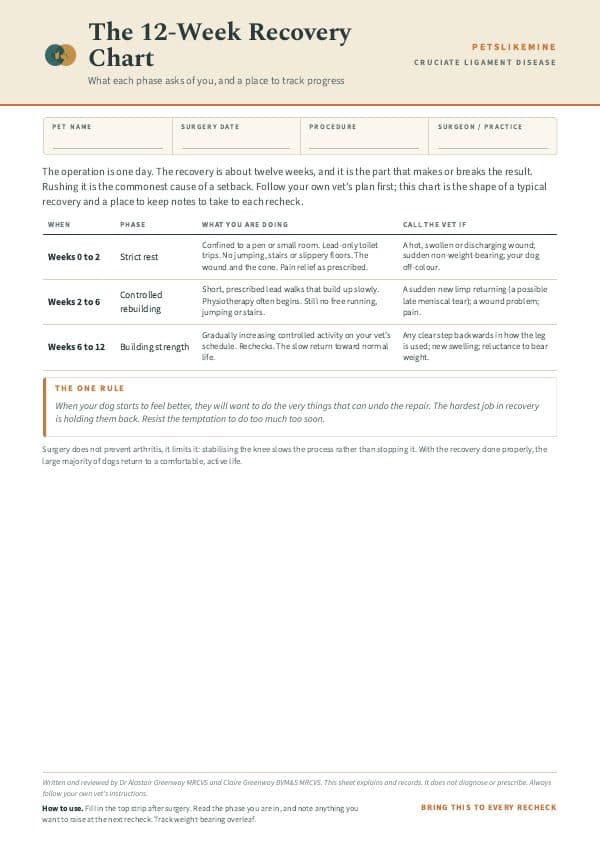
Companion worksheets to put what you've read into practice. Free PDFs, print at home.
Sister tool · Sightline
Track whether treatment is working
Sightline, a separate ConciergeVet tool, runs a short weekly check-in built on validated pain and mobility instruments, turns it into a single Sightline Score you can watch trend over weeks rather than judge on one bad day, and produces a report you can bring to your vet.
A written log, or our printable trackers, does much the same job.
See how Sightline tracks treatmentKeep track of how your pet is doing
The owners who cope best are the ones who notice changes early. A simple health log shows you what is working, and what is not, before the next vet visit.
Start tracking, freeYou're not doing this alone
Compare treatment journeys and talk to owners managing cruciate ligament disease. Free to join.
Join PetsLikeMine