

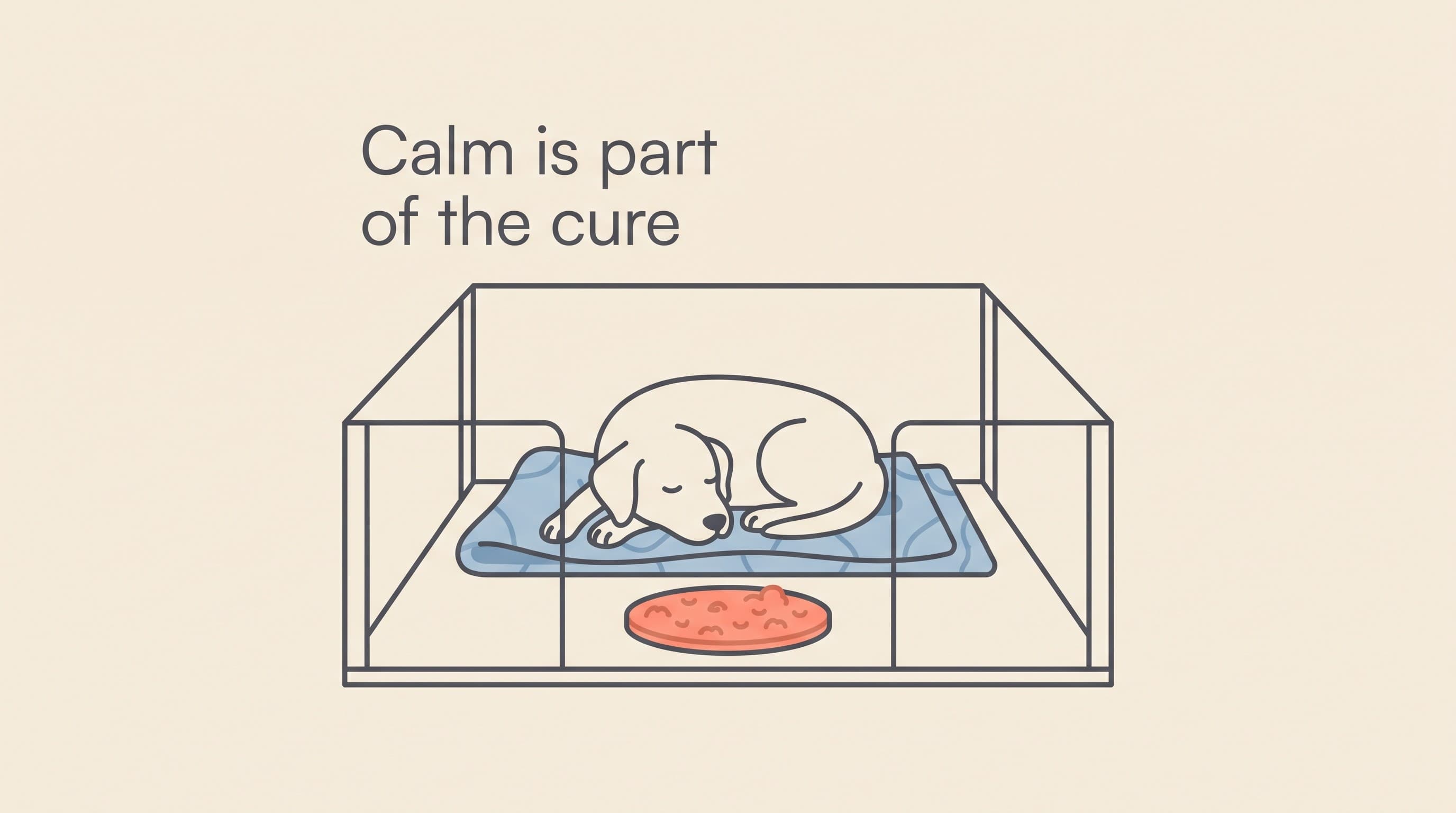
Strict Rest Without Losing Your Mind
Alastair Greenway
BVM&S MRCVS
The hardest part of cruciate recovery usually isn't the operation. It's the weeks afterwards, when your dog feels brilliant, looks brilliant, and has absolutely no idea that the repair holding their knee together is still healing. They want to leap onto the sofa. You have to stop them, again, for the fortieth time today, and there's a small voice asking whether one quick zoom round the garden would really do any harm. Nobody warns you about that part before surgery, and the dog at the edge of the pen whining at eleven at night doesn't help.
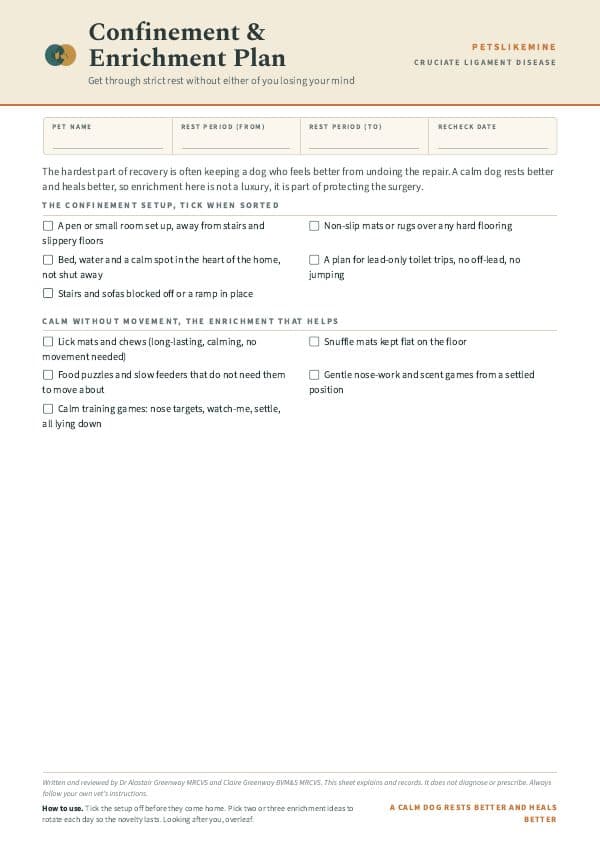
I understand that voice. I also want to lay out what's actually at stake, because candour is more reassuring here than cheerleading. So let's talk about getting a well-feeling dog through strict rest without either of you losing your mind. This piece assumes you've already got the confinement set up: the pen, the cone, the lead-only toilet trips, the no-stairs and no-slippery-floors basics. If you haven't, our guide to the first two weeks at home builds that scaffolding. This one is about coping inside it.
Why the boredom is worth enduring
Let me give you the rationale, because "because I said so" wears thin by week six.
Activity has to stay restricted for several weeks after surgery, not until your dog feels fine, but until your vet is satisfied that the implants and the healing tissue can take the load (American College of Veterinary Surgeons). In practice that protected window runs to around twelve weeks for most osteotomy repairs, which is why our twelve-week roadmap sets the pace. The catch is that dogs reach "feeling fine" weeks before "actually healed", and that gap is the whole problem.
The numbers explain why the restriction earns its keep. In a randomised trial that compared the two recovery paths head to head, overweight dogs who had a TPLO plus a full structured programme of physiotherapy, weight loss and anti-inflammatories reached a 92.6% success rate at twenty-four weeks, against 33.3% for the dogs managed without surgery at the same point (Wucherer et al., 2013). I want to be fair about that study, because the gap narrowed by a year: at fifty-two weeks the surgical group sat at 75.0% and the non-surgical group had climbed to 63.6%, so the fair reading is that surgery got these dogs there faster and more reliably, not that conservative care fails. Either way, the detail to hold onto is the same: in both arms the controlled programme was doing the work. The good result happened because of the rest and the rehab, not despite them. So when you protect the rest rules, you're delivering the actual treatment, not just avoiding a setback.
I want to be straight about risk too, because a lot of frightening talk online overstates one specific thing. You'll read that a single jump can snap the plate. The evidence doesn't really support that. When researchers looked at why the tibial tuberosity (a piece of the shin bone) sometimes fractures after TPLO, the risk tracked with anatomy and with having both knees done at once, not with owner activity: about 4.2% of cases overall, rising to 40% when both TPLOs were done simultaneously versus 2.4% for one leg at a time, with the odds falling 37% for every extra millimetre of bone width (Bergh et al., 2008). So the real reason for strict rest isn't "one zoomie will destroy everything". It's gentler than that, and it applies to lateral suture and TTA repairs just as much as TPLO: restriction protects healing tissue and avoids loading a joint that isn't ready. Overdoing it can certainly cause a setback, and a return of marked or non-weight-bearing lameness is a sign to phone your vet rather than wait. I've handed that "is this normal, do I call?" decision to our red flags guide for the moments that worry you.
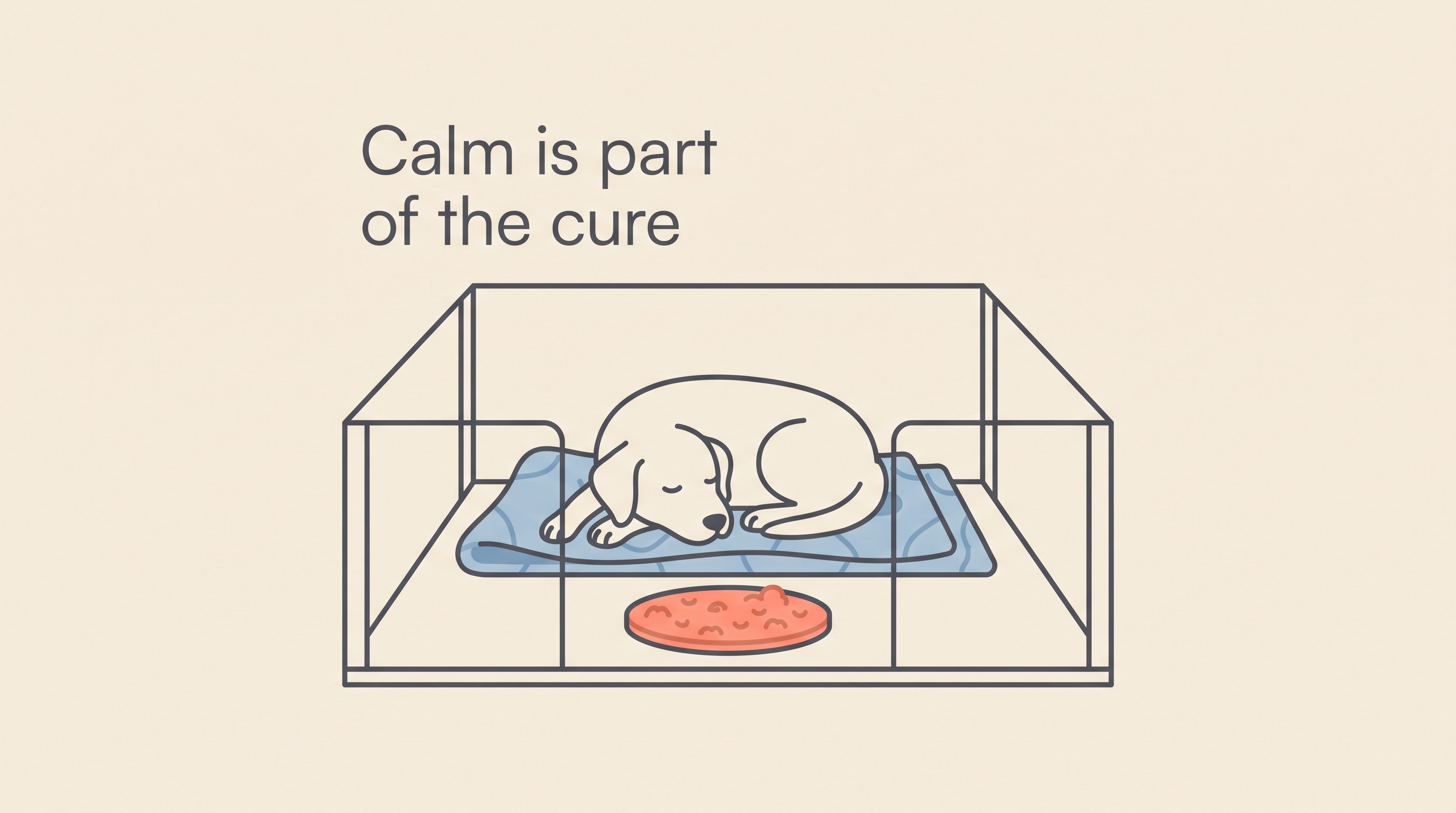
There's one more reason calm matters, and I'll flag clearly that this evidence comes from human medicine, not a dog trial. Across many studies in people, higher psychological stress is reliably linked to slower wound healing, with a pooled correlation of about -0.42, mediated by stress hormones suppressing the very inflammatory signals (IL-1 and TNF-alpha) that drive the early stages of repair (Gouin & Kiecolt-Glaser, 2011). We can't claim a proven canine result from that. But it's good reason to believe a settled, low-arousal dog is in a better state to heal than a frantic, frustrated one. Calm isn't just easier to live with: it's plausibly part of the cure.
Calm without movement
So how do you tire out a dog who isn't allowed to move? The trick is to give them brain work, not body work. A dog's day is built around using its nose and its problem-solving, and you can satisfy a surprising amount of that need from a settled, lying-down position.
I'll be upfront about evidence status here: the specific enrichment ideas below aren't backed by a clinical trial. They're what we recommend in practice, low-movement, low-arousal ways to meet a dog's needs without breaking the rest rules, and that's a different kind of claim from the research above.
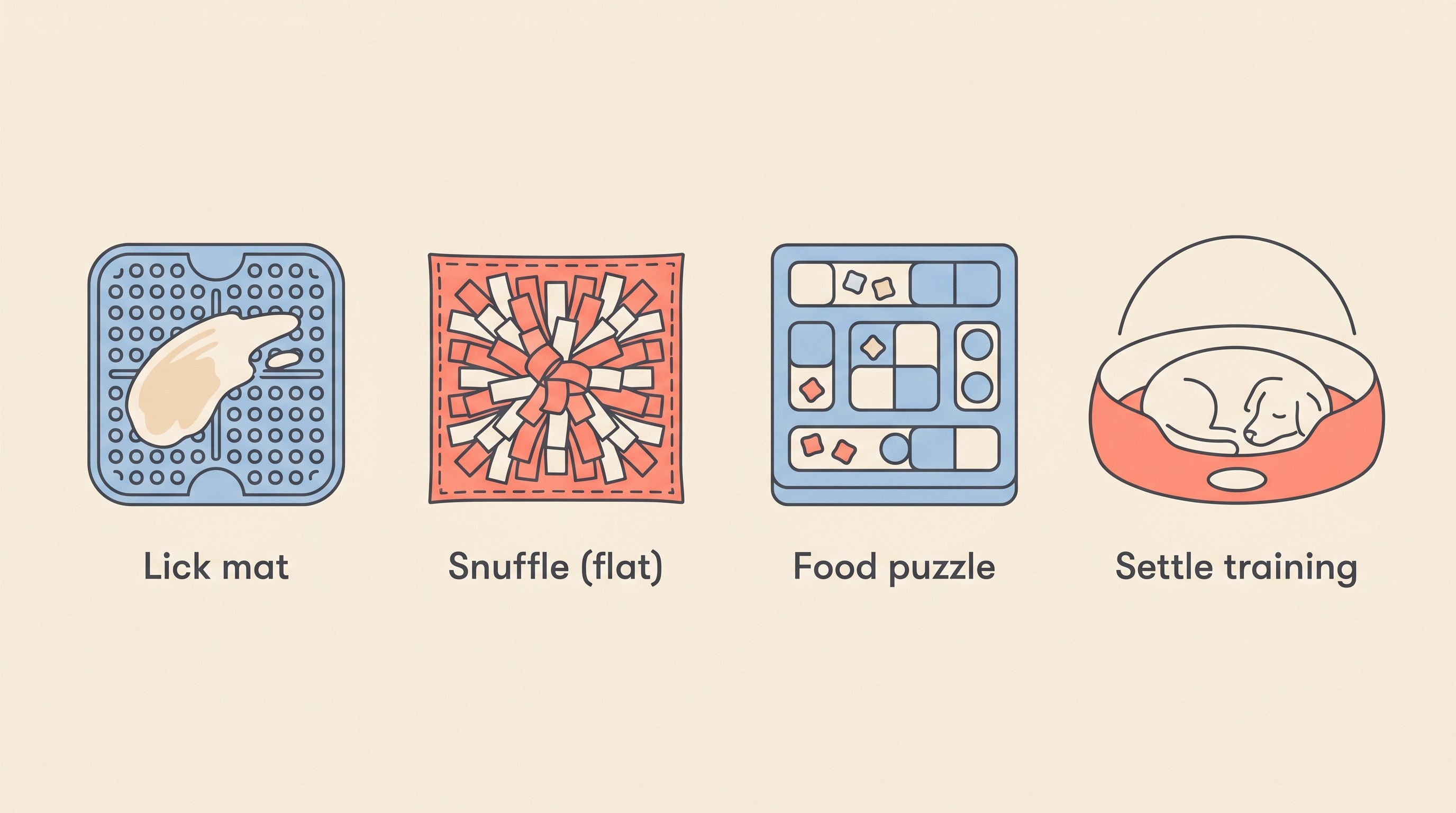
Things that work well during confinement:
- Lick mats and frozen stuffed toys. Smear a silicone mat with something soft, or pack a rubber toy and freeze it. Licking is calming, it lasts, and it happens lying down. These are the workhorses of confinement.
- Snuffle and scatter feeding, kept flat. Hide part of a meal in a snuffle mat or scatter it across a towel on the floor. The nose does the work, and keeping it on the ground means no reaching up or jumping.
- Food puzzles. Slow-feeder bowls and treat-dispensing puzzles make a dog think for their dinner. Choose ones they can solve while settled, not the kind that send them pawing around the room.
- Gentle nose-work from a settle. Let them sniff out a single treat placed within easy reach: a thinking dog, not a hunting one.
- Short settle and relaxation training. Rewarding your dog for choosing to lie calmly is itself enrichment, and it builds the exact habit you need for the next two months.
A word of caution that matters: this is mental stimulation to pass the time safely. It is not physiotherapy, and a snuffle game is not permission to start rebuilding. The active rehabilitation, the controlled exercises and the hydrotherapy, has its own timing and its own rules, and we cover it in the guides on physiotherapy and hydrotherapy and home exercises by phase. Don't let "my dog enjoyed a lick mat" slide into "my dog seems ready to trot about": those are different stages, and only your vet or physio gives the green light on the second.
Routine and company
Dogs cope with confinement far better when life is predictable. Meals, calm interaction, sniffy enrichment and rest at roughly the same times each day give a recovering dog a shape to lean on, and that routine does a lot of the work you'd otherwise be fighting for with willpower.
The instinct some owners have is to shut the recovering dog away somewhere quiet, thinking it'll help them settle. Usually the opposite is true: a dog tucked away on their own gets more frustrated, not less, and frustration is what spills over into barking, barrier-lunging and trying to climb out. So keep them in the heart of the home where they can see you and feel part of things, just with their activity contained. Short, calm bits of attention through the day, a quiet word, a slow stroke, a gentle game they can play lying down, are worth far more than one big burst of excitement. A dog who feels included and secure is a dog who rests.
When to ask about medication
Sometimes, despite a good routine and all the lick mats in the cupboard, a dog is genuinely climbing the walls, the frustration or anxiety wrecking the rest until you're both miserable. I want to say this plainly: that's a veterinary conversation, not a personal failure. If your dog's distress is putting the surgery at risk, your vet would far rather help than have you white-knuckle through it.
The medicine most studied for this exact situation is trazodone, a calming medication. An early open-label trial found owners reported it helped their dogs tolerate confinement and stay calmer, with good tolerability even alongside their post-op pain relief (Gruen et al., 2014). That sounds encouraging, and it may well help the right dog. But I'd be doing you a disservice if I stopped there, because the more rigorous follow-up tells a humbler story. When the same group ran a placebo-controlled trial, they found no significant difference between trazodone and placebo for at-home confinement, and more than 70% of owners in both groups rated their treatment helpful (Gruen et al., 2017). That's a small study (twenty-nine dogs), and the takeaway isn't "trazodone doesn't work". It's that a large part of what owners perceive is a caregiver and placebo effect, which is exactly why this belongs in your vet's hands and not on a forum. Medication can be a sensible part of the plan for the right dog, but it isn't a guaranteed fix, and routine plus enrichment do much of the work alone.
One firm line while we're here: never reach for human painkillers to take the edge off a restless dog, because many are toxic to dogs. The pain-relief side of recovery, with the prescriptions your vet has actually chosen, is covered in the first two weeks guide. The only drug question this article owns is the behavioural one above.
Looking after you
I haven't forgotten the human at the other end of the lead. The guilt, the broken sleep, the flash of resentment when you've cancelled plans again to supervise a dog who'd happily be tearing round a field: all of that is normal, and none of it makes you a bad owner. It makes you a tired one, doing something hard.
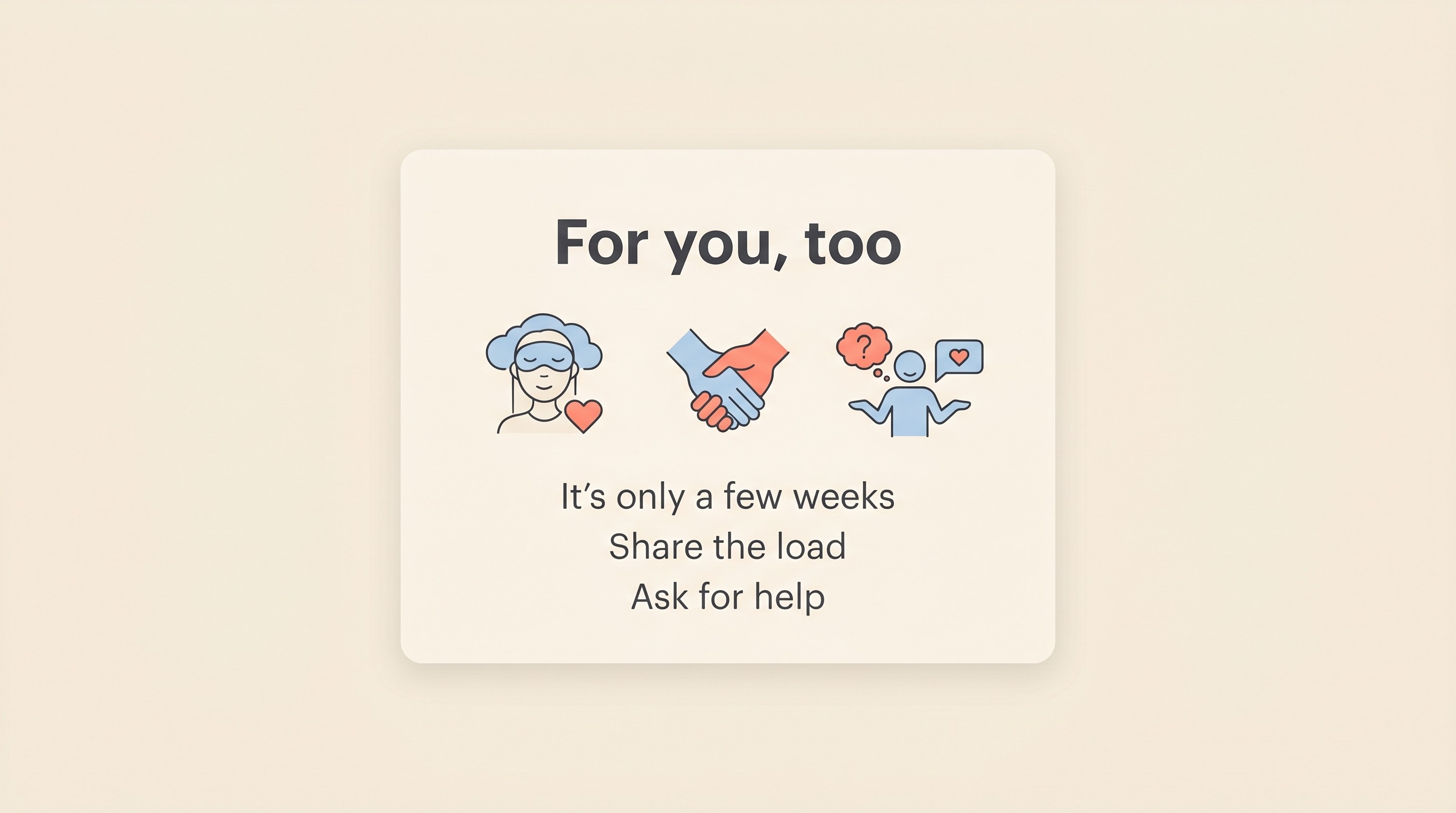
A few things genuinely help. Share the supervision if you possibly can, so no single person is on duty every waking hour. Lower the bar on everything else for a few weeks: the house can be untidy, the walks can wait. And hold onto the timeframe, because it really is finite. Around twelve weeks feels endless from the inside, but it ends, and the dog who comes out the other side is the reward for the slog. Looking after yourself here isn't self-indulgent. A calmer household is calmer for the dog too, and it's part of how you get them across the line.
If the not-knowing is the hard part, if "calm but bored" keeps making you wonder whether something's quietly wrong, our Recovery Tracker lets you log weight-bearing, lameness and swelling against the expected week. It turns a vague worry into something you can see, and gives this whole stretch a visible finish line.
You're not failing because it's hard. It's hard because you're doing it properly, and doing it properly is what gives your dog the best knee they can have. Keep the rest, keep the calm, keep your own head above water, and let the twelve-week roadmap show you what's coming next. The boredom is temporary. The healing it protects is the part that lasts.
References
- American College of Veterinary Surgeons. Cranial Cruciate Ligament Disease (owner factsheet). Available at:
- Bergh MS, Rajala-Schultz P, Johnson KA. Risk factors for tibial tuberosity fracture after tibial plateau leveling osteotomy in dogs. Veterinary Surgery 2008;37(4):374-382. DOI: 10.1111/j.1532-950X.2008.00391.x
- Gouin J-P, Kiecolt-Glaser JK. The impact of psychological stress on wound healing: methods and mechanisms. Immunology and Allergy Clinics of North America 2011;31(1):81-93. DOI: 10.1016/j.iac.2010.09.010
- Gruen ME, Roe SC, Griffith E, Hamilton A, Sherman BL. Use of trazodone to facilitate postsurgical confinement in dogs. Journal of the American Veterinary Medical Association 2014;245(3):296-301. DOI: 10.2460/javma.245.3.296
- Gruen ME, Roe SC, Griffith EH, Sherman BL. The use of trazodone to facilitate calm behavior after elective orthopedic surgery in dogs: results and lessons learned from a clinical trial. Journal of Veterinary Behavior 2017;22:41-45. DOI: 10.1016/j.jveb.2017.09.008
- Wucherer KL, Conzemius MG, Evans R, Wilke VL. Short-term and long-term outcomes for overweight dogs with cranial cruciate ligament rupture treated surgically or nonsurgically. Journal of the American Veterinary Medical Association 2013;242(10):1364-1372. DOI: 10.2460/javma.242.10.1364
Free downloads
Companion worksheets to put what you've read into practice. Free PDFs, print at home.
Sister tool · Sightline
Track whether treatment is working
Sightline, a separate ConciergeVet tool, runs a short weekly check-in built on validated pain and mobility instruments, turns it into a single Sightline Score you can watch trend over weeks rather than judge on one bad day, and produces a report you can bring to your vet.
A written log, or our printable trackers, does much the same job.
See how Sightline tracks treatmentKeep track of how your pet is doing
The owners who cope best are the ones who notice changes early. A simple health log shows you what is working, and what is not, before the next vet visit.
Start tracking, freeYou're not doing this alone
Compare treatment journeys and talk to owners managing cruciate ligament disease. Free to join.
Join PetsLikeMine