

Braces and Orthoses: What the Evidence Says
Alastair Greenway
BVM&S MRCVS
Type "dog knee brace cruciate" into a search bar and what comes back is a wall of confident advertising: hinged braces, before-and-after photos, the strong implication that for a few hundred pounds you can sidestep the operation altogether. When surgery is off the table, or a long way down your list, and the surgical numbers have frightened you, that's a comforting thing to read.
This page tries to give you something more useful than either the sales pitch or the dismissive eye-roll you'll sometimes get the other way. A stifle brace is a real device with a real, if modest, place in the right plan, and it's also routinely oversold. So let me walk you through what these things actually do, what the evidence really shows, and the kind of dog for whom one is a sensible idea rather than a comforting purchase.

What a brace tries to do
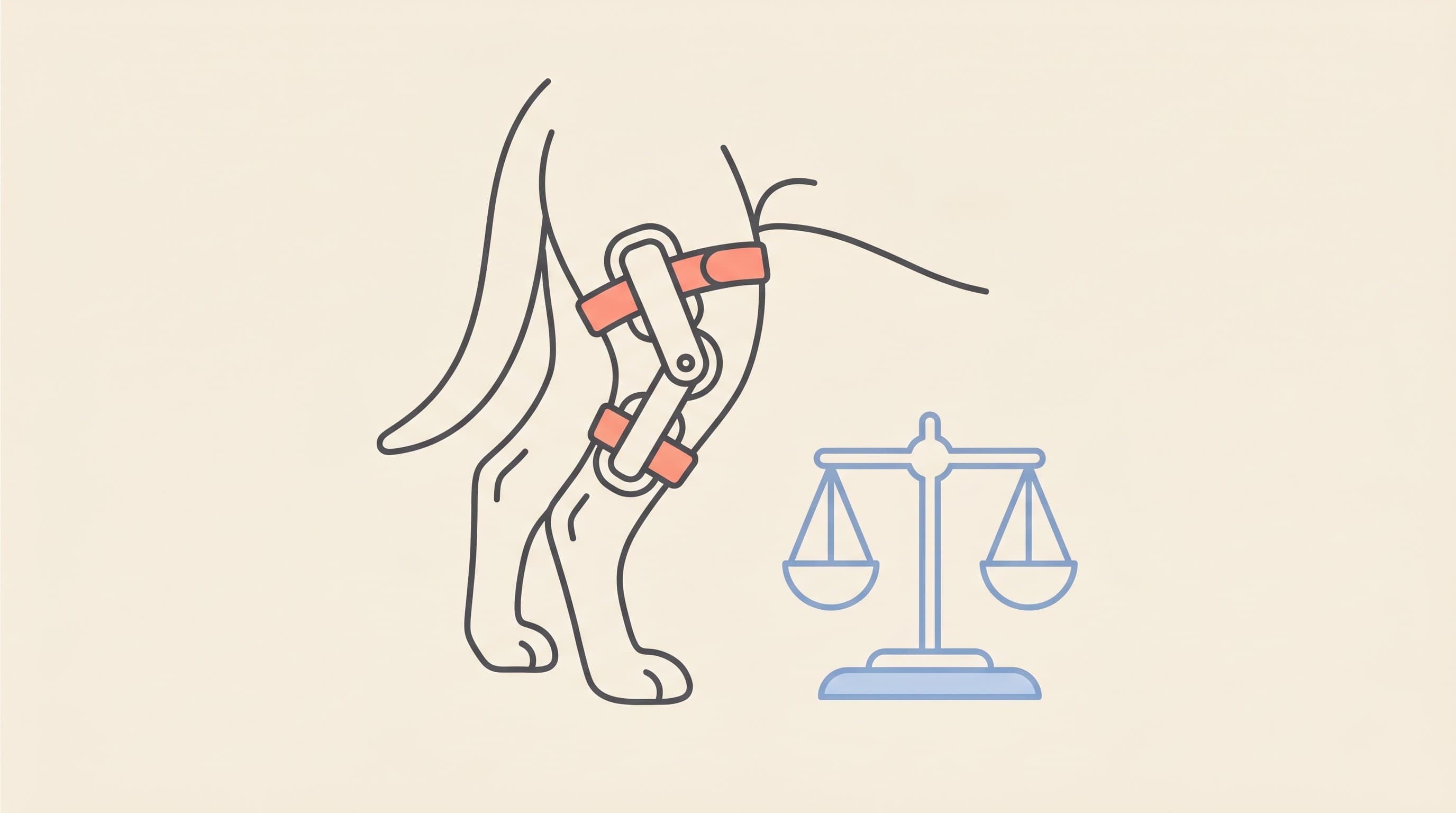
A custom stifle orthosis, to give it its proper name, is a rigid, hinged shell that's fitted to the back leg over the knee. The leg goes into a cast or a 3D scan, and a few weeks later you're handed a moulded brace with a metal hinge sitting either side of the joint. The job it's trying to do is mechanical. A cruciate-deficient knee is unstable: every time the dog bears weight the shin bone slides and rotates forward against the thigh bone in a way it shouldn't, and that abnormal movement is what hurts and what drives the arthritis. The brace tries to limit that movement from the outside, holding the joint steadier while the body lays down its own scar tissue around the joint to provide longer-term stability.
This is the part the adverts skate over. A brace does precisely nothing to the cruciate ligament itself. Cruciate disease in dogs is a degeneration, not a one-off injury: the ligament frays and weakens over months, and the leap off the sofa is usually the moment it gives way rather than the cause. No external device reverses that. What a brace can do, at best, is manage the mechanical consequence, the instability, which is the same target surgery aims at, by a very different and altogether gentler route. That reframing matters, because it tells you what a brace is and isn't. It's a tool of conservative management, the non-surgical path. It is not a non-surgical version of a TPLO.
One quick word, because frightened owners buy the wrong thing at 2am. The soft neoprene "knee supports" sold cheaply online are not the same object at all. A slip-on fabric sleeve does not stabilise a cruciate-deficient joint, and buying one under the impression it'll hold the knee together is a genuine mistake. If a brace is on your radar, it means a custom-cast, rigid, hinged device, fitted properly.
What the evidence shows
Let me be straight with you, because this is exactly where the marketing relies on you not looking too closely. The evidence base for stifle braces is genuinely limited and mostly low quality. No randomised controlled trial has ever compared a brace against surgery, or even against conservative management without a brace. What exists is a handful of small retrospective case series, one larger owner-satisfaction survey, and a knowledge summary or two, with no untreated or sham-treated dogs to compare against (Carr and Canapp, 2016). That isn't me being awkward. It's the state of the field, and it should make you cautious about any page presenting brace results as if they were settled fact.
Within those limits, there is a signal of benefit for the right dog, and I don't want to wave it away. Objective gait work, the kind that measures how much weight a dog actually puts through a leg, has shown measurable improvement on the braced limb. One retrospective series of ten dogs found a 5.1% rise in the total pressure index, a weight-bearing measure, on the affected leg after ninety days or more in a brace, alongside owners reporting they were happy with how their dogs were doing (Carr and Canapp, 2016). A separate prospective study likewise found improved weight distribution in braced dogs (Rosen et al., 2022). So a properly fitted brace can demonstrably help some dogs use the leg better. The big caveat is that these dogs were almost always having other treatment at the same time: weight management, painkillers, controlled exercise. With no control group you simply cannot isolate how much of the improvement was the brace and how much was everything else. The independent effect of the brace itself remains unproven.
What the evidence does not show, and I want to say this plainly because it's where owners get misled, is that a brace is equivalent to surgically stabilising the knee. The single most useful comparison we have is an owner-satisfaction survey that looked at dogs managed with a stifle orthosis versus dogs that had a TPLO. Owner-rated outcomes were good to excellent in 86% of the brace dogs, which sounds impressive until you see that the figure for the TPLO dogs was 98%, and that significantly more of the surgical dogs had only mild or no residual lameness (Hart et al., 2016). Now, this was an owner survey, not blinded gait analysis, and the two groups weren't randomised, so read it as a strong hint rather than proof. But it points the same way as the broader evidence. The best trial we have in cruciate-affected dogs gave every dog the conservative basics and then added surgery for half of them, and at twenty-four weeks the surgical group's success rate was 92.6% against 33.3% for the dogs managed without surgery (Wucherer et al., 2013). And when researchers systematically reviewed the surgical literature, the strongest evidence supported the TPLO, a bone-cutting procedure, for returning dogs to normal function (Bergh et al., 2014). For a large, active dog, the evidence favours surgical stabilisation, and a brace is not shown to match it. Anyone implying otherwise is selling you something.
The other thing the adverts file under the small print, and shouldn't, is how demanding a brace is to live with. Skin problems are common, not rare. In one prospective study, 58% of dogs in a stifle orthosis developed a skin complication, rubs, sores or hair loss, within the first three months (Rosen et al., 2022). In the larger owner survey, 46% of owners reported skin lesions, around 7% of dogs never tolerated the device at all, and roughly 11% went on to have surgery anyway (Hart et al., 2016). A brace is a daily-management commitment: on in the morning, off at night, skin checked every single day, and re-fitted periodically as the leg's muscle mass changes through the rehab. None of that is a reason not to do it. It's a reason to go in with your eyes open, knowing it's a job of work rather than a strap you fit and forget.
When a brace might be reasonable
So who is a brace actually for? In my view, the answer is narrower than the marketing and wider than the cynics allow.
A brace earns its place as one component of committed, vet-supervised conservative management, for a dog that genuinely can't have surgery. That might be a dog whose anaesthetic risk is too high because of heart or other disease, a dog with comorbidities that make a major operation unwise, or a household for whom the cost of surgery simply isn't possible and conservative care is the realistic route. For those dogs, a brace can be a reasonable part of the plan, not a magic fix, but a useful prop while the body builds its own scar-tissue stability. The dogs it suits best tend to be the same ones conservative management suits best overall: smaller, lighter, calmer, older. The bigger and more athletic the dog, the more the evidence says it deserves surgical stabilisation if at all possible, and the less a brace should be leaned on as a substitute.
If you do go this way, two things make the difference between a brace that helps and an expensive ornament. The first is fit. A brace should be measured and cast by a clinician or a certified orthotist who fits these for a living, not bought off the shelf as a generic wrap and hoped to fit. A poorly fitted rigid brace doesn't stabilise the joint and does rub the skin raw, the worst of both worlds. The second is candour about cost. As a UK practical estimate, not a peer-reviewed figure, a custom cast-and-fitted rigid stifle orthosis commonly runs to several hundred pounds, and that's before the fitting and adjustment visits and the ongoing rehab. The "it's cheaper than surgery" argument is real but narrower than it first looks once the refits and the physio are counted in. Our plain run-down of what cruciate surgery costs in the UK is worth a look so you're comparing like with like.
And a brace changes none of the bigger picture. Your dog will still develop some arthritis in that knee, because the instability has already started it, and stabilising the joint by any route slows that process rather than stopping it (a long view we pick up in cruciate disease and arthritis). The other knee is still at meaningful risk of going the same way, somewhere around a third to a half within a year or two, which is worth keeping on your radar and is covered properly in will the other leg go too (Buote et al., 2009). And the work that does the most for a braced dog isn't the brace at all: it's the weight control and the muscle, which we hand off to weight, muscle and the long game.
The single most useful way to hold all this in your head is to stop thinking of a brace as a decision in its own right. It isn't surgery's smaller rival. It's one optional tool inside a wider non-surgical plan, and that plan, not the brace, is what determines how your dog does. If you're still weighing surgery against conservative care at the top level, start with surgery or not. If you've already decided conservative is your road, the whole case for it, who it suits and what it asks, lives in conservative management: when it's a real option, and the day-to-day grind of actually doing it well is laid out in conservative management, day to day. A brace can have a genuine place in that plan. Just walk in knowing what it is, a support to good conservative care, and not a quiet way to skip stabilising the knee.
References
- Bergh MS, Sullivan C, Ferrell CL, Troy J, Budsberg SC. Systematic review of surgical treatments for cranial cruciate ligament disease in dogs. Journal of the American Animal Hospital Association. 2014;50(5):315-321. DOI 10.5326/JAAHA-MS-6356.
- Buote N, Fusco J, Radasch R. Age, tibial plateau angle, sex, and weight as risk factors for contralateral rupture of the cranial cruciate ligament in Labradors. Veterinary Surgery. 2009;38(4):481-489. DOI 10.1111/j.1532-950X.2009.00532.x.
- Carr BJ, Canapp SO. The use of canine stifle orthotics for cranial cruciate ligament insufficiency. Veterinary Evidence. 2016;1(1). DOI 10.18849/ve.v1i1.10.
- Hart JL, May KD, Kieves NR, Mich PM, Goh CSS, Palmer RH, Duerr FM. Comparison of owner satisfaction between stifle joint orthoses and tibial plateau leveling osteotomy for the management of cranial cruciate ligament disease in dogs. Journal of the American Veterinary Medical Association. 2016;249(4):391-398. DOI 10.2460/javma.249.4.391.
- Rosen SF, Duerr FM, Elam LH. Prospective evaluation of complications associated with orthosis and prosthesis use in canine patients. Frontiers in Veterinary Science. 2022;9:892662. DOI 10.3389/fvets.2022.892662.
- Wucherer KL, Conzemius MG, Evans R, Wilke VL. Short-term and long-term outcomes for overweight dogs with cranial cruciate ligament rupture treated surgically or nonsurgically. Journal of the American Veterinary Medical Association. 2013;242(10):1364-1372. DOI 10.2460/javma.242.10.1364.
Sister tool · Sightline
Track whether treatment is working
Sightline, a separate ConciergeVet tool, runs a short weekly check-in built on validated pain and mobility instruments, turns it into a single Sightline Score you can watch trend over weeks rather than judge on one bad day, and produces a report you can bring to your vet.
A written log, or our printable trackers, does much the same job.
See how Sightline tracks treatmentKeep track of how your pet is doing
The owners who cope best are the ones who notice changes early. A simple health log shows you what is working, and what is not, before the next vet visit.
Start tracking, freeYou're not doing this alone
Compare treatment journeys and talk to owners managing cruciate ligament disease. Free to join.
Join PetsLikeMine