

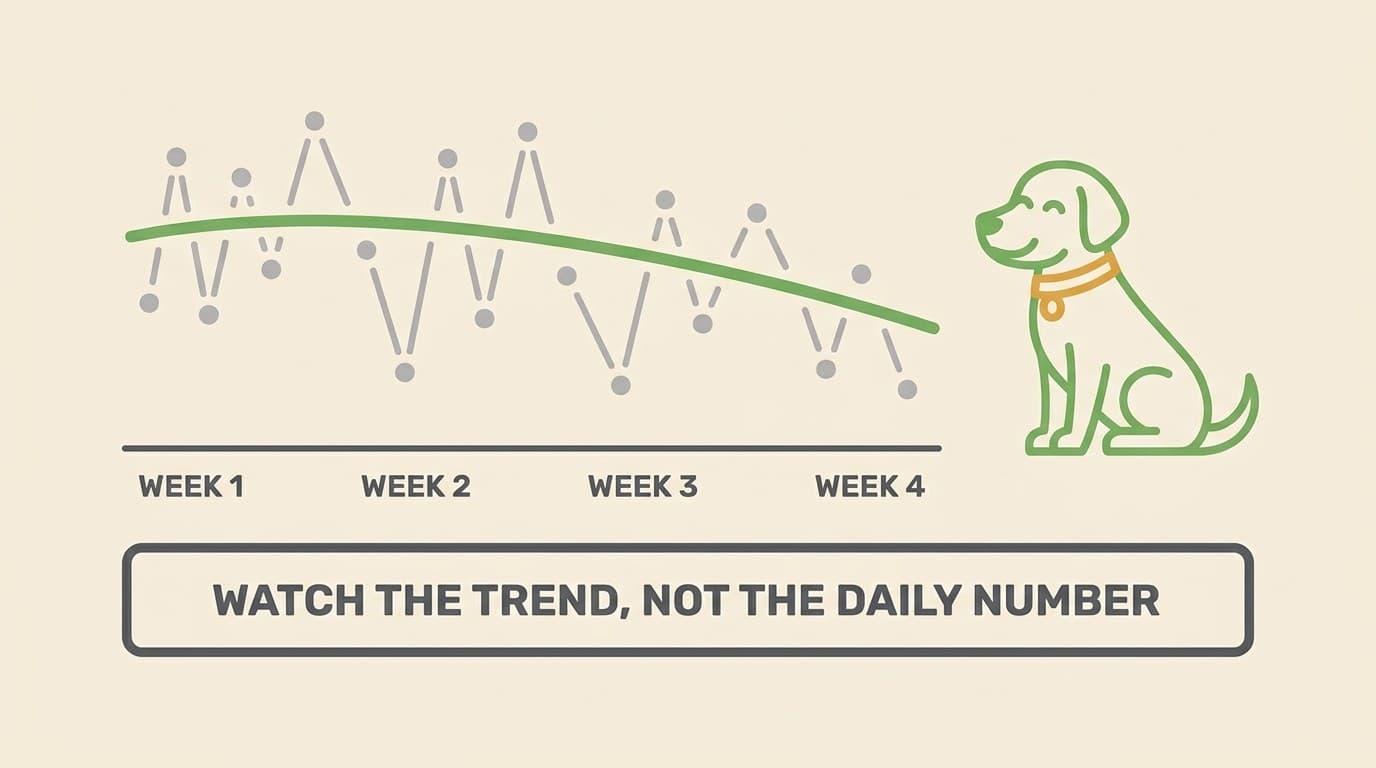
Is it working? Reading the trend, not the daily number
Alastair Greenway
BVM&S MRCVS
A morning weigh-in is one of the most misleading readings in the whole weight-loss plan. The figure goes up and your heart sinks; it sits stuck for ten days and you start to think the plan has failed. Before you change a thing, it helps to know what that number can and can't tell you, because reading too much into a single morning is how good plans quietly fall apart.
Think of this as the companion to busting a real plateau. That article fixes a genuine stall. This one is about the far commoner problem, a perfectly normal wobble that only feels like a stall because you're staring at it every day. Once you learn to read the line instead of the morning, most of those panics simply disappear.
The daily number lies; the trend tells the truth
A single morning weigh-in bounces around for reasons that have nothing whatsoever to do with fat. A long drink of water before you got to the scale can add a noticeable amount on a small pet. A full gut versus an empty one shifts the figure between morning and evening. A meal an hour ago, a wee they haven't had yet, the time of day, even the pet wriggling and leaning while you try to read the display, all of it moves the number. None of it is the thing you're actually trying to change.
Body fat does not appear or vanish overnight. It comes off slowly, gram by gram, as a small daily calorie deficit adds up over weeks. So when you weigh every single day, what you're mostly measuring is water and gut fill, not fat. The fat signal is real but tiny, and on any given morning it's buried under all that noise. Weigh daily and you don't see the diet working. You see a random number generator, and your mood rides up and down with it.
That's why daily weighing manufactures both false wins and false despair. A flattering low number one morning (an empty gut) feels like a triumph you didn't earn. A high one the next day (a big drink, a full bladder) feels like failure you don't deserve. Neither is telling you anything about fat. What matters is the line over several weeks, the direction of travel, not today's figure. So from the very start, set the expectation in your own head: you're tracking a direction, not sitting an exam every morning.
What a healthy loss curve actually looks like
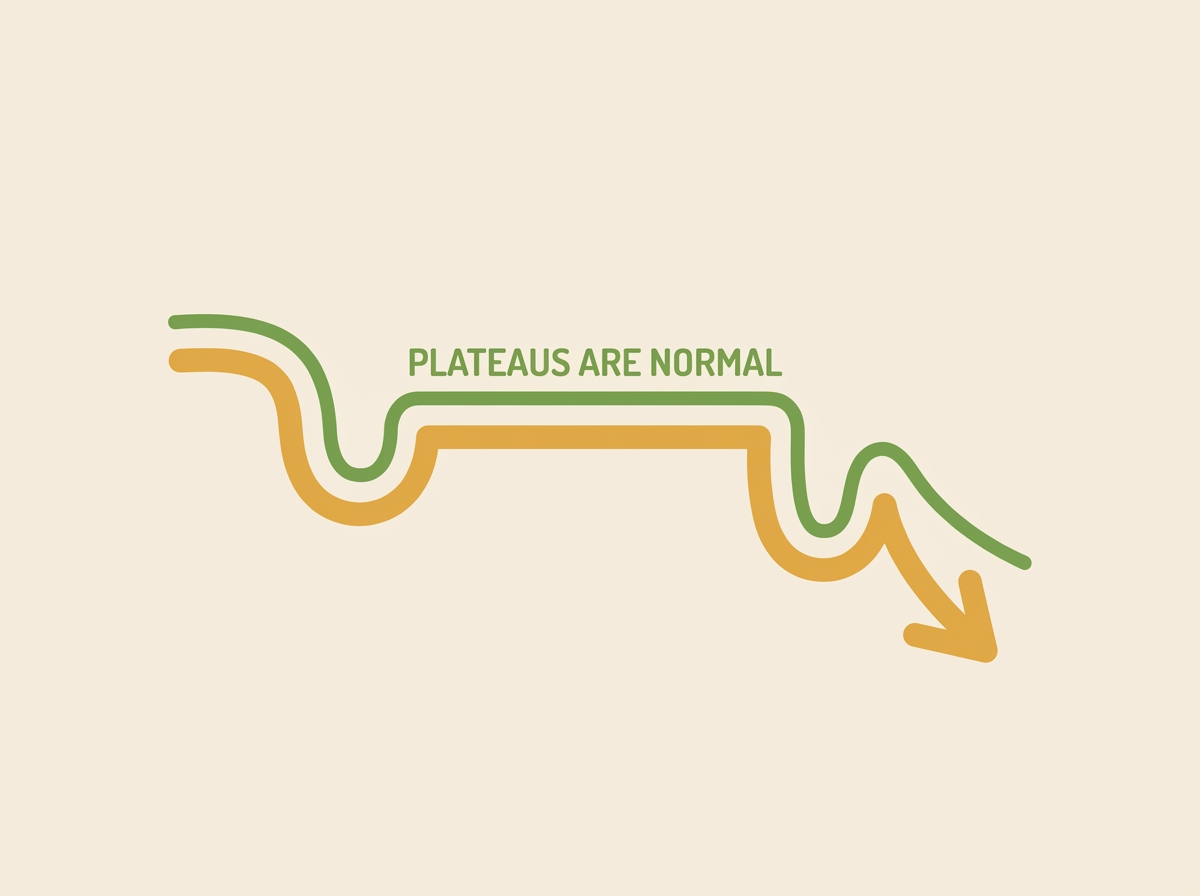
Here's the picture almost nobody draws for you. A healthy weight-loss curve is not a smooth ramp sliding neatly downward. It's a small drop, then a flat stretch where nothing much seems to happen, then another drop, then more flat, gradually heading down over weeks and months. Plotted out, it looks jagged and hesitant up close. Step back far enough and the overall line is clearly going the right way.
It helps to know what a "good" week actually weighs. Safe weight loss is slow: around 1 to 2% of body weight a week for dogs, and around 0.5 to 1% a week for cats (AAHA, 2021). On a 30kg Labrador that's roughly 300 to 600g a week. On a 5kg cat it's about 25 to 50g, a tiny amount to read off a bathroom scale at all. Faster isn't better, it risks losing muscle instead of fat and, in cats especially, it's genuinely dangerous (AAHA, 2021). So a week where your dog drops 200g, or your cat barely seems to have moved, is very often bang on target rather than a failure. Slow is the plan, not a problem with it.
Those flat stretches have a name. They're plateaus, and they are an expected feature of the curve, not a fault in it. As your pet gets lighter they burn fewer calories, so progress naturally levels off for a spell before resuming, and plateaus become especially common several months in (APOP, 2023). A genuine stall that lasts for many weeks is worth troubleshooting, and there's a whole playbook for that. A flat patch of a week or two, sitting inside an overall downward line, is just the curve doing what curves do. Zoom out. If the line over the last couple of months is heading down, it's working, whatever this morning said.
Weigh less, look at the body more (and take the photo)
The practical fix for daily-number anxiety is almost comically simple: weigh less often. During active weight loss, a weigh-in about once a week is plenty, and every two to four weeks is fine for a steady plan. A cadence like that lets you spot a meaningful trend without overreacting to the normal day-to-day bounce (PetMD, 2022). When you do weigh, keep everything the same: the same scale, the same time of day, the same routine (before breakfast is a good habit). Same conditions means the numbers are comparable, so the trend you read is real and not an artefact of weighing fed one week and fasted the next.
Then, crucially, trust the body more than the scale alone. Two pets can be the same weight and in completely different shape, because breed and frame make any single number hard to interpret. This is where the body condition score earns its keep. Running your hands over the ribs, checking for a waist from above and a tummy tuck from the side gives you a read on actual fat that the scale can't (WSAVA, 2020). And the numbers tie together neatly: each body-condition point above ideal is roughly 10% of body weight (WSAVA, 2020). So dropping a single point is real, substantial progress, even across a fortnight where the scale looked noisy and unconvincing.
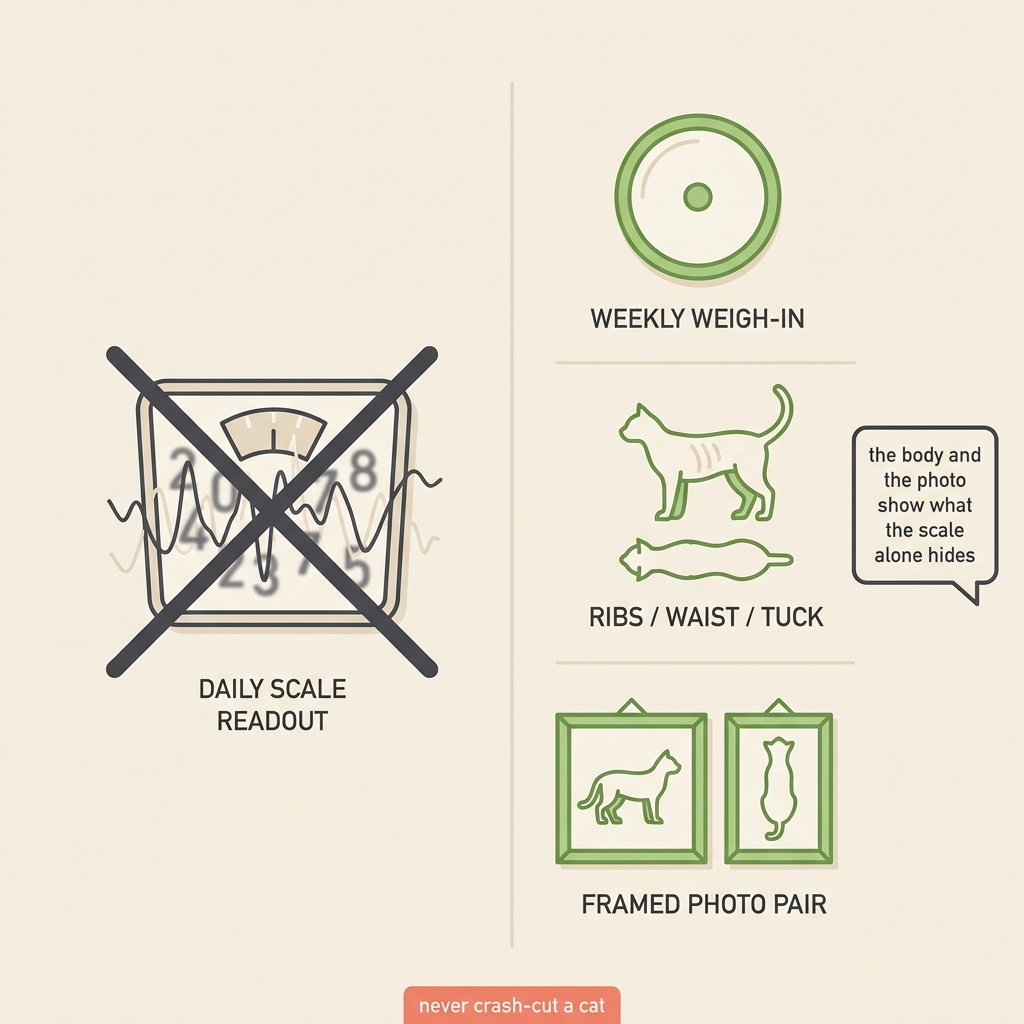
Best of all, take the photo. A side-on shot and a top-down shot, in good light, framed the same way each time, will show you change that hides inside a wobbly number. The waist coming in, the tuck appearing, the silhouette tightening, these are far easier to see in pictures a month apart than in a column of figures that goes up and down. The Healthy Weight Tracker is built for exactly this: it stores the weight, the body-condition score and the photo together on one trend line, so the picture, the score and the number all live in one place and you can see at a glance that the line is going the right way.
What the scale is really for
It's worth getting clear on what the scale actually does for you. It exists to give you permission to keep doing the hard part, which is saying a calm no to the begging face and sticking to the measured portion. It is not there to grade you each morning, and it is certainly not there to tell you off.
So when the number is flat, or up, read it as data, not as a telling-off. A single high reading is information about water and gut fill, nothing more. It does not mean you've failed, and it absolutely does not mean you should slash the food in frustration. That instinct, "the scale went up, I'll cut harder", is the classic trap, and it backfires. Slow is the way that sticks, both because it protects muscle and because a starving pet becomes an unmanageable, miserable, begging pet, and the plan collapses.
For cats this is not just unhelpful, it's a genuine red line. Never crash-cut a cat's food, and never let a dieting cat stop eating. A cat dropped onto far too little food, or one that simply stops eating, can develop hepatic lipidosis, a serious and potentially fatal fatty-liver condition that can take hold within days, and overweight cats are at the highest risk (Veterinary Partner, 2024). An overweight cat that refuses food for 24 to 48 hours is an emergency, not a successful diet. There's a full guide to slimming a cat safely, and it's essential reading before you change a single thing about how a cat is fed. A bad reading on the scale is never a reason to put a cat at that kind of risk.
When a flat or rising trend really does mean act
None of this means you should ignore the scale forever. The signal to act is not one bad morning, it's a genuine trend. If the line is genuinely flat for several weeks, or creeping upward, sitting at the same conditions each time, that's real, and it's worth a calm, methodical re-audit rather than despair. Work the order:
- Re-check the maths and the calorie creep first. Re-weigh the day's food (a heavier scoop sneaks in over time), and re-audit the treats, which are the commonest hidden source. There's a step-by-step plateau audit for this.
- Recalculate the ration to the lighter pet. They need fewer calories now than when they started, so the sums have to be redone against the new weight, or yesterday's deficit becomes today's maintenance.
- Brief the whole household. A genuine stall is very often someone else feeding on the side, so get everyone (and the dog-sitter) on the same page.
- If it's still stuck, loop in your vet. Time to rule out a medical brake such as an underactive thyroid, or to consider a therapeutic weight-loss diet that keeps a dieter fuller on fewer calories.
And there's a separate signal that runs the other way, one that's easy to misread as good news. A downward trend you didn't plan is not a win. If your pet is losing weight without you deliberately cutting the food, that needs checking, because unplanned weight loss can be the first sign of something medical (Cornell Feline Health Center). A losing pet is not always a winning pet, and that one is worth a vet visit sooner rather than later.
Keep reading the line
Here's the habit that holds the whole plan together. Pick a sensible weighing cadence, about weekly during active loss, and stick to the same scale and the same time. Log the body-condition score and take the framed photo each time. Judge by the month, not by the morning. And let the Healthy Weight Tracker draw the line for you, so a normal wobble never gets to masquerade as a stall.
If the trend really has flattened, bust the plateau properly and recalculate the ration for the lighter pet you now have. When you hit target, there's a safe way to switch to maintenance. And if you ever want to sanity-check the numbers behind it all, the BCS how-to and the Feeding Calculator will keep the figures straight. Watch the line, not the morning, and trust it to tell you the truth.
References
- American Animal Hospital Association (AAHA) (2021). 2021 AAHA Nutrition and Weight Management Guidelines for Dogs and Cats. J Am Anim Hosp Assoc 57(4):153-178.
- Association for Pet Obesity Prevention (APOP) (2023). A Simple Strategy for Healthy Dog Weight Loss.
- PetMD (2022). How to Weigh Your Dog at Home.
- World Small Animal Veterinary Association (WSAVA) (2020). Global Nutrition Committee Body Condition Score charts (dog and cat).
- Veterinary Partner / VIN (2024). Hepatic Lipidosis (Fatty Liver Disease) in Cats.
- Cornell Feline Health Center. Warning Signs of Cancer (weight loss as a warning sign). Cornell University College of Veterinary Medicine.
Free downloads
Companion worksheets to put what you've read into practice. Free PDFs, print at home.
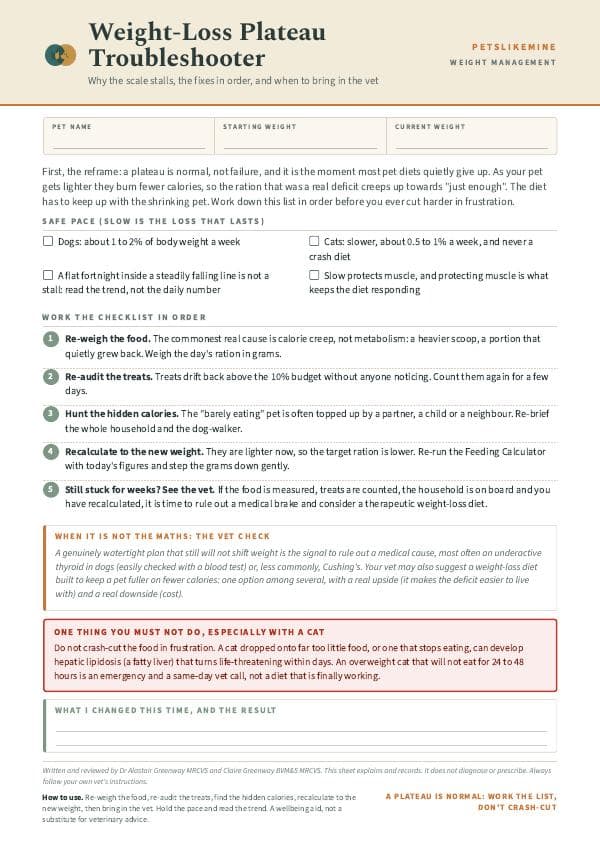
Weight-Loss Plateau Troubleshooter
PDF · 234 KBWhy weight loss stalls and the fixes in order: re-weigh the food, hidden calories, recalculate at the new weight, rule out hypothyroid/Cushing's, safe loss rate, and when to see the vet.
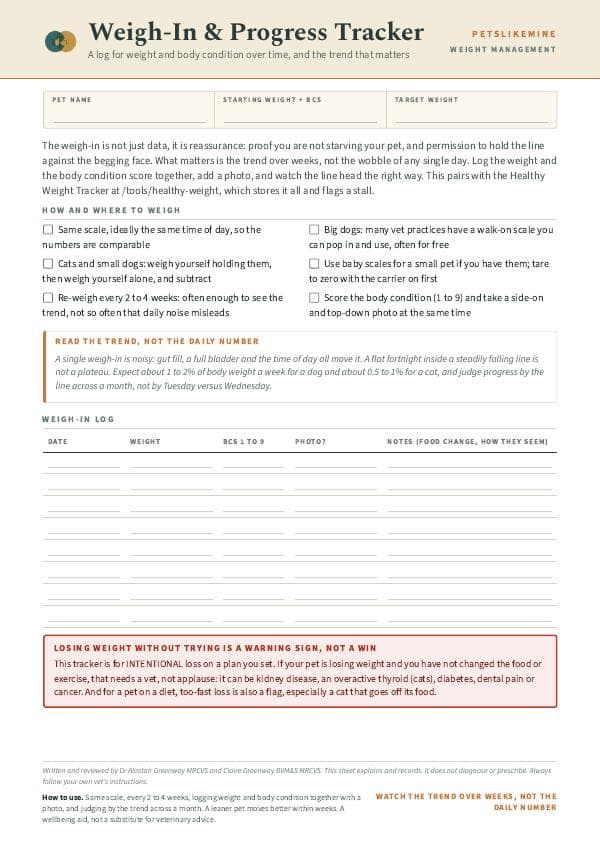
Weigh-In & Progress Tracker
PDF · 217 KBA log for weight and body condition score over time, how and where to weigh, a target line, and reading the trend that matters. Pairs with the Healthy Weight Tracker.
Keep track of how your pet is doing
The owners who cope best are the ones who notice changes early. A simple health log shows you what is working, and what is not, before the next vet visit.
Start tracking, freeYou're not doing this alone
Compare treatment journeys and talk to owners managing weight management. Free to join.
Join PetsLikeMine