

Never Crash-Diet a Cat: The Hepatic Lipidosis Rule
Alastair Greenway
BVM&S MRCVS
"Just feed less" is the standard advice for an overweight cat, and for a cat it comes with one rule attached that matters more than any portion size. Get the rule right and slimming your cat is safe, kind and genuinely worth doing. Get it wrong and you can make her seriously ill. So before we talk about how much to feed, let's start with the one red line.
The one red line, first
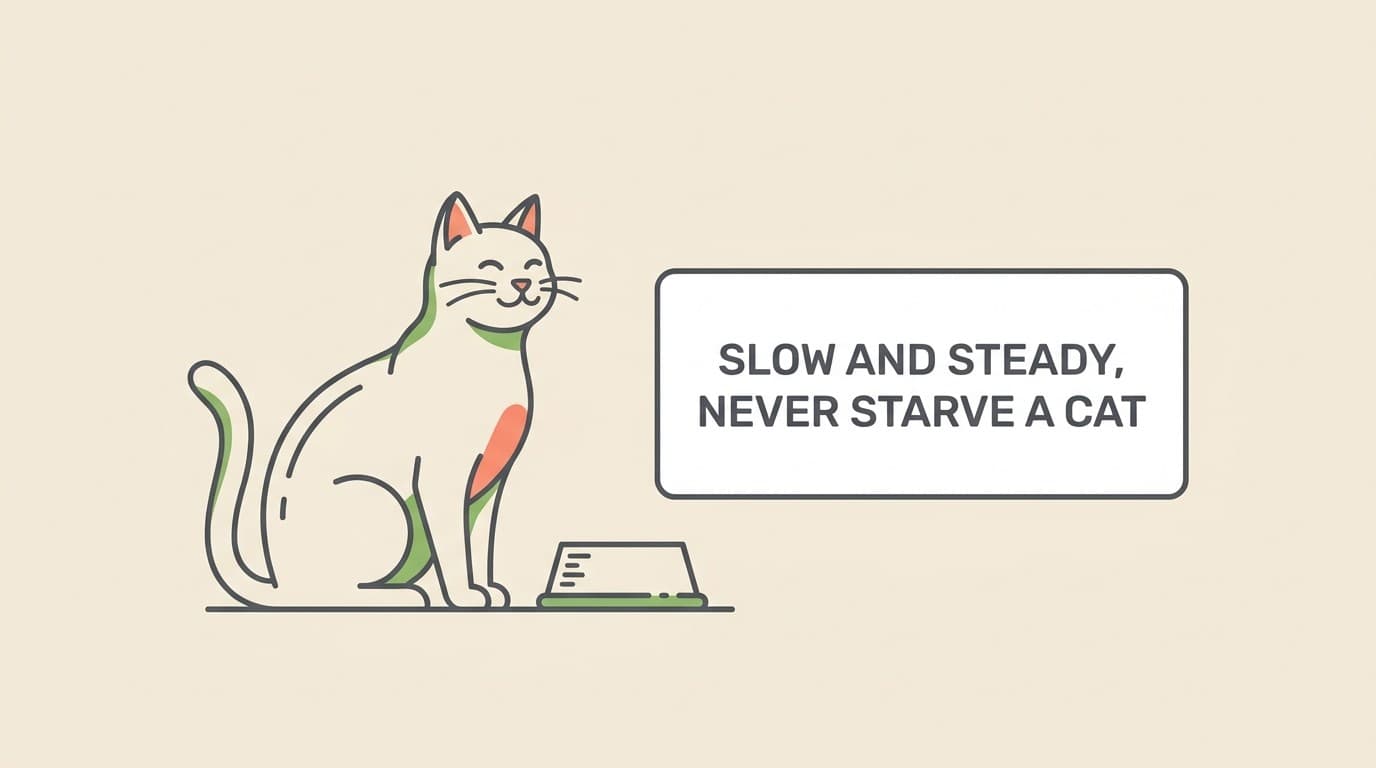
Never crash-diet a cat, and never let a cat on a diet stop eating.
If a cat eats far too little, or goes off her food altogether, her body starts shifting fat to the liver faster than the liver can deal with it. The liver clogs with fat, and it can stop working properly. This is hepatic lipidosis, also called fatty liver, and in cats it can become life-threatening (Valtolina and Favier, 2024). Overweight cats are the most at risk, because they have the most fat to mobilise.
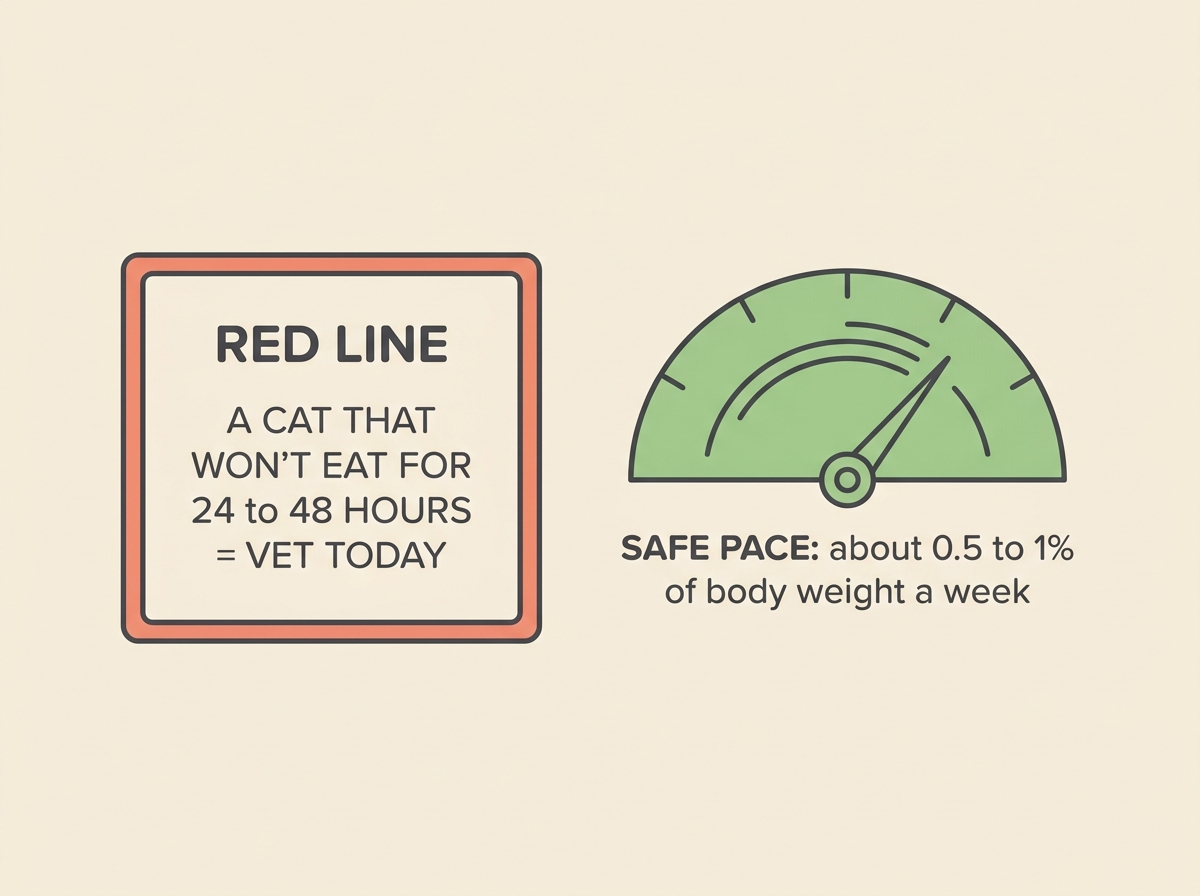
Here's the line to hold onto: an overweight cat that won't eat for 24 to 48 hours is an emergency, not a successful diet. Book the vet that day. Don't wait to see if her appetite picks up, and don't tell yourself the diet's finally working. A cat that has quietly stopped eating needs help fast, because hepatic lipidosis can follow a stretch of not eating, and the sooner it's caught the better.
The good news is that it's treatable when it's caught early, usually with intensive feeding support and sometimes a temporary feeding tube (Valtolina and Favier, 2024). That's exactly why speed matters. The danger isn't a sensible diet. The danger is a cat who silently opts out of eating, and you not noticing in time.
Dieting is safe, starving is not
The difference between the two is the part that gets lost, and it's the part that matters most.
A controlled, gradual diet does not cause hepatic lipidosis. Starving does. When overweight cats are put on a sensibly reduced ration, even a meaningful one, they lose weight safely without their livers failing. The cats who get into trouble are the ones who stop eating, lose a large amount of weight very fast, and develop fatty liver as a result (Valtolina and Favier, 2024). Affected cats have typically dropped a quarter or more of their body weight, usually over days to weeks of barely eating (Valtolina and Favier, 2024).
So a measured, slightly smaller meal is safe. A cat refusing her bowl is not. The whole trick to slimming a cat sits in that gap: cut the calories on purpose and gently, but never let the food stop going in.
So how do you slim a cat safely? Slowly
The safe way is slow and steady, with food going in every single day.
Aim for your cat to lose about 0.5 to 1% of her body weight a week. On a 5 kg cat that's a rough half-pound a month, which feels slow, and slow is the point. A gentle reduction in calories, never a sudden drop, gives her body time to burn fat without flooding the liver. There's no prize for rushing it, and rushing it is where the risk lives.
A few things make slow loss work:
- Small, frequent measured meals rather than one big bowl or a topped-up dish she grazes from all day. Splitting the day's ration into several measured meals keeps her satisfied and lets you see what she's actually eating.
- A higher-protein ration to protect her muscle. When a cat is eating fewer calories, a diet higher in protein helps preserve lean muscle and keeps her fuller on less (VCA Animal Hospitals). A purpose-made weight-loss food does this, with the obvious trade-off that it costs more. It's one good option, not the only one. Often you can simply measure and gently cut back the food she already has.
For the actual numbers, how many grams of your current food, or how many calories to aim for, use the Feeding Calculator. It works the maths out for you to her target weight, so you're not guessing. This article is about the rule, the pace and the never-starving. The calculator handles the gram count, How much should I actually feed? walks through where that number comes from, and you can see how fast is safe in How much to lose and how fast. The figures match, on purpose, so the tool and the advice never disagree.
Watch what goes in, not what's in the bowl
The real risk on a cat diet is the bit owners miss: it isn't the amount you put down, it's the amount she actually eats.
A bowl with food still in it tells you nothing if you don't know whether she's eaten her share. The cat who quietly eats less than you offered, or turns her nose up at a new food, is the one heading for trouble. So watch intake, not just the dish.
If your cat goes fussy on a reduced or new food, the answer is never to feed her less. Try slowing the change right down instead. Mix a little of the new food into the old and shift the balance over a week or two rather than all at once (see Cut back the food you have, or switch to a diet food?). Warming the food to body temperature lifts the smell and tempts a fussy cat. So can changing the texture, from biscuits to a pouch or back again. A cat refusing food is the alarm bell. Treat it as one.
Multi-cat homes and grazers
Cats who graze, and households with more than one cat, are the hardest of all to slim safely, because you can't easily see who's eating what.
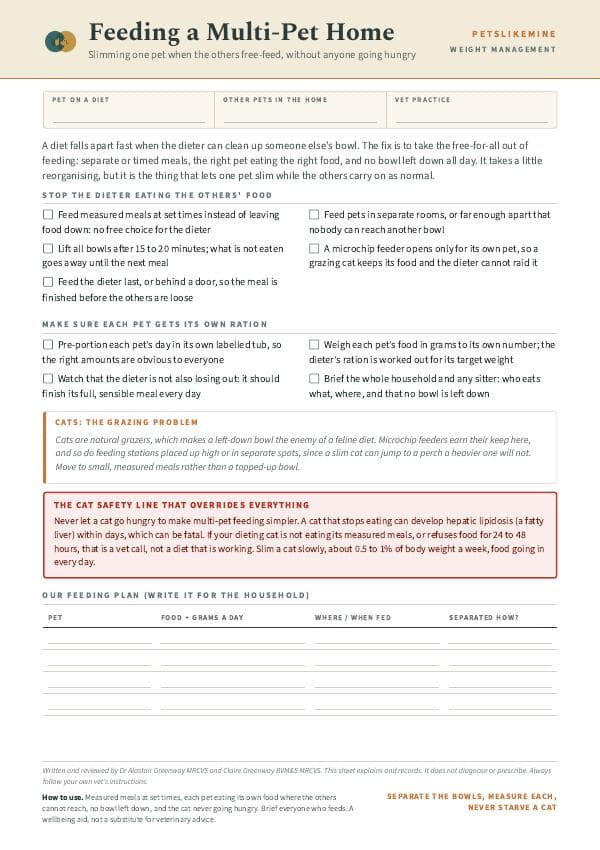
If your slimming cat shares a free-flowing bowl with another cat, or with a dog who hoovers up leftovers, you've no real way of knowing how much she's had, or whether she's had any at all. This is exactly where microchip feeders and separate feeding stations earn their keep. A microchip feeder opens only for the right cat, so each one gets her own measured ration and you can actually tell who's eaten. It also stops the slim cat raiding the other's bowl, and the other cat raiding hers. There's more on making this work in Feeding a dieter in a multi-pet home, and the multi-pet feeding plan download lays it out step by step.
The payoff, and the reassurance
Done slowly, slimming a cat is safe, and it's worth it.
A lean cat moves better. She jumps onto the windowsill, climbs to her favourite high perch and twists to groom the awkward spots, all the things extra weight quietly takes away. That's the prize, and you'll often see it within weeks: a cat who's more active and more like herself, not a number on a chart years from now.
And for a cat with diabetes, the payoff can be bigger still. Getting an overweight diabetic cat down to a healthy weight markedly improves the odds of remission, sometimes off insulin altogether (Clark and Hoenig, 2021). If that's your cat, Weight and diabetes: how slimming can drive remission is worth your time.
Ready to work out her portions? The Feeding Calculator turns her target weight into grams of your food, and the Healthy Weight Tracker plots her weigh-ins and flags if she's dropping too fast, so you'll know the moment to ease off.
References
- Valtolina C, Favier RP (2024). Feline Hepatic Lipidosis: a clinical review drawn from collective effort. Clinical review.
- VCA Animal Hospitals. Creating a Weight Reduction Plan for Cats.
- Clark M, Hoenig M (2021). Feline comorbidities: Pathophysiology and management of the obese diabetic cat. Journal of Feline Medicine and Surgery.
Free downloads
Companion worksheets to put what you've read into practice. Free PDFs, print at home.
Keep track of how your pet is doing
The owners who cope best are the ones who notice changes early. A simple health log shows you what is working, and what is not, before the next vet visit.
Start tracking, freeYou're not doing this alone
Compare treatment journeys and talk to owners managing weight management. Free to join.
Join PetsLikeMine