

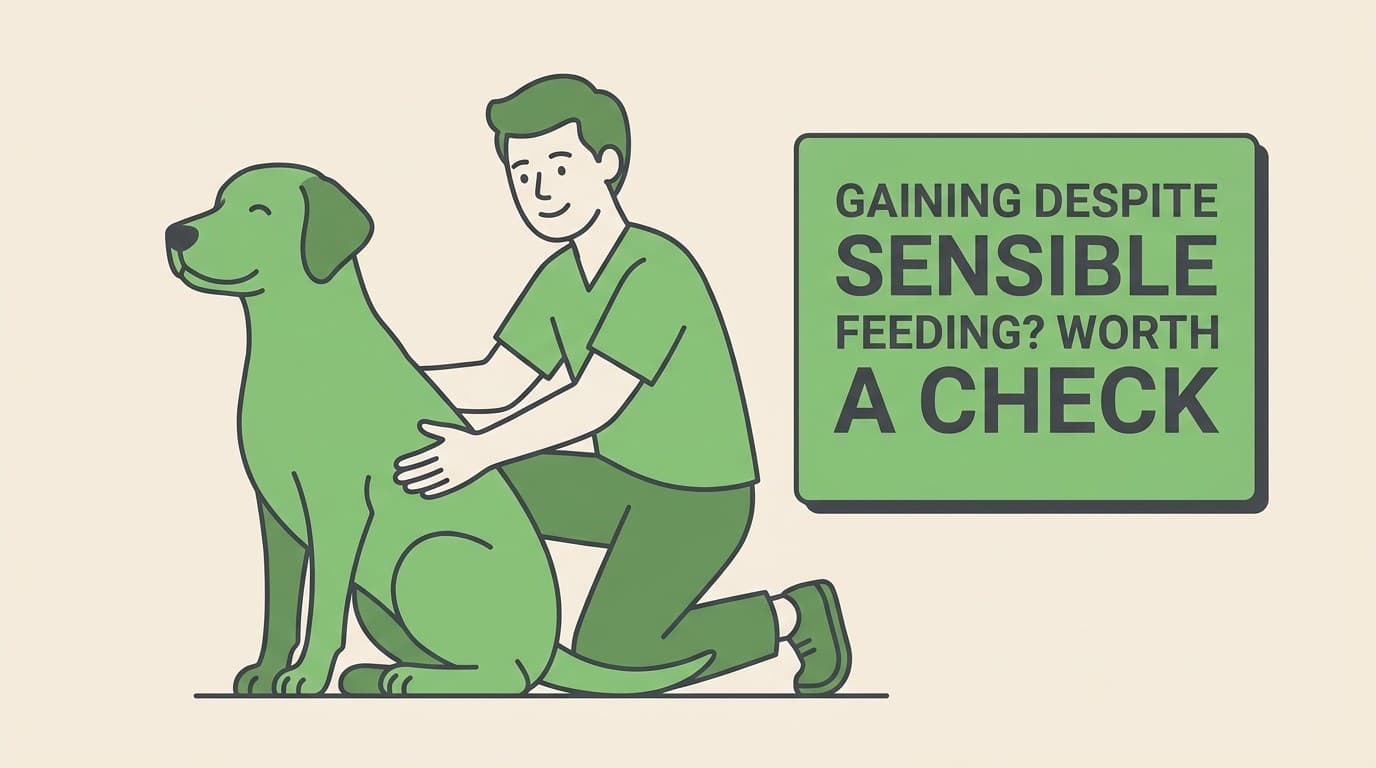
Could a health problem be behind the weight gain?
Alastair Greenway
BVM&S MRCVS
This is the mirror of our piece on losing weight without trying. That one makes the case that a pet who slims by itself is showing a symptom, not a success. This piece runs the other way. When a pet is gaining and you're sure you haven't changed a thing, it helps to know what's normal, what's not, and the two checkable causes worth ruling out before you blame yourself.
Most weight gain really is just calories in, so start there without shame
The reassuring headline first. The overwhelming majority of overweight pets are simply taking in more energy than they burn. Not because a gland has broken, but because the bowl, the treats and the day's activity have quietly drifted out of balance. True metabolic disease is the exception, not the rule (WSAVA, 2011).
The numbers make the point plainly. Around a quarter to two-fifths of dogs are overweight, while an underactive thyroid, the gland problem owners most often reach for, affects roughly one dog in five hundred (WSAVA, 2011). So for every dog whose gain is down to a sluggish thyroid, there are a great many more whose gain is down to calories. The maths still works, and it's almost always the lever that matters.
If you've come to this braced for a telling-off, you can let that go. Weight creeps on gradually, it's genuinely hard to spot on your own pet, and you're far from alone. In a recent UK report, vets reckoned around 46% of dogs and 43% of cats were overweight or obese, and 82% of owners didn't know their pet's body condition score (PDSA, 2024). You haven't necessarily done anything wrong, and you almost certainly haven't broken your pet.
One benign, common reason for gradual gain is worth naming up front, because it catches so many people out. Neutering lowers a pet's energy needs and tends to raise the appetite at the same time, so the same bowl that kept your pet trim before the op can quietly tip into a surplus afterwards (Cambridge, n.d.). It's not a fault in your pet and it's not a disease. It's a recalibration, and the fix is the food, not a worry.
So start with the calories, without shame. But before you pin every gram on the bowl, two glandular causes are worth ruling out, and there's a simple way to know when they're worth a thought.
When gain is worth a vet's eye, not just a smaller bowl
Weight gain on its own, in an otherwise bright pet, is usually a calorie story. What turns it into a "let's get this checked" is the company it keeps. Two patterns are the ones to watch for.
The first is steady gain despite genuinely sensible, measured feeding. Not "I think I'm feeding about right", but the real thing: you're weighing the food on a kitchen scale, the treats are budgeted in, the family isn't topping up behind your back, and the number is still creeping up. When careful, measured feeding and a climbing weight don't add up, that mismatch is worth a vet's eye.
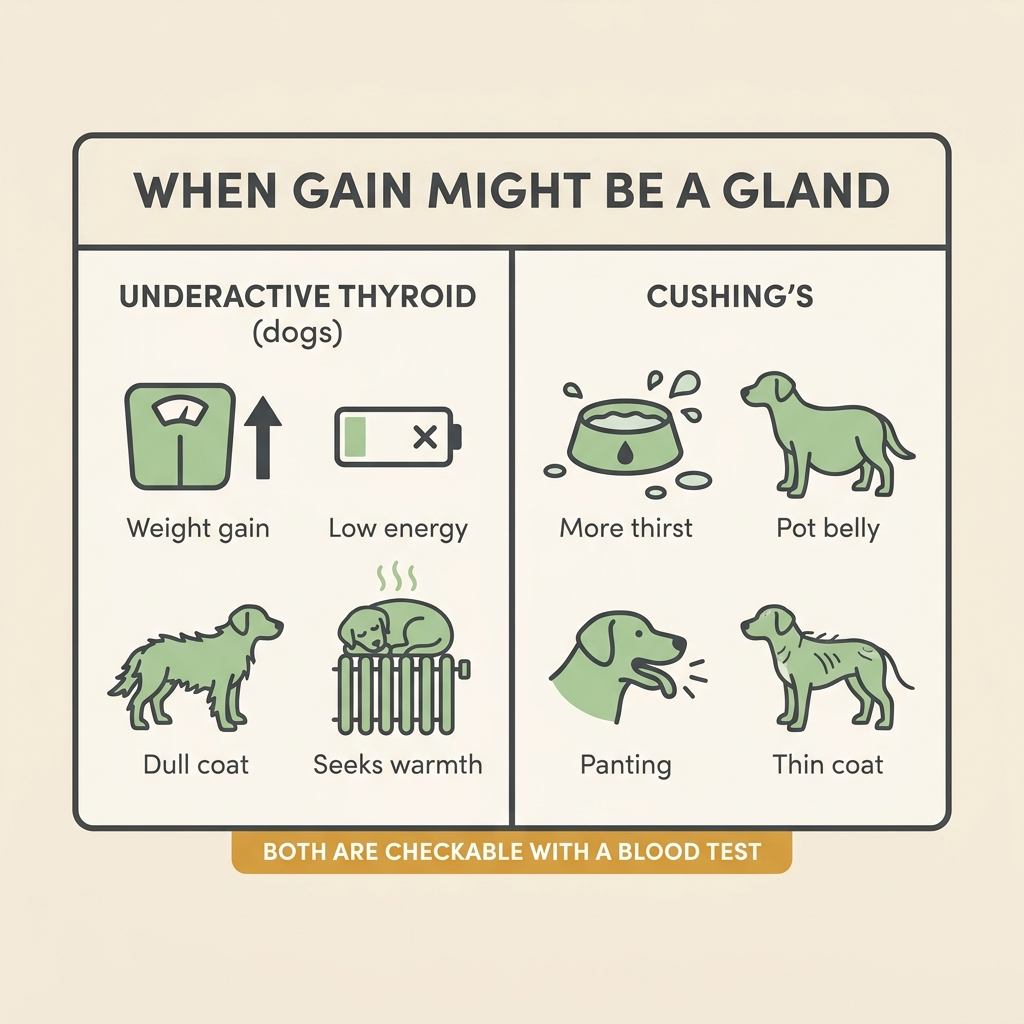
The second is gain that arrives with other signs. Keep an eye out for lethargy or a reluctance to exercise, a coat that's thinning, dull or dropping out, hair loss that isn't itchy, a pot-bellied look, new heavy panting, or a noticeable jump in how much your pet is drinking and weeing. Any of those, alongside the weight, shifts the picture.
So the cue isn't weight gain by itself. It's weight gain with the wrong company. A pet who's gaining but bright, playful and otherwise themselves almost certainly points you back to the feeding plan. When the gain comes with that company of signs, or it's defying a bowl you know is right, that's the point to book a check. The two conditions worth ruling out are next.
Underactive thyroid (hypothyroidism), the classic dog one
This is the one owners reach for, and it's the classic dog story. The thyroid gland sets the body's pace, and in hypothyroidism it slows down. When the engine idles low, weight goes on even though nothing about the food has changed.
The picture tends to come as a set. Weight gain on the same ration, low energy and a reluctance to get going on walks, and a pet that seeks out the warm spots and seems to feel the cold more than it used to (Cornell, n.d.). Then the skin and coat changes that often bring people in: a dull, dry, brittle coat, hair loss that isn't itchy, often falling symmetrically along the trunk and the base of the tail, and recurrent skin and ear infections (Cornell, n.d.). It's typically a middle-aged dog, most often between four and ten years old (Cornell, n.d.).
The genuinely good news is how checkable and how fixable it is. It's diagnosed on a blood test that measures the thyroid hormones, usually total T4 alongside free T4 and TSH (Cornell, n.d.). That combination matters, because a single low T4 on its own isn't enough to call it. Plenty of unwell dogs run a low T4 for other reasons, so the diagnosis leans on the fuller picture rather than one number (AAHA, 2023). Once it's confirmed, treatment is a daily levothyroxine tablet, taken for life, and the prognosis is good. The energy, the coat and the weight typically start to turn around within a few weeks (Cornell, n.d.).
One note for cat owners, because this is very much a dog story. A naturally underactive thyroid is genuinely rare in cats. Cats overwhelmingly get the overactive version, which causes weight loss rather than gain, so a gaining cat is most likely a simple calorie story (AAHA, 2023). The rare feline hypothyroidism that does turn up is usually a side effect of treating an overactive thyroid too hard, not a spontaneous cause of an overweight cat (AAHA, 2023).
Cushing's (an overactive adrenal gland), thirst, a pot belly and a thin coat
The second named cause is Cushing's syndrome, where the body is making too much of the stress hormone cortisol. Where the underactive thyroid is quiet and slow, Cushing's tends to be loud and thirsty.
The giveaway trio is hard to miss once you know it. Markedly increased thirst and weeing, to the point that more than 95% of affected dogs drink and pass water noticeably more than they used to, a ravenous appetite, and the classic pot-bellied look with a thinning coat and a lot of panting, usually in an older dog (Merck, n.d.; Dechra, n.d.).
One detail here is worth holding onto, because it's where the scale and the shape can tell different stories. That pot belly isn't simply your pet getting fatter all over. It's fat being redistributed into the abdomen together with a weakening of the muscles of the tummy wall, so the belly sags and rounds out even when the overall weight hasn't climbed the way the silhouette suggests (Merck, n.d.). A dog can look distinctly more rotund through the middle while the number on the scale moves far less than you'd expect. So if the shape and the scale disagree, that disagreement is itself a clue.
Like the thyroid, Cushing's is confirmed on specific blood tests, usually an ACTH stimulation test or a low-dose dexamethasone suppression test rather than a routine panel (Dechra, n.d.). Most cases trace back to a tiny benign change in the pituitary gland, and it's managed long-term with daily medication, with a good outlook when it's treated properly (Dechra, n.d.). It's a bigger picture than the thyroid, which is exactly why it's a job for your vet to diagnose and steer, not something to read off a list at home.
What the vet actually does, and why it's reassuring either way
If you do go in, it helps to know the visit is usually straightforward. Your vet will weigh your pet and body-condition score them against the records, looking at the trend rather than a single reading, and have a proper hands-on feel over the coat, the skin and the tummy. Where the picture fits, they'll usually run bloods: a general health panel and the thyroid, with the specific gland tests for Cushing's added if the signs point that way.
A clear result is a win on both sides of the coin. If it is a gland, you've found a treatable cause, you can start putting it right, and it was never your fault. If it isn't, which is the common outcome, you get to crack on with the feeding plan knowing nothing's quietly working against you underneath it.
It's also worth saying plainly that these aren't either/or. A good many of these dogs are both carrying a bit too much and have a condition ticking along, because an underactive thyroid or a dose of Cushing's makes weight all the easier to put on. In that case treating the gland and managing the calories aren't rival explanations. They go together, and you do both.
So which is it for your pet? The practical next step
Here is the simple sort.
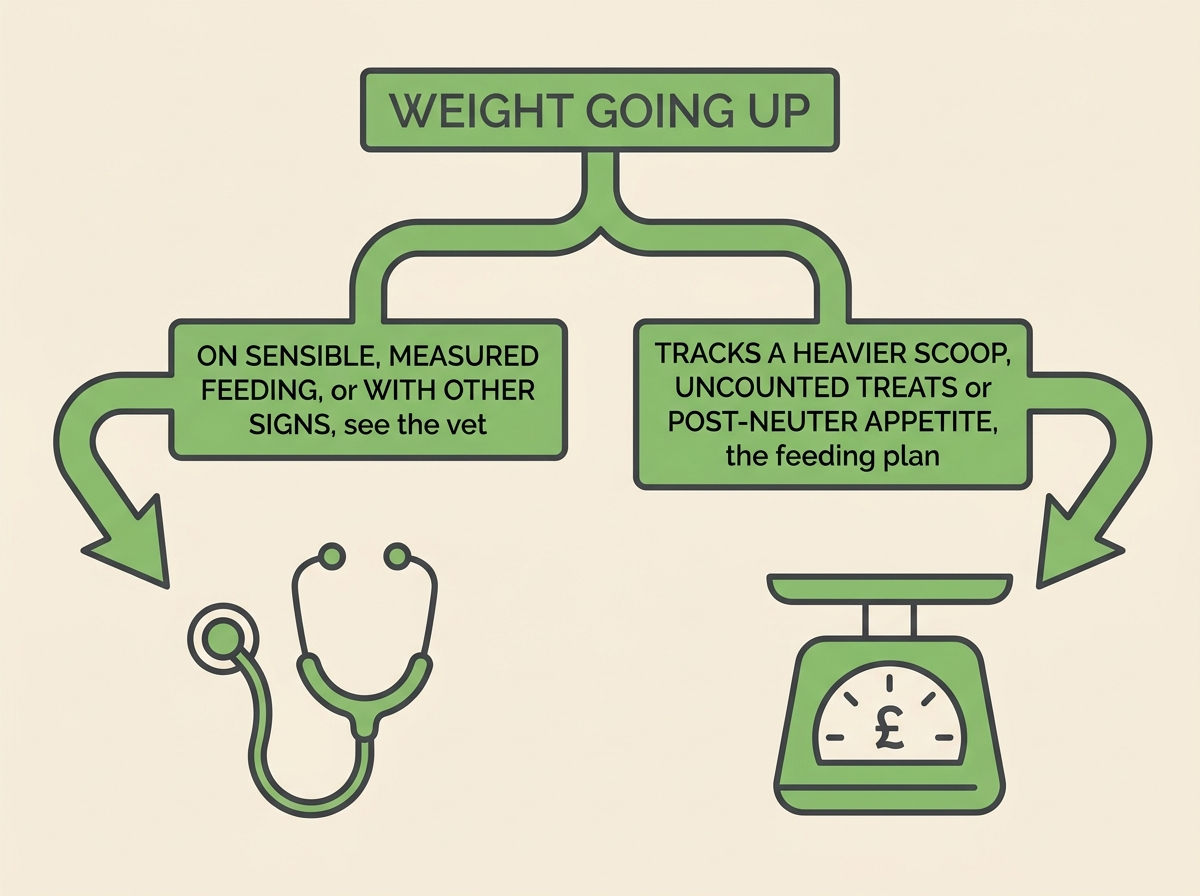
If the gain is happening despite genuinely sensible, measured feeding, or it's arriving with any of that red-flag company, the lethargy, the dull or dropping coat, the pot belly, the extra thirst, the new panting, then book the check. That's the picture where ruling a gland in or out is the right first move.
If, being straight with yourself, the gain tracks an over-estimate of portions, a scoop that crept heavier, treats nobody's been counting, or that post-neuter appetite catching the bowl out, then the calories are your lever, and the whole programme here is built to pull it.
To go deeper on the conditions themselves, the Hormone Health home covers the full underactive-thyroid and Cushing's picture, the signs, the tests and the treatment. If you've landed here from the other direction, worried about a pet that's slimming rather than gaining, its companion piece Losing weight without trying is the mirror to this one. If you're not even sure your pet is carrying too much to begin with, Is my dog actually overweight? walks you through the at-home check. And once a gland's ruled out and it's down to the food, How much should I actually feed? and the Feeding Calculator turn it into real grams of the food you already buy, while the Healthy Weight Tracker logs the weigh-ins and the trend your vet will want to see.
References
- World Small Animal Veterinary Association (WSAVA) (2011). Canine Obesity (WSAVA proceedings). Canine hypothyroidism prevalence ~0.2% versus 25–40% of dogs overweight; obesity is overwhelmingly a simple energy imbalance, not a gland.
- PDSA (2024). PAW Report 2024 (PDSA Animal Wellbeing Report). Veterinary professionals believe 46% of dogs and 43% of cats are overweight or obese; 82% of owners are unaware of their pet's body condition score.
- Cambridge (n.d.). Neutering in dogs and cats: an overview (review). Nutrition Research Reviews, Cambridge Core. Neutering lowers metabolic rate and raises appetite, a common benign cause of gradual weight gain.
- Cornell (n.d.). Hypothyroidism. Cornell Riney Canine Health Center, Cornell University College of Veterinary Medicine. Signs, diagnosis (total T4, free T4, TSH), and lifelong levothyroxine treatment of canine hypothyroidism.
- American Animal Hospital Association (AAHA) (2023). 2023 AAHA Selected Endocrinopathies of Dogs and Cats Guidelines. A low T4 concentration alone is inadequate to diagnose hypothyroidism; naturally occurring feline hypothyroidism is extremely rare.
- Merck (n.d.). Cushing Disease (Hyperadrenocorticism) in Dogs. Merck Veterinary Manual. More than 95% of affected dogs are polyuric/polydipsic; the pot belly reflects redistributed abdominal fat and a weakened/atrophied abdominal wall.
- Dechra (n.d.). Canine Cushing's Syndrome. Dechra UK. Most cases (80–85%) are pituitary-dependent; diagnosed by ACTH stimulation or low-dose dexamethasone suppression test and managed long-term with medication, with a good prognosis.
Keep track of how your pet is doing
The owners who cope best are the ones who notice changes early. A simple health log shows you what is working, and what is not, before the next vet visit.
Start tracking, freeYou're not doing this alone
Compare treatment journeys and talk to owners managing weight management. Free to join.
Join PetsLikeMine