

The Scale Won't Budge: How to Bust a Weight-Loss Plateau
Alastair Greenway
BVM&S MRCVS
The food has been measured, the treats reined in, and for a few good weeks the numbers came down nicely. Then the scale stopped. Three weigh-ins, near enough the same number, and the doubt creeps in: maybe it isn't working, maybe your pet just can't lose weight, maybe you've done something wrong.
None of that is true. This is a plateau, the single most common point at which pet diets quietly fall apart, and one of the most fixable once you know what's going on. So before you give up, let's work through the real reasons and the real fixes.
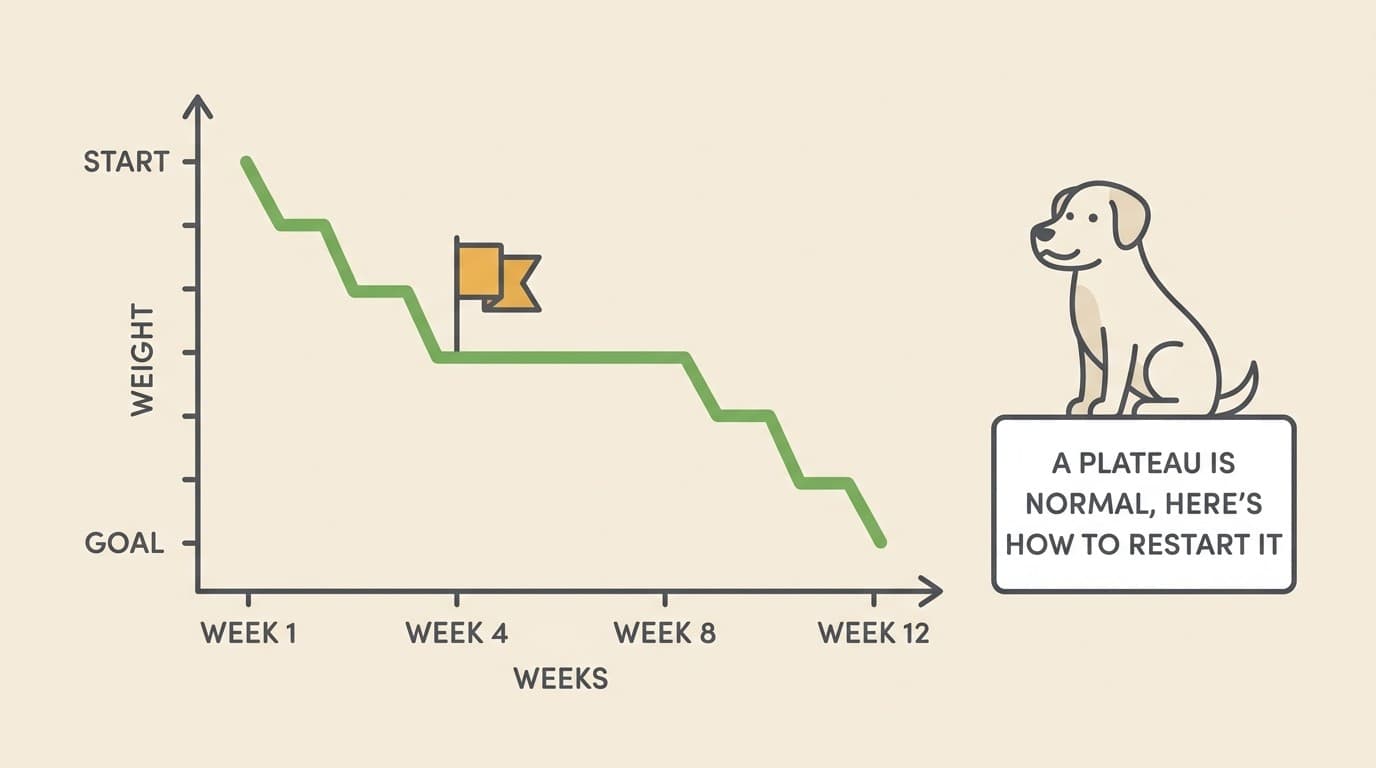
A plateau is normal, not failure
The part nobody mentions at the start is this: as your pet gets lighter, they need fewer calories to run. A 40kg dog burns more just existing than a 35kg dog does, so the ration that was a genuine deficit five kilos ago slowly becomes just about enough at the new, lighter weight. Nothing has gone wrong. The diet simply has to keep chasing a moving target, because the pet you're feeding today is smaller than the one you started with.
This isn't a hunch; it's measured physiology. When researchers followed obese dogs through a successful programme, the energy they needed afterwards stayed strikingly low, only about 10% above what they'd needed during active weight loss (German et al., 2011). It's so expected that it shows up in formal studies. In one international trial the rate of loss slowed from about 1.3% of body weight a week early on to about 0.8% a week later, even with the calories being adjusted, exactly "the plateau effect typical in weight loss interventions" (Flanagan et al., 2017). If it happens in a tightly run study, it'll happen on your kitchen scales too.
This is why the Healthy Weight Tracker treats a plateau as a normal event rather than a fail. It flags one when the weight has been essentially flat, under 1% total change, across at least three weigh-ins spanning three weeks or more, while you've still got a loss goal set. In plain terms, the scale is flat for about three weeks while you're trying to slim them. The tracker calls that out on purpose, so you know it's a recognised stage to push through and not a dead end.
Check the maths drift first, because it's almost never the metabolism
When the scale sticks, the instinct is to blame a slow metabolism. It's a comforting story, but usually the wrong one, and reaching for it stops you fixing what's actually broken. The most common real reason a plan stalls isn't physiology at all. It's calorie creep.
We know this fairly precisely. When researchers looked at dogs whose weight loss had gone wrong, the standout factor was the household rather than the dog. Among those losing too slowly, nearly half of the owners, 44.7%, simply weren't following the diet and exercise plan, and owner compliance was significantly linked to whether the dog succeeded (Porsani et al., 2020). What didn't predict failure is just as telling: not the pet's sex, neuter status, age, the type of food, or activity on its own. When a diet stalls, it's far more often the maths drifting than the metabolism failing.
So before anything else, audit the maths. Calorie creep sneaks in quietly:
- A heavier scoop. Portions creep up by eye over weeks. Almost nobody actually weighs the food, only about 3% of cat owners and 16% of dog owners weigh out their pet's meals (APOP, 2025), so "a scoop" today is often bigger than it was a month ago. Get the kitchen scales back out and re-weigh the daily ration to the gram. This is the single highest-yield thing on this list.
- The treats that stopped being counted. A new dental chew, a fresh bag of training treats, a crust of toast here and there. Re-audit the lot and get the treat total back under about 10% of the day's calories (see the treat budget).
- Someone topping up. The children, your partner, a visiting neighbour, the dog-sitter. One person feeding to the plan is undone the moment a second tops the bowl up out of love. Re-run the family briefing so everyone is feeding the same numbers (see getting the whole family on board).
Nine times out of ten, the plateau is hiding in that list and not in your pet's thyroid.
Then recalculate to the new, lighter weight
Once you're confident the food and treats really are what you think they are, do the other half of the job and redo the sums. Your pet weighs less than when you started, so the ration that created a deficit then may only be holding steady now. The plan has to shrink with the pet.
The maths hasn't changed, only the input has. Weight-loss feeding is built on your pet's resting energy requirement at their target weight, not their current one, worked out as roughly 70 multiplied by the target weight in kilograms to the power of 0.75, then fed at a deliberate fraction of that for steady loss (Cline et al., 2021). You don't have to do that on the back of an envelope. The Feeding Calculator runs exactly that in a few seconds, and re-running it as your pet gets lighter is what keeps the deficit real (there's more on why in recalculating as they shrink).
When a vet runs a weight clinic and a dog has genuinely stalled, the standard move is undramatic. They trim the ration by roughly 10% and re-weigh in a couple of weeks. That's the adjustment the studies above used when loss dropped below about 1% a week (Flanagan et al., 2017; Porsani et al., 2020). It's a nudge, not a crash. Make one measured cut, give it two to four weeks, and see what the scale says, rather than slashing the food in frustration.
Is it the food or the maths?
This is the fork in the road. If you've re-weighed the food, the treats really are counted and inside budget, the whole household is on the same page, and you've recalculated to the current weight, and it is still flat for several weeks, then you've earned the right to stop blaming yourself and loop in your vet. That isn't failure. It's good detective work that's narrowed the problem down.
There are two reasons to bring the vet in at this point. The first is to rule out a genuine medical brake. In dogs, the one to check is an underactive thyroid (hypothyroidism). It lowers the metabolic rate, so a dog can struggle to lose weight, or even gain it, on a sensible calorie intake, usually alongside lethargy and a drop in exercise tolerance (Merck Veterinary Manual). The framing matters here. True metabolic disease like this is uncommon, easily checked on a blood test, and treatable, and once it's ruled out or managed the calorie maths works just as it should. It's worth excluding, not worth assuming (more on the medical side in could a health problem be behind the weight? and the Hormone Health hub).
The second is to consider a dedicated weight-loss diet. This is one option among several and never the automatic answer, because very often you can keep slimming your pet perfectly well on a measured, cut-back portion of the food you already buy. But a therapeutic food has a genuine advantage when a pet is hungry and stuck. It's built to keep them fuller on fewer calories, with higher protein to protect muscle while they slim and added fibre for satiety (Cline et al., 2021). The catch is cost. If begging and hunger are wrecking your compliance, it can be the thing that gets a stalled plan moving (whether to switch is covered in cut back the food you have, or switch to a diet food?).
Hold the line emotionally (and never crash-cut a cat)
A plateau is as much a test of nerve as of maths. Weigh less often, not more. Daily weigh-ins are mostly noise. A full bladder, a big meal, or just where your pet stands on the scales can swing the number more than a real day's fat loss, and watching that bounce around is a fast route to despair. Weigh on the same scales the same way, no more than weekly or fortnightly, and read the trend over a month (see reading the trend, not the daily number). Lean on the photo and the body condition score too, because the change is often visible in a side-on picture before it shows convincingly on the dial.
And whatever you do, don't let a flat fortnight panic you into a crash-cut. For dogs that mostly means a hungry, miserable pet and a plan you can't sustain. For cats it's genuinely dangerous. A cat dropped onto far too little food, or one that reacts to a sudden change by going off its food, can develop hepatic lipidosis, a serious fatty-liver condition that can take hold within days. Safe feline loss is slow, about 0.5 to 1% of body weight a week, with food never withdrawn, and an overweight cat that won't eat for 24 to 48 hours is a same-day emergency, not a successful diet (see never crash-diet a cat). The tracker's cat fast-loss guardrail exists for exactly this reason. With cats, too fast is its own kind of failure.
Slow isn't the diet going wrong. Slow is the rate that actually sticks, and the plateau is the point where most people quit right before the next stretch of progress. If your heart's flagging, the reason to push on has nothing to do with lifespan. Even a small further loss pays off now, where your pet lives. In arthritic dogs, losing as little as about 6% of body weight produces a measurable improvement in lameness (Marshall et al., 2010). That isn't "she'll live longer" in the abstract. That's her getting back up the stairs in the coming weeks.
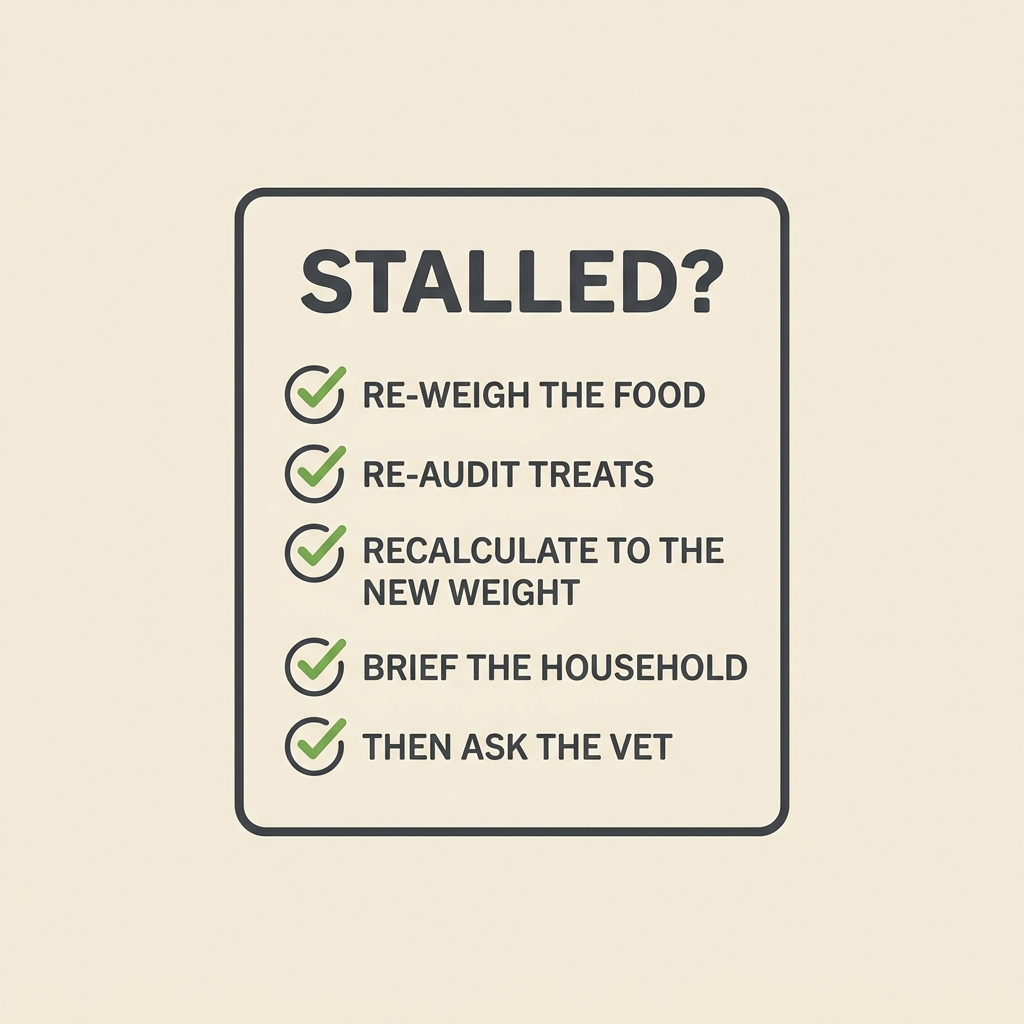
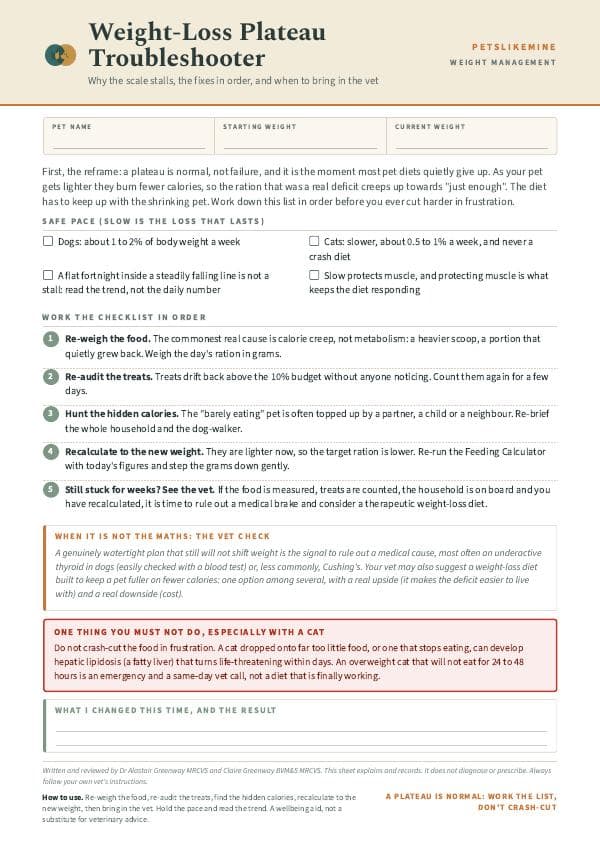
So when the scale won't budge, work the list. Re-weigh the food, re-audit the treats, brief the household, then recalculate to the new weight with the Feeding Calculator, and let the Healthy Weight Tracker confirm whether you're genuinely flat or just reading the daily noise. If it's still stuck after all that, the plateau troubleshooter walks you through it on paper, and your vet is the next step rather than the first. You haven't failed. You've just hit the part of the journey the paid programmes charge for, and you can get the line moving again.
References
- German AJ, et al. (2011). Low-maintenance energy requirements of obese dogs after weight loss. Br J Nutr. 106(Suppl 1):S93-S96.
- Flanagan J, et al. (2017). Success of a weight loss plan for overweight dogs: the results of an international weight loss study. PLoS One. 12(9):e0184199.
- Porsani MYH, et al. (2020). Factors associated with failure of dog's weight loss programmes. Vet Med Sci. 6(3):299-305.
- Association for Pet Obesity Prevention (APOP) (2025). 2025 Pet Obesity and Nutrition Survey.
- Cline MG, et al. (2021). 2021 AAHA Nutrition and Weight Management Guidelines for Dogs and Cats. J Am Anim Hosp Assoc. 57(4):153-178.
- Merck Veterinary Manual. Hypothyroidism in Animals.
- Marshall WG, et al. (2010). The effect of weight loss on lameness in obese dogs with osteoarthritis. Vet Res Commun. 34(3):241-253.
Free downloads
Companion worksheets to put what you've read into practice. Free PDFs, print at home.
Keep track of how your pet is doing
The owners who cope best are the ones who notice changes early. A simple health log shows you what is working, and what is not, before the next vet visit.
Start tracking, freeYou're not doing this alone
Compare treatment journeys and talk to owners managing weight management. Free to join.
Join PetsLikeMine