

They've hit target: switching safely to maintenance
Alastair Greenway
BVM&S MRCVS
First, celebrate it (then guard it)
Your pet has hit their target weight. Take a moment with that, because it is genuinely hard, and most pet diets never get here. You worked out how much to feed, you weighed it, you held the treat budget, you kept the household on side, and the scales finally agree with you. That is a real win, and the pet in front of you is feeling it already. They move more easily, they get up more readily, they are more comfortable in their own body. That is the whole point, and you did it.
Now comes the pivot, and it really is the whole article. Reaching target is not the finish line. It is a handover, from a plan designed to take weight off, to a plan designed to keep it off. Those are two different jobs, fed two different ways. The good news is that the second job is easier than the first, because you already have the disciplines. The catch is that the rebound is real, and roughly half of pets regain some of what they lost (German et al., 2012). It is also very preventable, and almost all of it comes down to one thing changing under your feet, which we will fix in the next section.
So celebrate it, and then guard it. Your pet's ration has to change now, the diet food may need to change, and the habit of weighing carries on. None of that is hard, it just is not automatic. Let's walk it through.
Recalculate: from a weight-loss ration to maintenance
This is the mechanical core, and it is the one thing most people get wrong at this stage. While your pet was losing, you were feeding a deliberate deficit. You took their resting energy need at their target weight and applied a tight factor, so that every day they ran a little short and the weight came off (this is the maths your Feeding Calculator does on the "lose" setting). Keep feeding that ration now and they will carry on dropping below their ideal, because it was never meant to hold a pet steady.
At maintenance you flip the logic. You feed their resting need at the weight they have achieved, which is now their ideal, and you apply a maintenance activity factor instead of the loss factor. The resting need itself is the same formula throughout, so the tool and this page never disagree:
RER = 70 x (weight in kg)^0.75
You take that resting figure and multiply by a maintenance factor that reflects how active and how gain-prone your pet is:
- Dogs: prone to gain or inactive, 1.4; a typical neutered adult, 1.6; very active or entire, 1.8.
- Cats: indoor or prone to gain, 1.0; a typical neutered adult, 1.2; very active or entire, 1.4.
To do this in the tool, open the Feeding Calculator, switch the goal from "lose" to "maintain", and put in the weight they have reached rather than a target below it. It hands you the new daily grams of the food you are using.
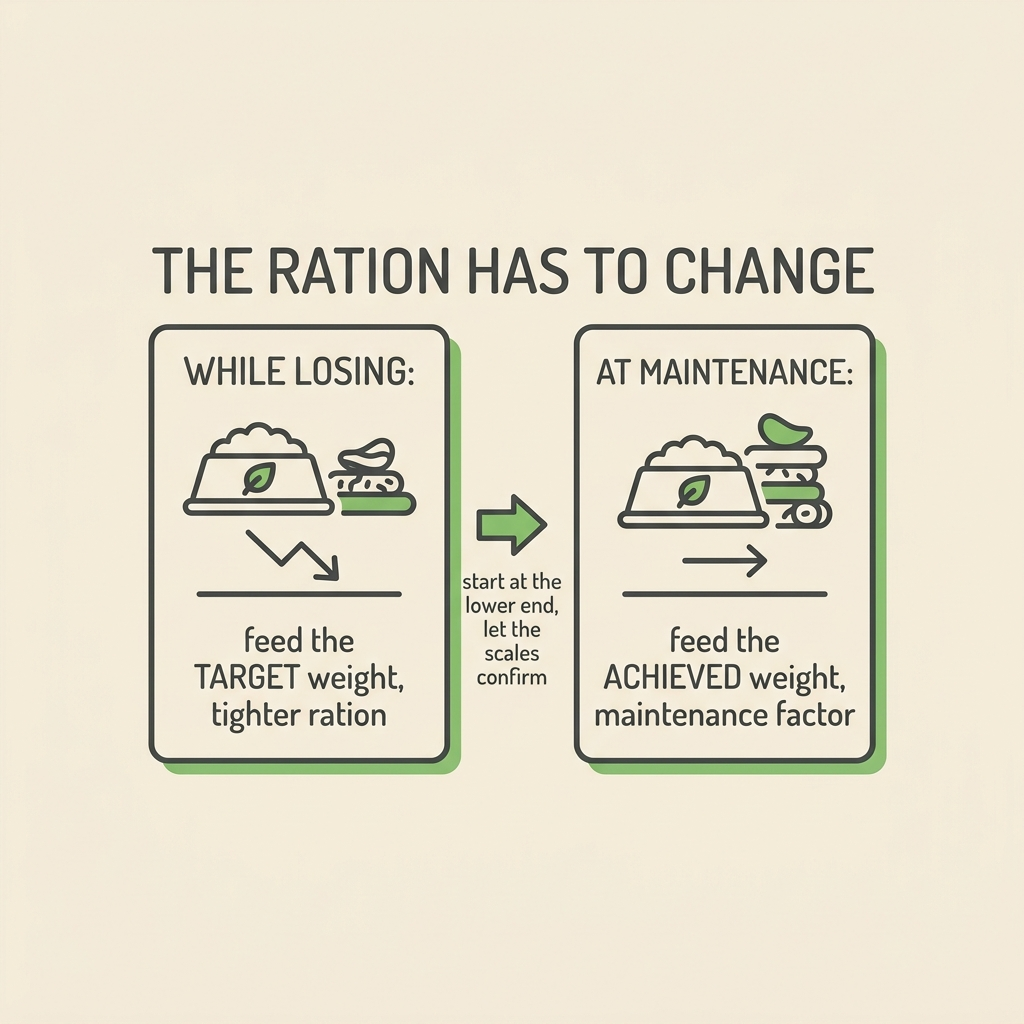
One number matters here more than any other, and it is the thing the research is most clear about. Start at the lower end of the maintenance band. A pet that has just been overweight has a genuinely low maintenance requirement, lower than you would guess from a chart. In one study of dogs after weight loss, the energy needed to hold steady was only about 10% above what they had been eating to lose (German et al., 2011). So begin with the cautious factor (the "prone to gain" end), let a couple of weeks of weigh-ins confirm they are holding, and only then nudge the ration up if they start to dip. Jumping straight to a generous maintenance ration is the single commonest way the rebound starts, because you over-correct out of a deficit and straight into a surplus. Recalculating as they shrink covers the same maths from the losing side, if the constant adjusting still feels odd.
Transition off the weight-loss diet gradually
If your pet was on a therapeutic or weight-loss diet and you are moving them onto a maintenance food, do not swap it in one bowl. Change it over about seven days, mixing a little more of the new food and a little less of the old each day (a rough 25%, 50%, 75%, then 100% over the week works well; allow ten to fourteen days for a fussy pet). A sudden switch is the classic cause of an upset tummy, and in cats it is also a classic cause of food refusal, which matters far more than it sounds (this is a practical timeline, not a precise clinical figure, but it is the standard of practice).
Switching off the diet food is a genuine decision, though, not an automatic step. Continuing a purpose-formulated weight-management diet long term is one of the few things actually shown to limit regain. In the dog follow-up study, animals kept on the weight-loss diet regained significantly less than those moved to a standard maintenance food, and the standard-diet dogs were eating significantly more energy to do it (German et al., 2012). So you are weighing the running cost of the therapeutic diet against the protection it buys against the weight creeping back. There is no single right answer, and plenty of pets hold target perfectly well on a measured amount of an ordinary good food. If you want to think that trade-off through properly, cut back the food you have, or switch to a diet food lays out both sides.
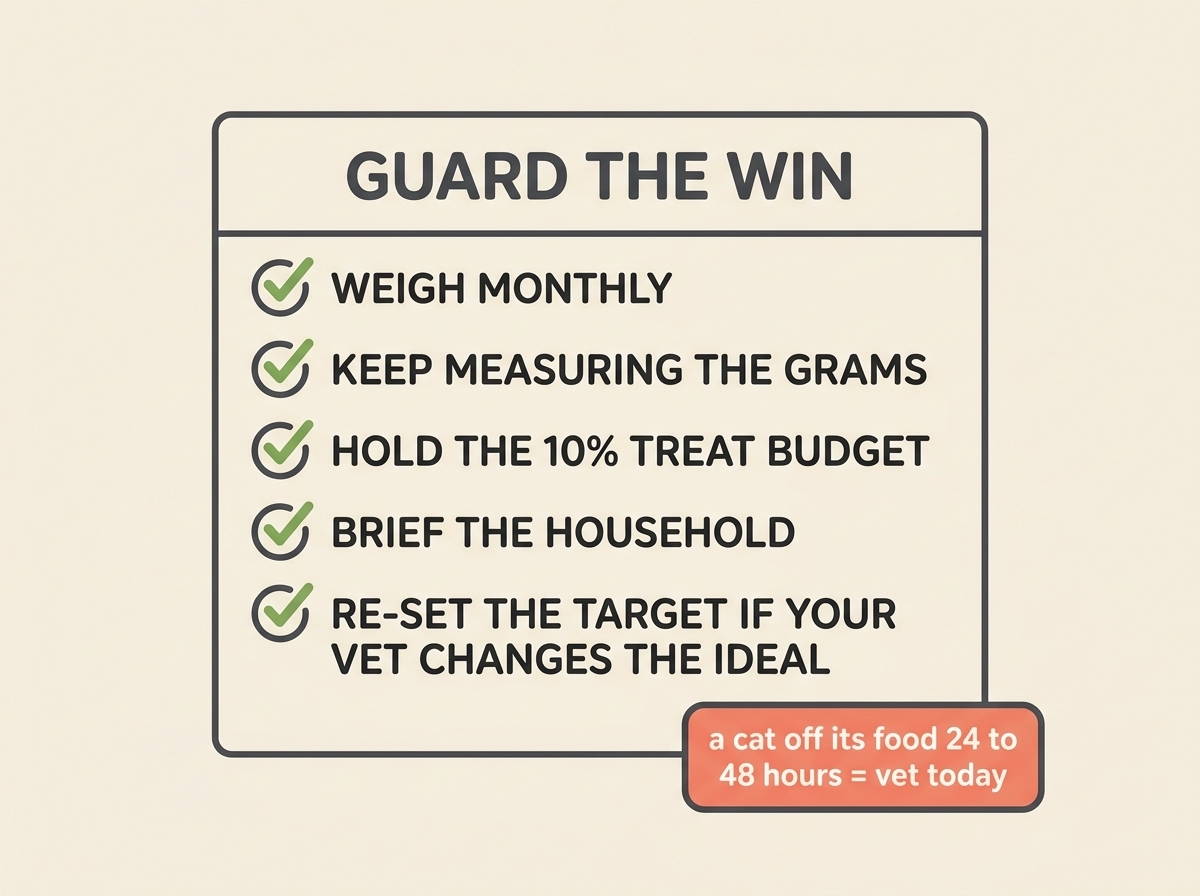
For cats: a cat that goes off the new food and will not eat for 24 to 48 hours is an emergency, not a fussy phase. Never push through it by leaving the new food down and waiting. A cat that stops eating can develop hepatic lipidosis (fatty liver) within days, so call the vet that day and, if you need to, go back to the old food to keep them eating while you sort it out. Never crash-diet a cat explains the why.
Watch for the rebound (it's the drift, not the metabolism)
Tell it straight: after a successful weight-loss programme, a meaningful number of pets put weight back on. In the dog follow-up, 48% regained more than 5% of the weight they had finished at, though most regained less than half of what they had originally lost (German et al., 2012). Cats look much the same, with 46% regaining more than 5% (Deagle et al., 2014). So it is real and it is common, and worth naming plainly. But for most pets it is a slice creeping back, not the whole lot, and it is preventable.
Why does it happen? Two things, and neither of them is a slow metabolism you cannot beat. The first is biological and we have already met it: that low maintenance need (German et al., 2011) means feeding a formerly-overweight pet like an average one of their size is quietly over-feeding from day one. The second is behavioural, and it is the bigger culprit. The discipline slips. Weighed grams drift back to an eyeballed scoop, a treat creeps back in here and another there, a family member starts topping the bowl up again, and none of it shows on any single day. It is drift, not destiny, and that is genuinely good news, because drift is fixable with exactly the habits that got you here.
So the fix is not heroic. Keep weighing the food rather than guessing it. Hold the treat budget at about 10% of the day's calories, with the rest from balanced food (WSAVA Global Nutrition Committee, 2021), and protect it the same way you did during the loss (the treat budget has the swaps). And keep the household briefed, because the most common silent leak is someone else feeding love by hand (getting the whole family on board). Done together, those three things are most of keeping it off.
Keep weighing monthly, and reset the target if the vet does
Sustaining is simple, and it is your early-warning system. Weigh your pet about once a month, and run an occasional hands-on body condition check alongside it. The number on the scales tells you the trend, and your hands over the ribs tell you whether what you are feeling still matches a healthy weight. Between them, they catch a problem while it is tiny. A 5% creep spotted early is a five-minute tweak to the ration. That same 5% ignored for six months is a relapse, and you are back to a full programme. That is the whole value of monthly weighing: it turns relapses into adjustments.
Read it as a trend, not a verdict on the day. Weight wobbles day to day with a full bladder, a big drink, or the time of the weigh-in, so a single reading above target is noise, not a relapse. What you are watching is the direction over a few weigh-ins. The Healthy Weight Tracker is built for exactly this: flip the goal to "maintain", keep plotting the monthly point, and let it draw the line so a real drift stands out from the daily jitter (and reading the trend, not the daily number is the longer version of that one idea).
One last thing, and it is the reason this is a handover and not a finish line. Your pet's ideal weight is not fixed in stone. If your vet re-scores their body condition at a check-up and adjusts the target (up a little because they were carrying less muscle than it looked, or down because there is still a touch to lose), reset the goal in the calculator and recalculate the ration to match. The whole system stays accurate as long as the target it is feeding to stays accurate.
You have done the hard part. The pet beside you moves better and feels better, today, because of the work you put in. Maintenance is not another mountain, it is just keeping your hand on the wheel: weigh monthly, hold the grams and the treats, keep everyone on side, and adjust early when the trend tells you to. The next piece, keeping it off, is the playbook for making those habits stick for a long, comfortable life.
References
- German AJ, et al. (2012). Long-term follow-up after weight management in obese dogs: the role of diet in preventing regain. The Veterinary Journal, 192(1), 65-70.
- German AJ, et al. (2011). Low-maintenance energy requirements of obese dogs after weight loss. British Journal of Nutrition, 106(Suppl 1), S93-S96.
- Deagle G, et al. (2014). Long-term follow-up after weight management in obese cats. Journal of Nutritional Science, 3, e35.
- WSAVA Global Nutrition Committee (2021). WSAVA Global Nutrition Toolkit.
Keep track of how your pet is doing
The owners who cope best are the ones who notice changes early. A simple health log shows you what is working, and what is not, before the next vet visit.
Start tracking, freeYou're not doing this alone
Compare treatment journeys and talk to owners managing weight management. Free to join.
Join PetsLikeMine