

The Treat Budget: Keeping Treats Without Blowing the Diet
Alastair Greenway
BVM&S MRCVS
Let's clear up the worry most owners arrive with: nobody is going to tell you to stop treating your pet. Treats are how you reward a good sit, how you say hello after work, and how you tell your dog or cat you love them. That ritual matters, and you get to keep it.
What trips most diets up isn't the existence of treats. It's that they're given on top of a full bowl, uncounted, by several people, all day. So this isn't a ban. It's a budget. Keep the ritual, control the total, and the plan still works.
It's worth saying plainly too: you're not a bad owner for treating. Over half of pets are above their ideal weight (APOP, 2022), the begging face that earns those treats is hardwired biology rather than a love-meter, and wanting to make your pet happy is the most normal thing in the world. Let's just make it add up.
A budget, not a ban
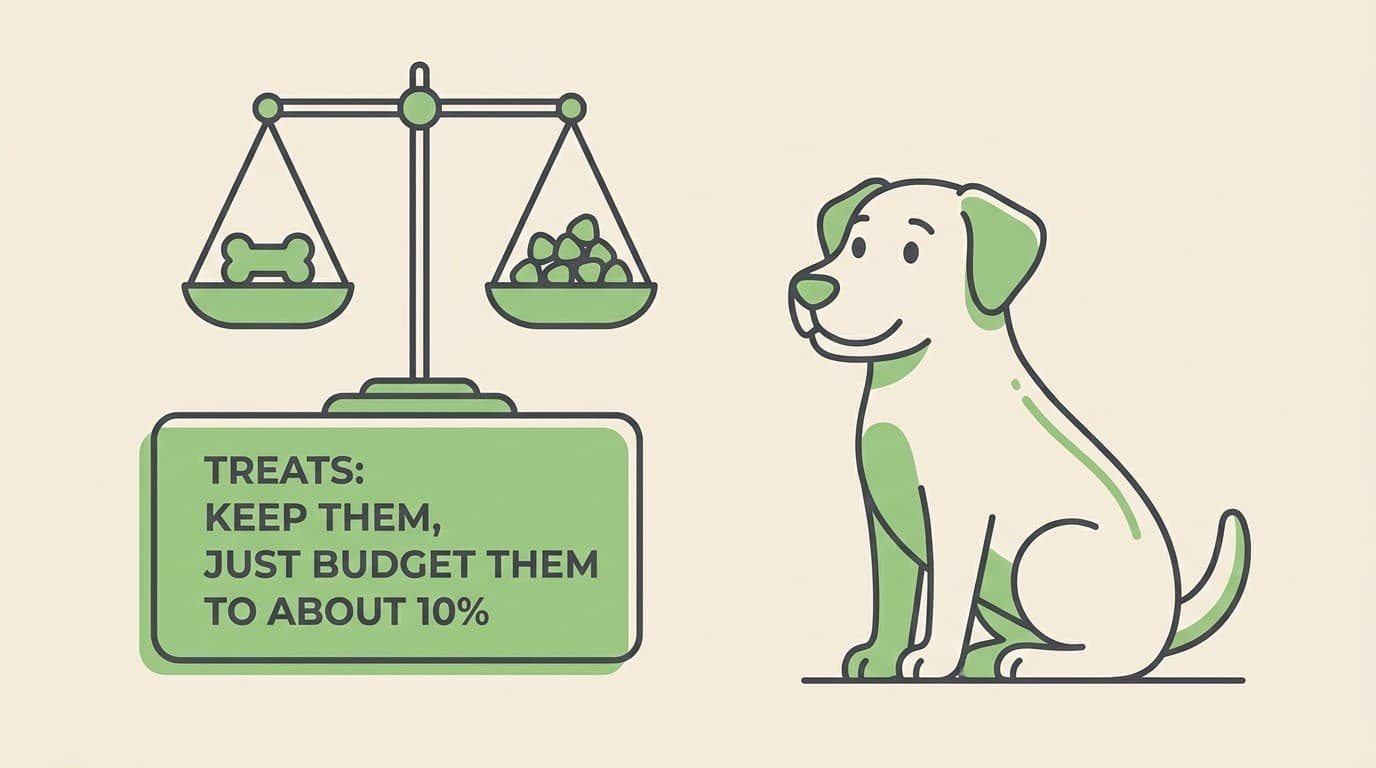
The whole rule fits in one line. Treats should make up no more than about 10% of your pet's daily calories, with the other 90% coming from a complete, balanced food (WSAVA Global Nutrition Committee, 2024; Cline et al., 2021). That's it. Ten per cent is yours to spend however you like.
The plain-English version that vets use is worth keeping in your head. If your dog eats 100 calories a day, no more than 10 of those should come from treats, with the other 90 from proper food (UC Davis VMTH, 2020). The reason for the 90% floor isn't fussiness. Treats aren't nutritionally complete, so once they creep past a tenth of the day they start crowding out the balanced nutrition your pet actually needs, on top of piling on calories (Cline et al., 2021).
The good news is you don't have to do this sum yourself. The 10% treat carve-out is exactly what the Feeding Calculator already builds in: it works out your pet's daily calories, sets aside the treat budget, and hands you back the grams of food for the rest. So the budget isn't a guess. It's a number.
Why treats blow diets so quietly
If 10% sounds generous, the catch is that treats are far more calorific than they look, and we almost never count them.
The comparison that tends to land comes from a PDSA vet, Emma Fisher, talking about a real overweight patient: "To a medium-sized dog, eating three cubes of cheese is like a person eating two chocolate bars" (Fisher, PDSA, 2020). Three little cubes. Two chocolate bars. That's the scale of the mismatch, and it's why a handful of "just a few" treats can quietly wipe out the deficit you worked to create.
It's worse the smaller the animal. A single dental chew or a cube of cheese is a meaningful slice of a small dog's whole day, and for a cat it can be a serious dent in a tiny calorie allowance. Cats need so little food to begin with that there isn't much room for extras, and many shop-bought treats are dense, some running around 415 kcal per 100g, more than a glazed doughnut gram for gram. None of that makes you reckless. It just means the eye is a poor judge, and the only safe approach is to budget treats in rather than bolt them on.
Keep the bonding, lose the calories
This is the part that does the heavy lifting, because you can keep treating just as often and spend far fewer calories doing it. Three moves cover most of it.
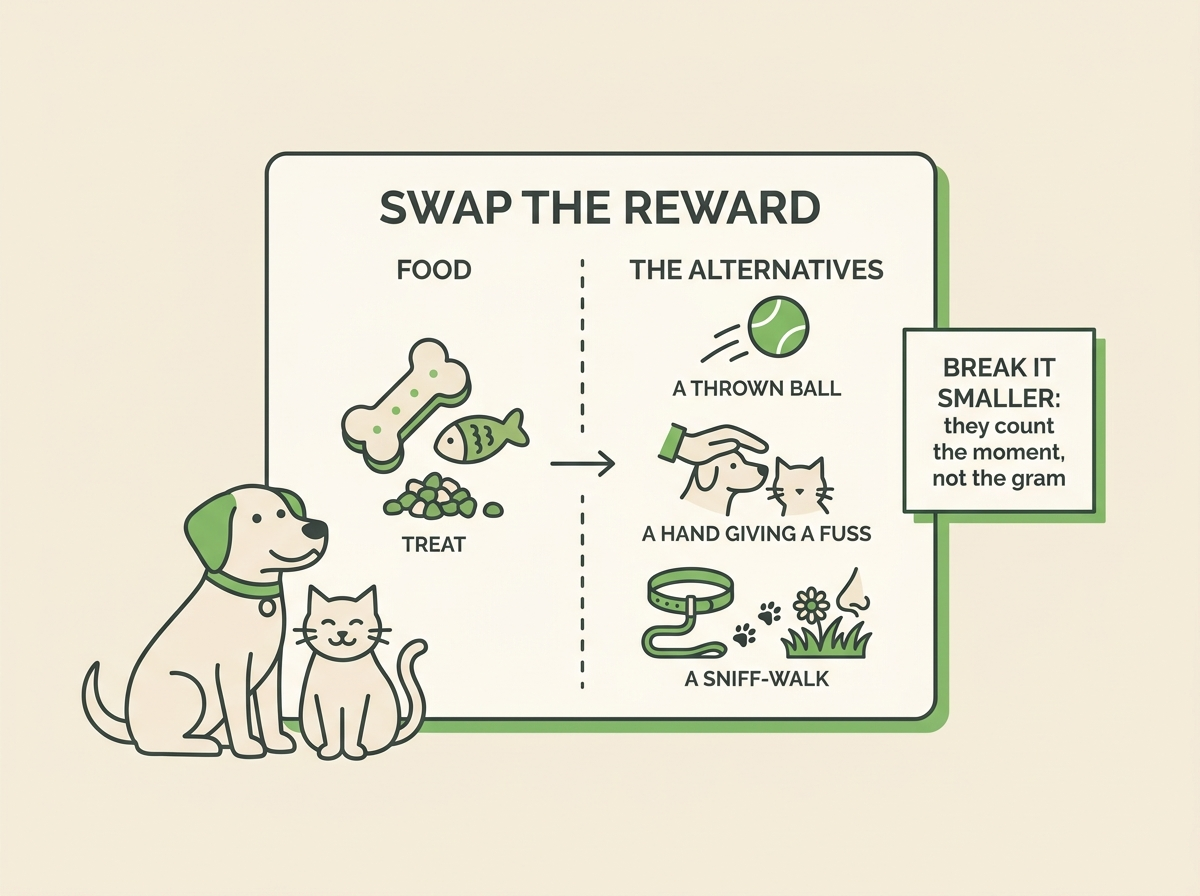
Swap to low-calorie treats. The simplest swap costs nothing: a piece of your pet's own kibble, counted out of the day's ration rather than given on top. For dogs, vegetables are a genuinely useful tool. Around 63g of boiled green beans is about 22 calories, 50g of raw baby carrots about 18, and a slice of apple with the skin (no pips) roughly 14 to 16 (UC Davis VMTH, 2020). You can hand those over generously and barely touch the budget. One safety aside so the swaps don't backfire: keep chocolate, grapes and raisins, onions and garlic, macadamia nuts and anything with xylitol well away, as these are toxic to pets (UC Davis VMTH, 2020). And a note for cat owners: veg isn't a cat tactic. Cats are obligate carnivores, so for them stick to a few pieces of their own kibble or a lick of wet food, counted in.
Reward with the relationship, not just food. Food is only one currency, and often not the one your pet wants most. A thrown ball, a proper fuss, a game, two minutes of a sniff-walk: these are rewards too, and they cost zero calories. Veterinary weight-management guidance specifically recommends offering play, grooming, walks and affection in place of food for pets that need to slim, and notes that praise and play are genuinely effective rewards in their own right (Cline et al., 2021).
Break treats smaller. A treat works as a reward because of the moment, not the mass. Training guidance is that food rewards should be pea-sized or smaller so your pet doesn't fill up, paired with praise (American Kennel Club, 2021). Snap a single treat into four and you've got four rewards for the price of one. For most pets the moment of being rewarded matters far more than the size of the piece, so smaller pieces lose you nothing your pet actually values.
When food feels like love
That begging face is incredibly persuasive, and it can feel like saying no is letting your pet down. But the begging is biology, not a verdict on how much you love each other. Dogs and cats are wired to ask for food, and they'll happily ask whether they're hungry or not. Saying no to one more treat isn't being mean to them. It's the kinder long game. You're not depriving your pet, you're protecting the parts of them that want to keep running, jumping and climbing the stairs comfortably, which is the whole point of doing this (see weight and arthritis).
The guilt has somewhere to go. The most loving thing on offer here isn't the treat. It's the lighter, more comfortable pet on the other side of the budget.
Make it a household rule
A treat budget only holds if everyone feeding the pet knows about it. The classic way a careful diet collapses is the day's allowance being handed out five times over, once by each member of the family and again by the neighbour who "only gave him a little something".
So make the budget and the swaps a shared rule, not a private one. Agree what counts, agree who gives what, and ideally keep the day's treats in one labelled pot so it's obvious when they're gone. There's more on getting everyone (including the dog-sitter) on the same page in getting the whole family on board, and on running this in a multi-pet house in feeding a dieter in a multi-pet home.
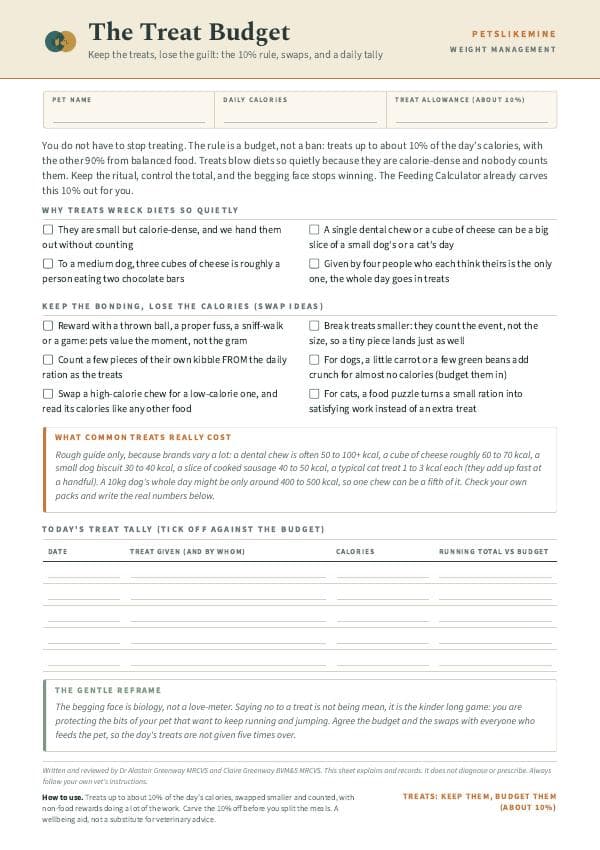
Your next step is the easy one: set your treat budget in the Feeding Calculator, which carves the 10% out for you alongside the grams of food. From there, how much should I actually feed? covers the food side of the plan, and handling begging and food obsession is for the pet who acts starving even when the maths is right. You can also print the treat-swap card and stick it on the fridge, so the whole household is spending the same budget.
References
- Association for Pet Obesity Prevention (APOP) (2022). 2022 State of U.S. Pet Obesity Survey: 59% of dogs and 61% of cats overweight or obese.
- WSAVA Global Nutrition Committee (2024). Feeding treats to your dog (client handout, v2). World Small Animal Veterinary Association.
- Cline MG, et al. (2021). 2021 AAHA Nutrition and Weight Management Guidelines for Dogs and Cats. Journal of the American Animal Hospital Association 57(4):153–178.
- UC Davis Veterinary Medical Teaching Hospital (VMTH) (2020). Treat guidelines for dogs. Nutrition Support Service.
- Fisher E, PDSA (2020). PDSA Pet Fit Club: "To a medium-sized dog, eating three cubes of cheese is like a person eating two chocolate bars." PDSA real-life story, 4 February 2020.
- American Kennel Club (2021). Using food rewards in dog training.
Free downloads
Companion worksheets to put what you've read into practice. Free PDFs, print at home.
Keep track of how your pet is doing
The owners who cope best are the ones who notice changes early. A simple health log shows you what is working, and what is not, before the next vet visit.
Start tracking, freeYou're not doing this alone
Compare treatment journeys and talk to owners managing weight management. Free to join.
Join PetsLikeMine