

Feeding a dieter in a multi-pet home
Alastair Greenway
BVM&S MRCVS
A diet can be calculated to the gram and still fail in a busy household, and the reason is almost always the same. The portions are weighed, the treats are budgeted, everything the plan asked for is done, and the scale still won't move, because the moment your back is turned the dieter has cleared his own bowl and started on the cat's. Or the bowls stay down all day for a grazing cat who "needs food available", and nobody can say who's eaten what.
That is worth naming plainly. Feeding one pet a diet in a house with others is the single hardest practical part of the whole plan. Your maths can be perfect and the diet can still fail, not because you got the numbers wrong, but because the room won't hold them. This isn't a willpower problem and it isn't your fault. It's a logistics problem, and logistics problems have logistics fixes.
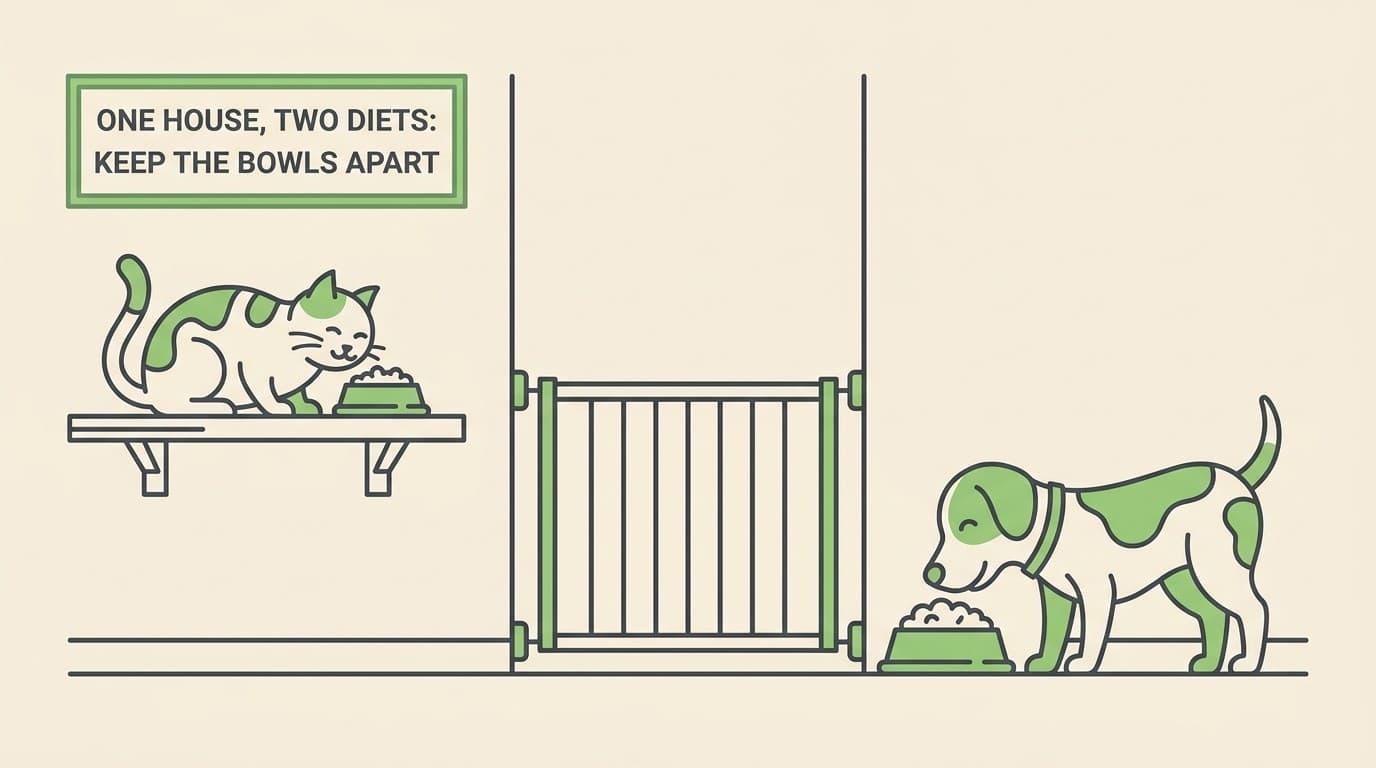
One bowl, two diets
A shared feeding setup quietly works against you in two ways, and most multi-pet households have both.
The first is the food-stealer. A food-motivated dog or cat will happily eat its own measured ration and then hoover up a housemate's, which blows the dieter's deficit and short-changes the other pet. This is so common that the profession's nutrition guidance specifically prompts vets to ask whether each pet has its own bowl and whether one pet out-competes another for food (AAHA, 2021). If your vet has ever asked you that, this is why.
The second is free-feeding. Leaving food down all day suits a grazing cat, but it makes a diet almost impossible to run, because you can't measure what you never portion and you can't see who ate it. Once the bowl is a shared, bottomless dish, the deficit you carefully calculated is a guess.
So the fix isn't to try harder. It's to change the setup so each pet eats its own meal, and only its own meal. There are three levers for that, and the good news is the first two are free.
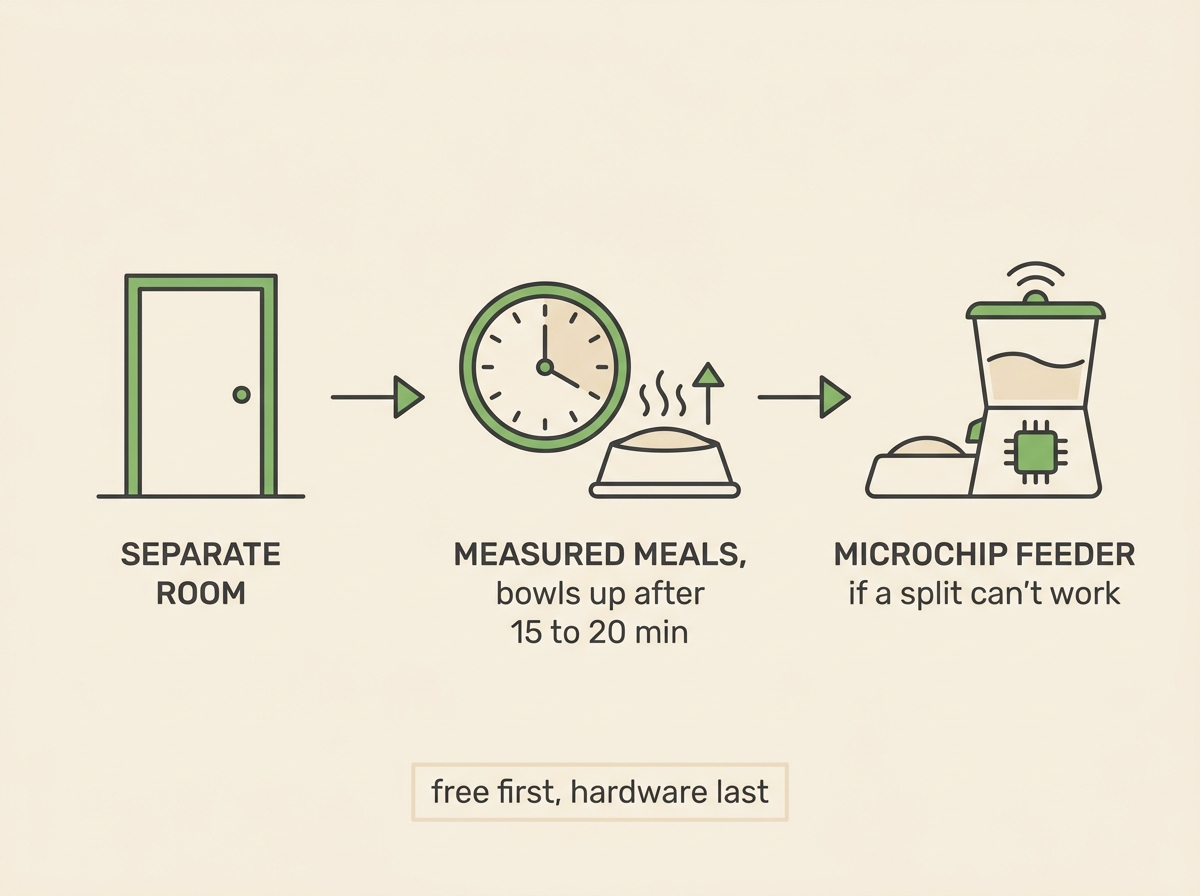
Separate the feeding: by room, by time, or both
Start with the two free levers before you spend a penny on hardware.
Separate by room. The simplest version is to feed each pet in its own space with a door or a baby-gate between them. The dieter eats in the kitchen, the other pet in the utility room, and neither can reach the other's bowl. For many households that one change does most of the work.
Separate by time, and end free-feeding. Instead of food left down all day, move to measured meals on a schedule. Put each pet's portion down, give them fifteen to twenty minutes to eat, then lift the bowls, whether they're empty or not. This is the moment free-feeding ends and a real diet begins, because now every meal is a known quantity (see how much should I actually feed? for turning that into grams of your current food). Scheduled meals also suit cats better than owners expect. Cats are naturally solitary eaters who prefer several small meals in a calm spot, not a competitive scrum at a shared bowl (AAFP, via PetMD, 2023), so a few measured meals a day works with their instincts, not against them.
For a multi-cat house, the spacing matters as much as the schedule. Give each cat its own feeding station, spread well apart, rather than a row of bowls side by side. The feline rule of thumb is one of each key resource per cat plus one spare, with the stations kept as far apart as is practical, so no cat has to eat within another's eyeline (International Cat Care, 2023). And use height. Feeding a slim, senior or nervous cat up on a stable shelf or a cat tree, where a heavier or pushier housemate can't or won't follow, is one of the most reliable ways to protect her meal (International Cat Care, 2023). The dieter eats on the floor, the cat who must not be left short eats up high, and the geography does the policing for you.
When hardware earns its keep: microchip and selective feeders
Sometimes a room-or-time split isn't enough. You've a determined grazer who will not be scheduled, or a layout that genuinely can't be divided. This is the one job a microchip feeder does that nothing else can.
A microchip or RFID feeder reads your pet's existing microchip (or a collar tag) and opens its lid only for the registered pet, then closes again when that pet steps away (Sure Petcare, 2024). The dieter is simply locked out of the other pet's food, and the right cat gets her own measured ration with no one raiding it. For a multi-pet home where one pet eats a special diet and another keeps stealing it, that's exactly the problem solved.
Be clear-eyed about the trade-offs, though, because they're real. They cost money, they suit cats and small dogs rather than a large dog who can shove the unit around, and crucially the pet has to be trained onto one slowly. Manufacturers build a staged training mode where the lid starts fully open and only gradually begins to close over several steps, precisely because a cat startled by a moving lid may simply stop using the feeder (Sure Petcare, 2024). Some cats take to it in a day; others need up to two weeks of patient acclimation (Sure Petcare, 2024). Rush that, and you don't just lose the feeder, you risk a cat who stops eating, which for a cat is a danger in its own right. So a feeder is a genuine fix for the stealing problem, but it's a tool you introduce gently, not a gadget you plug in and walk away from.
Pre-portion the whole day on the counter
Here's the simplest habit that holds a multi-pet diet together, and it costs nothing but a few minutes.
Each morning, weigh out every pet's entire day of food into its own named tub or bag, one per pet. Now the dieter's whole allowance for the day is visibly sitting in one container, and so is everyone else's. Anyone who feeds can see at a glance what's already gone and what's left, so the dieter can't be topped up five times over by five different people each thinking they're giving "just a bit". When a pet's tub is empty, that pet is done for the day. It turns an invisible, argued-over quantity into something you can point at on the counter.
This pairs with two things. Get the per-pet grams from the Feeding Calculator, which turns each pet's target weight into grams of the food you already buy, so the tubs hold the right amount in the first place. And brief everyone who feeds the household, including the dog-sitter and the relative who pops in, so the tubs are respected rather than bypassed (see getting the whole family on board and the treat side of it in the treat budget).
The cat safety line that changes the plan
There's one way of solving the logistics that you must never use, and it matters most for cats.
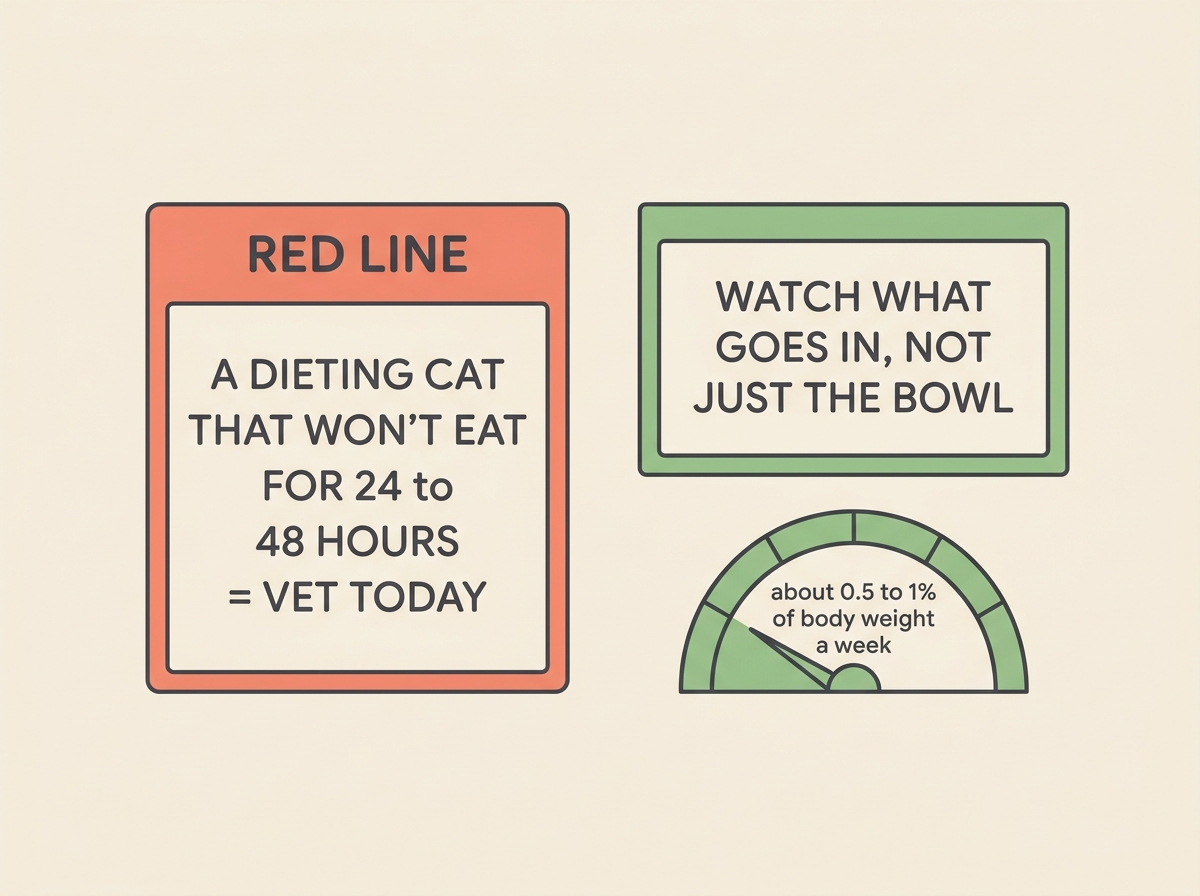
Never fix a multi-pet feeding problem by simply leaving the dieting cat with less food and walking away. A cat who quietly opts out and stops eating, or who is shut away from food by a feeder she won't use, can develop hepatic lipidosis, or fatty liver, where the body floods the liver with fat faster than it can cope and the liver can stop working properly. It is exactly the overzealous restriction, or being accidentally confined away from food, that tips an overweight cat into it (Valtolina and Favier, 2024). An overweight cat that won't eat for 24 to 48 hours is an emergency, not a diet that's finally working, so book the vet that day.
The practical rule that keeps her safe is this: watch what goes in, not just what's in the bowl. In a multi-pet house the temptation is to set the food down and assume the right cat ate the right amount, but a half-finished communal bowl tells you nothing about who ate what. So portion per cat, feed where you can actually see her eat, and keep her loss slow, about 0.5 to 1% of body weight a week (AAHA, 2021). If she goes off a reduced or new food, the answer is never less food. Slow the change down, warm it to lift the smell, or try a different texture. There's much more on this in never crash-diet a cat, and the Healthy Weight Tracker will flag it for you if she starts dropping weight too fast.
When you genuinely can't separate
Sometimes none of it is fully on the table. You're in a rental with no spare room, your pets are so bonded they distress when split up, or you're out all day and can't run a feeding schedule. If that's your reality, it's worth saying plainly: you may not get a perfect setup, and that's allowed. You go for the partial wins instead, and they add up.
Schedule what you can, even if it's only the meals you're home for. Microchip-feed the one pet who'll tolerate a feeder, even if the others won't, so at least the dieter (or the cat who must not be left short) is protected. Slow the whole household to measured meals rather than a bottomless bowl, which helps every pet a little. And accept a slower, safer rate of loss as the fair trade. A diet that comes off gently over a longer stretch, without ever starving a cat or sparking a turf war over food, is a win. A crash cut that triggers fatty liver or a behaviour problem is not, however fast the scale moves.
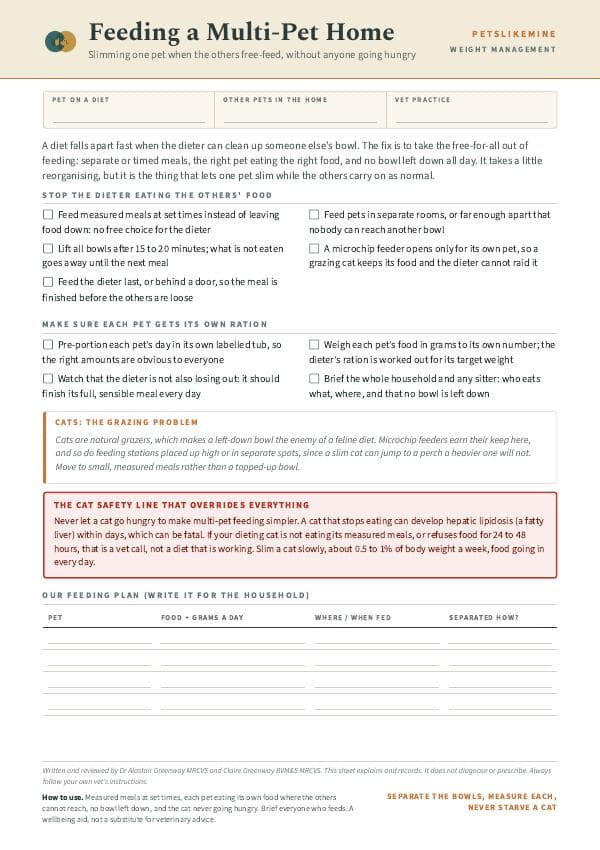
When you're ready for the next piece, how much should I actually feed? sets each pet's portion in grams of your own food, the treat budget keeps the extras from undoing it, and getting the whole family on board makes sure the household runs the same plan. For cats specifically, never crash-diet a cat covers the safety side in full. The Feeding Calculator gives you the per-pet grams to fill those morning tubs, the Healthy Weight Tracker watches the trend and the pace, and the multi-pet feeding plan download lays the whole split-feeding setup out as a one-page routine you can stick on the fridge.
References
- American Animal Hospital Association (AAHA) (2021). 2021 AAHA Nutrition and Weight Management Guidelines for Dogs and Cats.
- AAFP (American Association of Feline Practitioners), via PetMD (2023). Feeding Multiple Cats: How to Do It Right.
- International Cat Care / ISFM (2023). Multi-cat households.
- Sure Petcare (2024). SureFeed Microchip Pet Feeder: training your pet to use the feeder.
- Valtolina C, Favier RP (2024). Feline Hepatic Lipidosis. Veterinary Clinics of North America: Small Animal Practice.
Free downloads
Companion worksheets to put what you've read into practice. Free PDFs, print at home.
Keep track of how your pet is doing
The owners who cope best are the ones who notice changes early. A simple health log shows you what is working, and what is not, before the next vet visit.
Start tracking, freeYou're not doing this alone
Compare treatment journeys and talk to owners managing weight management. Free to join.
Join PetsLikeMine