

Body Condition Score: How to Score Your Dog or Cat at Home
Alastair Greenway
BVM&S MRCVS
Feeling the ribs gives you a hunch about where your pet sits. To turn that hunch into the actual number your vet writes in the notes, you score it. That number is the body condition score, and you can do it at home with nothing but your hands and a moment of clear-eyed looking. Once you have a score you can track it, and tracking is where the real change happens.
This is the proper method, made genuinely doable. By the end you'll have scored your pet on the 1-to-9 scale, you'll know the one cat detail nearly everyone gets wrong, and you'll have a photo worth coming back to.
What the score actually measures, and why 9 points beat "fat or not fat"
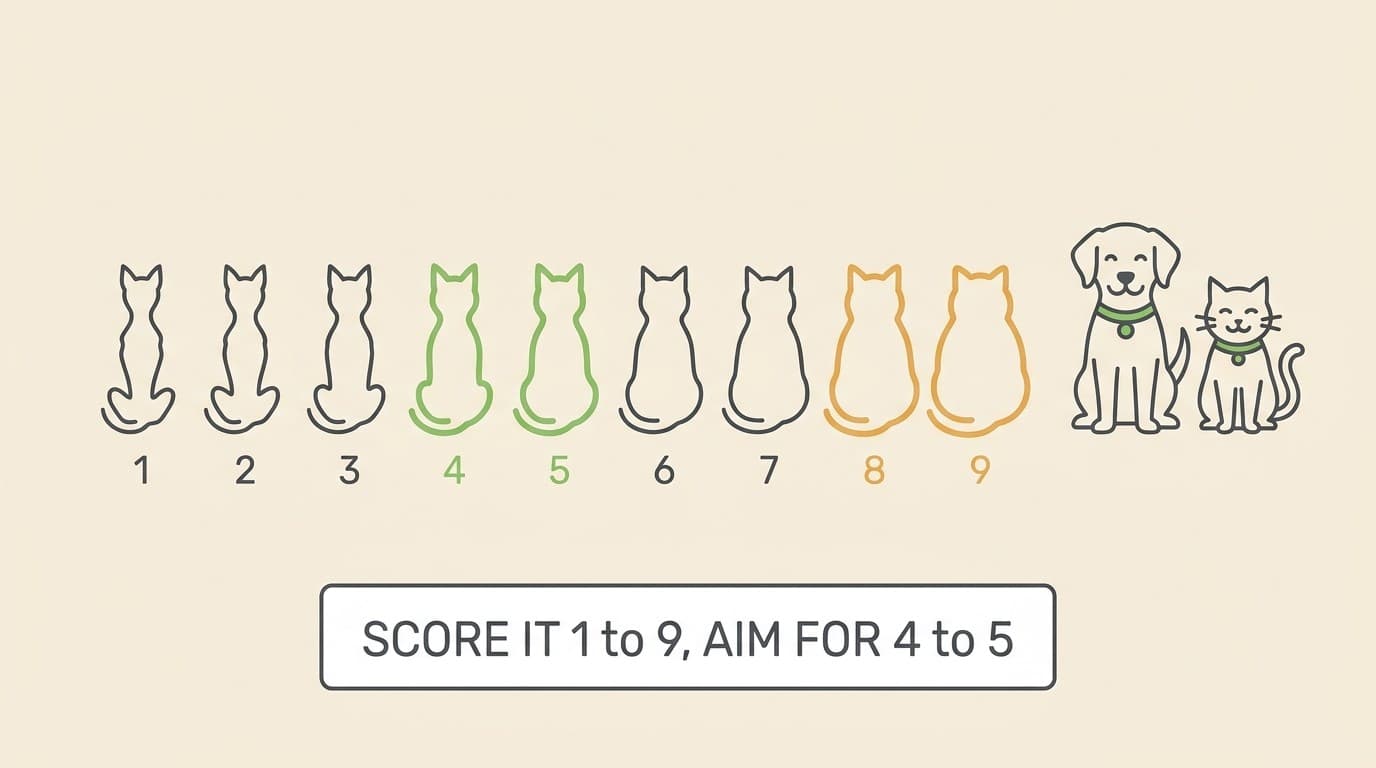
A body condition score, or BCS, is a structured way of judging how much fat your pet is carrying. Instead of a yes-or-no "is he overweight", it puts a number on it by combining three things you can check yourself: how easily you can feel the ribs, whether there's a waist when you look down from above, and whether the belly tucks up when you look from the side.
The scale your vet uses runs from 1 to 9. A 1 is emaciated, all bone and no cover. A 9 is grossly obese. The middle is the target: ideal is 4 to 5 for dogs and 5 for cats, with 4 the lean end of ideal (WSAVA Global Nutrition Committee, 2025). It's used worldwide because it's the one that's been validated, developed and tested against DEXA body-fat scanning, the gold-standard measure of how much of a pet is actually fat (Laflamme, 1997; AAHA, 2021). In plain terms, the number you read off at home genuinely lines up with what's under the skin.
The 9-point scale gives you one more thing "fat or not fat" never could, and it's the link that turns a score into a plan. Each point above ideal is roughly 10% over the target weight (AAHA, 2021). So a dog at BCS 7 is carrying about 20% more than it should, and a BCS 8 is around 30% over. That's the maths the Feeding Calculator uses to work out where you're aiming, which is why an accurate score matters.
Score it step by step
Do this now, on your pet. It takes a minute and it's far more reliable than standing back and squinting.
1. Feel the ribs. Run your hands flat along both sides of the chest, behind the front legs. At an ideal score you should feel the ribs easily, with only a thin layer of fat over them, a bit like feeling the bones on the back of your hand. You shouldn't have to press or dig. Sharp ribs with no cover at all is under ideal. Having to push through a soft pad to find them, or not finding them, is over.
2. Look from above. Stand over your pet, or lift a cat gently, and look straight down. You're looking for a waist, an inward tuck behind the ribs before the hips. A clear hourglass means lean and a gentle tuck is ideal. A straight, sausage-shaped back with no narrowing, or one that bulges outward, is over ideal.
3. Look from the side. With your pet standing, look at the line of the belly. It should rise up behind the ribcage towards the back legs, the "tuck". A belly that runs level with the chest, or sags below it, is carrying too much.
Now map what you found onto the scale. Here's the vet-standard wording at the bands that matter:
- Under ideal (1 to 3): ribs, spine and hip bones easily seen, no fat cover, obvious waist and a sharp tuck.
- Ideal, dog 4 to 5: "Ribs palpable without excess fat covering. Waist observed behind ribs when viewed from above. Abdomen tucked up when viewed from side." A 4 is the lean side of this, with the waist and tuck a little more obvious (WSAVA Global Nutrition Committee, 2025).
- Ideal, cat 5 (4 is lean-ideal): "Well-proportioned. Ribs felt with slight fat covering. Waist seen behind ribs, but not pronounced. Abdominal fat pad minimal" (WSAVA Global Nutrition Committee, 2025).
- Over ideal (6 to 9): ribs hard to feel or impossible under a fat layer, waist disappearing or gone, the belly level or rounded, and at the top end fat deposits over the back, the base of the tail and the limbs.
One useful caveat for cats: the WSAVA chart notes that a score of 6 of 9 may be acceptable in some cats, especially older ones (WSAVA Global Nutrition Committee, 2025). So a slightly higher reading in a senior cat isn't automatically a problem, and is worth a word with your vet rather than a sudden diet.
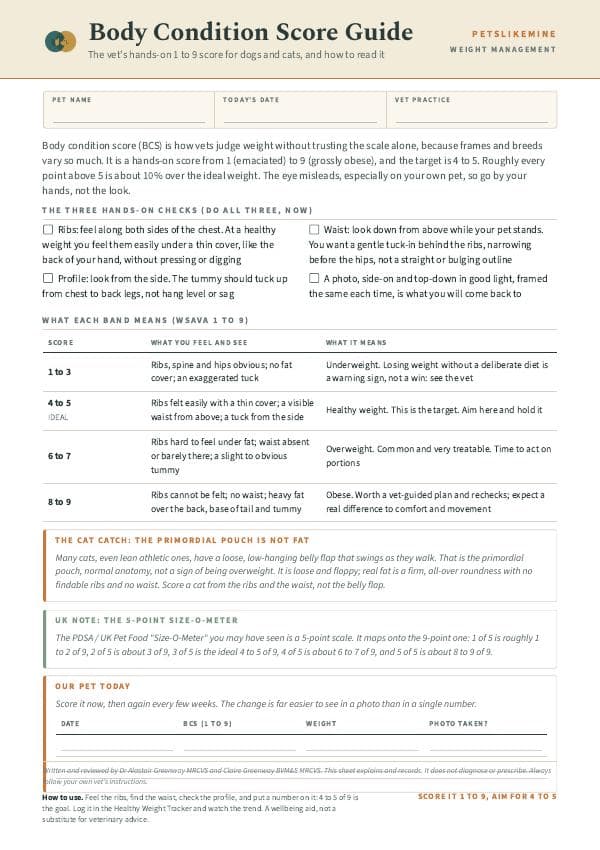
The UK 5-point chart, sorted. You may have come across a 1-to-5 chart and wondered why the numbers don't match. The "Pet Size-O-Meter" is a 5-point scale, from UK Pet Food, formerly the PFMA (UK Pet Food). It's a different scale, not a different answer. Here's how it lines up with the 9-point one your vet uses: 3 of 5 is the ideal 4-to-5 of 9, 4 of 5 is overweight, and 5 of 5 is obese (AAHA, 2021). Whichever chart you meet, aim for the middle and you're on the same page.
The one bit cat owners get wrong: the primordial pouch
If you have a cat, this is the part to read twice, because it trips up almost everyone.
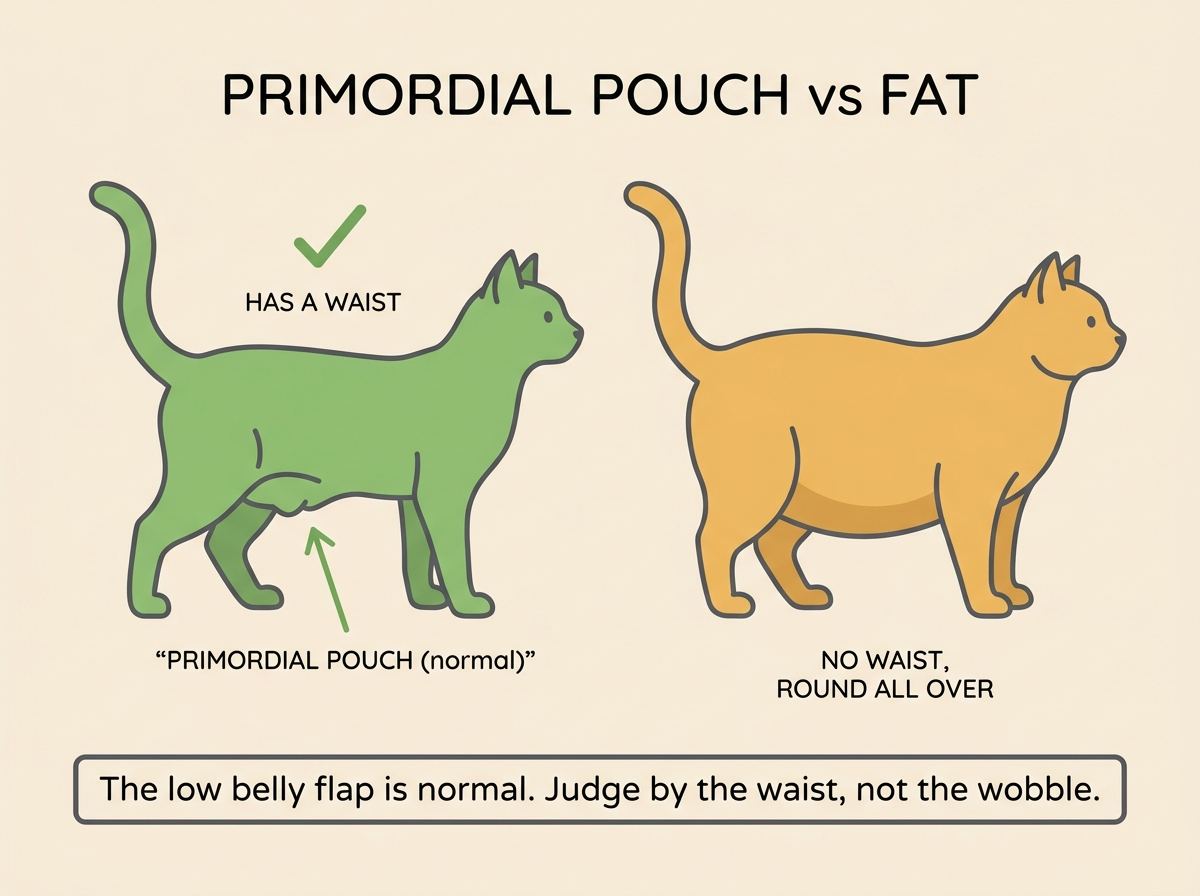
Many cats have a loose flap of skin and fat low on the belly, hanging between the back legs. It's called the primordial pouch, and it is completely normal. It's there in lean cats and overweight cats alike, in males and females, neutered or not, and its size doesn't track how heavy the cat is. A healthy pouch is soft, and it swings and sways from side to side when the cat walks.
So don't score your cat off the belly flap. Score off the ribs and the waist, exactly as above. To tell a normal pouch from a real weight problem: with a healthy-weight cat the pouch stays soft and loose but you can still feel the ribs easily and still see a waist from above. With an overweight cat the waist disappears from above, the ribs get hard to find under a firm, rounded belly, and the whole middle feels solid rather than swinging. The pouch is a red herring. The ribs and the waist tell the truth (WSAVA Global Nutrition Committee, 2025).
Take the photo (this is the bit nobody else tells you to do)
Most BCS advice stops at the score, and skips the step that does the most work.
Score your pet, then take two photos: one from the side and one from directly above, in good, even light. Frame them the same way every time, same angle, same distance, ideally the same spot. A number on its own is easy to talk yourself out of, but two photos a month apart are hard to argue with.
This matters because we're genuinely bad at seeing gradual change on our own pets. The change creeps in slowly, we see them every day, and a "normal" that has quietly drifted heavier starts to look like the baseline. Research is consistent on this: owners regularly judge an overweight pet to be a normal weight, and the misperception can persist even when they're handed a body condition chart to compare against. The eye drifts, but a repeated photo doesn't.
This is the gap the Healthy Weight Tracker fills. Every other BCS tool gives you a one-off score and forgets it. The tracker stores the score and the photo together, so you watch the trend over weeks rather than guessing. That stored history is the difference between scoring your pet once and actually getting them to a healthy weight.
Turn the score into a target
A score on its own is a snapshot. The reason it's worth doing is that it hands you a goal.
Use the 10%-per-point rule to estimate the ideal weight: take where your pet is now, and knock off roughly 10% for each point above 5. So a 10 kg dog at BCS 7 is about 20% over, which puts the ideal somewhere around 8 kg, and a cat at BCS 8 is roughly 30% over its target. Treat that as a rough starting estimate, not a precise prescription, and you'll refine it with your vet as the weight comes off (AAHA, 2021).
That target weight is what the rest of the programme runs on. It's what you feed to, not the weight they are today, and it's the number the [Feeding Calculator] turns into a daily portion in seconds. If you want to see the sums behind it, [How Many Calories? The Feeding Maths, Made Simple] walks through them, but you don't have to do any of it by hand. Get the score, estimate the target, and let the tools take it from there.
You've now got the two things that make everything else work: a proper body condition score, and a baseline you can beat. From here, see [What Should My Pet Actually Weigh? Finding the Ideal] to lock in the target, and use the [Healthy Weight Tracker] to log this first score and photo so you've got a starting line. If you came straight from [Is My Dog Actually Overweight? How to Tell at Home], you've now turned that hunch into a number, and if it's a cat you're worried about, ["He's Just a Big Cat": When Round Is a Real Problem] picks the thread up from here. You can also print the [body condition score chart] to keep by the scales.
References
- WSAVA Global Nutrition Committee (2025). Body Condition Score charts (dog and cat), 2025 revision. World Small Animal Veterinary Association.
- Laflamme DP (1997). Development and validation of a body condition score system for dogs. Canine Practice 22(4):10-15.
- AAHA (2021). 2021 AAHA Nutrition and Weight Management Guidelines for Dogs and Cats. American Animal Hospital Association.
- UK Pet Food (formerly PFMA). Pet Size-O-Meter: a 5-point body condition scale. UK Pet Food healthy-weight resources.
Free downloads
Companion worksheets to put what you've read into practice. Free PDFs, print at home.
Keep track of how your pet is doing
The owners who cope best are the ones who notice changes early. A simple health log shows you what is working, and what is not, before the next vet visit.
Start tracking, freeYou're not doing this alone
Compare treatment journeys and talk to owners managing weight management. Free to join.
Join PetsLikeMine