

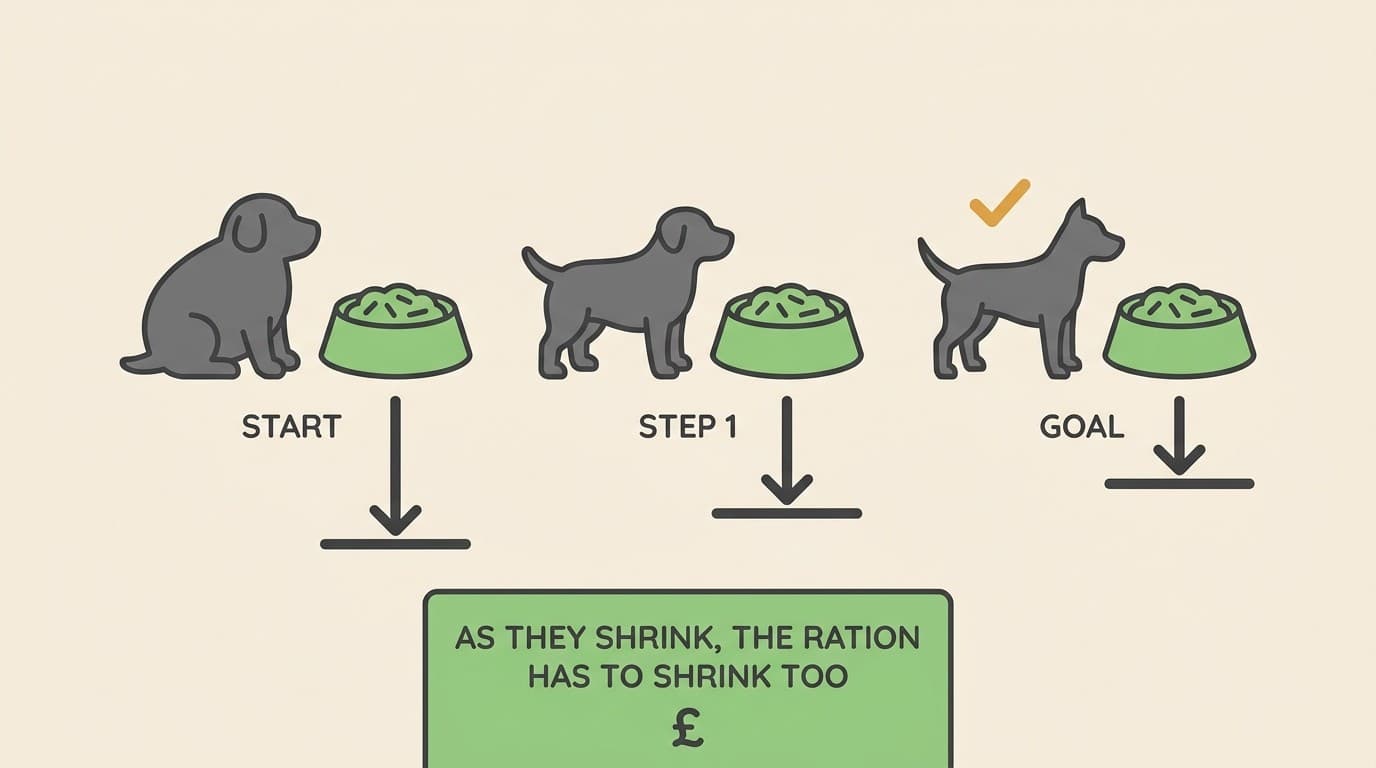
Recalculating as they shrink: why the ration has to change
Alastair Greenway
BVM&S MRCVS
A weight-loss ration has a shelf life, and almost nobody mentions it. You worked the number out once, maybe through our Feeding Calculator, maybe from a figure the vet wrote down, and since then you've measured that exact amount into the bowl every day. You've done it all correctly. So when the loss slows, or the scale sits in one place for a fortnight, it lands like a betrayal. Nothing on your end has changed, so why has it stopped working?
The amount you set was a deliberate deficit, but it was a deficit for the pet you had then. As your pet gets lighter, that same bowl quietly stops being a diet. This isn't your pet's body failing you, and it isn't a "slow metabolism". It's arithmetic, and once you can see it, the fix is straightforward.
Why the same bowl stops working
When you set a weight-loss ration, you're feeding fewer calories than your pet burns. That gap, the deficit, is what pulls the weight down. The catch is that the gap depends on two numbers rather than one. There's the food going in, which you've kept the same, and there's the energy your pet burns, which has been falling the whole time.
A smaller animal burns fewer calories. A 40kg dog needs more fuel just to exist than a 30kg dog does, because there's less of it to keep running. As your pet sheds weight, their resting energy requirement drops with them. So the bowl that was a real deficit in week one, comfortably below what they were burning, slowly creeps up toward "just enough" by week eight. The food hasn't changed. Your pet has. The deficit has been closing on its own, and when it closes, the loss flattens.
This is the mechanism sitting underneath almost every stalled diet, and it's exactly what we mean over on the plateau guide when we say the diet has to keep up with the shrinking pet. It is normal and it is expected. It is not a sign that your pet is one of the unlucky ones who "just can't lose". The maths simply moved, and the ration needs to move with it.
Arithmetic, not a broken metabolism
You'll have heard the folk version of this, and a fair bit of commercial copy leans on it too: dieting "slows the metabolism", so your pet's body is fighting you, and you're stuck. It's a discouraging story, and the good news is the evidence tells a more precise and much more reassuring one.
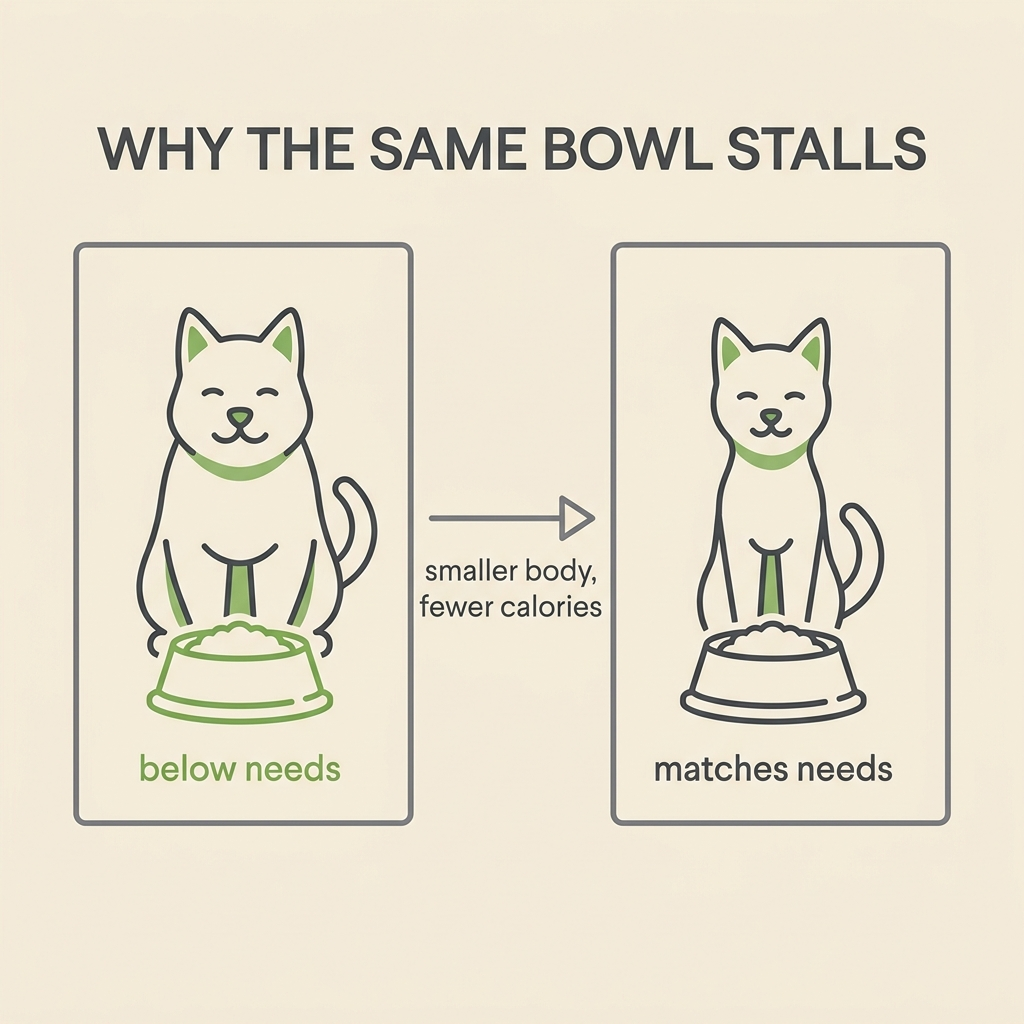
When researchers actually measured it, they found that dogs who had lost weight needed remarkably few calories to hold their new, lighter weight. In one study the maintenance requirement after slimming sat only around 10% above the weight-loss ration itself (German, 2011). The amount you were feeding to lose weight is, by the time they've slimmed down, almost the amount that maintains them. The deficit didn't vanish because your pet's metabolism rebelled. It vanished because the body it was feeding got smaller.
The same work points to why this matters for muscle. When lean tissue is protected during a diet, the energy a dog burns per kilo of body size barely changes (Larsson, 2015). So the absolute number of calories falls because there's less animal, while the rate, the burn per kilo, stays roughly where body size predicts. Your pet's metabolism isn't sabotaging the plan. It's behaving exactly as physics says it should.
This is also why we steer clear of the "boost the metabolism, no need to cut the portions" line you'll see on some bags. There's no metabolic trick that lets a shrinking animal keep eating the same amount and carry on losing. The lever that works is the one the food brands can't sell you: the size of the ration, recalculated as the body changes.
How to recalculate to the new weight
The fix is to turn that one-off sum into a habit. You re-weigh, you redo the maths against where they are now, and you nudge the ration down. None of it is complicated.
Start by re-weighing your pet. If you're not sure how to get an accurate figure at home, the weighing guide covers the scales-and-tricks side, including the hold-them-and-subtract method for cats and small dogs. Aim to do this every two to four weeks. That's roughly the cadence a vet weight-loss clinic reweighs at too, often every two to three weeks, adjusting the food allocation each time (German, 2011), so it's a sensible rhythm to borrow for home.
Then redo the calculation against the new, lower weight, stepping the ration down toward the amount you'll eventually feed at their ideal weight. This is where our Feeding Calculator does the heavy lifting, and there's a neat shortcut hiding in it. A weight-loss ration is always worked out against the target weight, not today's weight, with a deliberate deficit built in. As the actual weight falls, the target stays put, so simply re-running the calculator with your pet's current figures gives you the updated ration each time. The recalculation is re-running the tool. You don't need to remember a formula or do sums on the back of an envelope. Pop in today's weight, read off today's grams.
And while you've got the scales out, weigh the food, not just the pet. The single commonest reason a diet drifts is that the portion quietly grew, a heaped scoop here, a rounded cup there. Measuring the day's ration in grams keeps the number accurate, which is the whole foundation the recalculation rests on.
Step it down gently, not in a lurch
Recalculating means a series of small reductions over time. It does not mean a sudden deep cut. This matters for any pet, and for cats it's a hard safety line.
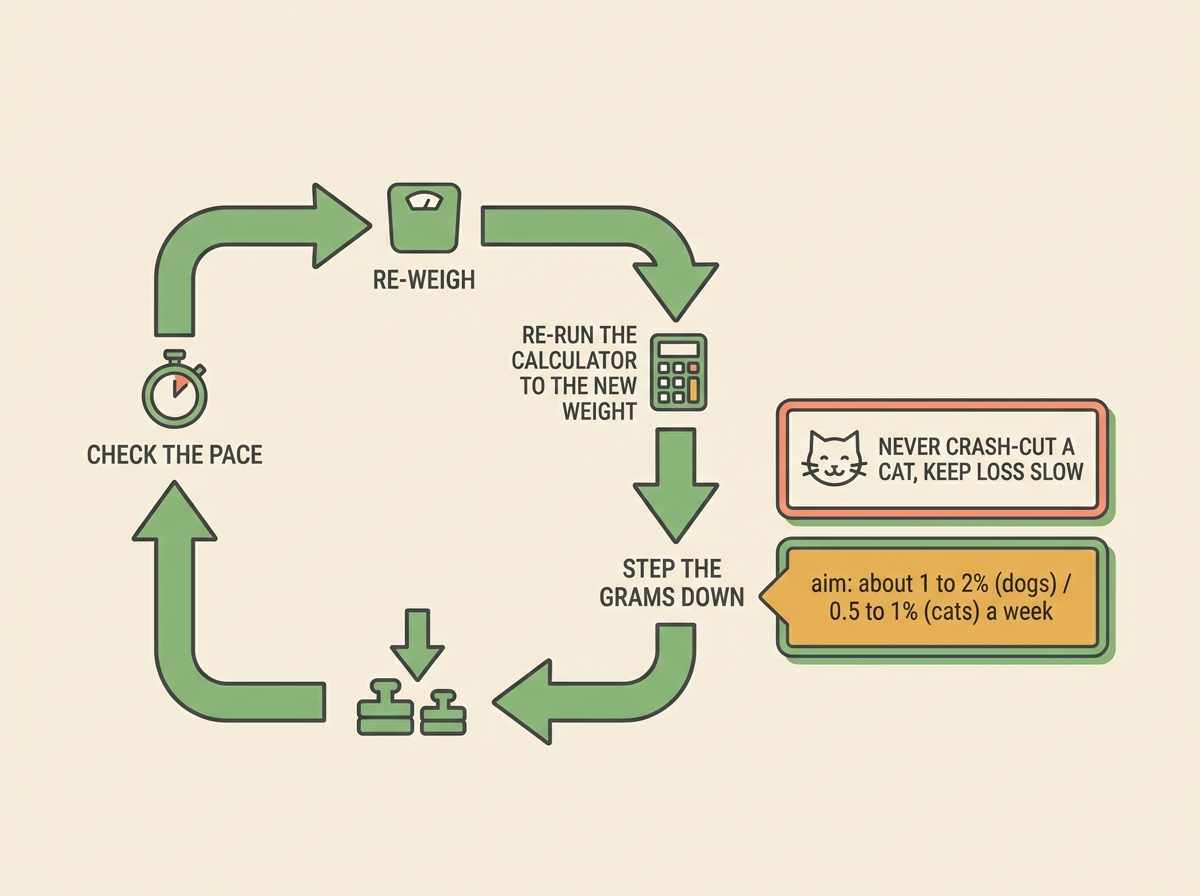
Never crash-cut a cat. A cat dropped onto far too little food, or one who simply stops eating, can develop hepatic lipidosis, a serious fatty-liver condition that can turn life-threatening within days. An overweight cat who won't eat for 24 to 48 hours is an emergency, not a diet that's finally working. So when you step a cat's ration down, do it in small moves and make sure they're actually eating the new amount. The full safety picture is in the hepatic lipidosis guide, and it's worth reading before you tighten a cat's bowl.
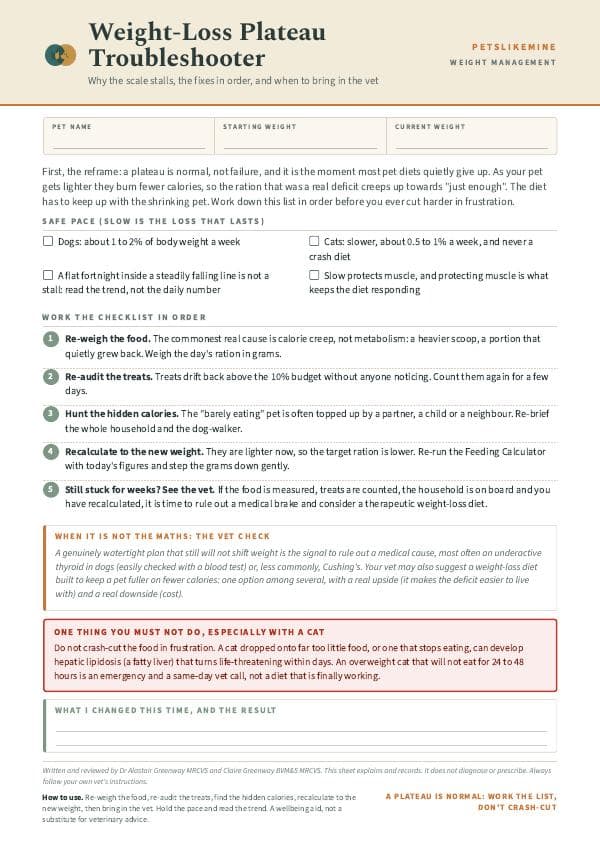
Keep the pace inside the safe band whatever you're feeding. Dogs do well losing about 1 to 2% of their body weight a week. Cats should lose more slowly, about 0.5 to 1% a week. Slow is not the consolation prize here. Slow is the loss that protects muscle, and protecting muscle is precisely what keeps the per-kilo burn where it should be, so the diet keeps responding instead of grinding to a halt (German, 2011). A crash cut sheds lean tissue along with fat, which is the one thing you don't want, and it's miserable for a hungry pet besides.
As your pet closes in on their target, the recalculated ration is, by definition, the amount that feeds their ideal weight. At that point the deficit naturally shrinks to nothing and the diet levels into maintenance. That handover, from losing to holding steady, is its own small skill, and the switching to maintenance guide walks you through it so the weight stays off.
One note on the numbers. Throughout, I've deliberately not printed a single "multiply by this" figure for the deficit, because the exact factor is what the calculator handles, and it differs between dogs and cats. Trust the tool with the precise grams. Your job is the habit: re-weigh, re-run, step down gently, hold the pace.
<!--: feeding-calculator.ts weightLossFactor() uses 1.0x RER-of-ideal for dogs (0.8x for cats); published weight-loss rations commonly sit lower (~0.7 to 0.9x RER-of-ideal; German 2011 median ~62 kcal/kg^0.75 ~ 0.89x). Prose is kept qualitative on purpose so it never disagrees with the lib; flag is for Claire / integration only, not rendered. -->When recalculating doesn't restart the loss
Sometimes you'll do all of this, re-weigh diligently, recalculate to the new weight, account for every treat and every household member, and the scale still won't move for weeks. When that happens, it's no longer a maths problem, and it's the right moment to bring your vet in.
Before that, do a careful audit of the two things that most often hide in plain sight. One is the treat budget: treats should sit at no more than about 10% of the day's calories, and they creep back without anyone noticing. The other is the household: the dog who's "barely eating" is often being topped up by a partner, a child, or a well-meaning neighbour. Our plateau troubleshooter walks you down that checklist on one page so nothing gets skipped. If both of those are genuinely watertight and the recalculated ration still isn't shifting anything, that's your signal.
Your vet will want to do two things. First, rule out a medical brake on the loss, most commonly an underactive thyroid in dogs, which slows the metabolism for real and is easily checked with a blood test (the hormone and weight guide covers what they'll look for). Second, they may suggest a therapeutic weight-loss diet, which is built to keep a pet feeling fuller on fewer calories by leaning on protein and fibre. It's one option among several. The upside is real, it makes the deficit easier to live with, and so is the downside, it costs more than the food you already buy. The cut-back-or-switch guide lays out when it's worth it.
And through all of it, read the trend rather than the daily number. A single weigh-in is noisy, full of gut fill and the time of day, and a flat fortnight inside a steadily falling line is not a stall (the reading-the-trend guide shows you how to tell the difference). The loss that lasts is the slow one, and the surest way to keep it slow is to keep the maths up to date as the body changes.
So when it slows, don't cut harder in frustration. Re-run the Feeding Calculator against today's weight, and log the new figure in the Healthy Weight Tracker so the next recalculation has something to build on.
References
- German AJ, Holden SL, Mather NJ, Morris PJ, Biourge V. (2011). Low-maintenance energy requirements of obese dogs after weight loss. British Journal of Nutrition, 106(Suppl 1):S93–S96.
- Larsson C, Vitger A, Jensen RB, Junghans P, Tauson A-H. (2015). Energy expenditure in dogs before and after body weight reduction. Acta Veterinaria Scandinavica, 57(Suppl 1):O19.
Free downloads
Companion worksheets to put what you've read into practice. Free PDFs, print at home.
Keep track of how your pet is doing
The owners who cope best are the ones who notice changes early. A simple health log shows you what is working, and what is not, before the next vet visit.
Start tracking, freeYou're not doing this alone
Compare treatment journeys and talk to owners managing weight management. Free to join.
Join PetsLikeMine