

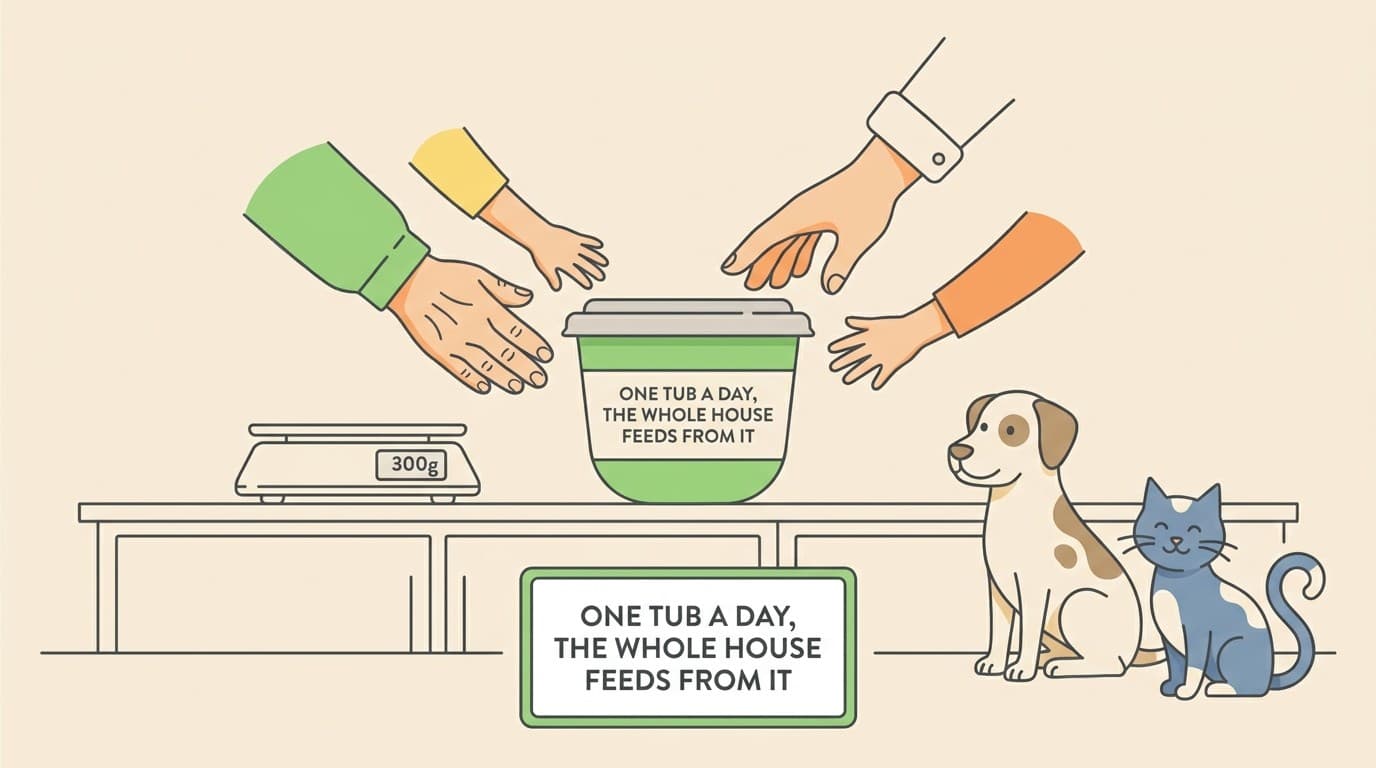
Getting the whole family (and the dog-sitter) on board
Alastair Greenway
BVM&S MRCVS
When a careful diet stalls, count the hands not the calories
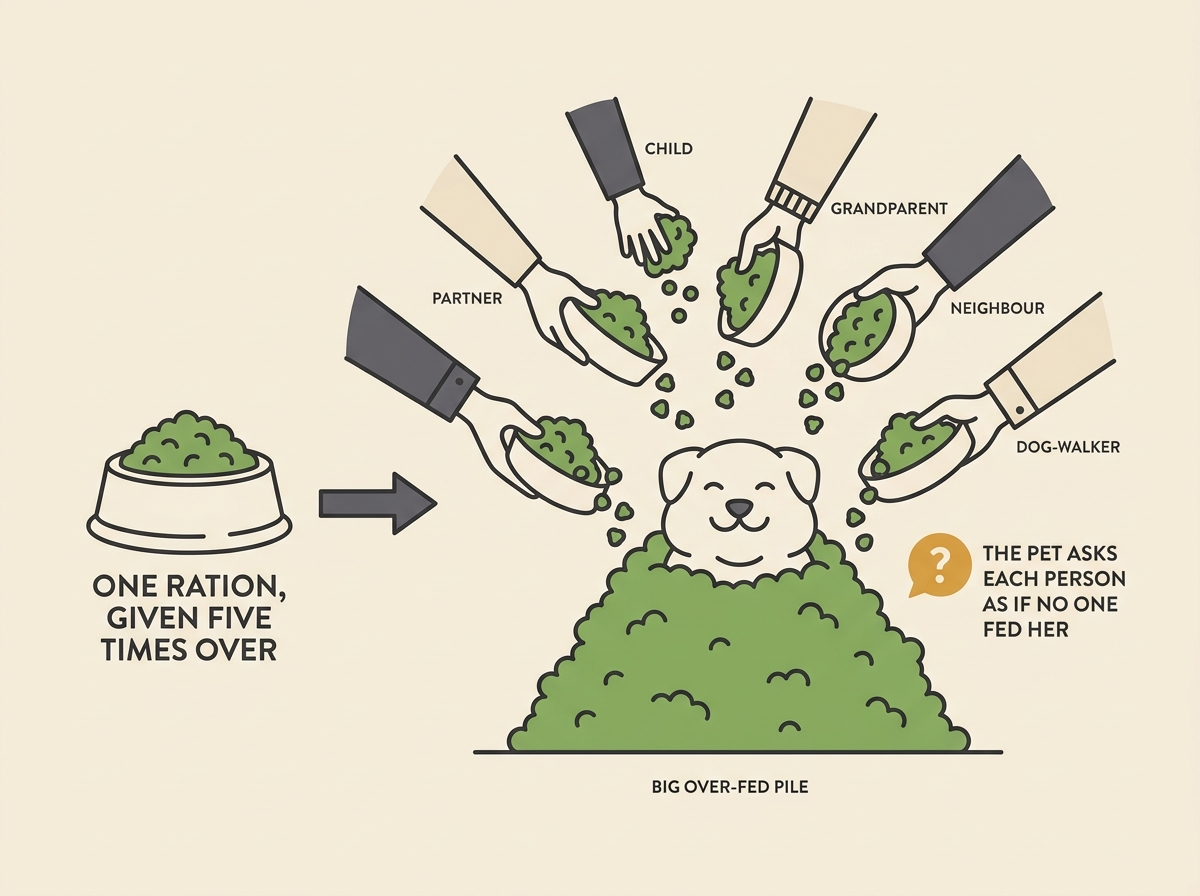
Picture a household where the food is measured, the treats are counted, everything is done by the book, and the scale still won't move. Before you blame yourself or your pet's metabolism, look at how many people are feeding her. The commonest reason a careful diet quietly stalls is much simpler than willpower or biology. The day's ration gets given, and then it gets given again. You feed the measured breakfast, your partner tops the bowl up at lunch because she "looked hungry", a child slips half a biscuit under the table, and the dog-walker hands out two of their own on the round. Each person gives a small, loving amount. Added together, it's a second dinner.
Pets are very good at this, and they're not being naughty about it. They learn, fast, that if they ask the next person as if no one has fed them all day, it often works. As VCA Animal Hospitals put it plainly, "pets are great at begging and may deceive multiple family members into feeding them, leading to overeating" (VCA Animal Hospitals). Your dog isn't lying to you. She's just found out that the household has more than one food dispenser in it.
So this isn't a chapter about willpower, and it isn't a telling-off. The diet isn't failing because you're doing it wrong. It's failing because one person can't run it alone, and right now you're trying to. Let's get everyone on the same side.
Why one person's diet is everyone's job
Here's the awkward maths. A measured ration only stays a measured ration if it's handed out once. Split that same job across three people who each "just give a little", and you've quietly served three rations. The treat budget goes the same way. We carve treats down to about 10% of the day's calories for a good reason (more on that in the treat budget), but a 10% allowance spent by four people, each thinking theirs is the only one, is most of the day gone in treats. The number on the bowl was never the problem. The number of hands was.
The reason this matters so much is that your pet doesn't know she's on a diet. She isn't going to pace herself or turn down the fifth offer of the day out of solidarity with the plan. The plan lives entirely in the humans. So if the humans aren't acting as one unit, there is no plan, there's just a hopeful idea that one person is holding and everyone else is gently undoing.
The guidance is blunt about it. VCA notes that weight-loss programmes "work especially well when all members of the family support the weight loss program and do not disrupt or overthrow it" (VCA Animal Hospitals). The Association for Pet Obesity Prevention says the same thing from the other direction: "everyone should follow the same feeding, treat, and activity plan", and "everyone needs to be aware of how much and how often they are feeding the pet during the weight-loss period" (Association for Pet Obesity Prevention). One feeder going off-script doesn't dent the plan a little. It can cancel it out completely.
None of this means appointing a single martyr who polices everyone and gets resented for it. It means the household agreeing the rules together, once, so nobody has to be the food police at all.
Pre-portion the whole day so it can't be over-given
This is the single tactic that makes everything else work, and it's almost embarrassingly simple. Each morning, measure out the pet's entire day's ration in one go, into one labelled container. A tub, a jar, a row of little bags, whatever suits your kitchen. Then every meal and every treat, for everyone in the house, comes out of that one container. When it's empty, that's it until tomorrow.
That's the whole trick, and it's so powerful because it survives the begging. You no longer have to remember who fed her, or referee whether someone "already did breakfast". The tub is the memory. As Dr Matt McCormick, DVM, describes the method, "the best method is to measure out a day's (24 hours) ration in the morning and then feed out of that container", and crucially this "allows multiple people to be involved with feeding while avoiding being tricked into providing extra food because the cat swears that someone forgot to feed them" (McCormick). Swap "cat" for "dog" and it's identical. The worst that happens is the day's food runs out a little early, not that it gets given twice.
A couple of things make it bulletproof. Weigh the ration on a kitchen scale, in grams, rather than using a scoop or a cup. This isn't fussiness, it's the only way the amount stays the same from person to person and day to day, which is the entire point of a shared system. A scoop in your partner's hand and a scoop in yours are not the same scoop, and as McCormick notes, "a 10 percent change in a quarter cup is almost impossible to do accurately by volume measure", whereas a scale is "much more accurate and repeatable" (McCormick). If you've already set the ration in the Feeding Calculator, you've got your grams. (For the why and how of weighing rather than scooping, see measure, don't scoop and how much should I actually feed.)
And carve the treats out of that same tub. Take the day's treat allowance from the ration, set it aside in the container, and let it be the only treat supply. That way a treat costs something visible, and nobody can hand out "just one more" from a separate, uncounted bag in the cupboard.
Food is love, and the grandparent problem
Now the hard part, because the obstacle here usually isn't logistics, it's feelings. In a lot of homes, feeding and treating is simply how people show they care. It's true of all of us, and it's especially true of grandparents and of children, for whom slipping the dog a treat is one of the purest little joys going. So when the plan lands as "stop feeding the dog", what people actually hear is "stop loving the dog", and they will, very sweetly, ignore you. This is real and common: in a UK survey of overweight pets' owners, 15% said they give treats because it shows how much they love their pet, and far more (29%) admitted they simply give in when their pet begs (PDSA).
This is killing them with kindness. The begging face is biology, not a love-meter. Your pet is not sad and she's not going short. She's running a very effective routine that evolved to get more food, and the genuinely loving move is the lighter, more comfortable animal who can still jump on the sofa and trot up the stairs without it hurting. That's the prize, and it's a present-tense one. Not "she'll live longer in the abstract", but "she'll move better in a few weeks". (We've written about the difference weight makes to stiff, achy joints in weight and arthritis.)
The practical version of this, the thing that actually changes a grandparent's behaviour, is to give everyone a job that isn't food. Affection needs somewhere to go, so redirect it rather than banning it. Grandad does the grooming, ten unhurried minutes of contact the dog adores. The kids are in charge of throwing the ball, refilling the water, or teaching a trick. Nobody is being told to love the pet less. They're being handed a better way to show it, one that doesn't quietly undo the week. The aim is for the household to feel like a team looking after someone together, not a regime with one enforcer and four rule-breakers.
Briefing the dog-walker, the sitter and the boarding kennel
The people outside your front door can undo a careful week in a single afternoon, simply because they don't know the plan exists. The fix is to make sure they do. Hand over a written brief, not a verbal "oh, go easy on the treats", which never survives contact with a hopeful spaniel.
Keep it concrete. Spell out the exact grams of food and when, what counts as a treat and what doesn't, the swaps you're using, and one firm line: no food from your own pocket. Most over-feeding by walkers and sitters is generous improvisation, treats they brought themselves, with no idea those calories sit on top of a careful budget. Take the guesswork away by pre-bagging their portions, the same way you'd pack a child's lunch. If the sitter has exactly the right amount in a labelled bag and nothing else is offered, there's nothing to get wrong.
For a cat, the brief carries one extra, non-negotiable line, and it's a safety line rather than a feeding one. A cat that goes off its food is not a diet that's going well, it's a cat that needs a vet. Cats who stop eating can develop a serious liver problem surprisingly fast, so the instruction to any sitter is "tell me at once if she doesn't eat", not just "feed her less". This matters enough that it's worth understanding properly before you hand a cat to anyone, and we've set it out in full in never crash-diet a cat. The headline for the sitter's card is simple: a cat that won't eat is a phone call, not a win.
If you've got more than one pet, the brief needs to cover that too, because a sitter feeding two bowls in one room is the easiest way in the world for the dieter to clean up the other one's dinner. Separate them at mealtimes, or use a microchip feeder that only opens for the right pet, and say so explicitly in the notes. (There's more on running a diet in a busy multi-pet house in feeding a dieter in a multi-pet home.)
Make it a written house rule, not a nag
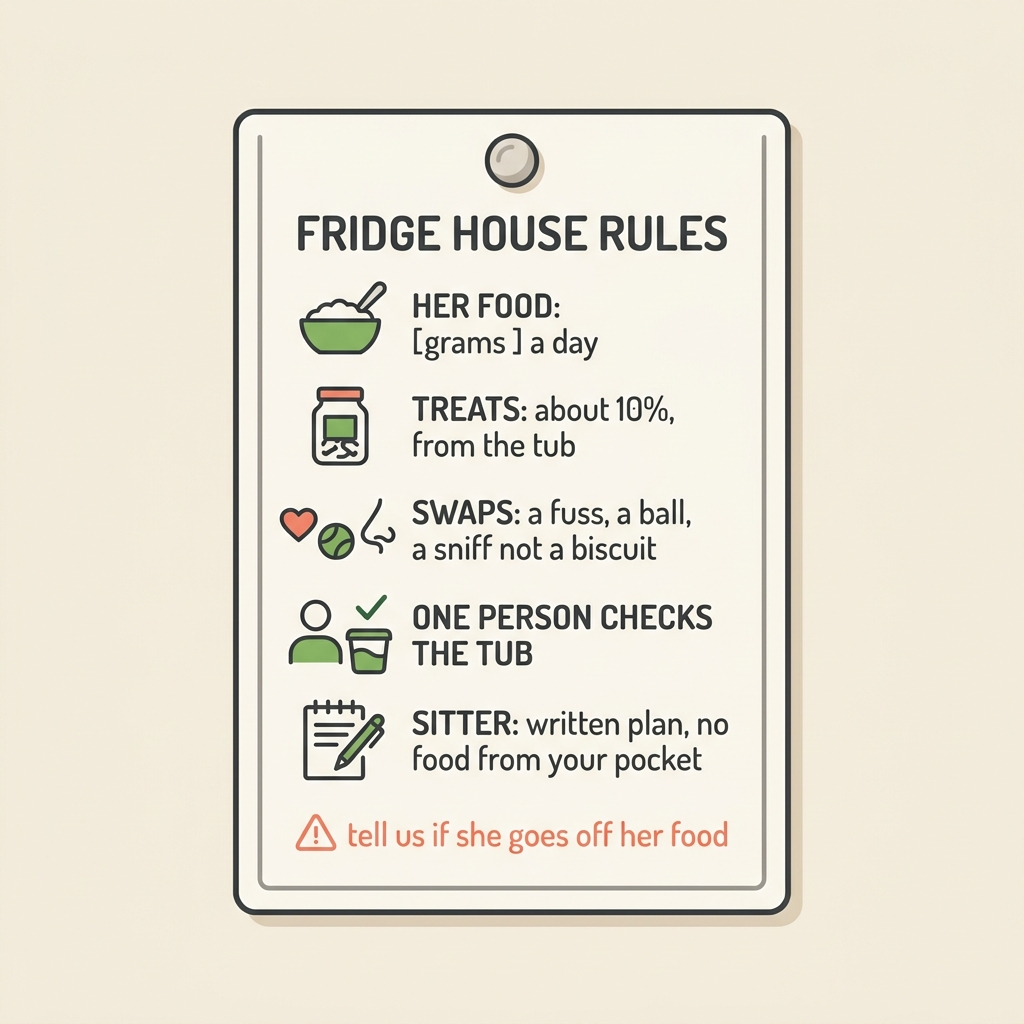
Everything above comes down to one piece of paper on the fridge, because the alternative is you reminding everyone forever, and slowly becoming the person nobody wants to feed the dog in front of. A written house rule does the nagging so you don't have to. It's also the thing the sitter reads, the thing that settles the "did you already feed her?" argument, and the thing that keeps the plan alive on the days you're not the one in the kitchen.
Write it together, not at people. Agree the ration in grams, the treat budget, the swaps you'll use instead of food, and the one-container-a-day rule, then stick it where everyone, family and visitors alike, will see it. Decide who checks the tub each evening, so there's one quiet point of truth rather than five guesses. Keep it warm. This is a shared project to make someone you all love more comfortable, not a list of bans.
When you're ready, set the ration and the treat budget in the Feeding Calculator so the grams on the fridge are the right ones, and print the house-rules and treat-swap sheet from the downloads to save yourself drawing it out. The three articles that make the card work are the treat budget for keeping treats without blowing the plan, how much should I actually feed for getting the number right, and feeding a dieter in a multi-pet home if yours is a full house. Get the household feeding as one, and the diet you've been running alone, against the odds, finally starts pulling in the same direction.
References
- VCA Animal Hospitals. Steps to Help Reduce Your Pet's Weight.
- VCA Animal Hospitals. Maintaining Weight Loss in Dogs and Cats.
- Association for Pet Obesity Prevention (APOP). Dog Weight Loss Information.
- McCormick M, DVM. How to Feed Your Cat So It Stops Begging and Starts Losing Weight. Companion Animal Clinic.
- PDSA (2021). Pet obesity paw-demic: weight gain during lockdown.
Free downloads
Companion worksheets to put what you've read into practice. Free PDFs, print at home.
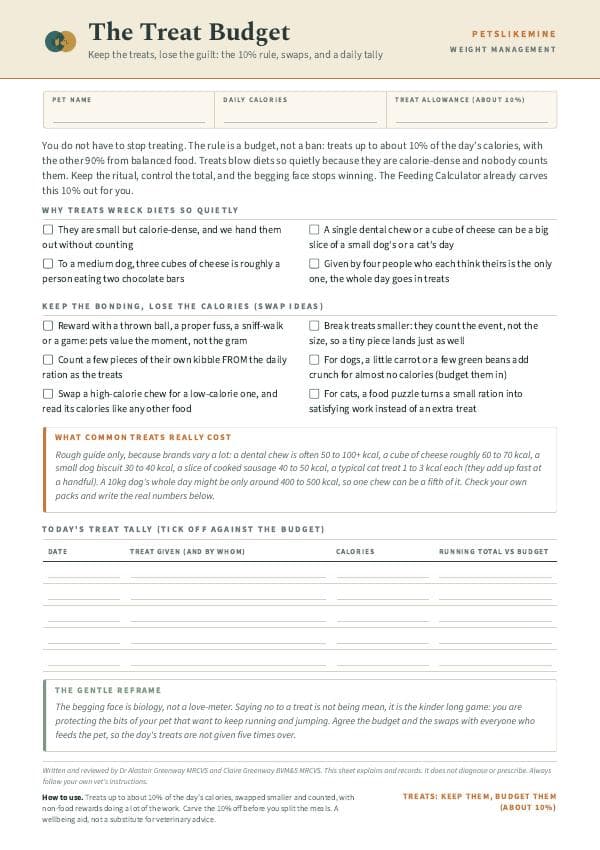
The Treat Budget
PDF · 204 KBKeep the treats without blowing the diet: the 10%-of-calories rule, treat-swap ideas, what common treats really cost in calories, and a daily treat tally.
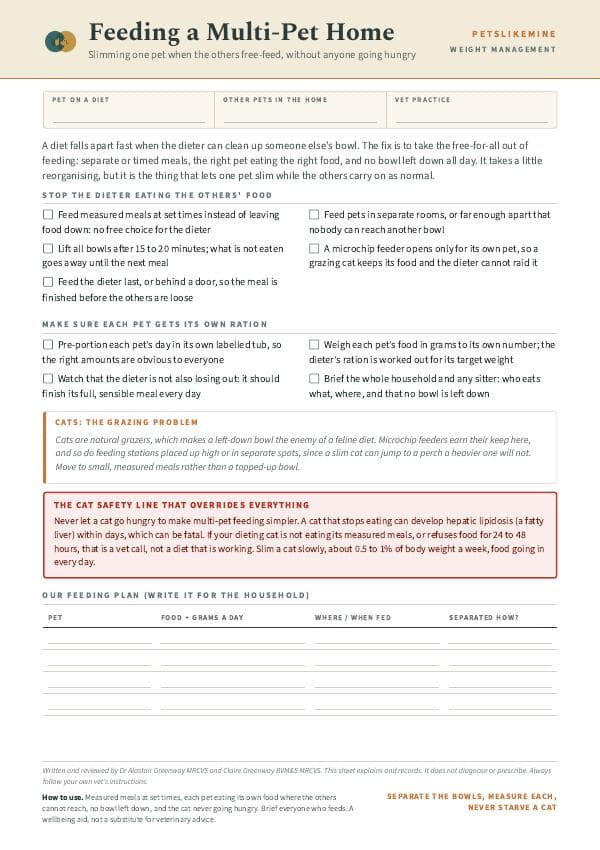
Feeding a Multi-Pet Home
PDF · 218 KBSlimming one pet when the others free-feed: separate and timed meals, microchip feeders, no bowl left down, cat-specific grazing notes, and the cat safety line.
Keep track of how your pet is doing
The owners who cope best are the ones who notice changes early. A simple health log shows you what is working, and what is not, before the next vet visit.
Start tracking, freeYou're not doing this alone
Compare treatment journeys and talk to owners managing weight management. Free to join.
Join PetsLikeMine