

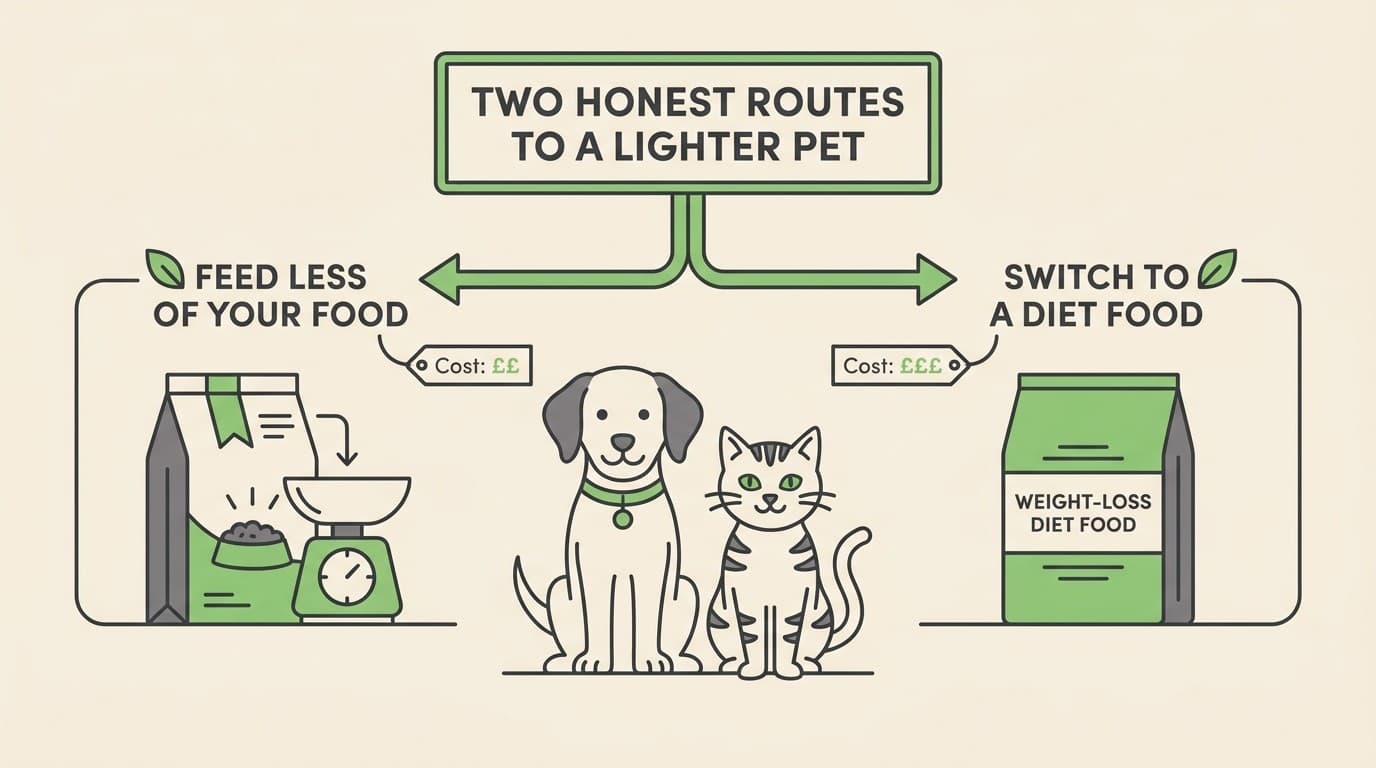
Cut back the food you have, or switch to a diet food?
Alastair Greenway
BVM&S MRCVS
So your pet needs to lose weight, and now you've hit the fork everyone hits. Do you just give less of the food you already buy, or do you go and buy a special weight-loss diet? The bags don't help. "Weight management" is splashed across half the shelf, the marketing implies you must switch, and somewhere in the back of your mind you're wondering whether cutting your pet's normal food right back is even safe.
We can give you the straight version because we don't sell food. There isn't one right answer. There are two legitimate routes, and the one that fits your pet depends on how much weight has to come off and how hungry your pet gets along the way.
Two real routes, not one right answer
Start by clearing away the false belief, because it's the one the marketing leans on. You do not have to buy a special diet to slim a pet. Plenty of pets reach their ideal weight on the food that's already in the cupboard, simply fed in the right amount. A purpose-built weight-loss diet is a genuinely useful tool for some pets and some situations, but it's one option among several, not a requirement and not the default.
Both routes work. Both are legitimate. The choice isn't about which is "proper" or which a good owner picks. It comes down to two practical things: the size of the loss you're aiming for, and how food motivated your pet is when the portions get smaller. Get those two clear and the decision more or less makes itself.
Route 1: feed less of the food you already buy
This first route is the cheapest and the simplest, and for a lot of pets it's all that's needed. If your pet is only a little over ideal, you can very often just measure and cut back the food they already eat.
This is exactly the method we lay out in how much should I actually feed and measure, don't scoop. The shape of it is short. Work out the calories your pet needs for their target weight, not the weight they are today. Convert that to grams of your current food by reading the kcal per 100g off the bag. Weigh the day's ration on a kitchen scale instead of eyeballing a scoop. Then carve out a little room for treats so they don't quietly blow the maths (that's the treat budget). If you want the calorie sums spelled out in full, the feeding maths made simple walks through them, and the portions-in-grams guide is a printable place to jot the daily grams once you've got your number.
You don't need to relearn any of the sums to do this. The Feeding Calculator does the whole conversion in about ten seconds: tell it your pet's target weight and the calories on your bag, and it hands back the grams a day. The food you own, weighed properly, fed to the target. For a mild case, that's the entire plan.
There is one real limit to this route, though, and it's worth understanding before you decide.
Where cutting a normal food too far falls down
An everyday maintenance food is balanced to be complete at a normal portion. The protein, the vitamins, the minerals are all calibrated against the amount an average pet eats in a day. That's fine when you're trimming a little. It becomes a problem when you have to cut deep.
The reason is simple arithmetic. When you reduce the portion, you reduce everything in it by the same proportion. Drop the calories by around 30% for a big loss and you drop the protein and the micronutrients by around 30% too, which can take them past the safety margin the food was built with (Today's Veterinary Practice, 2020). For a small reduction this is a non-issue, there's slack in the system. For a large deficit, or a long diet held over many months, it can leave your pet genuinely short, and a shortfall in protein in particular can cost them muscle at exactly the time you want to keep it.
This is the real, non-marketing reason a therapeutic diet sometimes earns its place (Cleary et al., 2021). Not because your pet's metabolism needs a special boost. Not because the bag says so. Simply because you cannot cut a food built for full portions down to a fraction of itself and expect it to stay complete.
Route 2: a therapeutic (weight-loss) diet, and what it actually buys you
So what does a purpose-built weight-loss diet actually do, in plain terms? Three concrete things.
First, it stays nutritionally complete on far fewer calories. It's re-fortified, meaning the protein, vitamins and minerals are concentrated up so that even a small, calorie-restricted portion still delivers a full day's nutrition (Cleary et al., 2021). That's the headline difference, and it's the thing a normal food simply can't do when you cut it hard.
Second, it's built high in protein, which helps protect muscle while your pet is in a calorie deficit. High-protein rations spare lean mass during weight loss, so more of what comes off is fat and less is the muscle you're trying to keep (Cleary et al., 2021).
Third, the high protein plus added fibre helps your pet feel fuller on less food, which is the difference between a diet you can stick to and one your pet fights you on every evening. This isn't just theory. In one study, dogs eating a high-protein, high-fibre weight-loss diet ate roughly half as much when later offered food freely, compared with dogs on diets high in only protein or only fibre (Weber et al., 2007). Fuller pet, calmer household.
Now the downsides. A therapeutic diet costs more than the food you already buy, sometimes considerably more. And most are prescription or vet-recommended, so you can't simply grab one off the supermarket shelf. Worth it for the right pet, an unnecessary expense for a pet who'd have done fine on a measured portion of their normal food.
One thing to ignore while you're shopping. You'll see diets marketed on the promise that they "boost the metabolism" so you don't need to cut portions. Be a little wary of that line. The portion is still the lever that moves the weight. A good weight-loss diet helps by keeping your pet full and complete on a smaller amount, but it works because the amount is smaller, not instead of it.
So which one? A simple way to choose
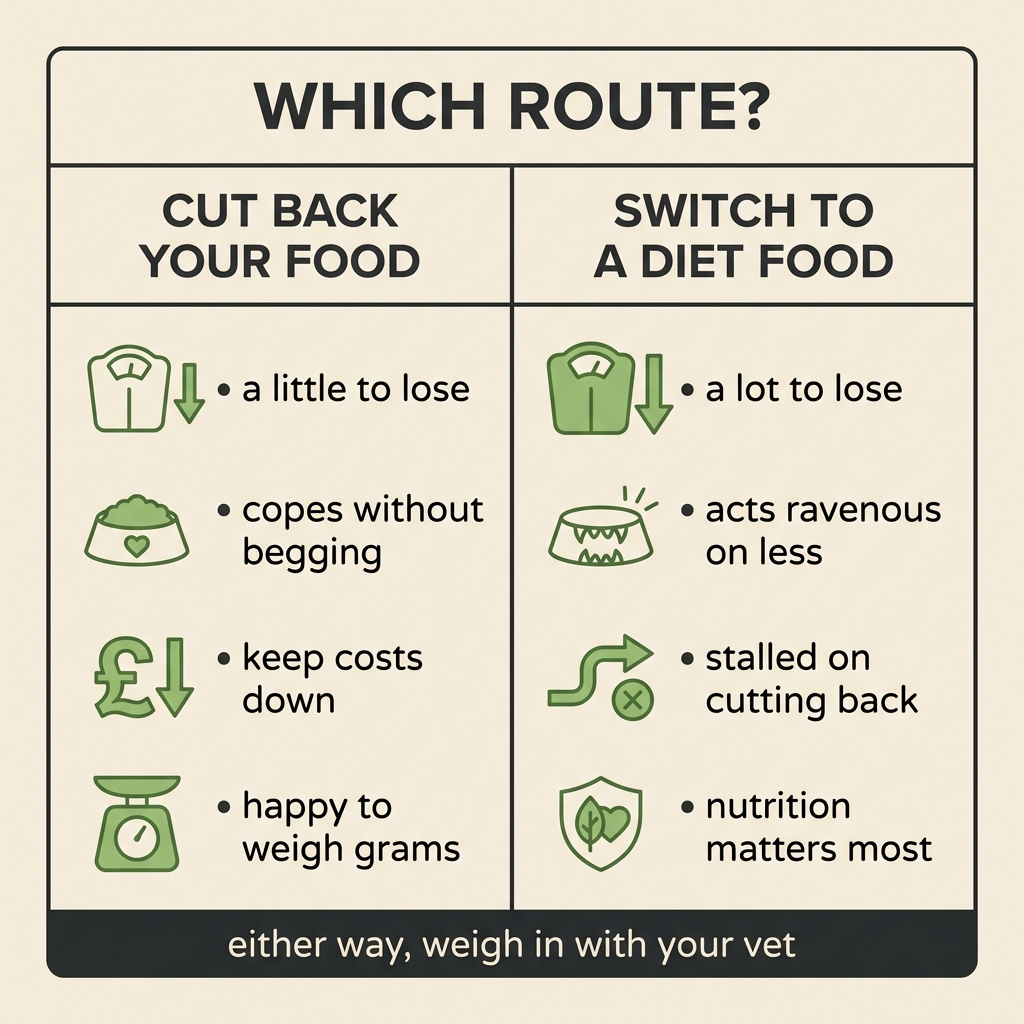
Here's the decision, made usable.
Lean towards route 1, cutting back your current food, when there's only a little to lose, your pet copes without obvious hunger, the budget matters, and you're happy to weigh portions. For a mildly overweight, easy-going pet, this is the sensible first move every time.
Lean towards route 2, a diet food, when there's a lot to come off and you need a big sustained deficit, when your pet acts starving the moment the portions shrink and the begging is wearing you both down, when you've genuinely stalled on cutting back and the scale won't move (more on that in busting a plateau), or when there's a medical reason that getting full, complete nutrition on fewer calories really matters.
You don't have to make this call alone, and you shouldn't make it once and forget it. The vet weigh-in is where to confirm the plan and adjust it, and it's the natural moment to talk through whether a diet food is worth it for your particular pet. Either route, the clinic is your checkpoint.
A note for cats: go slowly so she keeps eating
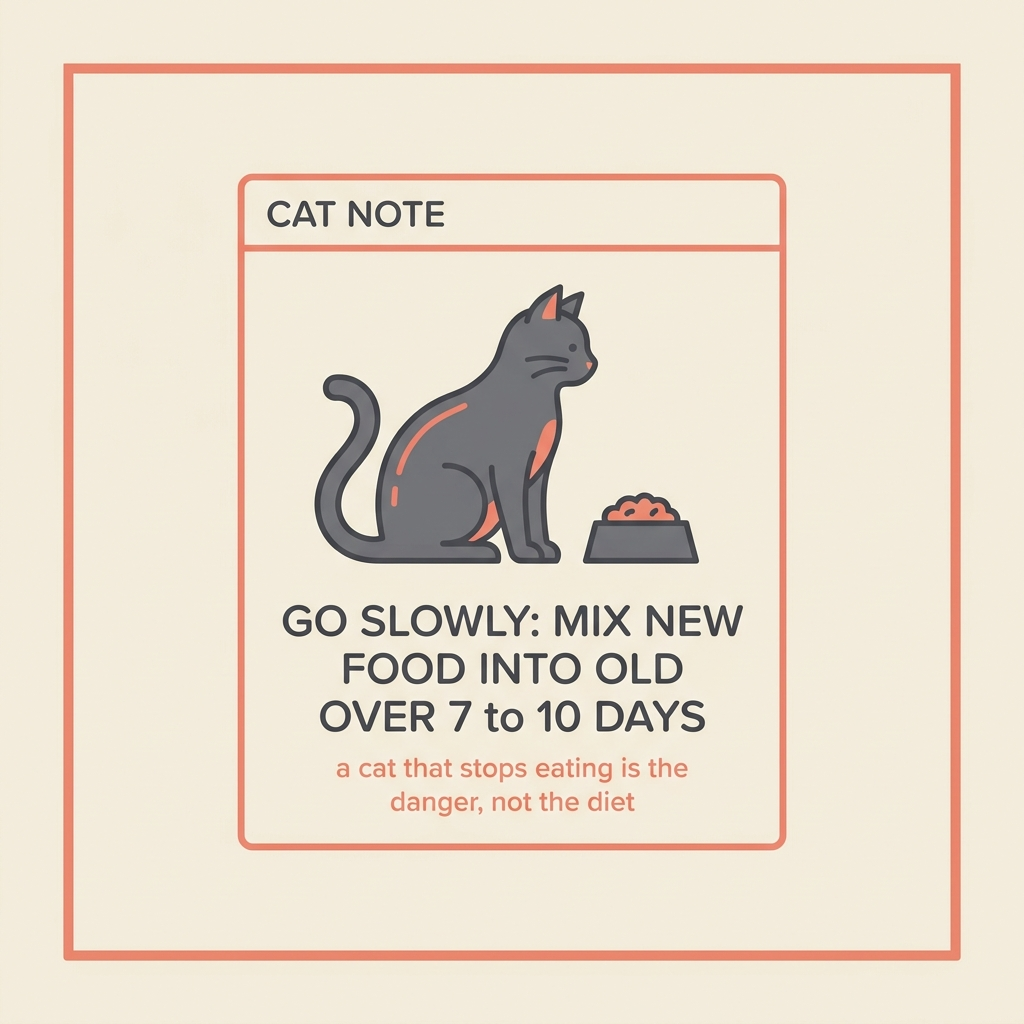
For cats, how you switch matters as much as what you switch to, and this is the one place to slow right down.
If you're moving a cat onto a new food, of either kind, do it gradually. Mix a little of the new into the old and shift the ratio over about 7 to 10 days, longer if your cat is fussy. The reason isn't fussiness for its own sake. A cat who's served something unfamiliar in one go may simply opt out and stop eating, and a cat that stops eating is the real danger here, not the diet itself.
That's the line to protect. An overweight cat who goes off food for 24 to 48 hours isn't on a successful diet, she's a cat who needs the vet, because too little food too fast can tip a cat into hepatic lipidosis, a serious fatty-liver condition. We cover the full rule and the red line in never crash-diet a cat, and it's worth reading before you start. Keep the pace gentle too: for cats, safe loss is around 0.5 to 1% of body weight a week (Cleary et al., 2021). Slow and steady, food going in every single day.
Done this way, either route is safe and it works. So pick the one you can actually stick to, the cheaper measured portion of your own food or the purpose-built diet that keeps your pet fuller, and let the Feeding Calculator work out the grams for whichever food you land on. The Healthy Weight Tracker will show you it's working from there.
References
- Today's Veterinary Practice (2020). Caloric Restriction Without Malnutrition. Today's Veterinary Practice.
- Cleary CC, Linder DE, et al. (2021). 2021 AAHA Nutrition and Weight Management Guidelines for Dogs and Cats. Journal of the American Animal Hospital Association 2021;57(4):153-178.
- Weber M, et al. (2007). A high-protein, high-fiber diet designed for weight loss improves satiety in dogs. Journal of Veterinary Internal Medicine 2007;21(6):1203-1208.
Keep track of how your pet is doing
The owners who cope best are the ones who notice changes early. A simple health log shows you what is working, and what is not, before the next vet visit.
Start tracking, freeYou're not doing this alone
Compare treatment journeys and talk to owners managing weight management. Free to join.
Join PetsLikeMine