

Losing Weight Without Trying: When Slimming Is a Warning Sign
Alastair Greenway
BVM&S MRCVS
This whole space is about helping your pet lose weight. So here's the one warning that runs the other way, and it matters more than any of the rest.
A pet getting thinner when you haven't put them on a diet is a reason to see the vet, not a result to be pleased about. It's an easy trap, especially with an older pet you'd quietly been meaning to slim. The number on the scales drops, the thought "at least it's working" arrives, and you relax a little. That bit of relief is the feeling to distrust here. Weight that comes off by itself is a clue that something's going on, and not the sign of a job done.
Weight that comes off by itself is a clue
Body weight is fairly stubborn. If you haven't cut the food, changed the diet or upped the exercise, your pet shouldn't be losing it. When the number falls anyway, the weight is going somewhere, and the body is usually telling you about a problem before anything else does.
Planned weight loss, on a diet you set, is a good thing and the whole point of the programme. Unplanned weight loss, with nothing changed at your end, is a symptom. The two look identical on the scales. What tells them apart is whether you meant to do it.
What unplanned loss can mean
So what's actually behind it? The list is specific, not "lots of things", and several of these are very treatable when they're caught early.
In cats especially, three conditions sit at the top:
- An overactive thyroid (hyperthyroidism). The classic patient is a cat over eight years old with a good appetite who's losing weight anyway (Merck Veterinary Manual). An overactive thyroid revs the metabolism up, so the cat burns through everything it eats. We'll come back to this one, because it produces the single clearest red flag of all.
- Kidney disease. Chronic kidney disease is one of the commonest serious illnesses in older cats, and weight loss is often its earliest visible sign (Freeman et al., 2016).
- Diabetes. In both cats and dogs, diabetes classically shows up as drinking more, weeing more, and losing weight, often while still eating well (Merck Veterinary Manual).
In dogs and cats alike, the wider list takes in dental pain (a sore mouth makes eating miserable), gut disease that stops food being absorbed properly, organ problems such as liver or kidney trouble, and cancer, which can strip weight off through a process called cachexia (Merck Veterinary Manual). It's a real spread, which is exactly why this is a vet visit and not a guessing game. You don't need to work out which one it is. You need someone to check.
The clearest red flag of all: eating more, but losing
If there's one pattern to commit to memory, it's this one. A pet that's eating the same as ever, or even eating more, and still losing weight is waving the brightest flag there is.
It feels back to front, which is why it's so telling. An overactive thyroid in a cat does exactly this: the cat loses weight despite a normal or increased appetite, often hungrier and more vocal than usual (Merck Veterinary Manual). Diabetes does it too, in both species: the body can't get fuel into the cells, so it burns muscle and fat while the bowl empties faster than ever (Merck Veterinary Manual). Weight coming off while your pet eats like never before is not a diet finally working. It's a reason to book the vet.
One caveat, so you read this the right way. A bigger appetite is the clearest sign, though it isn't the only one. Plenty of illnesses, including diabetes in cats as it advances, do the opposite and put a pet off its food while the weight still falls (Merck Veterinary Manual). So the rule isn't "only worry if they're eating more". It runs the other way: unplanned weight loss is worth checking whether the appetite is up, down or unchanged. Up-and-still-losing is simply the most clear-cut version of it.
When you didn't plan it: a sorting question
Here's the question to ask first, the one no listicle gives you. When you notice the weight dropping, run it through a quick self-test before you decide whether to be pleased or worried.
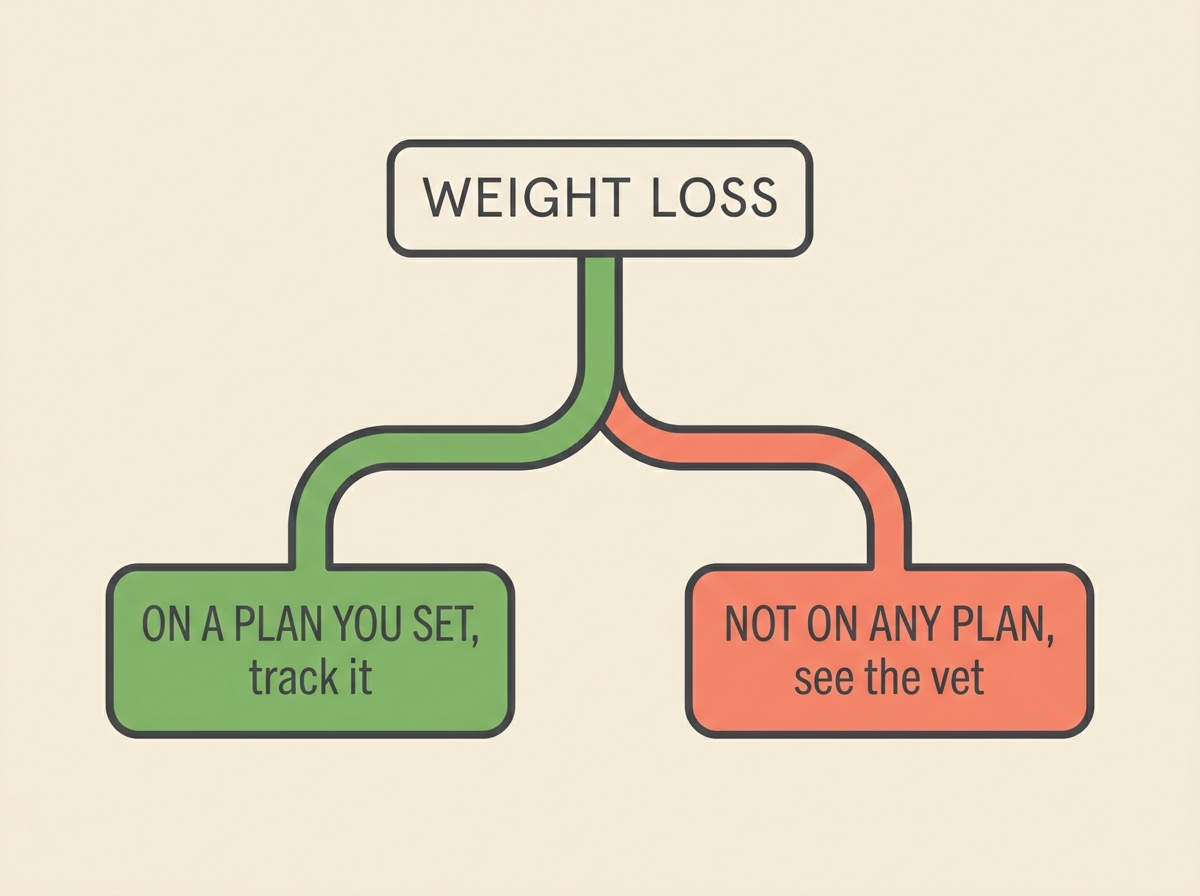
- Did you change anything? Did you cut the food, switch to a lighter diet, or get them moving more? If yes, and the loss is gradual, this is your plan working. Plot it against your target in the Healthy Weight Tracker and carry on.
- If you changed nothing, look for company. Is the appetite up, down or normal? Is there extra thirst, or more frequent or larger wees? Any vomiting, or diarrhoea? Bad breath, or a sore-looking mouth? Are they more tired, or hiding more than usual?
If you didn't plan the loss, or any of those extras are tagging along, that's your answer: get it checked. The tracker works to the same logic. Log a weigh-in that's dropping without a diet behind it and it flags the loss as unexplained, for exactly this reason.
What the vet will actually do
None of this is meant to frighten you, so it helps to know what the visit looks like. It's usually straightforward.
The vet will weigh your pet and body-condition score them against your records, looking at the trend over time rather than a single number (WSAVA Global Nutrition Committee). This is where your own weigh-ins really earn their place, because a clear before-and-after makes an early problem far easier to spot. There's a subtler version of this too: a pet can lose muscle to illness or age while the scales still read normal, which is why vets score muscle condition separately from body fat (WSAVA Global Nutrition Committee). A "normal" weight doesn't always mean nothing's changed.
Then a hands-on examination, including a proper look in the mouth, since dental pain is a common and very fixable cause. And usually some blood tests, typically checking the kidneys, the thyroid and blood glucose, which between them catch the big three at once.
Why "today, not in a month" is genuinely reassuring once you see it. Weight loss can show up before a disease is otherwise obvious. In one study of cats with chronic kidney disease, the weight loss began up to three years before the diagnosis, with the cats losing around 8.9% of their body weight in the year before they were diagnosed (Freeman et al., 2016). The authors' own conclusion was that a falling body weight may be an early warning that should prompt a closer look (Freeman et al., 2016). Caught early, many of these conditions are very treatable, and an overactive thyroid in particular is highly manageable. Early isn't alarm. Early is the good outcome.
A note for genuine dieters
One last thing, for the owners who are slimming on purpose and doing it right. Loss that's too fast is its own kind of flag. Quick isn't winning either.
The safe pace is gradual: roughly 1 to 2% of body weight a week for dogs, and a gentler 0.5 to 1% a week for cats. If your pet is dropping faster than that, ease off and look again, because rapid loss can mean the deficit is too harsh, or that something medical is driving it rather than your diet.
Cats carry the firmest line of all. An overweight cat that won't eat for 24 to 48 hours is an emergency, not a successful diet. A cat that stops eating can develop a serious liver condition called hepatic lipidosis, and the safe way to slim a cat is always slow with food going in every day. If you've a cat on a diet, Never crash-diet a cat is the one to read before you change a thing.
So that's the counterweight. In a whole space about losing weight, the loss you didn't plan is the one to act on. If your pet is slimming and you didn't set it in motion, book the vet. To understand the conditions behind a change like this, Could a health problem be behind the weight gain? covers the medical causes, and for the specific illnesses, the Hormone Health home covers overactive thyroids, the CKD space covers kidney disease, and the Diabetes space covers diabetes. If you're going the other way and aren't even sure your pet was carrying too much to begin with, Is my dog actually overweight? walks you through the at-home check. And if you'd like to keep an eye on the trend yourself, the Healthy Weight Tracker plots every weigh-in and flags a loss you didn't plan for.
References
- Merck Veterinary Manual. Diabetes Mellitus in Dogs and Cats; Hyperthyroidism in Animals; Gastrointestinal Neoplasia in Dogs and Cats. Merck & Co.
- Freeman LM, et al. (2016). Evaluation of Weight Loss Over Time in Cats with Chronic Kidney Disease. J Vet Intern Med 30(5):1661-1666.
- WSAVA Global Nutrition Committee. Global Nutrition Toolkit and Global Nutrition Guidelines (body condition score and muscle condition score). World Small Animal Veterinary Association.
Free downloads
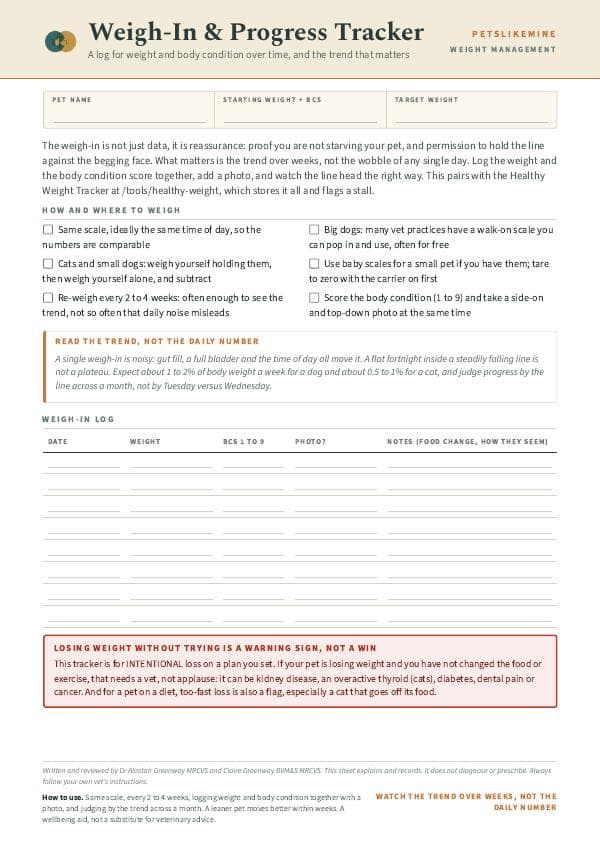
Companion worksheets to put what you've read into practice. Free PDFs, print at home.
Keep track of how your pet is doing
The owners who cope best are the ones who notice changes early. A simple health log shows you what is working, and what is not, before the next vet visit.
Start tracking, freeYou're not doing this alone
Compare treatment journeys and talk to owners managing weight management. Free to join.
Join PetsLikeMine