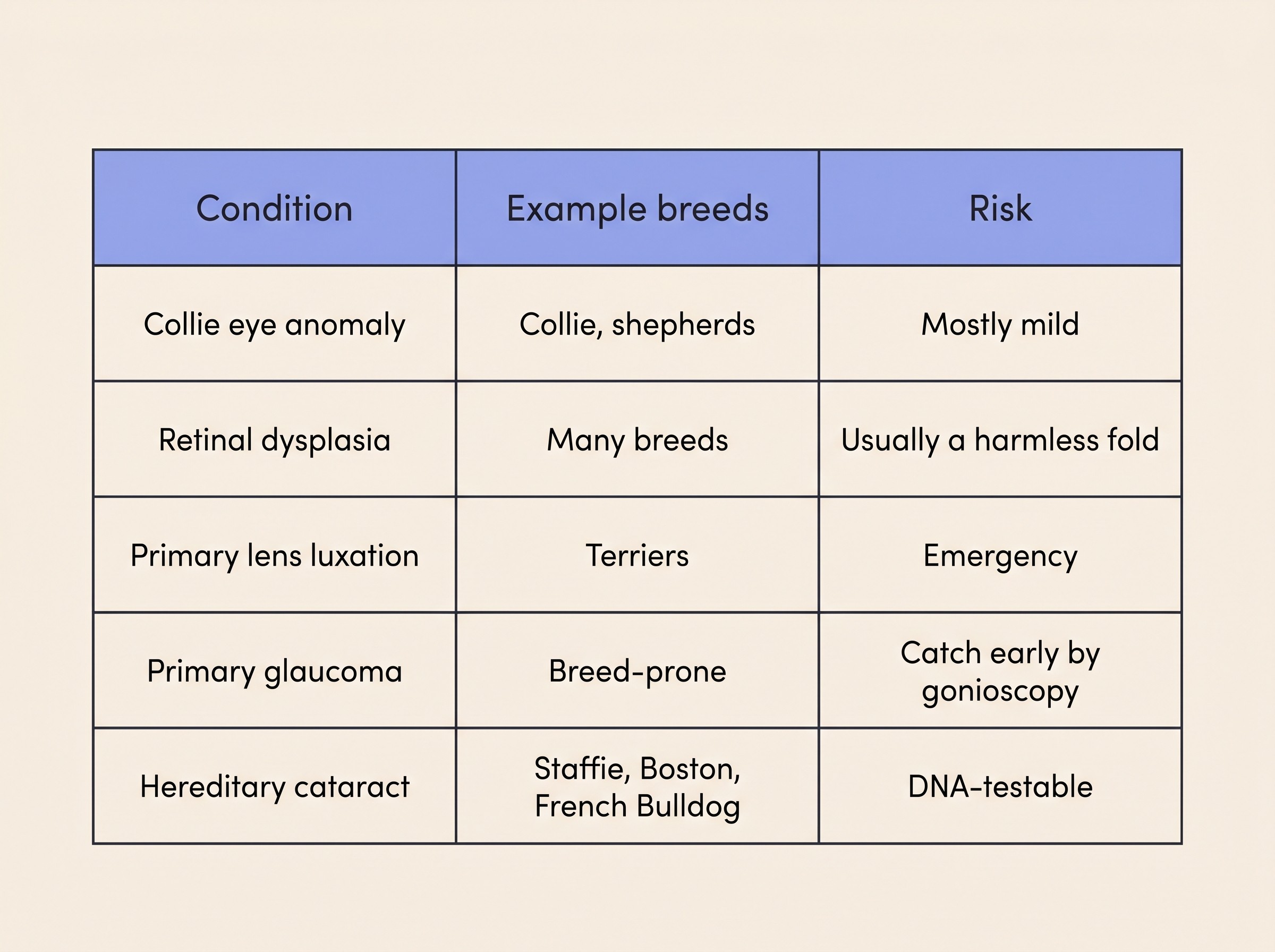
Primary lens luxation: the one emergency on this list
Read this entry carefully, because it breaks the gentle pattern of the others. A sudden, red, painful or cloudy eye in an at-risk terrier is a same-day emergency, not a wait-and-see; if that's happening as you read, use the eye-emergency triage and call a vet now.
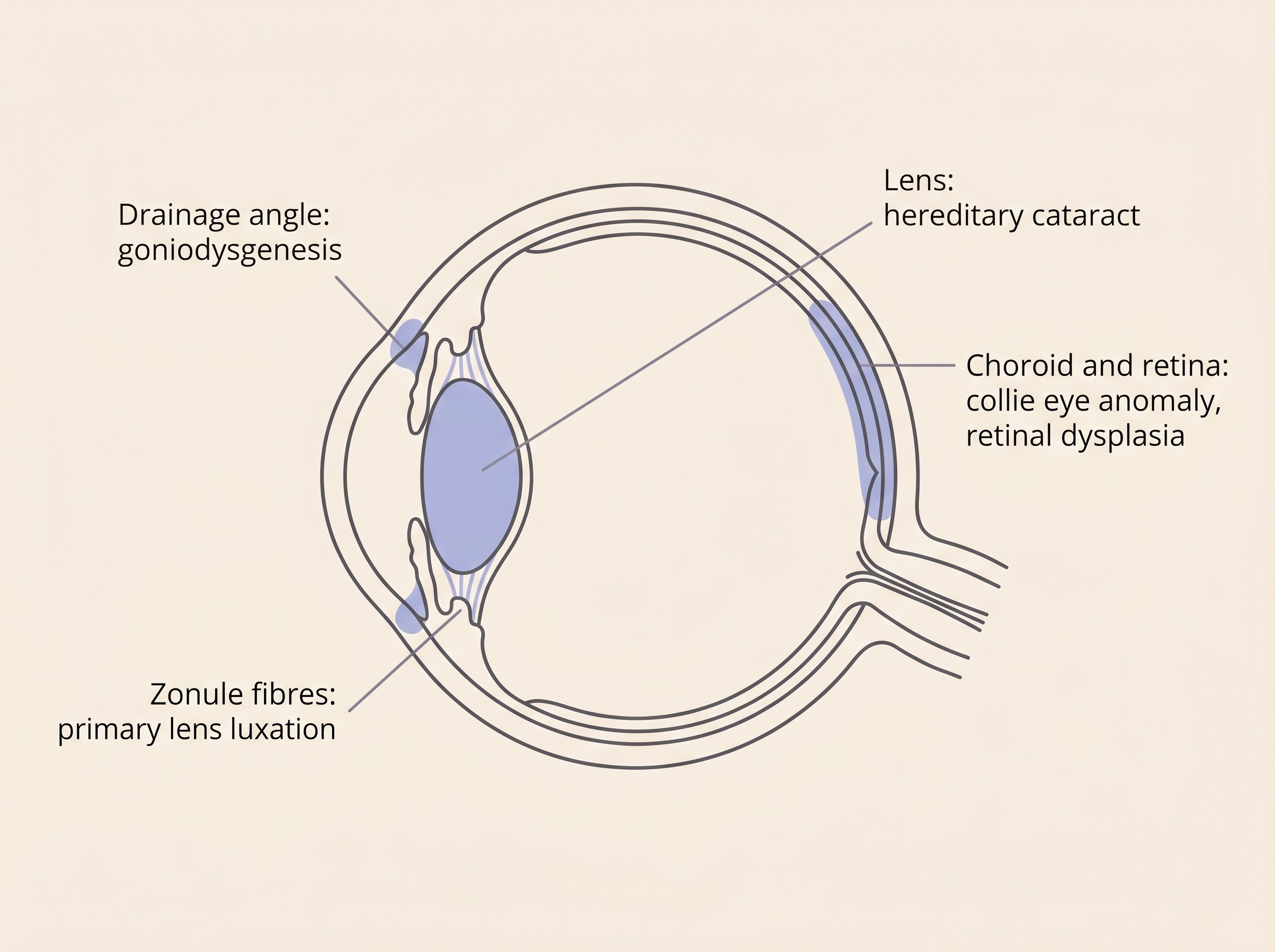
Primary lens luxation (PLL) is an inherited weakening of the zonules, the tiny fibres that hold the lens in place. When they give way the lens slips out of position, and if it drops forward it blocks fluid drainage and triggers a rapid, painful secondary glaucoma that can cause irreversible vision loss if it isn't treated quickly (CAGT, n.d.; Gould et al., 2011). It typically strikes in middle age, around three to eight years, is almost always bilateral (both eyes, often weeks to months apart), and presents as a sudden painful, cloudy, red eye (CAGT, n.d.). The mechanism is glaucoma, but the disease itself, the hours-window and the second-eye risk all belong to glaucoma in dogs; here, just hold the rule that this is the inherited condition where speed saves sight.
It's overwhelmingly a terrier story. The single recessive ADAMTS17 mutation has been found in more than a dozen additional breeds beyond the first three, most of them terriers or breeds with terrier ancestry, including the Jack Russell, Parson Russell, Miniature Bull, Lancashire Heeler, Fox, Tibetan and Yorkshire Terriers and the Chinese Crested (Farias et al., 2010; Gould et al., 2011). One important nuance: although PLL is mostly recessive, carriers with a single copy carry a small but real risk of luxating too, so a carrier of an at-risk breed isn't entirely off the hook (Gould et al., 2011). If you own one of these breeds, knowing the emergency signs is sight-saving knowledge.