


Cataracts in Cats: Less Common, Usually Secondary
Alastair Greenway
BVM&S MRCVS
The word "cataract" tends to drag a fixed picture along with it: the one you carry from people, or from a dog you once knew. A clouding eye, creeping blindness, an operation. I'd like to take that picture apart, because the feline story is genuinely different, and once you see how, the whole thing becomes far less frightening.
Two things are worth saying at the top. Cataracts are uncommon in cats, much less common than in dogs. And when a cat does develop one, it's usually a clue that something else has been going on inside the eye, most often inflammation, rather than a disease that arrives on its own. That single shift, from "my cat has a cataract" to "my cat's cataract is telling us to look for a cause", is mostly good news, because a cause you can find is often a cause you can treat. If you want the plain-English groundwork on the lens going from clear to cloudy, what a cataract actually is has it; here I'm staying feline-first.
How rare is rare?
It helps to put a number on it. In a large French referral series, an ophthalmology unit saw 2,054 cats over the study period, and only 268 had a cataract, so even among cats already referred for eye problems it turned up in around one in eight (Guyonnet et al., 2019). In the wider cat population it's rarer still, and the median age of affected cats was 9.5 years, so this is largely a condition of middle-aged and older cats (Guyonnet et al., 2019).
I mention the rarity not to wave the worry away but to frame the exam that should follow. A cloudy-looking cat eye is not automatically a cataract, and you genuinely cannot tell which it is by looking. Even as a vet I reach for a bright light and often dilate the pupil to be sure. So a cloudy eye deserves a proper look rather than a shrug or a panic. The full cloudy-eye differential, benign causes included, lives in should I worry about a cloudy eye?; here, just hold the principle that "cloudy" needs confirming, not assuming.
Most feline cataracts come second
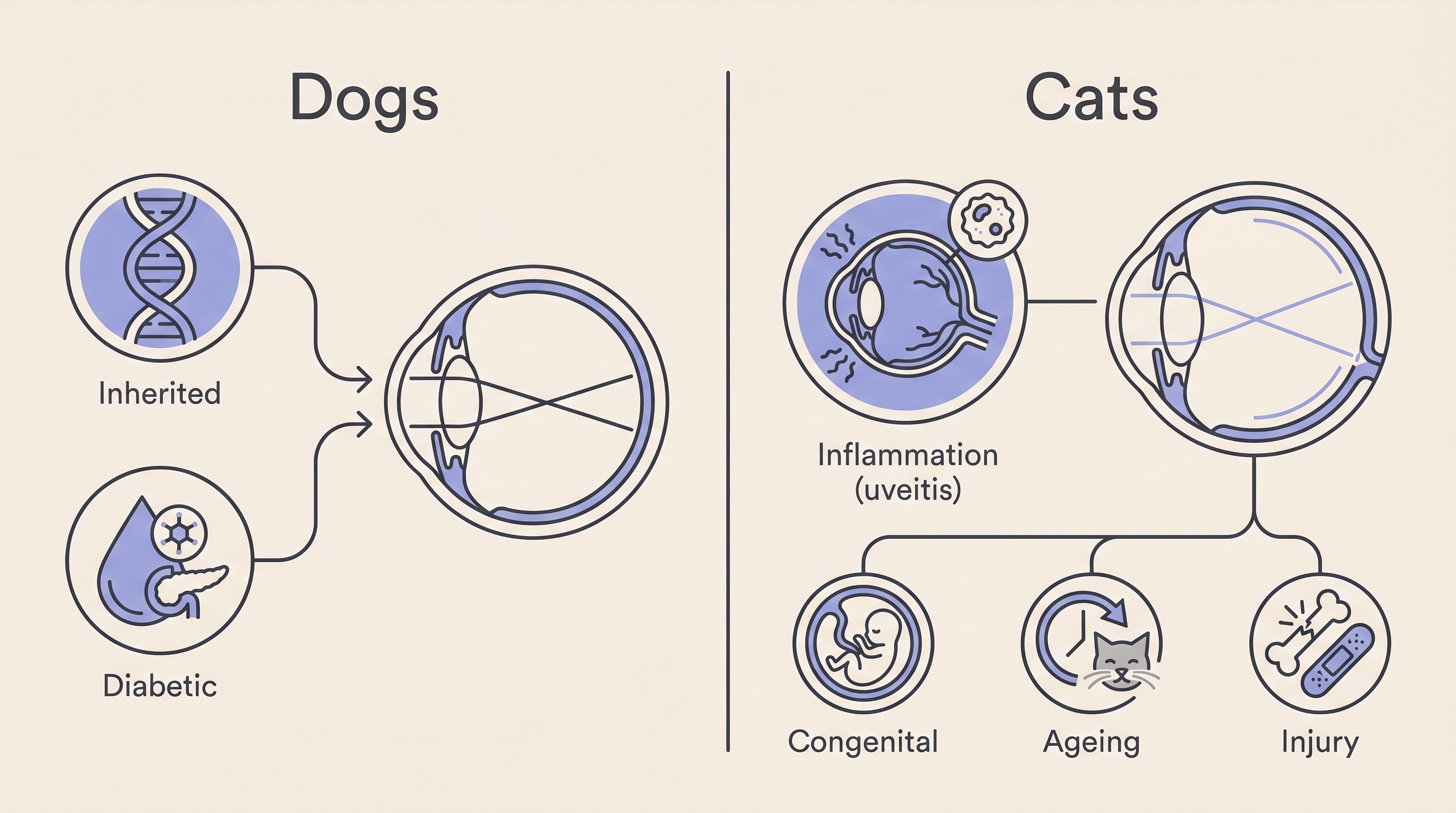
The owner-facing veterinary manuals put it almost exactly this way: unlike dogs, most cataracts in cats do not occur on their own but often result from inflammation of the front part of the eye, anterior uveitis (Merck Veterinary Manual, n.d.).
The data underneath that sentence make the same point. When the French team recorded the cause behind each cat's cataract, inflammation came out clearly on top: uveitis accounted for 35.8% of cases, then congenital 15.7%, ageing 10.8%, presumed hereditary 8.2%, trauma 7.8%, lens luxation 3.3% and glaucoma 1.5%, with the cause undetermined in 16.4% (Guyonnet et al., 2019). Notice what's barely on that list. Diabetes mellitus, the single biggest cause of cataracts in dogs, accounted for just 0.4% of feline cataracts (Guyonnet et al., 2019). I'll come back to why that's not a fluke.
So in cats, the cataract is usually downstream of something. Chronic inflammation inside the eye damages the lens over time, as inflammatory mediators diffuse across the lens capsule and drive the lens cells and fibres to degenerate (Townsend, 2008). A cat's cataract is often, in effect, a scar left by inflammation that's been smouldering for a while. In a UK study of feline uveitis, a cataract was present in a quarter of affected cats (18 of 72), grouped by the authors with other signs of chronic inflammation such as adhesions inside the eye, lens luxation, glaucoma and retinal detachment (Salih et al., 2023). When I see a cataract in a cat, part of what I'm reading is time: this has probably been going on longer than anyone noticed.
A cataract is a clue, so we hunt for the cause
If most feline cataracts grow out of inflammation, the useful question becomes "what's driving the inflammation?". That's why a cat with a cataract usually earns more than an eye exam. Because a meaningful share of feline uveitis is infectious or part of a whole-body problem, the workup typically includes blood tests and screening for specific infections, plus a look for any sign of cancer (Townsend, 2008; Salih et al., 2023; Cornell Feline Health Center, n.d.). The headline suspects are toxoplasma, feline immunodeficiency virus (FIV), feline leukaemia virus (FeLV) and feline infectious peritonitis (FIP), and Cornell's owner guidance names uveitis as the leading inflammatory cause of feline blindness, linked most often to exactly those infections (Cornell Feline Health Center, n.d.).
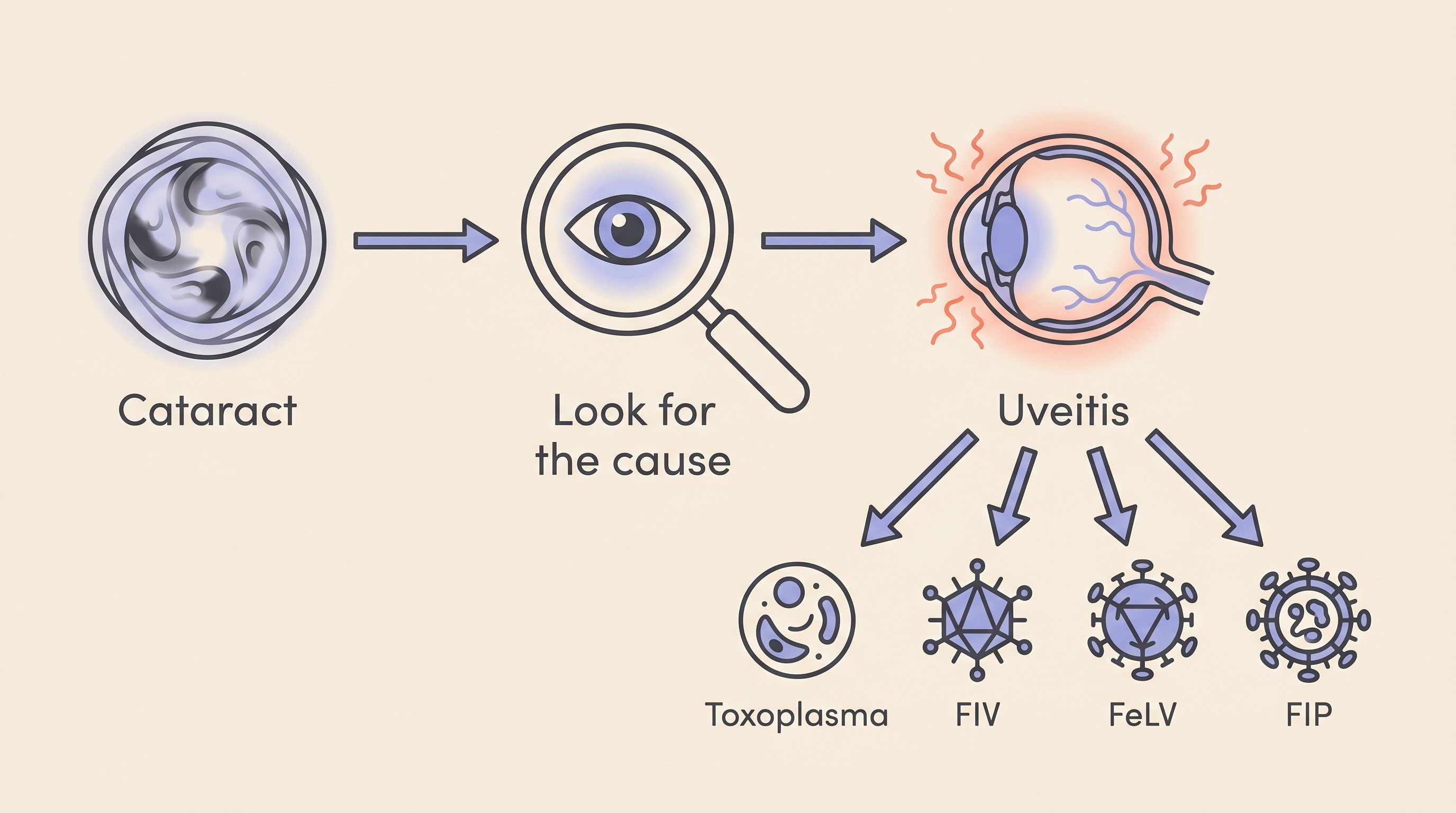
Now the part where a lot of pages go quiet. We run those tests, and very often we find nothing nameable. In the UK series, 37.5% of uveitis cases were idiopathic, meaning no cause was identified, with a further large slice inconclusive after testing; confirmed infectious causes made up under 10%, and confirmed cancer a similar share (Salih et al., 2023). Across the wider literature, somewhere around 30 to 62% of cats with uveitis have no identifiable concurrent systemic disease at all (Townsend, 2008). Read that as reassurance rather than a dead end. Drawing a blank on the infection and cancer tests usually means there's no nasty hidden disease, and we treat the inflammation itself whether or not we ever put a name to it. The depth of that workup and how the uveitis is managed belongs to the uveitis guide, so I'll send you there.
Why diabetic cataracts are a dog problem, not a cat one
That 0.4% figure deserves its explanation, because it surprises people who know a diabetic dog. In dogs, high blood sugar floods the lens, an enzyme called aldose reductase converts the excess into sorbitol, water is drawn in osmotically, and the lens clouds, which is why around 80% of diabetic dogs develop cataracts within the first year or so of diagnosis (Beam et al., 1999). Cats are largely spared, for a clean biological reason. Cats have low lens aldose reductase to begin with, and its activity is significantly lower again in the lenses of older cats than in young cats or in dogs (Richter et al., 2002). In the laboratory, lenses from cats aged four years or younger developed extensive sugar opacities when bathed in high glucose, while lenses from cats older than four did not (Richter et al., 2002). Layer onto that the timing of the disease: feline diabetes usually begins after about seven years of age, so the cats most at risk of diabetes are precisely the ones whose lenses hold the least of the enzyme that would cloud them (Richter et al., 2002). A diabetic cat is therefore far less likely to get cataracts than a diabetic dog, despite the same high blood sugars. If you've arrived from the canine side, the full diabetic-cataract story sits in diabetic cataracts in dogs.
When a cataract is more than cosmetic
I don't want to swing too far into reassurance, because a feline cataract isn't always harmless. The same complications that trouble dogs can follow in cats: in the French series, the most common associated problems were the lens slipping out of position (subluxation or luxation) in 17.8%, glaucoma in 14.9% and retinal detachment in 4.4% (Guyonnet et al., 2019). Left to its own devices, a cataract can stir up further inflammation, raise the pressure in the eye, and in the worst cases leave a blind, shrunken eye (Merck Veterinary Manual, n.d.). This is why controlling the underlying inflammation matters, and why I'd rather you knew the red flags of an eye in trouble: a red eye, squinting or holding it half-shut, rubbing at it, or an eye that suddenly looks cloudier, larger or more uncomfortable all warrant a prompt call to your vet. If glaucoma is named in your cat's case, the feline picture has its own quirks, covered in glaucoma in cats. And if you ever face the recommendation to remove a blind, painful eye, please know that's one of the kindest operations we do, not a failure, and enucleation explained walks through why.
Is surgery the answer?
Usually, no, and that's not bad news. In cats, treating the underlying cause comes first, and surgery is the exception rather than the default. Often it isn't even on the table, because the very thing that caused the cataract, active inflammation, makes the eye a poor surgical candidate. As one specialist puts it, concurrent and potentially serious intraocular disease frequently rules cataract surgery out in cats (Davis, n.d.), and cats whose cataracts followed chronic uveitis tend to have less favourable surgical outcomes (Merck Veterinary Manual, n.d.; Fenollosa-Romero et al., 2020).
Where surgery is appropriate, though, it tends to go well, arguably better than in dogs, because cats inflame less after lens surgery. In a multicentre series of 71 cats, 92.6% of eyes with a year of follow-up were visual, and 89.5% were visual at last check (Fenollosa-Romero et al., 2020). Tellingly, the cats operated on were mostly those whose cataracts came from trauma or were congenital, with only a small fraction following uveitis, precisely because uncontrolled uveitis is a contraindication, not a candidate (Fenollosa-Romero et al., 2020). So the takeaway is twofold: feline cataract surgery is uncommon and reserved for selected cats, and in those it works well. Whether your cat is one of them is a specialist judgement, and the operate-or-not decision, candidacy and cost are laid out in the cataract surgery decision.
What this means for you and your cat
So here's what it comes down to in practice. The cataract itself rarely hurts, and one in a single eye, or a partial one, often makes little difference to a cat day to day. The real job is rarely the lens. It's finding and calming the inflammation behind it, working with your vet through the cause-hunt, and watching for the red flags of a painful eye so you can act early.
And if your cat's sight is genuinely fading, hold on to this: cats are remarkable at managing reduced or lost vision, leaning on a memorised map of home, their nose, their hearing and those superb whiskers, and most settle within weeks to a few months with a good quality of life. The rule that helps most is the simplest, don't rearrange the furniture, because that map is doing a lot of quiet work. How cats adapt, and the small things that ease it, is the whole subject of living well as a blind cat, and a repeatable at-home vision check lets you track how your cat is really coping rather than guessing.
References
- Beam, S., Correa, M. T., & Davidson, M. G. (1999). A retrospective-cohort study on the development of cataracts in dogs with diabetes mellitus: 200 cases. Veterinary Ophthalmology, 2(3), 169-172.
- Cornell Feline Health Center. (n.d.). Feline vision problems: A host of possible causes. Cornell University College of Veterinary Medicine.
- Davis, R. L. (n.d.). Cataract: Feline. Animal Eye Clinic.
- Fenollosa-Romero, E., Jeanes, E., Freitas, I., Enache, A. E., Carrington, S., Sanchez, R. F., Grinwis, G., & Matas Riera, M. (2020). Outcome of phacoemulsification in 71 cats: A multicenter retrospective study (2006-2017). Veterinary Ophthalmology, 23(1), 141-147.
- Guyonnet, A., Donzel, E., Bourguet, A., & Chahory, S. (2019). Epidemiology and clinical presentation of feline cataracts in France: A retrospective study of 268 cases. Veterinary Ophthalmology, 22(2), 116-124.
- Merck Veterinary Manual. (n.d.). Disorders of the lens in cats (Cat Owner version).
- Richter, M., Guscetti, F., & Spiess, B. (2002). Aldose reductase activity and glucose-related opacities in incubated lenses from dogs and cats. American Journal of Veterinary Research, 63(11), 1591-1597.
- Salih, A., Giannikaki, S., Escanilla, N., Ioannides-Hoey, C. S. F. K., & Best, M. (2023). Etiologies of nontraumatic feline uveitis in the UK: A retrospective observational study of 72 cats. Open Veterinary Journal, 13(9), 1195-1204.
- Townsend, W. M. (2008). Canine and feline uveitis. Veterinary Clinics of North America: Small Animal Practice, 38(2), 323-346.
Keep track of how your pet is doing
The owners who cope best are the ones who notice changes early. A simple health log shows you what is working, and what is not, before the next vet visit.
Start tracking, freeYou're not doing this alone
Compare treatment journeys and talk to owners managing vision & eye health. Free to join.
Join PetsLikeMine