

Removing a Blind, Painful Eye (Enucleation): Kinder Than It Sounds
Alastair Greenway
BVM&S MRCVS
The word lands hard across the consulting table. Enucleation. Eye removal. What most owners picture is something brutal being done to a pet who's already suffering. They feel they've failed, they feel they're agreeing to a mutilation, and they're grieving the eye before it's even gone.
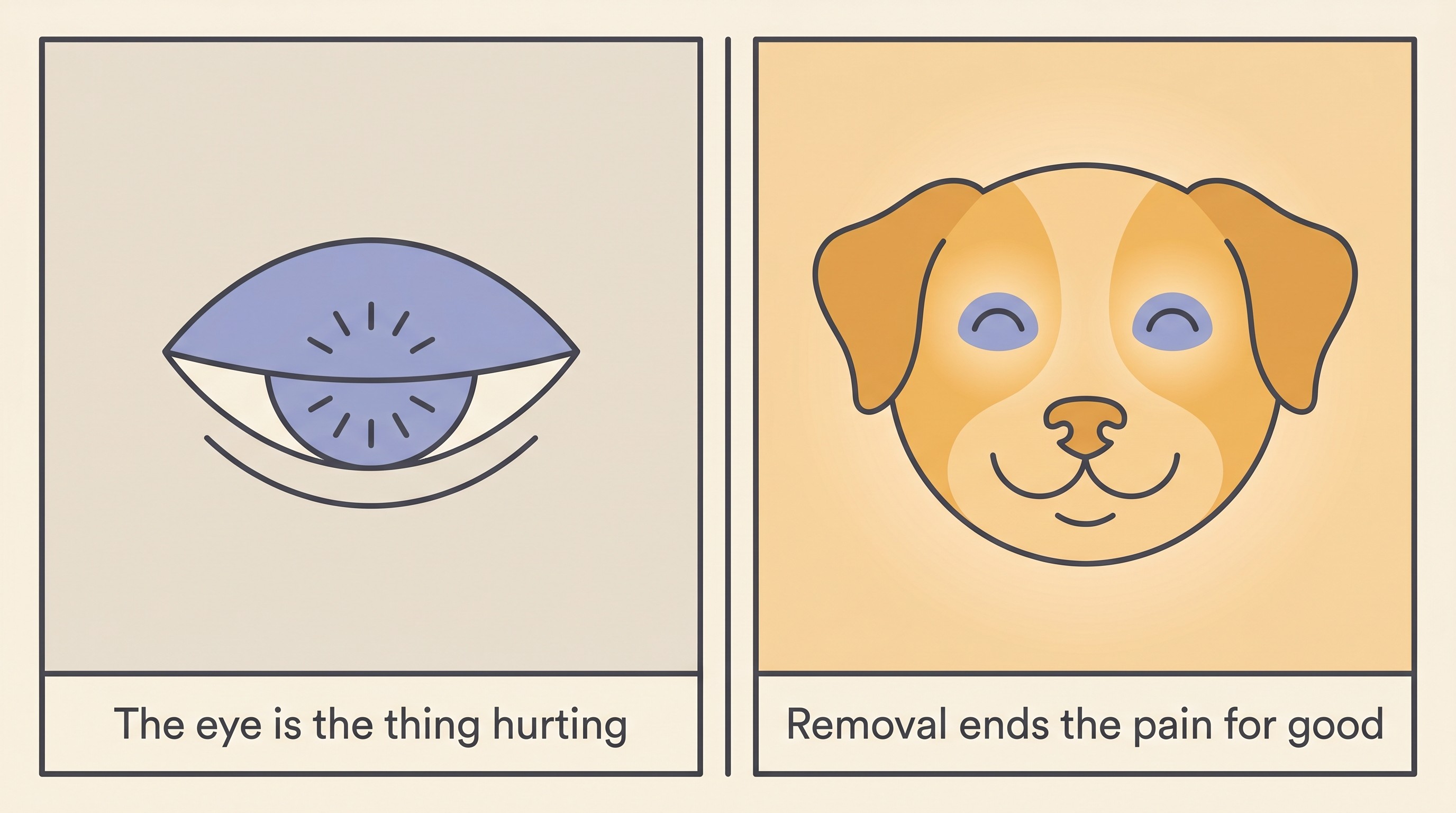
Removing a blind, painful eye is one of the kindest operations we do. The pain relief is the whole point. Pets do extraordinarily well, and the owners who dreaded it most are, again and again, the ones who ring me a week later to say they've got their pet back. This isn't running out of options. It's taking the pain away for good.
The cruelty isn't the surgery. It's the eye.
When an eye has gone blind and become painful, and it can't be saved, that eye isn't a passive, sad thing sitting quietly in your pet's face. It's actively hurting, all the time. In end-stage glaucoma especially, where the pressure inside the eye stays high, the discomfort is relentless. One UK referral centre puts it to owners in a way I find genuinely useful: the pain is often comparable to having a chronic migraine, and removing the eye relieves it (NDSR). A migraine that never lifts, with no way to tell anyone. That's the eye.
Pets don't show us that pain the way we'd expect. They don't yelp. They go quiet, they rub, they sleep more, they're a bit flat, and we mistake it for "slowing down" or "getting old". So the eye is the source of cruelty here, hour after hour, and the operation is simply what stops it (more on how pets hide that pain in spotting eye pain). The specialty's own consensus body, the American College of Veterinary Ophthalmologists, tells owners exactly that: enucleation can resolve a painful condition, and removing the eye can actually improve a pet's quality of life (ACVO, Enucleations).
Why it gets recommended, and why blindness alone isn't enough
A comfortable blind eye does not need removing. A pet can be blind in one eye, or even both, and live perfectly happily with eyes that don't hurt. The threshold is the combination: no useful vision and pain (or a diseased, dangerous or untreatable eye). As one UK clinical review puts it, only when vision loss is accompanied by ocular disease causing severe or chronic pain is a salvage procedure likely to be necessary (Mills, Lewin & Carter, 2023). Blindness by itself is not the reason. Uncontrollable pain is.
The usual reasons an eye reaches that point are end-stage glaucoma, severe injury, a deep ulcer or perforation that can't be repaired, long-standing inflammation, or a tumour inside the eye (PDSA, dogs; Mills, Lewin & Carter, 2023; ACVO, Enucleations). By a long way the commonest is glaucoma: in a two-centre UK series of dogs who had both eyes removed it accounted for 97% of those eyes (Hamzianpour et al., 2019), and in a large US series of enucleations it was the leading cause at around 69% (Palmer et al., 2021). If glaucoma is the road that's brought you here, the disease, the emergency and the at-risk breeds live in glaucoma in dogs and, for the rather different feline picture, glaucoma in cats.
There's a bridge to draw from the drops. For a long time, medication can hold glaucoma at bay, and managing that schedule is its own job, covered in managing glaucoma at home. But glaucoma pain comes from the raised pressure, and the only way to relieve it is to bring that pressure down (Miller, Clinician's Brief). When an eye is already blind and the pressure can no longer be controlled, the drops have stopped being able to do their job, and a fair suggestion to an owner is enucleation to take the discomfort away for good (Miller, Clinician's Brief).
The reassurance, and the evidence behind it
This is where the fear and the facts part company most sharply. Owners brace for regret, and the data say the opposite. It's some of the most consistent owner-outcome evidence we have anywhere in eye medicine.
In a UK study from the Royal Veterinary College of dogs who had an eye removed for glaucoma, 96% of owners were happy with their decision, and not one regretted it (Diaz Bujan, Boyd & Tetas Pont, 2021). They reported their dogs showing more normal behaviour afterwards, more themselves, with the strongest improvements by the two-month mark (Diaz Bujan, Boyd & Tetas Pont, 2021).
It holds even in the hardest case. In a UK two-centre study of dogs who had both eyes removed, and so were left fully blind, 90% of owners were satisfied and would consent again, with significant improvements in their dog's pain, their reaction to having the face touched, their activity and their overall quality of life (Hamzianpour et al., 2019). I find that especially powerful, because it answers the worst-case owner's exact fear: even with both eyes gone, the owners were glad and the dogs were better. A larger US series found much the same, with around 85% satisfied (Palmer et al., 2021). And it shows up fast: that referral centre reports animals appearing much happier within 24 hours and back to their normal selves within about five days (NDSR).
Pets don't mourn the eye the way you will
Part of what makes this so hard is that we project, imagining waking up after losing an eye and layering our own grief onto our pet. But a dog or cat doesn't experience it as we would. They lean far more on smell and hearing than on any single eye, and they simply get on with life. The PDSA puts it plainly for both species: owning a one-eyed dog isn't particularly different from owning a fully sighted one, and the same goes for cats, who adapt very well (PDSA, dogs; PDSA, cats). For a pet keeping vision in the other eye, the adjustment is usually a matter of days. One small tip carries over: approach a one-eyed pet from the seeing side, or speak to them first so they know you're there (PDSA, cats).
Your grief, though, is real, and I won't wave it away. It's completely normal to feel sad, and even guilty, about removing a part of your pet. Let it be there. What to hold onto alongside it is what nearly every owner describes afterwards: a pet who is brighter, lighter, playing again, free of a pain you may not have fully realised they were carrying.
If both eyes have come out, or are going to, your pet will be navigating without sight. That's a genuine adjustment, and one pets handle remarkably well: the first 30 days as a newly blind pet and the first 30 days blind-pet toolkit are written for exactly it. The golden rule to carry in the meantime: don't move the furniture, and talk before you touch. And if the bigger question underneath is whether your pet's life is still a good one, blind-pet quality of life meets that squarely. The short version is that removing the painful eye removes the suffering, which is usually the very thing that was tipping the balance.
What actually happens, start to finish
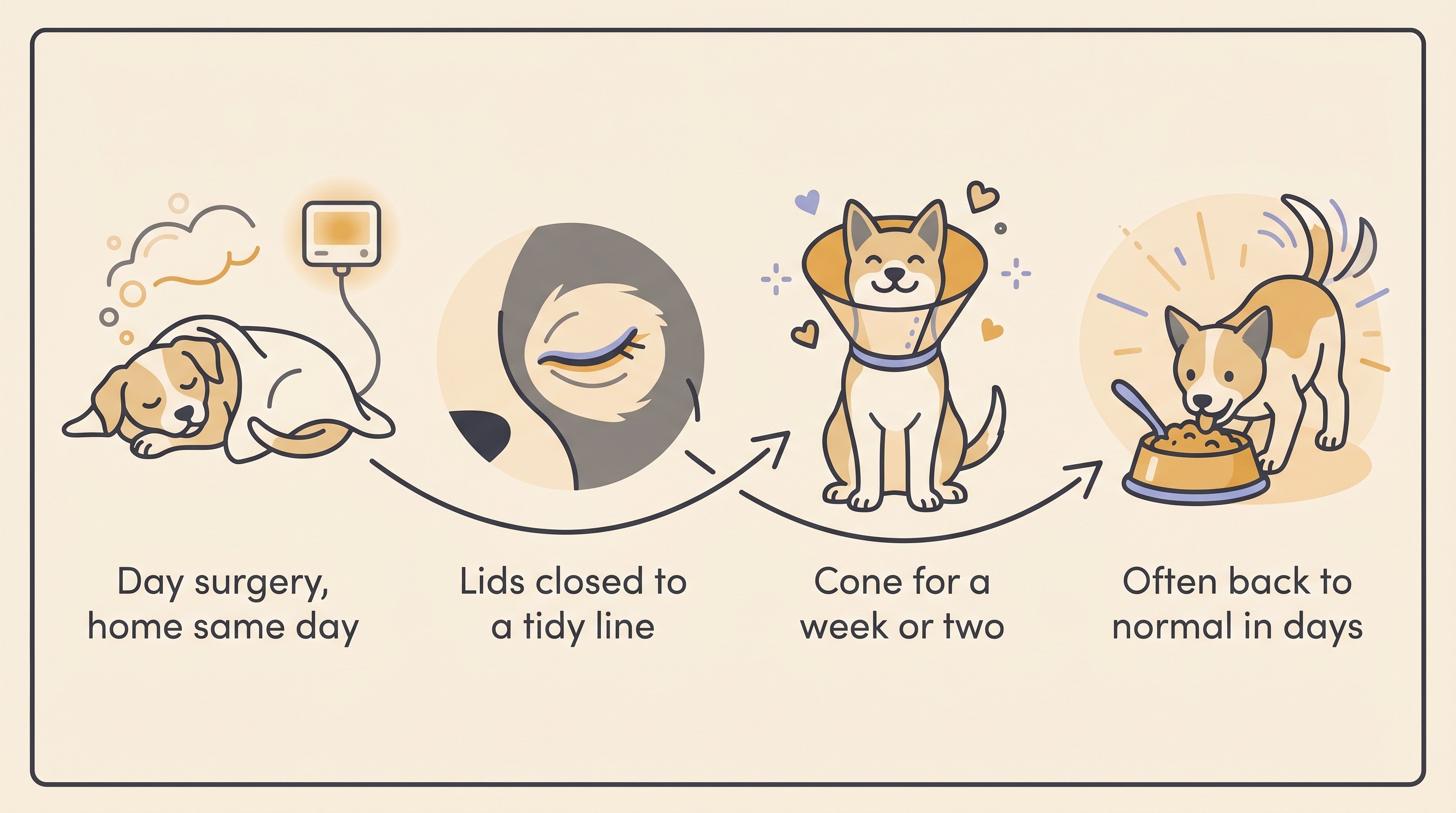
Owners almost always feel calmer once they can picture it. It's done under general anaesthetic, usually as a day case, so most pets go home the same day (NDSR; PDSA). The fur is clipped, the whole eye and the eyelids are removed, and the skin is stitched neatly closed, leaving not a glass eye but a settled line that the fur grows over (PDSA; ACVO, Enucleations). Once it has, you'll barely see the scar, and the area sinks in slightly over time, less noticeable in pets with longer hair or darker coats (PDSA, dogs; NDSR).
Your pet gets strong pain relief during and after, and any soreness at the site is short-lived, with no lasting pain there in the long term (PDSA, cats; NDSR). They'll wear a buster collar (the cone) for several days, the first three to five being the important ones, until your vet checks the wound and removes the stitches (PDSA, dogs; NDSR). And then, very often, you have your pet back within about five days (NDSR). Serious complications are uncommon: in that large US series the overall rate was around 6.5%, mostly a treatable swelling behind the eye, and diabetic dogs accounted for a noticeable share of those few (Palmer et al., 2021), so a diabetic dog is worth flagging to your vet though it doesn't change the recommendation.
Is there a way to keep the eye? (And a special note for cats)
Some owners ask, understandably, whether the eye can be kept for appearance. For some blind, painful eyes, usually those blinded by glaucoma rather than by a tumour or infection, there's a globe-sparing option called an intrascleral prosthesis: the inside of the eye is removed and a silicone sphere placed inside the eye's own outer shell, so the pet keeps a more natural-looking eye (ACVO, Ocular Prosthesis; MSD Veterinary Manual). It's an ophthalmologist's procedure, and around 98% of these eyes end up comfortable and looking reasonably normal (ACVO, Ocular Prosthesis). But be clear-eyed about the caveats: the eye stays blind, the cornea often turns cloudy or greyish so it's a cosmetic result rather than a perfect one, the complication rate is higher than for a straightforward removal, and it isn't suitable where there's a tumour, a serious infection or significant corneal disease (Mills, Lewin & Carter, 2023). Plenty of owners, given the choice, still prefer a clean enucleation: simpler, lighter aftercare, and it removes any future risk from the eye. If a more natural look matters to you, ask your ophthalmologist whether your pet's eye is a candidate.
For cats there's an extra reason this usually lands on full removal, and I'll put it gently because it sounds more alarming than it should. A chronically diseased, blind or badly injured feline eye carries a small but real risk of developing an aggressive cancer inside it over the years, so the globe-sparing cosmetic procedures are generally advised against in cats (Wood & Scott, 2019; Mills, Lewin & Carter, 2023). When your vet recommends removing a damaged cat's eye rather than saving its appearance, taking it out also takes that future risk away. It's a protective recommendation, not a frightening one.
What it costs, and what comes next
I'll be straight about money, because it's part of the decision and the PDSA doesn't dodge it either: the procedure can be expensive (PDSA, dogs). At a UK first-opinion practice a single eye removal commonly runs from a few hundred pounds up to around £800, more at a specialist centre or for a large dog, and roughly one and a half to two times that for both eyes, plus diagnostics. Those are practical, varies-by-region figures rather than a quote, and you'll always get a written estimate first. If cost is weighing on you, say so to your vet early, because there are often ways to plan for it.
The blind, painful eye is the thing that's been hurting your pet, quietly, for longer than you probably realised. Removing it is not a defeat and it isn't a mutilation. It's the single intervention that, in study after study, leaves owners glad and pets brighter within days. The call I quietly dread making, the one that asks an owner to let their pet's eye go, is so often the one that ends with them ringing back to tell me their dog is playing again. That's not the end of something. For your pet, it's the start of feeling well.
References
- People's Dispensary for Sick Animals (PDSA). Enucleation (eye removal) in dogs. Pet Health Hub.
- People's Dispensary for Sick Animals (PDSA). Eye removal (enucleation) in cats. Pet Health Hub.
- American College of Veterinary Ophthalmologists (ACVO). Enucleations. ACVO Public Resources.
- Diaz Bujan, J., Boyd, E. J., & Tetas Pont, R. (2021). Comparing the behaviour of dogs before and after enucleation due to glaucoma. Veterinary Record, 188(7), e53.
- Hamzianpour, N., Smith, K., Dawson, C., & Rhodes, M. (2019). Bilateral enucleation in dogs: a review of owner perceptions and satisfaction. Veterinary Ophthalmology, 22(5), 566-576.
- Palmer, S. V., Velloso Ramos, R., Woodoff-Leith, E. D., & Rodriguez Galarza, R. M. (2021). Causes, outcomes, and owner satisfaction of dogs undergoing enucleation with orbital implant placement. Veterinary Ophthalmology, 24(4), 346-353.
- North Downs Specialist Referrals (NDSR). Enucleation. Pet owner information sheet.
- Miller, P. E. Canine Glaucoma. Clinician's Brief.
- Mills, E., Lewin, A., & Carter, R. (2023). Ocular salvage procedure options: when is the right time to enucleate? Vet Times (UK), 5 May 2023.
- MSD/Merck Veterinary Manual. Glaucoma in Animals.
- American College of Veterinary Ophthalmologists (ACVO). Ocular Prosthesis (Evisceration). ACVO Common Conditions.
- Wood, C., & Scott, E. M. (2019). Feline ocular post-traumatic sarcomas: current understanding, treatment and monitoring. Journal of Feline Medicine and Surgery, 21(9), 835-842.
Keep track of how your pet is doing
The owners who cope best are the ones who notice changes early. A simple health log shows you what is working, and what is not, before the next vet visit.
Start tracking, freeYou're not doing this alone
Compare treatment journeys and talk to owners managing vision & eye health. Free to join.
Join PetsLikeMine