

Spotting Eye Pain in Pets: The Signs We Overlook
Alastair Greenway
BVM&S MRCVS
The eye that worries me most on the consult table is often the one that has stopped looking sore. An owner brings a dog in because they have finally noticed a slight squint, and they apologise for wasting my time. They have not wasted my time. More often than not, that quiet, half-shut eye has been hurting for days, and the pet has simply been getting on with life around it.
That should take a weight off you, because owners carry a lot of guilt about this. The eye is a recognised blind spot in pain detection, and not just for worried owners. It has been formally identified by the American Animal Hospital Association and the American Association of Feline Practitioners as a common source of overlooked pain in veterinary medicine (Eaton, 2018). So if you have ever felt you should have spotted a sore eye sooner, let that go. Pets are built to hide this, so let me hand you the tells to catch it earlier next time.
Why pets are so good at hiding it
There is a hard-wired reason your pet makes no fuss about a painful eye. Most of the animals we treat have evolved to mask "expected" pain in order to avoid predation (Eaton, 2018). An obviously hurting animal in the wild is a target, so the instinct is to carry on as normal and give nothing away.
It works distressingly well. As the American College of Veterinary Ophthalmologists puts it, most pets are stoic and do not vocalise or complain when they are in pain, and they will often continue to eat, drink, ask for walks and even play while they are uncomfortable (ACVO). That is the trap. We assume a pet that is eating and wagging feels fine, so a painful eye gets easily missed, and a treatable disease can quietly progress to irreversible vision loss while it does (ACVO). The stoicism is exactly why a sore eye is worth taking seriously the moment you spot it.
The signs you can actually see
These are the ones the ophthalmologists rely on, and the ones an owner can genuinely catch at home (ACVO).
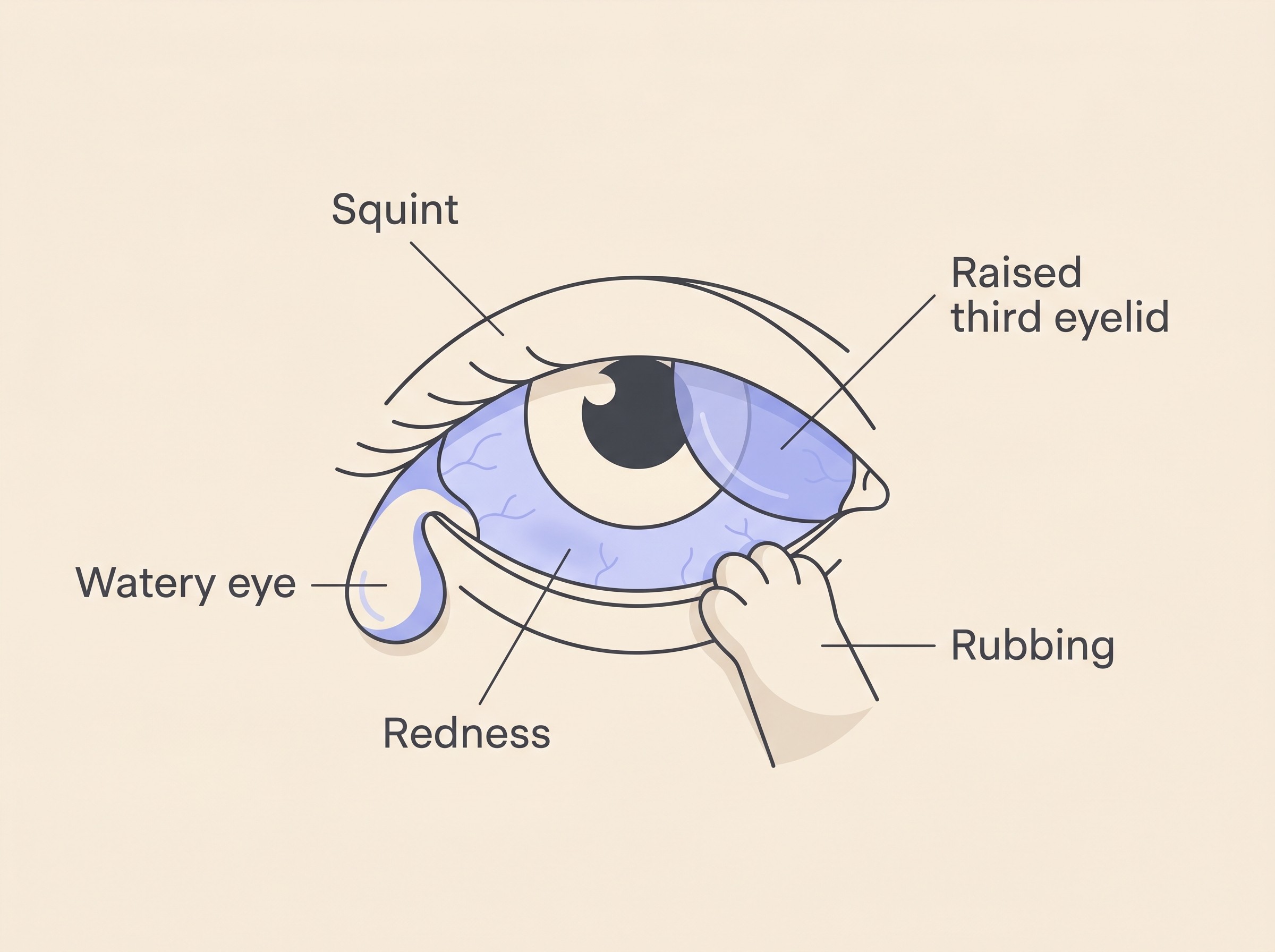
Squinting. If your pet is holding an eyelid less open than the other side, or screwing the eye fully shut, that is discomfort, plain and simple (ACVO). It has a clinical name, blepharospasm, and it is the single most useful sign on this whole list. A review of the literature in dogs found that blepharospasm is widely considered the strongest and most consistent indicator of corneal pain (Eaton, 2018). If you learn to read one thing, read the squint.
Redness. An irritated eye looks more pink or red than its partner (ACVO). The other eye is your built-in comparison, so get into the habit of looking at the pair together.
A watery or weepy eye. Excessive tearing or discharge from one eye is a flag worth heeding (ACVO).
Rubbing or pawing. A pet that keeps rubbing an eye on the carpet or pawing at its face is telling you it itches or hurts (ACVO). One caveat lives inside this sign, and I will come back to it: this behaviour is more often seen in dogs than in cats (ACVO).
A raised third eyelid. Pets have a third eyelid that normally tucks away in the inner corner. When it creeps up across a sore eye, that is not a separate problem, it is the eye flinching. Any source of ocular pain makes the eye retract deeper into the socket, and the third eyelid rises passively as it does (Merck/MSD Veterinary Manual). The membrane sliding across is the body pulling away from the pain.
If you see one or more of these, the advice from the same specialists is not to wait and watch: seek veterinary care promptly (ACVO). A markedly painful eye, especially one that is also red, cloudy or suddenly different, is a same-day problem, because when an eye is at the serious end it gives very little time. If you are unsure how urgent your particular eye is, our Eye-emergency triage and the is this an eye emergency guide will sort it for you.
When the signs don't look like eye signs at all
This is where most pain gets missed, because these tells do not look like "eye" problems. They look like a pet having an off day.
In acute glaucoma, alongside the obvious squinting and head-shyness, the quieter tells are lethargy, a reduced appetite and sleeping more, and these subtle signs of pain are easily overlooked (Reinstein, 2018). I cannot overstate how often this is the real picture. A behavioural ocular-pain study in 50 dogs found that increased lethargy was more telling as a sign of ophthalmic discomfort than a drop in appetite was (Williams and Grudzien, 2015). In other words, the withdrawn, quiet dog may be flagging eye pain before it ever goes off its food.
So widen your gaze. A pet that has become head-shy, flinches from a stroke near its face, has gone quiet or taken itself to a dark corner deserves a look at its eyes, even if the eyes seem unremarkable at a glance.
Two signs that catch everyone out
There are two genuinely counter-intuitive points here, and they are the difference between a near miss and a real one.
An eye that looks more comfortable is not always healthier. The cornea, the clear window at the front of the eye, is richly supplied with pain nerves from the ophthalmic branch of the trigeminal nerve, which is why a scratch on it can be a real source of pain (Willard and Stavinohova, 2024). The catch is that those nerves are not spread evenly. A shallow scratch on the nerve-rich surface screams, but as an ulcer erodes deeper, the eye can paradoxically appear more comfortable to the owner because of the sparsity of corneal nerves within the deeper tissue (BSAVA). That is a dangerous reassurance. A previously painful eye that has gone quiet has not necessarily got better, it may have got worse. If an eye that was clearly bothering your pet suddenly seems easier, that is a reason to be seen, not a reason to relax.
Some pets feel eye pain less, so do not wait for obvious distress. Flat-faced breeds, the brachycephalics, often have reduced corneal sensation, and they can appear less painful even with serious surface disease (Willard and Stavinohova, 2024). A calm-seeming Pug with a cloudy, weepy eye may be in more trouble than its quiet manner suggests. The same trap appears with long-standing glaucoma, where the dramatic, obviously painful eye is the sudden pressure spike, and a pressure that has been high for a long time can settle into a duller ache a dog bears more quietly. That chronic, migraine-like pressure pain, and how glaucoma presents, belong to glaucoma in dogs. The thread through both is the same: judge by the eye and the whole pet, not by how loudly your pet complains.
Cats: the hardest of all to read
If dogs are stoic, cats are something else again. They instinctively conceal pain as a survival mechanism, and owners genuinely struggle to recognise it (Merola and Mills, 2016). A cat with a sore eye rarely paws at it. It tends to retreat, go quiet and behave more cautiously instead.
That is why the feline signs are mostly behavioural. When a panel of experts built the landmark consensus on cat pain, they agreed a list of behaviours whose presence is enough on its own to signal that a cat is hurting, and two of them are about the eye: a held-closed eye and blepharospasm, with blepharospasm flagged as something any chronic eye disease can cause (Merola and Mills, 2016). A third ocular sign, a half blink, came up too, though the panel did not rank it as proof of pain by itself. The catch with this list is that no single sign is required, so you read the eye alongside the rest of the picture: a cat that is hiding, has gone off its food, has stopped grooming, or has changed in temperament. The message for cat owners is the one that saves sight: do not wait for an obvious sign. A half-shut eye in a cat that has taken itself off to a quiet room is enough to warrant a look. The feline side of glaucoma and the painful eye is covered in glaucoma in cats.
Pain and sight loss are not the same thing
One quick boundary, because two skills get muddled. This article is about a pet whose eye hurts. A separate one is about a pet that cannot see well, the bumping, the hesitating on stairs, the staying close, which lives in signs of sight loss. They are not the same thing. A painful eye may see perfectly well, and a blind eye may feel nothing at all. Reading discomfort is its own skill, and it is the one worth having, because pain is treatable on a timeline that vision often is not.
The reason spotting it always pays off
Spotting eye pain is worth it because the pain itself is fixable, whatever happens to the sight.
That holds even at the far end, even when an eye is blind and cannot be saved. Removing such an eye is most commonly advised precisely to relieve uncontrollable pain, and far from being a loss, most animals are more comfortable afterwards and appear much happier within 24 hours, with no pain at the surgical site in the long term (North Downs Specialist Referrals). In glaucoma, where the discomfort is often comparable to a chronic migraine, taking the eye away takes that migraine with it (North Downs Specialist Referrals). It is one of the kindest things we do, and it is the opposite of giving up. The decision itself, and the reassurance around it, is laid out in enucleation and eye removal.
So the next time you catch a squint, a watery eye, a raised third eyelid, or simply a pet that has gone quiet and a bit withdrawn with an eye that looks somehow off, trust it and ring your vet. You are not fussing. You are reading something your pet has spent millions of years learning to hide, and on a sore eye, catching it early is the whole game. If you want a second pair of eyes on how urgent it is, the Eye-emergency triage and the red, painful eye guide will help you decide what to do in the next hour.
References
- American College of Veterinary Ophthalmologists (ACVO). Signs of Ocular Discomfort in Your Pet. ACVO Public Resources.
- BSAVA. Common eye conditions in dogs: clinical tips (Part 1). bsava.com.
- Eaton, J. S. (2018). Pain in the Eye: Ocular Anaesthesia and Analgesia (continuing-education proceedings). J. Seth Eaton, VMD, DACVO, School of Veterinary Medicine, University of California, Davis.
- Merck/MSD Veterinary Manual. Prolapse of the Eye in Animals (third-eyelid protrusion and globe retraction with ocular pain), Ophthalmology.
- Merola, I., & Mills, D. S. (2016). Behavioural signs of pain in cats: an expert consensus. PLoS ONE, 11(2), e0150040.
- North Downs Specialist Referrals (NDSR). Enucleation: pet owner information sheet.
- Reinstein, S. (2018). Acute Glaucoma: A True Emergency. Today's Veterinary Practice.
- Willard, H., & Stavinohova, R. (2024). Corneal ulcers in dogs. Vet Times (UK), 23 July 2024.
- Williams, D., & Grudzien, A. (2015). Constructing a canine ocular pain score. BSAVA Congress Proceedings 2015. BSAVA Library, DOI 10.22233/9781910443521.ch70sec2.
Keep track of how your pet is doing
The owners who cope best are the ones who notice changes early. A simple health log shows you what is working, and what is not, before the next vet visit.
Start tracking, freeYou're not doing this alone
Compare treatment journeys and talk to owners managing vision & eye health. Free to join.
Join PetsLikeMine