

Is This an Eye Emergency? A 60-Second Check
Alastair Greenway
BVM&S MRCVS
An eye has gone cloudy, or red, or your pet is holding it half shut, or they've started bumping into the coffee table they've walked past a thousand times. Underneath whichever sign you're looking at sits one practical question: do I need to act now, or can this wait until morning? I've taken that phone call more times than I can count, often late, often from someone working hard to sound calmer than they feel. So here's the fast version first, then we'll sort the rest in about a minute.
The one-line rule: a red, painful or suddenly-blind eye is an emergency. Be seen today. Not tomorrow, not "let's see how it looks in the morning". Acute vision loss in particular is treated as an emergency by the people who fix eyes for a living, because it needs prompt evaluation to find the cause and start treatment while there's still something to save (Plummer, 2016). If your pet ticks one of those three boxes, you can stop reading and ring your vet or the out-of-hours service now. Everything below is for the less obvious cases.
Why eyes don't give you much time
This isn't me being dramatic about "today". The eye is one of the few places in the body where the serious problems are measured in hours, not days. Take acute glaucoma, where pressure suddenly builds inside the eye: it's defined as a pressure rise of less than 12 to 24 hours' duration, and if it's caught and treated in that window vision may still be salvageable (Reinstein, 2018). Miss it, and the cells at the back of the eye that carry vision to the brain, the retinal ganglion cells, start to die, and that loss is irreversible (Komáromy et al., 2019). A cruel twist sits on top of that: even when we treat in time, only about half of patients get their sight back, because the pressure often spikes silently before the obvious attack (Reinstein, 2018). That's the whole case for "today" in a few sentences.
The 60-second self-check, by sign
Run down this list against what you're actually seeing. The point isn't to diagnose, it's to sort.
Sudden vision loss. Bumping into furniture, hesitating on stairs, a wide blank stare, getting lost in a familiar room. This is an emergency, today, full stop (Plummer, 2016). One species split is worth knowing: in an older cat, sudden blindness very often means dangerously high blood pressure that has detached the retina, so the single most useful thing you can do is ask your vet to check the blood pressure today (Kern, Cornell Feline Health Center). The eye is in fact the commonest place feline high blood pressure shows itself, and is often the very reason the cat is brought in (Carter, 2019). Treated fast with a drug called amlodipine, the retina can sometimes reattach and some sight return, and recovery is best when the detachment has been there less than a week, though by the time many cats are seen it's already permanent, which is exactly why "today" matters (Carter, 2019; Kern, Cornell Feline Health Center). That journey is cat sudden blindness and blood pressure; here, just hold the flag.
Redness with pain. A red eye on its own can be minor. A red eye that also hurts is not one to sit on. The trouble is that pets are quietly stoic about eye pain: most won't cry out or stop eating, so a genuinely painful eye is easy to miss and a treatable disease can slip past while you wait (ACVO, Signs of Ocular Discomfort). The tells are squinting, a third eyelid creeping across, tearing or discharge, and rubbing or pawing at it (which dogs do more than cats), and the specialist advice is blunt: if you see one or more, seek care immediately (ACVO, Signs of Ocular Discomfort). Reading pain in a pet that can't tell you is a skill in itself, drawn out in spotting eye pain, and the question of how a red eye sorts by cause and urgency is the whole job of how urgent is a red, painful eye.
An eye that's bulging or out of its socket. Unmistakable, and a true emergency, commoner in flat-faced breeds whose shallow sockets give the eye less protection. Roughly a quarter of dogs keep useful vision afterwards, while for cats the outlook for sight is grave, so speed genuinely changes the result (Merck Veterinary Manual, 2023). While you head in: keep the eye moist with clean lubricant or sterile saline rather than tap water, stop them rubbing it, and never try to push it back yourself.
Cloudiness. Here is where I want to lower the temperature, because most cloudy eyes are not emergencies. A quiet bluish haze in both eyes of a comfortable older pet is usually nuclear sclerosis, a normal age-related change to the lens that turns up after about 8 to 10 years and doesn't meaningfully harm vision (ACVO, Cataracts vs Nuclear Sclerosis). The catch is that you can't reliably tell it from a cataract just by looking, even we dilate the pupil to be sure, so it's worth confirming once at a routine visit (ACVO, Cataracts vs Nuclear Sclerosis). What changes the urgency is the company it keeps: a cloudy eye that's also red, painful, suddenly changed, or in a diabetic dog moves up the list. The full differential is is a cloudy eye something to worry about.
A diabetic dog whose eyes are clouding over. Treat this as a "don't wait" even when the eye looks calm. Most diabetic dogs develop cataracts fast, around 80% within the first year or so of diagnosis, whatever the blood sugar control, because it's the sugar in the lens doing it rather than anything you've done wrong (Beam, Correa & Davidson, 1999). They can go from clear to blinding in days to weeks, and surgery works best on a recent cataract, so early referral beats waiting. The depth, including why cats are largely spared, is in diabetic cataracts.
One eye that's suddenly different from the other. A pupil that's a different size, an eye that looks bigger, a colour change, a new squint. Sudden asymmetry is worth a same-day call even if your pet seems comfortable, because the eye hides discomfort so well.
You'll notice there's no alarm bell here for "watery and a bit pink but otherwise happy", and that's deliberate. A mild, comfortable, both-eyes pink eye in a well pet sits at the gentle end, and it lands in the lower bands below.
Sorting what you've found into one of four bands
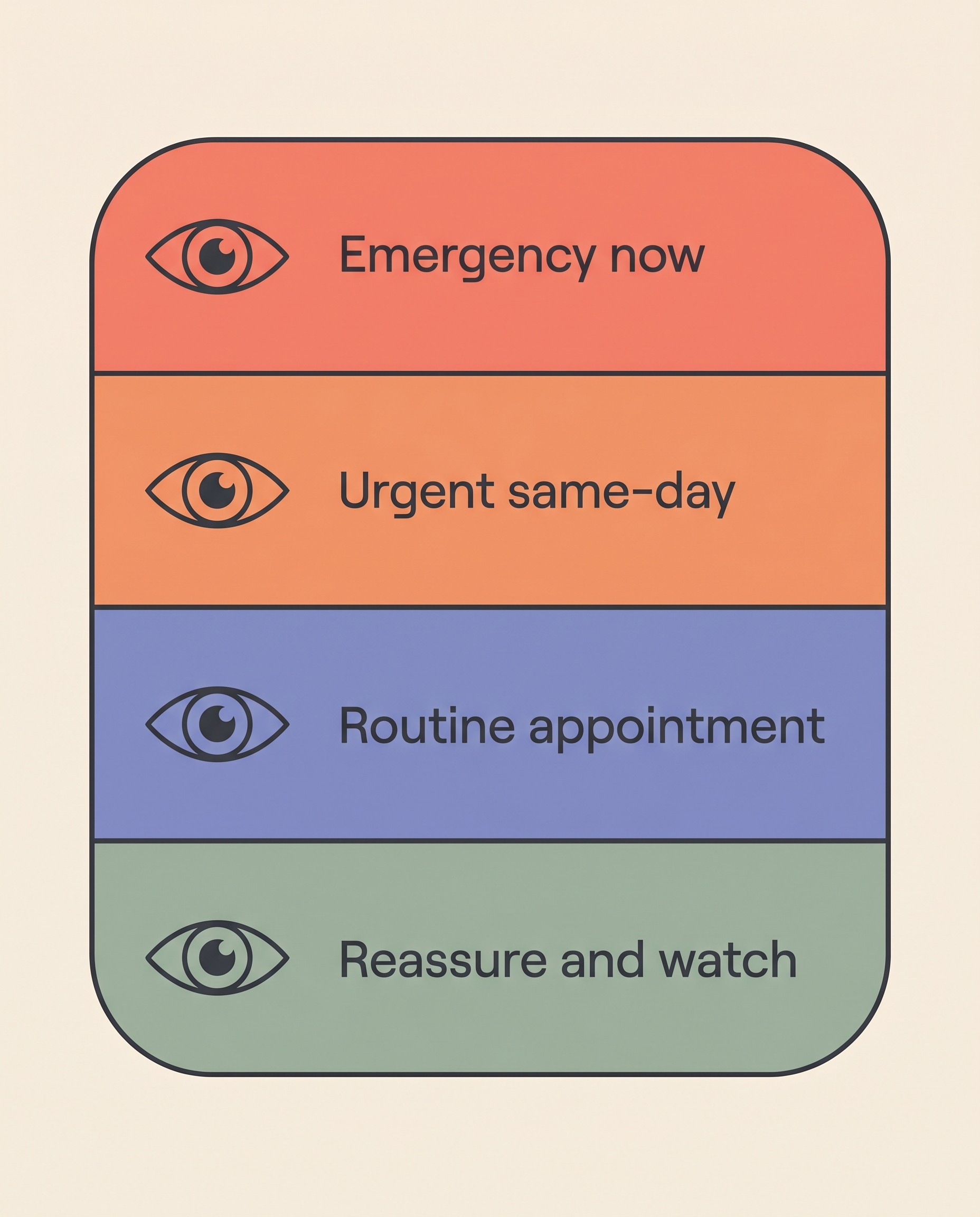
Now place what you've found into one of four bands. Most eyes land in the lower two.
Emergency now (today, ring ahead, out-of-hours if needed). Sudden vision loss; an eye out of or bulging from its socket; a red and painful eye; a cloudy and painful eye; a suddenly enlarged eye; any chemical splash or obvious penetrating injury; and a suddenly blind cat, where you specifically ask about blood pressure. These are the presentations the profession classes as urgent or emergent, from acute glaucoma to severe inflammation to a displaced lens (Plummer, 2016).
Urgent, same-day. A clearly painful eye, held shut, being rubbed, with your pet a bit flat or off their food, but without obvious vision loss; a new ulcer picture (squinting plus watering plus a dull or bluish patch on the surface); a diabetic dog whose eyes are clouding; one eye that's become suddenly different. Get seen today if you can, tomorrow morning at the latest.
Routine appointment (within a few days). A quiet, comfortable cloudy haze in an older pet with no redness or pain; a mild, comfortable, both-eyes pink eye with a little watery discharge in a well pet; a gradual, long-standing change you've only just clocked. Book it in, but you can breathe.
Reassure and keep watching. A single episode of mild watering that settles, an eye that looks and behaves completely normal again within the hour. Carry on, with one safety net: any new redness, pain, cloudiness or change in vision moves it straight up the ladder.
The eye-emergency triage tool is the interactive version of this exact 60-second check, and the eye-emergency red-flags sheet is a printable summary for the fridge or the dog-walker.
When sudden doesn't mean fixable
Here's one point that stops people making the wrong call. Not every sudden change can be reversed, and that isn't a reason to slow down. Some sudden blindness is a save-the-eye emergency, acute glaucoma or a slipped lens or a hypertensive detachment caught early. Some, like SARDS in dogs, comes on just as fast but the retina has already gone, so there's nothing to rescue (SARDS tells that story). You can't tell which is which at home, and that's the entire reason to be seen quickly: not because speed always saves the eye, but because it's the only way to find out whether this is the kind that can be. The "what do I do right now" walkthrough is sudden blindness: what to do.
While you arrange to be seen
A few practical things for the wait, and one firm don't.
The firm don't: do not reach for leftover or human eye drops, especially anything with a steroid in it. A steroid drop is genuinely dangerous on an eye with an ulcer, where it can turn a treatable scratch into a melting, sight-threatening one, and you simply can't tell at home whether a red eye has an ulcer underneath (Allbaugh, 2019). When your pet's pain isn't controlled, that's a reason to ring the vet, not to raid the medicine cupboard.
The dos are gentler. Stop the eye being rubbed, with a buster collar if you've got one. Keep your pet calm and indoors. If their vision is affected, leave the furniture exactly where it is, because a pet who can't see navigates by a memorised map and moving things pulls the rug out from under them. And if any red flag is in play, ring the practice or the out-of-hours line now rather than waiting for the surgery to open. A worried call about an eye is never a waste of anyone's time, and the difference between a good outcome and a lost eye is so often just the hours.
That's the whole sort. When you're genuinely unsure which box you're in, treat it as the more urgent one and let the vet downgrade it, because an eye exam is quick and the eye gives you so little time when it's the serious end. If you've landed here mid-worry and the eye is red, painful or your pet can't see, the next click is the phone. If it's a quiet cloudy haze in an older pet, the next click is is a cloudy eye something to worry about, and a calmer read.
References
- American College of Veterinary Ophthalmologists. Signs of Ocular Discomfort in Your Pet. ACVO Public Resources.
- American College of Veterinary Ophthalmologists (Conway, E.). (2023). Cataracts vs. Nuclear Sclerosis. ACVO Public Resources.
- Beam, S., Correa, M. T., & Davidson, M. G. (1999). A retrospective-cohort study on the development of cataracts in dogs with diabetes mellitus: 200 cases. Veterinary Ophthalmology, 2(3), 169–172.
- Carter, J. (2019). Hypertensive ocular disease in cats: a guide to fundic lesions to facilitate early diagnosis. Journal of Feline Medicine and Surgery, 21(1), 35–45.
- Kern, T. Sudden Blindness. Cornell Feline Health Center, Cornell University College of Veterinary Medicine.
- Komáromy, A. M., Bras, D., Esson, D. W., et al. (2019). The future of canine glaucoma therapy. Veterinary Ophthalmology, 22(5), 726–740.
- Allbaugh, R. A. (2019). Managing uveitis in dogs and cats. Today's Veterinary Practice.
- Merck Veterinary Manual. (2023). Proptosis in Small Animals.
- Plummer, C. E. (2016). Diagnosing acute blindness in dogs. Today's Veterinary Practice, November/December 2016.
- Reinstein, S. (2018). Acute glaucoma: a true emergency. Today's Veterinary Practice, March/April 2018.
Keep track of how your pet is doing
The owners who cope best are the ones who notice changes early. A simple health log shows you what is working, and what is not, before the next vet visit.
Start tracking, freeYou're not doing this alone
Compare treatment journeys and talk to owners managing vision & eye health. Free to join.
Join PetsLikeMine