

My Pet Suddenly Went Blind: What to Do Right Now
Alastair Greenway
BVM&S MRCVS
Here is the short version. Sudden loss of sight needs to be seen today, not at the weekend, not "if it's no better in a few days." Ring your vet or the nearest emergency clinic now and tell them your pet has suddenly gone blind. Acute vision loss in a dog is generally considered an emergency that warrants prompt evaluation, and delayed care carries a poorer outlook for sight (Plummer, 2016). The same urgency applies to cats. While you dial, our Eye-Emergency Triage walks you through the questions a vet would ask, and the eye-emergency red-flags sheet is worth a glance.
The reason for the rush is worth spelling out, because vague urgency just frightens people. Two things are at stake. First, a couple of the causes are sight-saving emergencies measured in hours, where speed genuinely changes whether vision comes back. Second, sudden blindness is sometimes the very first sign of a serious whole-body problem, high blood pressure, kidney disease, an overactive thyroid or, occasionally, something in the brain, and delayed care can hold up that diagnosis too (Plummer, 2016). So this is rarely "just an eye."
This page won't try to diagnose your pet from your sofa, and it hands the deep detail of each cause to its own guide. Right now, the useful thing is to work out roughly which fork you're on.
First, is it truly sudden, or suddenly noticed?
Give this thirty seconds of thought, because it changes how worried to be. Pets compensate for failing sight astonishingly well, leaning on a memorised map of the home plus their nose and ears, so a slow loss of vision often goes unseen until something shifts: you move the sofa, redecorate, visit somewhere new, or the room is simply dimmer than usual. A great deal of "sudden" blindness is really "suddenly noticed."
There's a behavioural tell that helps. A pet that has genuinely lost sight in the last day or two usually looks very confused, bewildered and frightened, whereas one who lost it gradually tends to seem as though it has known for a while, more relaxed, albeit blind (Cornell Feline Health Center, Sudden Blindness). Truly sudden loss is the one more likely to be an emergency with a treatable cause to catch fast, which is exactly why it shouldn't wait. The full picture of that distinction, and why it lifts a lot of guilt off owners, lives in sudden versus suddenly-noticed blindness. Either way a vet check is the right call. It's just that genuinely overnight loss is tonight's problem.
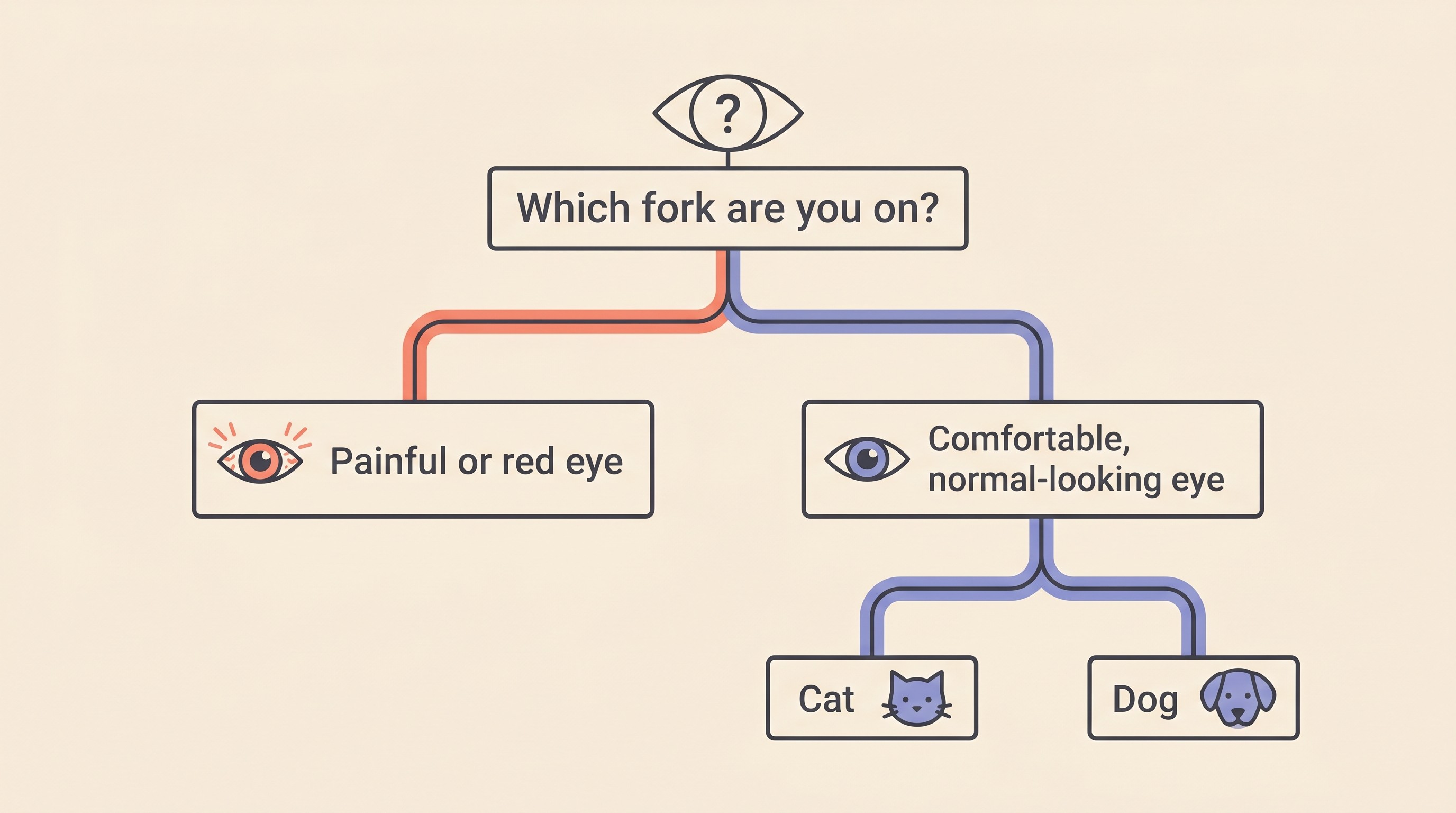
Fork one: a painful, red or cloudy eye
If the blind eye also looks red, cloudy or sore, if your pet is squinting, holding it half-shut, rubbing at it or clearly uncomfortable, treat this as a today emergency and go now. Two things sit at the front of my mind here, acute glaucoma and a dislocated lens, and both are sight-threatening emergencies where the clock is the enemy.
Glaucoma is a dangerous rise in pressure inside the eye, and acute glaucoma is considered an emergency in which the pressure should be brought down as quickly as possible (Reinstein, 2018; Thomasy, MSD Veterinary Manual, Acute Glaucoma in Small Animals, 2024). The word "quickly" is not a figure of speech: the acute phase is defined as raised pressure of less than around twelve to twenty-four hours' duration, and even when treatment starts within that window only about half of eyes regain sight (Reinstein, 2018). A dislocated, or luxated, lens can cause this directly, slipping forward and blocking the eye's drainage so the pressure spikes. A forward lens luxation is the most damaging kind and is considered an emergency precisely because it can rapidly raise the pressure, cause pain and threaten sight, and several terrier breeds and others (Jack Russells, Miniature Bull and Yorkshire Terriers, Border Collies, Shar Pei) are predisposed to it (Cornell Riney Canine Health Center, Primary Lens Luxation).
You don't need to tell these apart yourself. The action is identical for both: go today. The disease detail, the pressure figures, the treatment and the breeds at risk belong to glaucoma in dogs and, where a detached retina is in the mix, retinal detachment. Your job tonight is simply to recognise "blind and sore" and move fast.
Fork two: a comfortable, normal-looking eye
This one is trickier to read at home, because a normal-looking, pain-free eye feels reassuring and often isn't. Here the fork splits by species.
If you have a cat, ask your vet to check the blood pressure today. A cat that has suddenly gone blind, often with widely dilated pupils and a normal-looking eye, most commonly has a retina that has detached because of very high blood pressure. In cats, the eye is the most common place high blood pressure shows up, and chronic hypertension can cause the retina to detach and bleed at the back of the eye (Cornell Feline Health Center, Hypertension; Sudden Blindness). It's so common a presentation that in the landmark referral series, most affected cats, 68.1%, were referred specifically because of vision loss (Maggio et al., 2000). The hopeful part, and the reason "today" matters so much, is that caught quickly it can sometimes be reversed: the first-line medication, amlodipine, may allow the retina to reattach and some sight to return, and recovery is best if the detachment has been present for less than about a week (Cornell; Carter, 2019). Often it's sadly already permanent by the time the cat is seen, which is the argument for speed rather than a reason to lose hope. The full feline journey, why the blood pressure climbs (usually kidney disease or an overactive thyroid) and what to expect, is owned by my cat suddenly went blind: check the blood pressure, with the wider science in high blood pressure and the eyes. If your cat already has kidney disease or a thyroid problem, that link is worth reading tonight.
If you have a dog with a quiet, normal-looking eye, the usual suspects are SARDS, a detached retina, or a problem behind the eye in the optic nerve or brain. SARDS, sudden acquired retinal degeneration syndrome, causes painless loss over days to a couple of weeks, and the tell-tale part is that the eye looks entirely normal at first, so it can only be confirmed by an ophthalmologist running a specialised retinal test (Plummer, 2016; Thomasy, MSD Veterinary Manual, Acute Vision Loss in Small Animals, 2024). A cause higher up, in the optic nerve or brain, is also possible, which is why the vet checks the pupils carefully and may want to image the head.
Here I have to be straight with you. Sudden onset does not mean salvageable. With glaucoma and a fresh detachment, speed protects sight. With SARDS, the loss is permanent and there's nothing to save no matter how fast you move. Getting seen quickly is about finding out which of these it is, not because rushing can always undo it. SARDS in full, including why so many of these dogs have been thirstier, hungrier and heavier lately, lives in SARDS in dogs.
What the vet will do, and why a torch tells them so much
Knowing what's coming makes the visit less daunting. Expect a careful eye examination, a check of the pupils and their reflexes, very often a blood-pressure measurement, and usually some blood tests.
Pupils are more informative than you'd think. The pupillary light reflex is best understood as a test of the wiring, the retina and the nerve tracts, rather than of sight itself (Plummer, 2016), so it can be sluggish or absent when the problem is in the retina or optic nerve, yet look almost normal when the cause sits in the brain even though the pet genuinely can't see. That single observation, made with nothing more than a torch, steers the whole workup. If detachment or bleeding is found at the back of the eye, the blood pressure should be measured, because high pressure is a leading cause (Plummer, 2016), and the blood tests then hunt for the kidney, thyroid or adrenal disease behind it. Sometimes the eye looks normal and a specialised retinal test, an electroretinogram, is needed to separate retinal disease from an optic-nerve or brain cause and to confirm SARDS (Plummer, 2016; Thomasy, MSD, 2024). So don't be alarmed if your vet mentions referral to an ophthalmologist. That's thoroughness, not bad news in itself.
Getting through the wait safely
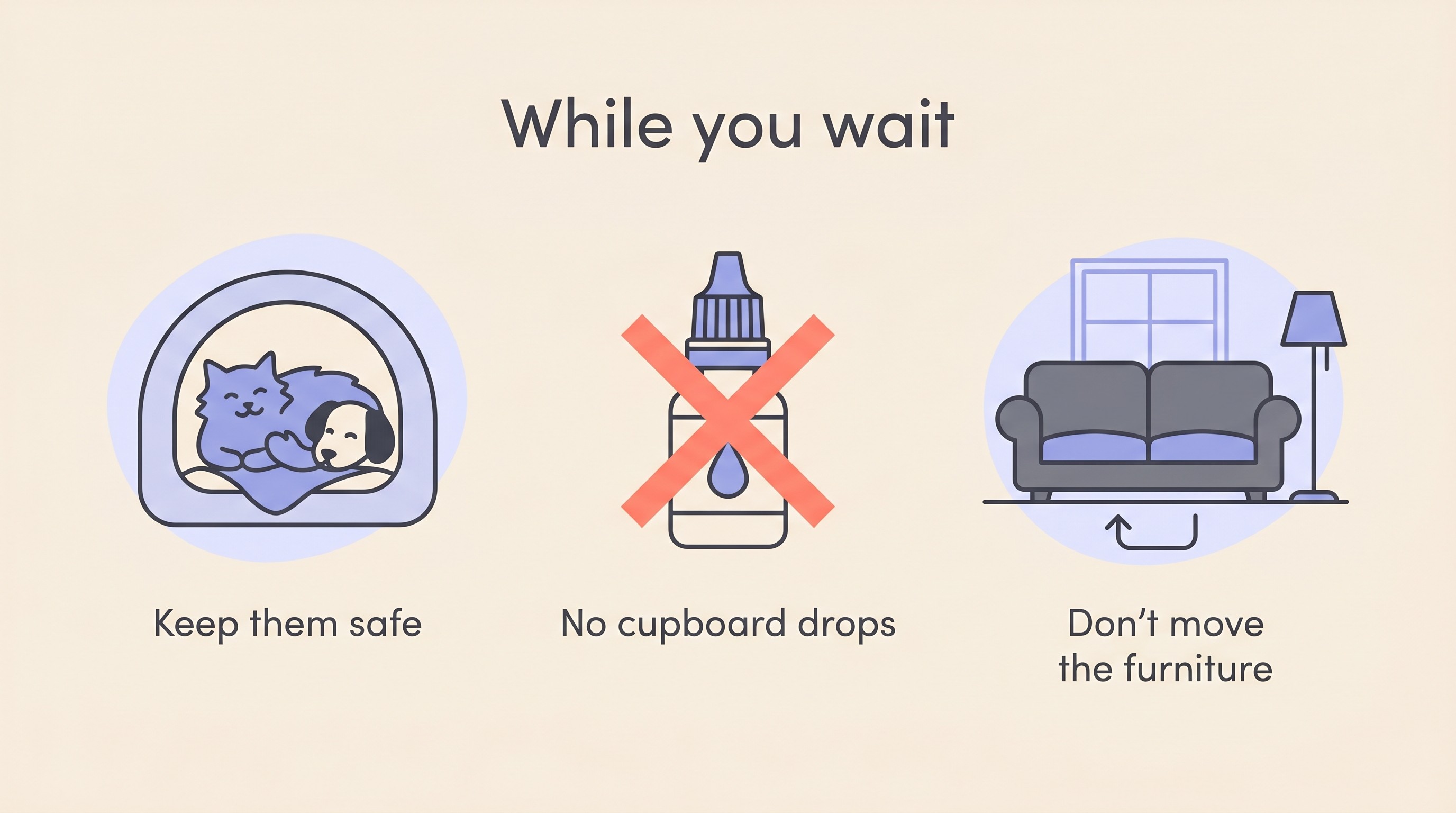
Whether you're waiting for the morning or an hour for the emergency clinic, three simple rules carry you through.
Keep them safe and confined. Settle your pet in a calm, supervised space without stairs, ponds, sharp corners or things to fall from. There's nothing clever about it, just plain common sense: a newly blind pet is disoriented and frightened, and the kindest thing you can offer right now is a small, safe world and a familiar voice. Make a little sound as you approach so you don't startle a pet who can no longer see you coming (Donohue, Texas A&M VMBS, 2025).
Do not reach for any eye drops from the cupboard. This one matters more than people realise. Leftover or human eye drops can make the exact emergencies you're worried about worse. Topical steroid drops are dangerous on an undiagnosed eye because they inhibit the surface healing and can augment the enzyme activity that makes a corneal ulcer "melt," sometimes within a day (MSD Veterinary Manual, Anti-inflammatory Agents in Animals). Even the proper glaucoma drops aren't universally safe: the prostaglandin type should be avoided when glaucoma is caused by a dislocated lens or severe inflammation (Reinstein, 2018). The right drop depends entirely on the diagnosis, which is a job for your vet, not the medicine drawer.
Don't move the furniture. Your pet navigates by a memorised mental map, so rearranging the room out of a wish to help is the worst thing you can do (Donohue, Texas A&M, 2025). Keep the layout, the bowls and the beds exactly where they are, and get the whole household into the habit of speaking before they touch, especially when the pet is asleep, so nobody startles an animal that can no longer see them coming. That "talk before you touch" habit, and the fuller home setup, is owned by home-proofing a blind pet, but those two reflexes will see you through tonight.
What comes after the panic
But that's the next chapter, and you're not there yet. Tonight has one small, concrete job: get your pet seen. Make the call, run the Eye-Emergency Triage if you want a steadier sense of how urgent it is, work out which fork you're likely on (a sore eye, a cat needing its blood pressure checked, or a quiet eye in a dog), and follow the right link above. When the diagnosis is in, the emotional arc of those first weeks, the dip, the timeline, the things that help, is waiting in a newly blind pet: the first 30 days. For now, breathe, keep them safe, and pick up the phone. That's the right first move, and it's enough.
References
- Carter J. Hypertensive ocular disease in cats: a guide to fundic lesions to facilitate early diagnosis. Journal of Feline Medicine and Surgery. 2019;21(1):35-45.
- Cornell University College of Veterinary Medicine, Cornell Feline Health Center. Hypertension.
- Cornell University College of Veterinary Medicine, Cornell Feline Health Center. Sudden Blindness.
- Cornell University College of Veterinary Medicine, Riney Canine Health Center. Primary Lens Luxation.
- Maggio F, DeFrancesco TC, Atkins CE, Pizzirani S, Gilger BC, Davidson MG. Ocular lesions associated with systemic hypertension in cats: 69 cases (1985-1998). Journal of the American Veterinary Medical Association. 2000;217(5):695-702.
- MSD/Merck Veterinary Manual (Professional). Anti-inflammatory Agents in Animals (Systemic Pharmacotherapeutics of the Eye).
- Plummer CE. Diagnosing Acute Blindness in Dogs. Today's Veterinary Practice. 18 October 2016.
- Reinstein SL. Acute Glaucoma: A True Emergency. Today's Veterinary Practice. 31 January 2018.
- Stuckey JA, Pearce JW, Giuliano EA, et al. Long-term outcome of sudden acquired retinal degeneration syndrome in dogs. Journal of the American Veterinary Medical Association. 2013;243(10):1425-1431.
- Texas A&M College of Veterinary Medicine & Biomedical Sciences (VMBS News, Pet Talk), featuring Donohue L. Seeing The Bright Side: Helping Pets Adjust To Vision Loss. 4 September 2025.
- Thomasy SM. Acute Glaucoma in Small Animals. MSD/Merck Veterinary Manual (Professional), Ophthalmic Emergencies in Small Animals. 2024.
- Thomasy SM (rev. Carnevale J). Acute Vision Loss in Small Animals. MSD/Merck Veterinary Manual (Professional), Ophthalmic Emergencies in Small Animals. Modified July 2024.
Keep track of how your pet is doing
The owners who cope best are the ones who notice changes early. A simple health log shows you what is working, and what is not, before the next vet visit.
Start tracking, freeYou're not doing this alone
Compare treatment journeys and talk to owners managing vision & eye health. Free to join.
Join PetsLikeMine