

My Cat Suddenly Went Blind: Check the Blood Pressure
Alastair Greenway
BVM&S MRCVS
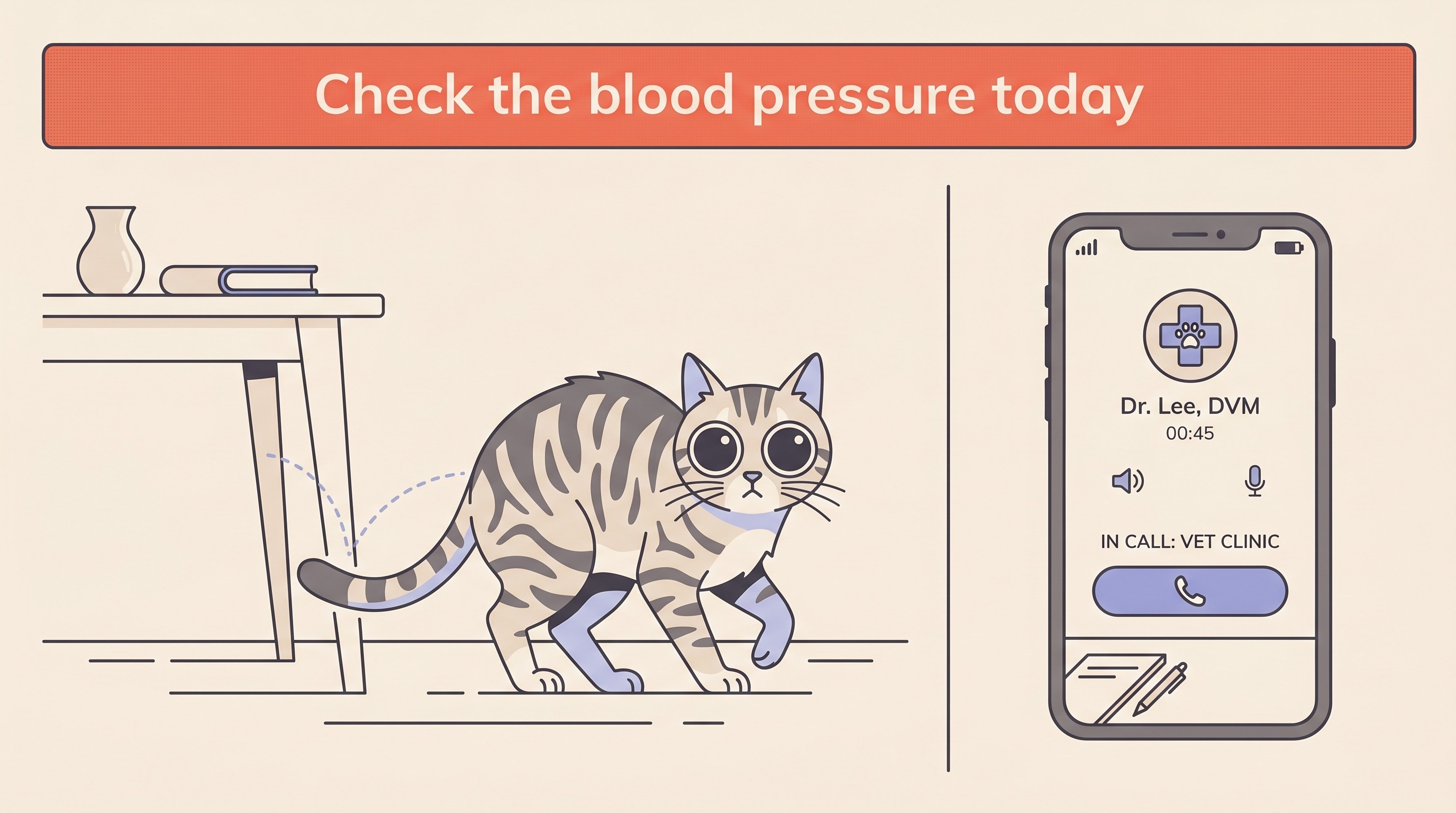
A cat that has, in the space of a day or even overnight, started walking into furniture, missing the sofa, freezing in the middle of the room with both pupils wide and black needs one thing from you before any of the biology. So I'll give you that first.
Ring your vet now and ask them to check your cat's blood pressure today. Not next week, not at the next routine appointment. Today.
I say it that plainly because in an older cat that has gone suddenly blind, the single commonest cause is a retina that has detached because the blood pressure is dangerously high (International Cat Care, 2023; Taylor et al., 2017). That is an emergency, not a wait-and-see. And it is one of the very few causes of sudden blindness where acting fast can sometimes give sight back. The cats who get some vision back are, almost without exception, the ones who were seen quickly (Young et al., 2019). So this is the rare situation where the speed of your phone call genuinely matters to the outcome, and I'd rather you made it an hour too early than a day too late.
This page is about the cat in particular, and the blood-pressure story behind so many of these cases. If you want the more general "what do I do in the next hour, painful kind or painless kind" version, the front door is What to Do When Your Pet Suddenly Goes Blind, and the Eye-emergency triage will tell you whether this counts as an emergency. For a cat with wide pupils bumping about, though, you already have your answer: be seen today.
Why high blood pressure does this
The back of the eye is lined by the retina, the thin sheet of light-sensing cells that turns the world into signals the brain can read. Behind it sits a dense bed of tiny blood vessels. When blood pressure climbs very high and stays there, those little vessels can't cope, and they leak. Fluid is forced out of them and pools behind the retina, and the pressure of that fluid lifts the retina away from the back of the eye like wallpaper peeling off a damp wall (Carter, 2019). Once the retina is detached it can no longer send a picture to the brain, and the eye goes blind, often with bleeding inside the eye on top of it (Acierno et al., 2018).
This is why the eye is so often the first place high blood pressure announces itself in a cat. Of all the organs high pressure damages, the eye is the one you can actually see into, and it is the most easily recognised site of blood-pressure damage in cats (Carter, 2019). Across studies, the proportion of hypertensive cats found to have some ocular damage has been reported as high as 100% (Acierno et al., 2018). I don't say that to frighten you, but so you see why "check the blood pressure" is not a tangent. In a cat, sudden blindness and high blood pressure are so tightly linked that one should always make us think of the other.
The wide pupils you may have noticed are part of the same picture. When the retina detaches in both eyes, the pupils typically sit large and fixed and don't shrink in bright light the way they should (Taylor et al., 2017). Owners often describe it just as you might: the eyes look big and black and "staring", and a light shone at them doesn't change much. Alongside the bumping and disorientation, those wide pupils are a genuinely useful red flag. The full mechanics of how a retina lifts, across all its causes, belong to Retinal Detachment Explained. Here the short version is enough: pressure leaks the vessels, fluid peels the retina, the eye goes dark.
One thing worth saying, because it bears on how guilty you feel. Not every "sudden" blindness is truly sudden. Cats navigate a familiar home so well from memory that creeping sight loss can go unseen until the day it tips over, or until you move a chair, and then it looks as though it happened overnight (more on that in Sudden Versus Suddenly Noticed Sight Loss). It changes nothing about tonight, though. Wide pupils and a cat crashing into things still mean the same thing: be seen today, because if blood pressure is behind it, the clock has already started.
What drives the blood pressure up
This is where it stops being an eye problem and becomes a whole-cat problem. High blood pressure in cats is almost never a disease in its own right. It's nearly always secondary to something else, and that something else is usually going on quietly in an older cat already.
The two big drivers are chronic kidney disease and an overactive thyroid (hyperthyroidism). At least 60% of cats found to be hypertensive also have signs of kidney disease, and around 20% of cats diagnosed with an overactive thyroid turn out to be hypertensive too (Cornell Feline Health Center, 2023). Both conditions are common in older cats, which is precisely why this happens to the senior cat and not the kitten. Heart disease can play a part as well. So when your vet checks the kidneys and the thyroid after a sudden-blindness presentation, they aren't casting around. They're looking for the engine behind the high pressure, because finding and treating it is half the job.
That also explains a connection you may not have made. If your cat was already known to have kidney disease or an overactive thyroid, this blindness is not a bolt from the blue. It's a complication of a condition you were already living with, and one that routine blood-pressure checks are meant to catch before it ever reaches the eye. The kidney side is covered properly in our CKD space, and the overactive-thyroid side in the Hormone Health home. I won't re-tread either here, beyond naming them as the usual culprits.
One quick word for anyone who's landed here with a dog, or comparing notes. In dogs, the sudden-but-painless blindness story is more often something different called SARDS, which isn't driven by blood pressure and behaves quite differently. If that's you, SARDS in Dogs is the page you want. For cats, though, blood pressure is the headline, every time.
The hopeful part, and the hard part
There are two true things to hold side by side here, and I'd rather do it openly than pick the comforting half.
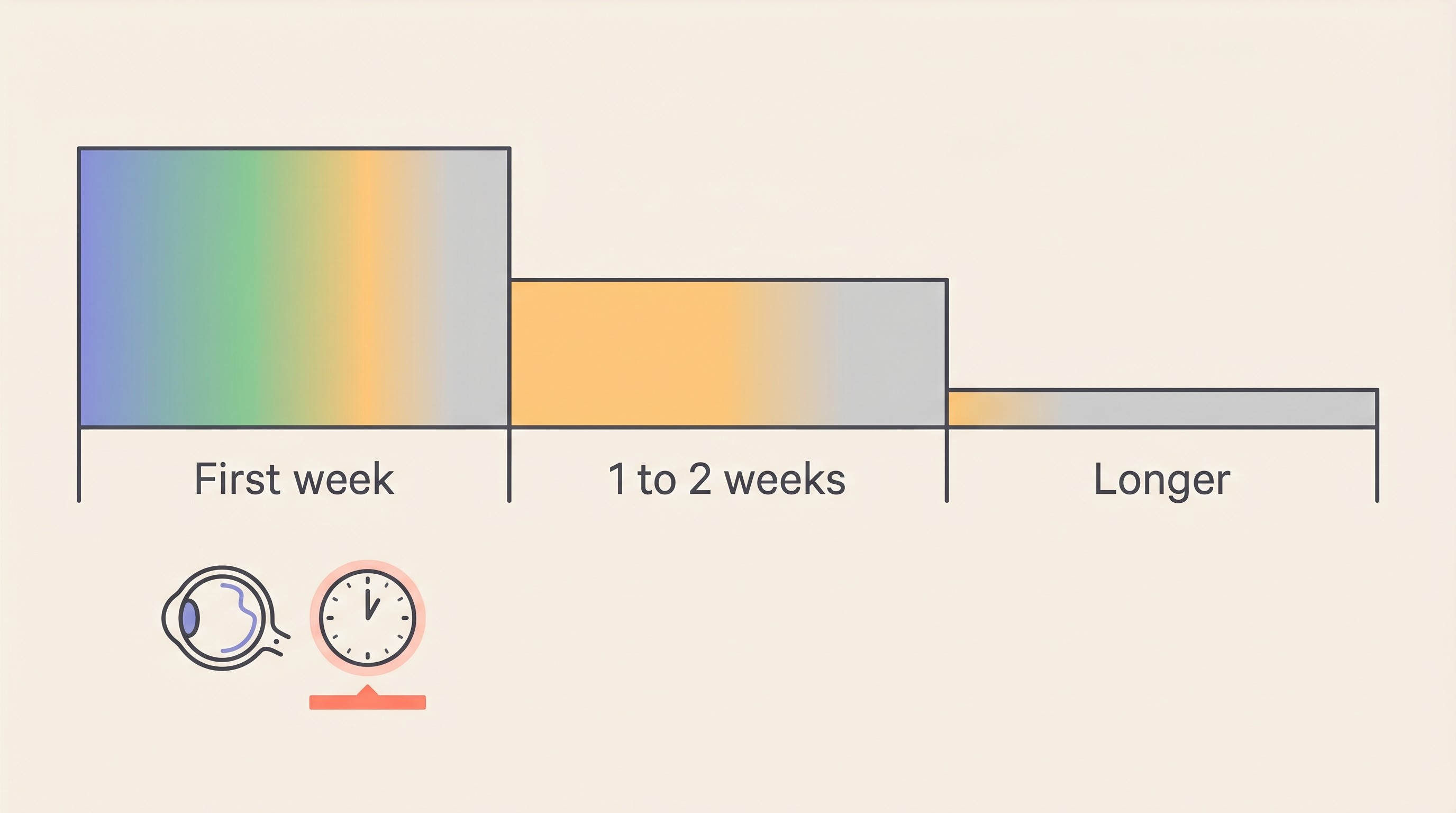
The first is the genuinely hopeful one. If the high pressure is brought down quickly, a detached retina can sometimes lie back down and reattach, and some vision can come back. This is real, not wishful. In one study of cats whose retinas had been damaged by high blood pressure and who were then treated, 76 of the 132 eyes that were blind on arrival regained some vision, and the authors concluded that the outlook for vision was good even after a complete detachment, as long as treatment started promptly (Young et al., 2019). The single biggest factor in whether sight returns is how long the retina has been detached: recovery is best when it has been down for less than a week (Carter, 2019). That is the whole reason "today" matters so much, and it's why I led this page with the phone call rather than the explanation.
The second truth is the one I won't dress up. By the time many cats are presented, the blindness is already permanent (Cornell Feline Health Center, 2023), and even with prompt, effective treatment, full sight returns in only a minority of patients (Acierno et al., 2018). Sudden onset does not, on its own, mean salvageable. The reason to rush is not that we can always fix it. It's that the cats who do recover are the ones seen fast, so getting in quickly is how you give your cat the best chance of being in that lucky group, while knowing the chance isn't a certainty.
Put those two together and it comes to one sentence: see your cat today to find out which kind of case this is, because being seen fast is the only thing that keeps the hopeful door open. Anyone who promises you a cure is overselling it, and anyone who says it's hopeless and not worth rushing is selling your cat short.
What to expect at the vet
Knowing roughly what happens can take some of the fear out of the trip. Your vet will look into the back of the eyes with an ophthalmoscope to see the retina directly, and may test whether your cat blinks at a hand moving towards the eye, a quick check of whether any sight remains. They'll measure the blood pressure with a small inflatable cuff on a leg or the tail, much as it's done in people, taking several readings to get past the stress of the visit. If a detached retina or bleeding is found, measuring that blood pressure is the expected next step, not an optional extra (Plummer, 2016). They'll very likely run blood and urine tests to look for the kidney or thyroid disease underneath. Some cats are referred on to an eye specialist, but the core of it, eyes, blood pressure, bloods, is something most first-opinion practices can start straight away.
If high blood pressure is confirmed, the treatment is reassuringly straightforward. The first-line medication is a small tablet called amlodipine, given once a day, which lowers the pressure effectively (Cornell Feline Health Center, 2023; Taylor et al., 2017). In one series it brought the pressure down in 31 of 32 cats and improved the eye signs in most of them (Maggio et al., 2000). Sometimes a second drug, such as telmisartan, is added or used instead. Alongside that, your vet treats whatever is driving the pressure, the kidneys or the thyroid, so you're often managing two linked things rather than one. I won't give doses here, because they're tailored to your cat, but the shape of it is gentle: a daily pill, regular pressure rechecks to confirm it's working, and treatment of the underlying disease.
While you wait to be seen, keep your cat safe and calm: one familiar room if you can, away from stairs, balconies and anything they could fall from, because a frightened cat that can't see may bolt. Don't reach for any drops or tablets from the cupboard. There's nothing useful you can give at home, and the only treatment that helps is the one aimed at the blood pressure.
Turning a tragedy into a near-miss
If there's one thing I'd lift off this page and pin to the fridge, it's this. The cats I most want to help are the ones who never reach the point of blindness at all, and for an enormous number of them, that's achievable.
High blood pressure is common in older cats, and the conditions that cause it usually sit quietly in the background. A blood-pressure check is quick, cheap and painless, and it catches the problem before the eye is ever involved. So if your cat is getting on in years, or already has kidney disease, an overactive thyroid or a heart condition, please ask your vet about routine blood-pressure monitoring: the guidance is to measure it regularly in senior cats, and more often still in those with kidney disease or a thyroid problem (International Cat Care, 2023; Acierno et al., 2018). Why high pressure harms the eye in the first place, in both cats and dogs, and exactly who ought to be screened, is set out in full in High Blood Pressure and the Eyes. Catching a high reading on a calm Tuesday and starting a daily tablet is a world away from the night your cat suddenly can't find the food bowl. That, more than anything, is how this particular tragedy becomes a near-miss. If it would help, the home checklist for this exact situation lays out the warning signs and the screening message on one shareable page.
And for anyone reading this on the wrong side of that line, with a cat who has already lost their sight and may not get it back, I don't want to leave you there. Cats are remarkable at coping without vision. They navigate by a detailed memory map of their home, topped up constantly by scent, sound and those clever whiskers, and most adjust far better than their owners dare hope, often within weeks. The most helpful thing you can do is keep their world predictable: don't move the furniture, keep food, water and litter in the same places, and talk to your cat before you touch them so you never startle them. There's a proper guide to all of that in Living With a Blind Cat, and the emotional arc of those first weeks is held in Your Newly Blind Pet: The First 30 Days.
But that's the next chapter. Tonight, if the pupils are wide and your cat is bumping about, the chapter you're in has exactly one action in it. Phone your vet, and ask them to check the blood pressure today.
References
- Acierno, M. J., Brown, S., Coleman, A. E., Jepson, R. E., Papich, M. G., Stepien, R. L., & Syme, H. M. (2018). ACVIM consensus statement: Guidelines for the identification, evaluation, and management of systemic hypertension in dogs and cats. Journal of Veterinary Internal Medicine, 32(6), 1803-1822.
- Carter, J. (2019). Hypertensive ocular disease in cats: a guide to fundic lesions to facilitate early diagnosis. Journal of Feline Medicine and Surgery, 21(1), 35-45.
- Cornell Feline Health Center. (2023). Hypertension. Cornell University College of Veterinary Medicine.
- International Cat Care. (2023). Blindness in cats.
- Maggio, F., DeFrancesco, T. C., Atkins, C. E., Pizzirani, S., Gilger, B. C., & Davidson, M. G. (2000). Ocular lesions associated with systemic hypertension in cats: 69 cases (1985-1998). Journal of the American Veterinary Medical Association, 217(5), 695-702.
- Plummer, C. E. (2016). Diagnosing acute blindness in dogs. Today's Veterinary Practice, November/December 2016.
- Taylor, S. S., Sparkes, A. H., Briscoe, K., Carter, J., Sala, S. C., Jepson, R. E., Reynolds, B. S., & Scansen, B. A. (2017). ISFM consensus guidelines on the diagnosis and management of hypertension in cats. Journal of Feline Medicine and Surgery, 19(3), 288-303.
- Young, W. M., Zheng, C., Davidson, M. G., & Westermeyer, H. D. (2019). Visual outcome in cats with hypertensive chorioretinopathy. Veterinary Ophthalmology, 22(2), 161-167.
Keep track of how your pet is doing
The owners who cope best are the ones who notice changes early. A simple health log shows you what is working, and what is not, before the next vet visit.
Start tracking, freeYou're not doing this alone
Compare treatment journeys and talk to owners managing vision & eye health. Free to join.
Join PetsLikeMine