

Your Pet Has Gone Blind: The First 30 Days
Alastair Greenway
BVM&S MRCVS
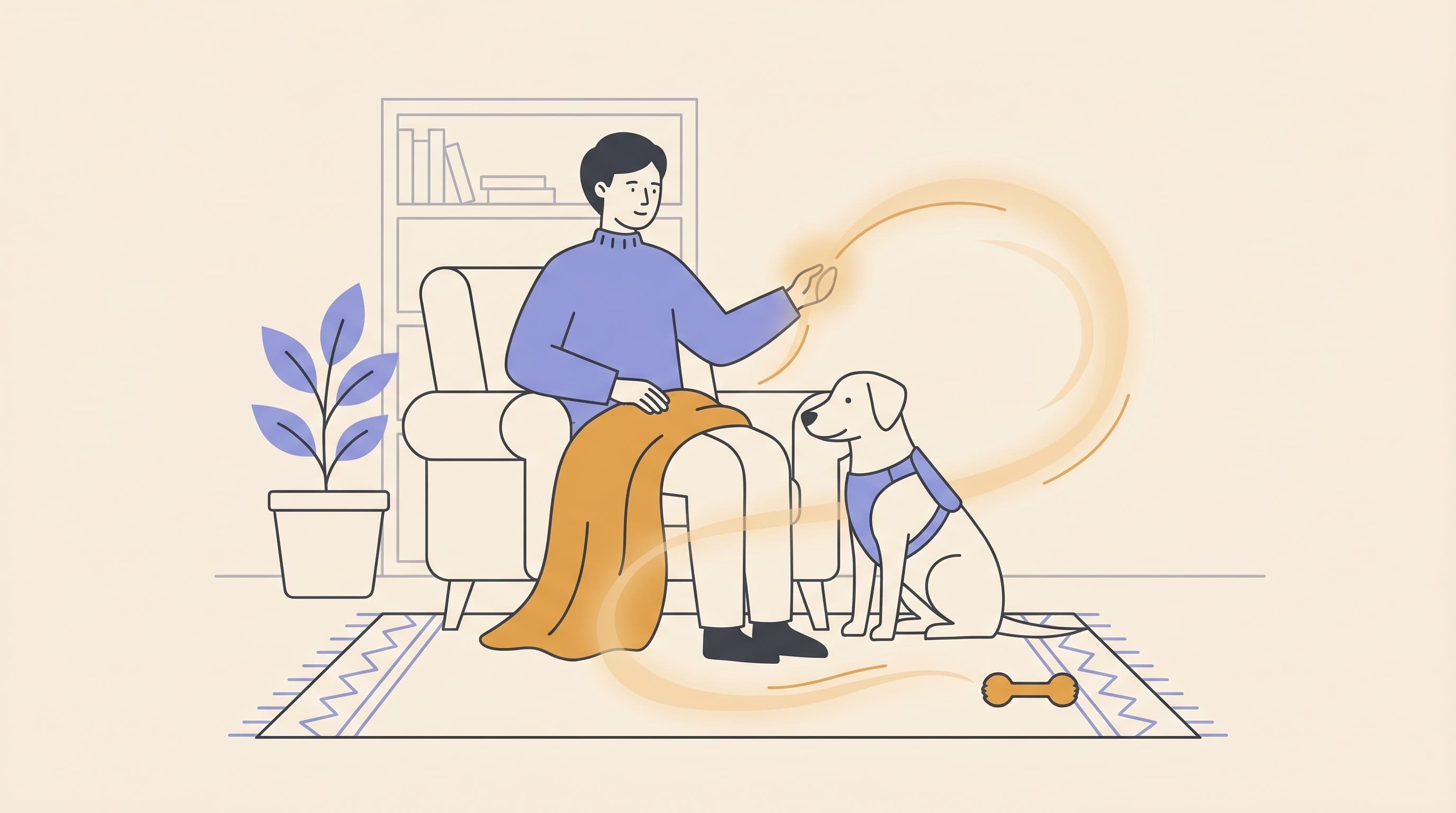
You may be reading this at three in the morning with a frightened animal in the next room. Your pet's life is not over. This feels like a catastrophe right now, and I won't pretend the next few weeks are easy, but blind dogs and cats go on to live full, happy lives, and yours can too, with a little time and a few changes (Donohue / Texas A&M, 2025; Patterdale / AKC, 2026). I've watched a great many families through exactly this, and the pet you're frightened you've lost is, far more often than not, still coming back.
This piece is for the first month or so, once the urgent part is behind you. If you've only just discovered the blindness and your pet hasn't been seen yet, especially with a red, cloudy or painful eye, or a pet who seems genuinely unwell, that's a more urgent job: read what to do right now and ring a vet, because some causes of sudden sight loss are emergencies where speed matters. This article picks the story up afterwards, when the real work, gentle and undramatic, begins.
The grief is real, and so is the hope
Let me name the thing you might not be saying out loud. You feel wretched, and there may be guilt in there too, a sense you should have caught it sooner or somehow failed them. That is an utterly ordinary reaction, and I'd be more surprised if you didn't feel it. In the largest survey of its kind, owners of newly blind dogs commonly described worrying, at first, about whether their dog could even have a happy life again (Ng, 2024, summarising Borzatta et al., 2023). You are in good company, and you are not overreacting.
What holds that grief steady is what comes next. The same research captures it, and the shape of it is genuinely hopeful. Most blind pets do well: around 80% of owners rate their pet's quality of life as good to excellent once things have settled. The firmer numbers underneath are striking. After acclimatising, 89.3% of owners perceived their dogs as happy (Borzatta et al., 2023; Ng, 2024), over 75% rated quality of life as excellent (VCA Animal Hospitals), and among dogs that went suddenly and permanently blind, 95% of owners said they would discourage anyone from putting a blind dog to sleep (Stuckey et al., 2013). These aren't kind words from a vet trying to make you feel better. They're what the people who've already walked this path report, looking back. The fuller, calmer version of the happy-or-suffering question belongs to is my blind pet still happy?, worth reading when you're ready. For tonight, hold the headline: this usually turns out well.
A word about those numbers before we go on. The hardest figures come from studies of dogs, because that is where the good research sits. The principle they point to, that pets adapt remarkably well and most are happy again on the other side, holds just as firmly for cats (Donohue / Texas A&M, 2025; Best Friends Animal Society). So read the percentages as the shape of the thing, whichever animal is asleep in your house tonight.
What the next few weeks actually look like
The second week is where a lot of owners lose heart, and knowing the shape of the road in advance takes the sting out.
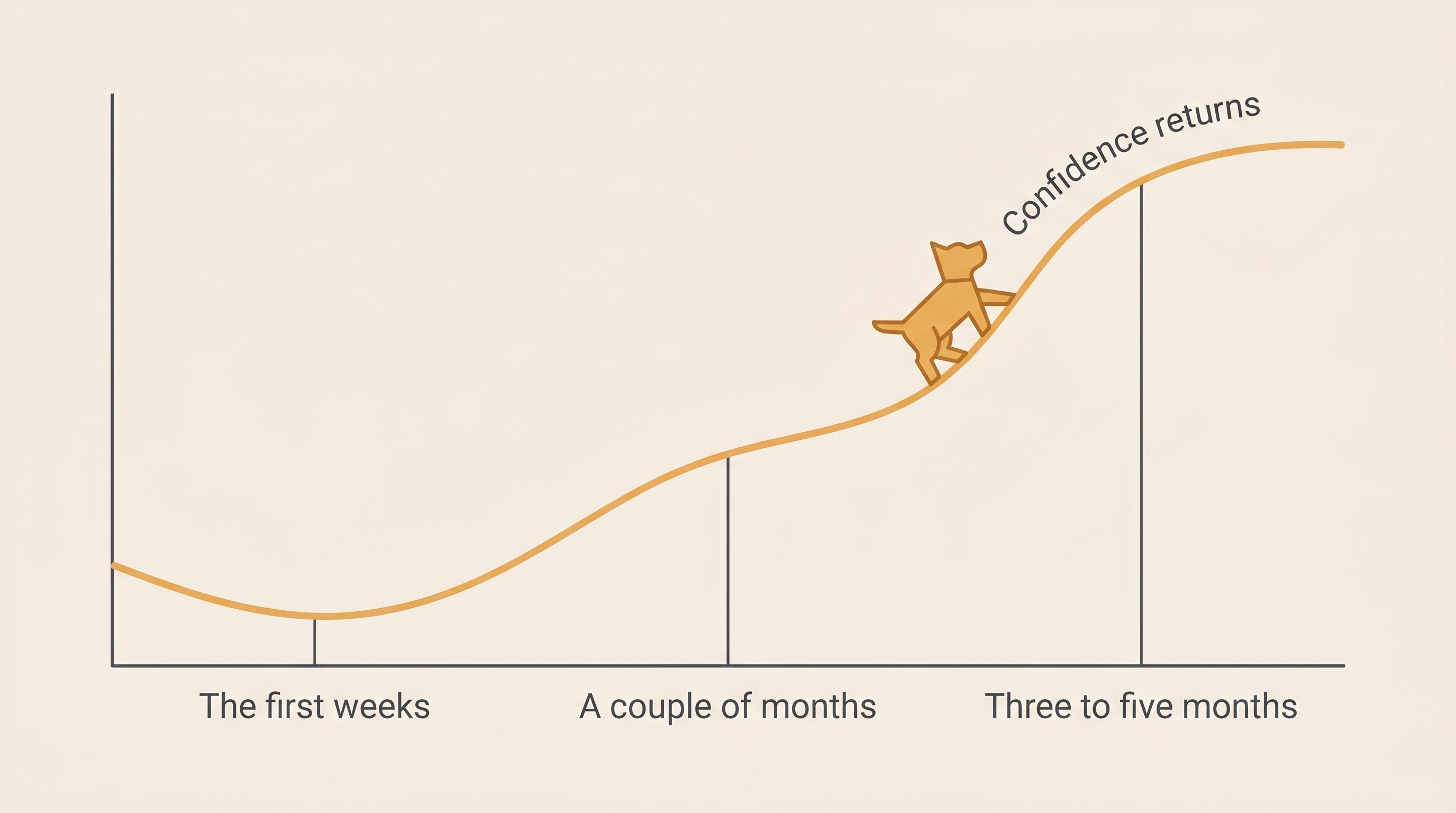
Expect a dip. Your pet may go flat and quiet for a while, sleep more, lose their spark, and shadow you around the house, suddenly clingy in a way they weren't before. This is normal and temporary. In the survey, roughly a third of dogs were depressed (27.9%) or anxious and more dependent on their owners (28.3%) at first, and then, as they acclimatised, owners watched that separation anxiety fade and independence return (Borzatta et al., 2023; Ng, 2024). One vet who does this work describes the phase well: blind dogs go through "a depressed period, in which they show a lack of energy and unwillingness to appear enthusiastic about anything," and the kind thing is to "let them have their mope time," because it lifts (Young, n.d.). Your job in that fortnight isn't to fix the sadness. It's to keep things steady and let them grieve their own way, the same as you're grieving yours.
Carry one phrase through the dip: at first you get about 80% of your pet back, and the rest comes later. That's the lived experience of clinicians who set realistic expectations that an owner "might only get 80% of their dog back" at first, then "typically report a more zesty dog within 3 to 5 months" (Young, n.d.). It pre-empts the despair of week two, because when your pet is at their flattest, you'll know that flat version isn't the finished article. It's the middle of the story, not the end.
Hold the timing softly, because every pet is different. The first weeks are the hardest. Most find their feet within a couple of months and start resuming normal activities (VCA Animal Hospitals; Donohue / Texas A&M, 2025), with confidence often still building for three to five months after that (Young, n.d.). One caveat: a pet that lost its sight suddenly has a harder, slower start than one that faded gradually, because the gradually-blind pet has been quietly adapting for months without anyone noticing (Patterdale / AKC, 2026). So if your pet went blind overnight, be especially patient. The early weeks really are the steepest part, then it gets better. (Why "sudden" and "suddenly noticed" differ so much, and why neither is your fault, is its own piece: sudden versus suddenly noticed.)
If the thought of euthanasia has crossed your mind
I'll say this as gently as I can, because it matters and a lot of loving owners think it quietly and feel ashamed of it. In the worst of the dip, looking at a sad, disoriented pet, some people wonder whether the kind thing would be to let them go. If that thought has visited you, you are not a bad owner. We tend to imagine ourselves blind and project our own fear onto them, and it's a very human thing to do (Biondi et al., 2022).
But please don't decide anything in the panic. The evidence is clear: vision loss on its own is not a reason to put a pet to sleep, and the great majority of blind dogs go on to live good lives (Biondi et al., 2022). The numbers back it from every angle. Most owners (84.9%) never once considered euthanasia in response to the blindness, and of the small handful who did, it was because their pet was in genuine pain, not simply because it couldn't see (Ng, 2024, reporting Borzatta et al., 2023). And in the long-term study of suddenly blind dogs, not only did 95% of owners say they'd discourage it, 37% reported their relationship with their dog actually improved after the diagnosis (Stuckey et al., 2013). The flat, withdrawn pet in front of you now is not the life they're going to have. Give it the weeks, and the picture changes.
There is one real exception, and it's the next section.
Make sure nothing hurts
Blindness itself isn't painful. A pet that's lost its sight from something like SARDS, a quietly detached retina or progressive retinal atrophy simply has a navigation problem to solve, not a sore eye (and where SARDS is the cause, the SARDS guide carries the detail). But some causes do hurt: end-stage glaucoma and severe inflammation leave a genuinely painful eye behind. Pain is the one thing that truly undermines a blind pet's quality of life, and it's almost always fixable. In one early survey of blind dogs, the ones that did badly were overwhelmingly in pain, and glaucoma pain was the single commonest reason owners chose to let a blind dog go (Chester & Clark, 1988; Biondi et al., 2022).
So the rule is simple. If your pet seems sore, squinting, pawing or rubbing at an eye, holding it shut, off their food, or withdrawn well beyond the ordinary dip, that is not "just blindness" and it's worth a vet visit. Comfort can nearly always be restored, sometimes with drops and sometimes by removing a blind, painful eye, which sounds drastic but is one of the kindest operations we do and leaves most pets visibly brighter within days. That decision has its own plain guide: removing an eye. For now, just separate the two problems. A comfortable blind pet needs your patience; a blind pet in pain needs your vet. Tell them apart, and you've done the most important medical thing this month.
The handful of rules that matter most
Once your pet is comfortable, almost all of the early adaptation comes down to a short list of habits. Get these few right and you'll have covered most of what makes the difference. There's a lot of room to overthink this and very little need to, so I'll keep it to the headlines and point you to the detail.
- Don't move the furniture. This is the big one. Your blind pet navigates by a memorised map of your home, so a fixed layout is that map. Once they know where things are, leave them there (Best Friends Animal Society; VCA Animal Hospitals; Donohue / Texas A&M, 2025).
- Talk before you touch. Speak as you approach, especially if they're asleep, so you don't startle a pet who can't see you coming (Battersea, 2023/2026; Best Friends Animal Society).
- Keep bowls, bed, litter tray and routine fixed. Feed in the same place, leave the water where it's always been, don't shuffle the bed or the cat's tray. Consistency is the whole game (Best Friends Animal Society; Battersea, 2023/2026).
- Block the hazards. A baby gate at the top of the stairs and a fence around a pond or pool prevent the falls that matter while they're still learning the layout (Best Friends Animal Society; Patterdale / AKC, 2026).
- Use scent, sound and texture, and let them find their own way. A different scent or a textured rug at a doorway, or a bell on a collar so a cat can place the other animals, all help a pet build the map themselves. Resist carrying them everywhere, because it resets the very map they're learning (Best Friends Animal Society; Battersea, 2023/2026).
That really is the heart of it. The full, room-by-room version, with scent markers, runners and hazard-proofing, lives in home-proofing for a blind pet, and talk-before-touch grows into a small set of spoken cues ("wait", "step up", "this way") worth teaching, covered in talking to a blind pet. If you'd like it on one page for the fridge, the blind-pet home checklist gathers these into a printable list.
A quick word for cat owners, because the principles are the same but the geography differs. Cats often adapt at least as readily as dogs, leaning hard on whiskers, scent and memory (Best Friends Animal Society). Keep the cat tree, litter tray and feeding spot exactly where they are, clear the floor of clutter, and for now a blind cat is usually safest indoors or in a secure garden. The cat-specific detail, including height and multi-cat homes, is in life for a blind cat.
You don't have to do this alone
Two last things, both forward-looking, because that's where you're headed even if it doesn't feel like it tonight.
First, give yourself something hopeful to watch. The hardest part of the dip is that progress is invisible day to day, so it can feel like nothing's improving when in fact it is. The At-Home Vision Check lets you log how your pet is navigating and how confident they seem, week by week, so you can actually see the line trending upward. When the second-week gloom tells you it's all going wrong, a record that says otherwise is worth a great deal.
Second, find your people. The evidence is explicit that peer support helps: owners do better when they can talk to others who've been through the same thing, and clinics are encouraged to point families towards support groups for exactly this (Ng, 2024). There's a whole community whose pets went blind and came out the other side, and they'll tell you, unprompted, exactly what the research says, that it gets better, and sooner than you fear. The first 30 days guide gathers the steps from this article into one printable companion for the month.
When you're ready to turn the corner from coping to settling in, home-proofing for a blind pet is where the next month begins.
References
- Battersea Dogs & Cats Home. (2023, updated 2026). Blind dog care and training. Battersea.
- Best Friends Animal Society. (n.d.). Tips to care for a blind dog or blind cat.
- Biondi, V., Pugliese, M., Voslarova, E., Landi, A., & Passantino, A. (2022). Animal welfare considerations and ethical dilemmas inherent in the euthanasia of blind canine patients. Animals, 12(7), 913.
- Borzatta, D., Gualandi, L., & Lucidi, P. (2023). Blindness in adult dogs: owners' and dogs' reactions and changes in human–animal interaction. Anthrozoös, 36(6), 1025–1038.
- Chester, Z., & Clark, W. T. (1988). Coping with blindness: a survey of 50 blind dogs. Veterinary Record, 123(26-27), 668–671.
- Donohue, L. (2025, September 4). Seeing the bright side: helping pets adjust to vision loss. Texas A&M School of Veterinary Medicine & Biomedical Sciences (Pet Talk).
- Ng, Z. (2024, March). Coping with canine blindness (research note summarising Borzatta et al., 2023). Clinician's Brief.
- Patterdale, S. (2026, April 27). Supporting a blind dog: helping dogs adjust to vision loss. American Kennel Club.
- Stuckey, J. A., Pearce, J. W., Giuliano, E. A., Cohn, L. A., Bentley, E., Rankin, A. J., Gilmour, M. A., Lim, C. C., Allbaugh, R. A., Moore, C. P., & Madsen, R. W. (2013). Long-term outcome of sudden acquired retinal degeneration syndrome in dogs. Journal of the American Veterinary Medical Association, 243(10), 1425–1431.
- VCA Animal Hospitals. (n.d.). Sudden acquired retinal degeneration syndrome (SARDS).
- Young, G. (n.d.). Special needs training for owners of blind dogs (guest blog hosted on Dr Patrick Mahaney VMD's website).
Keep track of how your pet is doing
The owners who cope best are the ones who notice changes early. A simple health log shows you what is working, and what is not, before the next vet visit.
Start tracking, freeYou're not doing this alone
Compare treatment journeys and talk to owners managing vision & eye health. Free to join.
Join PetsLikeMine